Top Mixed Reality (AR/VR) Development Firms In 2026
Dominic Tarn
Head Writer - ReVerb
12.26.2025
Immersive work now spans real training, virtual showrooms, spatial analytics and live ops.
Shortlists of top mixed reality development firms in 2026 help, but the real advantage comes from knowing who can translate business goals into shippable software, not just demos.
This guide focuses on execution. Each firm below shows a repeatable way to scope, build, and support XR — from device selection to content pipelines and analytics. You will also see where each team is strongest so procurement and product teams can move quickly with the right partner among the best mixed reality companies in 2026.
Your Guide To The Best Mixed Reality Development Firms In 2026
Since 2016, Treeview has run as a boutique studio focused on enterprise spatial computing. The team pairs spatial product design with 3D production and XR engineering to ship field-ready software, not just demos. With Microsoft, Meta, Ulta Beauty and Medtronic on the roster, they’re comfortable with complex scopes and clear outcomes — a strong fit for AR/VR development services in 2026.
Portfolio highlights show range and rigor. The HoloLens 2 digital twin for a renewable energy project gave stakeholders a shared 3D view for decisions, while “Treaty Story” on Apple Vision Pro preserved Cree culture with immersive narratives. Additional work — a Magic Leap 2 ski navigation concept for NEOM and an Ulta Beauty in-store experience — points to repeatable mixed reality development services across training, culture, retail and data visualization.
Services and expertise: Spatial product design, XR software engineering, 3D content creation, long-term support
Location: New York, USA; Montevideo, Uruguay
Team size: 11–50 experts
Portfolio: Microsoft HoloLens 2 digital twin; Treaty 8 Polytechnic cultural experience; NEOM MR ski navigation concept; Ulta Beauty immersive retail
Takeaway Reality is a London XR consultancy launched in 2020 that runs “white-glove” builds from strategy through maintenance. Small cross-functional teams plan, prototype and ship bespoke AR, VR and metaverse projects with an eye on engagement and ROI. That approach keeps the studio in conversations around the best AR/VR development firms in 2026 for marketing and education use cases.
Case work includes the Kois Center VR platform with lecture halls, hands-on simulation and assessments, plus a Microsoft Defender matching game campaign that held attention for minutes, not seconds. The emphasis on gamification and learning design shows up in measurable interaction rates and crisp scopes that reduce friction. It is a nimble option when you want tangible outcomes without heavy overhead, and a credible shortlist pick for the best AR/VR development agency.
Groove Jones, founded in 2015 in Dallas, is known for creative technology that ties AR/VR to training, marketing and sales enablement. Its GrooveTech platform taps volumetric scanning, real-time animation and personalization to deliver content at scale. Big-brand work across retail, automotive and nonprofit puts the studio among the best mixed reality companies in 2026 for high-visibility launches.
Recent projects underscore practical value. “Disasterville” uses Meta Quest 3 headsets and physical props to train U.S. Army National Guard recruits in simulated emergencies, while an American Heart Association VR app teaches hands-only CPR and AED use through game mechanics. Add Toyota’s WebGL configurator for the Mirai, and you get a picture of a studio that engineers reliable, durable experiences.
Services and expertise: Strategy, AR/VR/XR/ML/AI development, real-time engines, motion and volumetric capture, mobile AR, WebGL and 360° content
Location: Dallas, TX, USA
Team size: ~100 experts
Portfolio: U.S. Army National Guard “Disasterville”; American Heart Association VR training; Toyota Mirai WebGL configurator
Trigger XR calls itself the most experienced XR developer after delivering 300+ projects over 15+ years. Relationships with top IP owners and tech partners — Disney, LEGO, Nike, NBA; Apple, Meta, Unity, Niantic and more — let the team move from concept to scale with fewer unknowns. That history earns Trigger a place on lists of top mixed reality development firms in 2026 for consumer-facing activations.
The studio covers full lifecycle work from R&D to live operations and maintenance. Branded experiences tied to Spider-Man, Star Wars and Avengers sit alongside festival apps and sponsorship activations like Coachella and BNP Paribas Desert Champions, while partner showcases include the Miller Lite Bigfoot AI demo. For timelines that must hold under scrutiny, Trigger’s pipelines support AR/VR development services in 2026 that reach large audiences.
Services and expertise: Advisory, creative, and development across the XR lifecycle; R&D, scalable AR/VR/MR, live ops and maintenance
Location: Los Angeles, CA, USA
Team size: ~42 experts
Portfolio: Franchise activations (Spider-Man, Star Wars, Avengers); Coachella app; BNP Paribas Desert Champions AR; Miller Lite Bigfoot AI demo
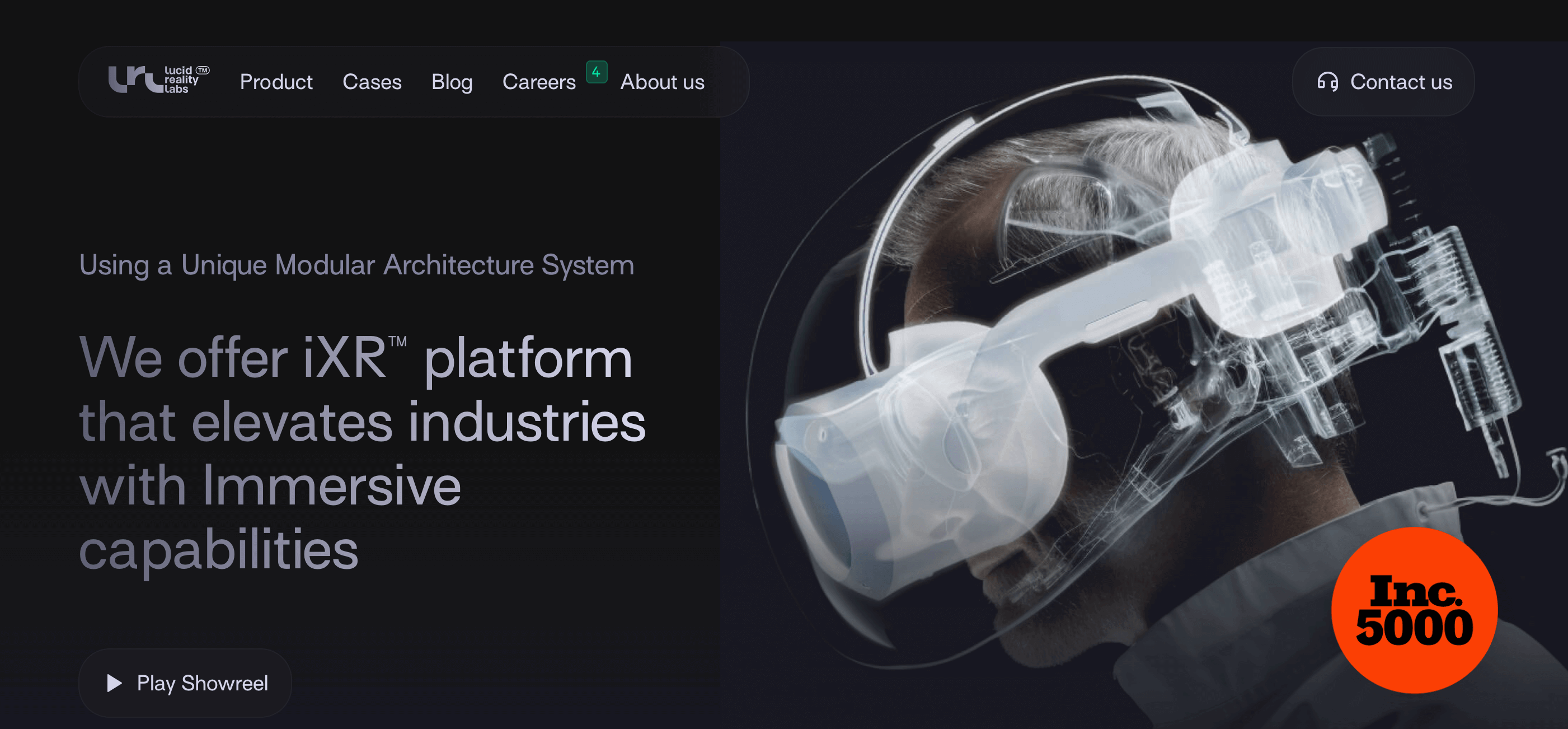
Lucid Reality Labs builds XR and AI systems for organizations that can’t afford surprises. The team works out of Miami with a second office in Singapore, serving healthcare, life sciences, manufacturing, aerospace and education. ISO-aligned workflows and HIPAA/GDPR fluency place the studio among the best AR/VR development firms in 2026 for regulated programs.
Its toolkit covers VR training with agentic AI coaches, AR digital twins and mixed reality collaboration that scales across departments. Engagements with Philips, Medtronic, Novo Nordisk and Roche point to real domain depth and steady delivery. If you want a partner that balances risk with useful experimentation, this crew builds for longevity and clean audits.
Services and expertise: Enterprise XR and AI/VR training, agentic AI, AR digital twins, mixed reality collaboration, intelligent XR prototypes
Location: Miami, FL, USA; Singapore
Team size: ~31 experts
Portfolio: Healthcare and life sciences training; manufacturing AR tools; aerospace collaboration platforms
Saritasa is a full-cycle engineering firm with an established AR/VR practice. From Irvine, the company runs multi-office delivery with experience in cloud, DevOps, mobile, web and 3D, which helps mixed reality projects plug into existing stacks. The emphasis is practical: training, configurators and guidance apps that reduce error rates and standardize workflows through mixed reality development services.
Examples include Loadstar Railcar Inspection VR — a Unity simulation that standardizes inspections and accelerates training — a kid-friendly surgery prep experience, and an AR billing app where a 3D concierge explains costs using ML-assisted recognition. Tooling spans ARCore, WebAR, Unity, Unreal, Apple Vision Pro and Meta Quest, so constraints get handled early and builds are maintainable.
Services and expertise: Custom AR/VR, 3D modeling, asset customization, environment design; Unity/Unreal; ARCore, WebAR; Apple Vision Pro, Meta Quest, HTC Vive, Pico Neo
Location: Irvine, CA, USA; hubs in Tampa, New York, Chicago, Dallas, Los Angeles
Team size: 206 experts
Portfolio: Loadstar railcar VR training; pediatric surgery prep VR; Avadyne Health AR billing app
Magnopus holds an Emmy and ships cross-reality work at global scale. More than 180 artists, designers, and engineers across Los Angeles and the UK handle everything from pre-production design to production-grade 3D, VFX, audio, and live ops. If fidelity, performance, and reach are non-negotiable, it sits among thebest mixed reality development firms in 2026.
At Expo 2020 Dubai, the Xplorer app mapped a 4.38 km² digital twin with persistent anchors so on-site and remote visitors shared the same space. Mission: ISS recreates NASA-approved zero-G procedures in VR. The Daft Punk Experience for Fortnite Festivals blends music play, light combat, and LEGO-style video making, showing a team equally comfortable with cultural icons and complex systems.
Services and expertise: Cross-reality spatial design and development, QA, deployment, live ops; R&D, audio, digital humans, motion capture
Location: Los Angeles, CA, USA; St Albans, UK
Team size: 180+ experts
Portfolio: Expo Dubai Xplorer; Mission: ISS; Daft Punk Experience for Fortnite Festivals
Program Ace, headquartered in Nicosia, brings decades of software delivery plus 150+ specialists to immersive work. The team covers VR/AR/MR, AI and computer vision, 3D visualization, and enterprise game solutions with a focus on training and simulation. It is a dependable source of mixed reality development services for enterprise change programs.
Projects span VR training simulators, virtual tours, digital assistants, configurators and digital twins. Summaries reference an active threat simulation for a major retailer, engine control unit training and a medical VR platform with serious game elements. The takeaway: repeatable patterns for onboarding, safety and operations that map easily to KPIs.
Services and expertise: Custom software with VR/AR/MR, AI/computer vision, cloud, 3D visualization, gamification and enterprise games
Location: Nicosia, Cyprus; representatives in USA, Poland, Ukraine, Slovakia, Hungary, Japan
Team size: 150+ experts
Portfolio: Enterprise VR simulators and training platforms across retail, manufacturing and healthcare
Vention counts 3,000+ specialists across more than 20 offices and runs a dedicated AR/VR practice. The team ties application development, AI, cloud, and data work directly into its immersive builds so mixed reality fits cleanly into wider product roadmaps. If you’re comparing the best mixed reality companies in 2026 for programs that span teams and platforms, that kind of reach and delivery record helps.
Its AR work overlays 3D content and animation on the real world; VR supports training and communication; MR links both with object-aware logic. Notable examples include a metaverse game and NFT economy for VerseX Studios and “Postman: API First Journey,” an educational mobile game. Tooling spans OpenCV, Vuforia, ARKit, Unity, and Wikitude — a stack built for cross-platform delivery andAR/VR development services in 2026.
Services and expertise: AR/VR development services, custom AR apps, advanced VR software, MR experiences, 360° video and 3D rendering; OpenCV, Vuforia, ARKit, Unity, Wikitude
Location: New York, NY, USA; San Francisco, USA; London, UK; Berlin, Germany; Vienna, Austria
Team size: 3,000+ experts
Portfolio: VerseX Studios metaverse game with blockchain integration; Postman: API First Journey educational game
Visartech pairs solid cloud and AI engineering with interactive 3D, describing its craft as “software art.” A long track record and strong client retention point to a team that ships without drama. Its browser-based collaboration metaverse shows XR and the web meeting halfway, giving big brands a low-friction way to roll out.
That platform supported more than 200 concurrent users and won enterprise adopters within weeks. Under the hood it links Unity environments to a React front end, with serverless services keeping everything in sync in real time. Other highlights include digital twins, e-learning ecosystems and graphics-heavy WebGL work, with pragmatic talks about scale, latency and secure data flows.
Services and expertise: Cloud/DevOps, VR/AR 3D solutions, metaverse ecosystems, digital twins, WebGL graphics
Location: Orlando, FL, USA (U.S. office); two office locations overall
Team size: 50–99 experts
Portfolio: Browser-based metaverse for remote collaboration (200+ users; rapid enterprise adoption); sports digital ecosystem; e-learning metaverse
Match your use case and risk profile to the team’s proof. Cultural or retail activations call for battle-tested showrunners; regulated training needs governance, audits and secure pipelines. Ask finalists from the best mixed reality development firms in 2026 for device matrices, build pipelines, sample analytics and a one-page maintenance plan.
Request a pilot with clear success criteria and one production-ready deliverable. Confirm content ownership, source access, and support windows. With a tight brief and transparent reporting, you can move from shortlist to shipment — whether that’s with a boutique specialist or one of the top mixed reality development firms in 2026 — and keep scaling with the right partner.