The 7 Parts Of An Email Structure
Every effective business email has the same seven parts. Get each one right and the reader knows, within seconds, who you are, what you want and what to do next.
| Part |
What It Does |
Example |
| Subject line |
Tells the reader what the email is about and why it deserves attention |
Question about your vendor review process |
| Greeting |
Addresses the reader by name at the right level of formality |
Hi Maria, or Dear Mr. Chen, |
| Opening line |
States in one sentence why you are writing to this person |
I am reaching out because your team is opening a new office in Toronto. |
| Body |
Gives the context, value or facts in two or three short paragraphs |
What you offer, why it matters to them, one proof point |
| Call to action |
Asks for one specific, easy next step |
Are you free for a short call on Thursday afternoon? |
| Sign-off |
Closes the email politely |
Best regards, |
| Signature |
Gives your name, role and contact details so the reader can reply or call |
Your name, title, company and phone number |
Example Business Email, Labeled
Subject line: Question about your Toronto office opening
Greeting: Hi Maria,
Opening line: I am reaching out because your team is opening a new office in Toronto next quarter.
Body: We help growing companies set up IT, phones and security for new offices. We recently did this for two firms of a similar size, and both opened on schedule.
Call to action: Would you be open to a 15-minute call on Thursday afternoon to see if we could help?
Sign-off: Best regards,
Signature: [Your name], [Title], [Company], [Phone]
Keep the order fixed. Readers skim the subject line and the first two lines, so the purpose of the email should be clear before they reach the body. Put only one request in the call to action: an email that asks for three things usually gets none of them.
Business Email Templates
The templates below follow the structure above. Replace everything in square brackets, cut any sentence that does not apply, and keep the finished email short enough to read on a phone without scrolling much.
Sales Introduction Email
Subject: [Result] for [their company]
Hi [First name],
I noticed [specific, recent thing about their company, such as a launch, hire or expansion]. Teams in that position often run into [problem you solve].
At [your company], we help [type of company] [achieve result] by [how you do it, in one line]. For example, [client or type of client] used us to [concrete outcome].
Would it be worth a 20-minute call next week to see if this fits your plans for [goal]?
Best regards,
[Your name]
[Title], [Company]
[Phone]
Follow-Up Email
Subject: Following up on [topic of first email]
Hi [First name],
I wanted to follow up on my note from [day] about [topic]. I know your inbox is busy, so here is the short version: [one-sentence value statement].
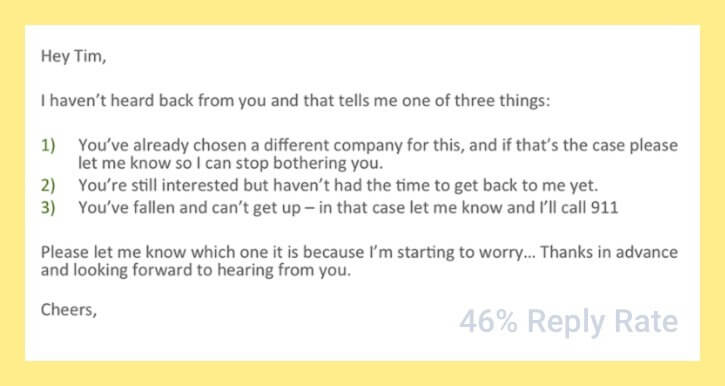
If now is not the right time, just let me know and I will check back in [month or quarter]. If it is, would [day and time] work for a quick call?
Thanks,
[Your name]
Meeting Request Email
Subject: Meeting request: [topic] on [proposed date]
Hi [First name],
I would like to set up a meeting to discuss [topic] and agree on [decision or outcome you need].
Would [option 1: day, date, time and time zone] or [option 2] work for you? The meeting should take about [length], and I will send an agenda beforehand. If neither time suits you, feel free to suggest another.
Best regards,
[Your name]
[Title], [Company]
Deal Close Email
Subject: Next steps for [project or agreement name]
Hi [First name],
Thank you for the productive conversation on [day]. To confirm what we agreed:
[Scope or deliverables]
[Price and payment terms]
[Start date and timeline]
I have attached the agreement for your review. If everything looks right, you can sign it by [date] so we can start on [start date]. If anything needs to change, reply here and I will update it the same day.
Looking forward to working together,
[Your name]
[Title], [Company]
Formal Complaint Email
Subject: Complaint about [order, invoice or service], reference [number]
Dear [Name or Customer Service Team],
I am writing to make a formal complaint about [product or service], which I [bought or received] on [date], reference [number].
[Describe the problem in two or three factual sentences: what happened, when, and any steps you have already taken to fix it.]
To resolve this, I am asking for [refund, replacement, repair or other specific outcome] by [date]. I have attached [receipt, photos or previous emails] for reference.
Please confirm that you have received this complaint and let me know the next steps.
Yours sincerely,
[Your name]
[Phone or account number]
Tips For Using These Templates
Personalize the first line every time. A template that opens with a detail the reader recognizes gets read, while one that could have gone to anyone gets archived. Keep the subject line specific rather than clever, and send follow-ups a few working days apart rather than the next morning.
The last lines of a business email carry more weight than most people expect. For sign-offs that fit formal, semi-formal and casual emails, plus how to build a clean signature, see our guide on how to end an email.
Email Structure Every Professional Should Follow