Top Firms Powering AI Agents With Vector Search, RAG And LLM Orchestration
Daria Pohrebniak
Marketing Director - Reverb
29.09.2025
Agentic AI delivers when agents can find the right facts, reason, and act inside business systems. That takes LLMs paired with vector search, RAG and orchestration — not just prompts. Here are the top firms powering AI agents with Vector Search, RAG and LLM orchestration turning that stack into outcomes you can ship.
These teams blend software engineering with product sense and domain context. Some operate globally at enterprise scale, others move fast as boutique partners. Together they represent the best firms powering AI agents with Vector Search, RAG and LLM orchestration that keep accuracy, security and change management front and center.
Best Partners For Agentic AI With Vector Search And RAG
Impekable brings product design discipline to agent systems, connecting UX, workflow and infrastructure. Their engineers pair OpenAI APIs with retrieval augmented generation and vector search so agents answer with evidence and respect permissions. It’s a thoughtful, end-to-end build that suits teams who want prototypes that can graduate to production.
Work typically starts with research and a thin slice of value, then expands into cloud deployment and governance. The agency’s Silicon Valley roots show in its insistence on measurable outcomes and testable interfaces — a practical stance among the best companies building AI agents. Clients get modular deliverables they can extend internally, avoiding brittle one-offs.
Services and expertise: UI/UX and product design, web and mobile development, enterprise SaaS, AI agent development with OpenAI and vector search
Location: Headquarters in San Francisco, with offices in San Jose (USA) and Sydney (Australia).
Team size: ~50 experts
Portfolio: Google, Panasonic, Twilio and a mix of startups to Fortune 500 enterprises
SoftServe builds multi-agent RAG platforms that run at enterprise scale. One reference architecture pulls context from Amazon OpenSearch, coordinates agents via AWS Lambda and SQS, and uses Bedrock models for generation — a pattern tuned for reliability and observability. That rigor makes SoftServe stand out among best AI infrastructure companies.
The company has delivered more than 100 generative AI use cases, and the platform approach helps standardize security and data pipelines across business units. As one of the top firms powering AI agents with Vector Search, RAG and LLM orchestration, SoftServe aligns cloud foundations with AI product needs — the difference between a demo and a durable system.
Services and expertise: AI/ML, AR/VR, cloud solutions, cybersecurity, data engineering, digital transformation, IoT and robotics, testing, UI/UX and web development; multi-agent RAG using AWS vector search and LLMs
Location: Headquarters in Austin, Texas with European HQ in Lviv, Ukraine and 58 offices worldwide
Team size: ~12,000 experts
Portfolio: IBM, Cisco, Panasonic, Cloudera, Henry Schein, Spillman Technologies and numerous Fortune 500 clients
N iX fields a 200+ engineer practice focused on agent strategy, integration and lifecycle management. Their teams tailor RAG, multi-agent patterns and domain-specific fine-tuning to meet compliance and accuracy targets. That balance of engineering depth and governance fits the best vector search AI agents powering companies in regulated environments.
Implementation isn’t just model wiring — it includes data contracts, observability and rollout plans across operations. N iX supports continuous optimization so agents keep pace with evolving processes, a practical way to sustain artificial intelligence agents in production without drift.
Services and expertise: Cloud and DevOps, data analytics, embedded software, IoT, AI/ML, digital platforms and cybersecurity; AI agent strategy and development using RAG and multi-agent architectures
Location: Headquarters in Kraków, Poland with offices in Ukraine, Sweden, Malta and the USA
Team size: >2,400 experts
Portfolio: Enterprise clients such as Grainger, Office Depot, Digital Property Group, Wargaming and Fortune 500 companies
Intellias brings clear thinking to RAG design. Their guidance explains how vector databases store high-dimensional embeddings for fast semantic retrieval, letting chatbots answer domain questions even when keywords don’t match. That foundation maps well to the data realities of the best vector search AI agents powering companies.
Delivery spans digital engineering, cloud and AI, which helps when agents must operate inside complex product ecosystems. Intellias emphasizes context quality — from chunking to metadata — so retrieval stays faithful, and teams can tune recall vs. precision without breaking downstream workflows.
Services and expertise: Digital product engineering, cloud and DevOps, data and AI, automotive software, embedded systems and cybersecurity; LLM-enabled chatbots with RAG and vector databases
Location: Headquarters in Lviv, Ukraine with development centers across Poland, Croatia, Bulgaria, Spain, Portugal, Colombia and India, plus offices in Germany, USA, UK and UAE
Team size: ~3,000 experts
Portfolio: HERE Technologies, Omio, BrainStorm Inc., Elmos, TomTom, HelloFresh, Travis Perkins and other global brands
DataArt invests in agentic architectures that move beyond scripts to adaptive services. Their AI Lake Accelerator unifies siloed data into an AI-ready environment so agents can ingest, classify, draft and escalate in one coherent flow. That focus puts them firmly among AI agent orchestration companies that care about system-level autonomy.
Airport deployments show the pattern at work: agents triage messages, propose replies and hand off edge cases, cutting setup times and operational overhead. The team frames agents as products with telemetry and escalation rules — a pragmatic way to run artificial intelligence agents where safety matters.
Services and expertise: Custom software development, data analytics, cloud computing, AI/ML, QA and consulting; agentic AI frameworks and AI Lake Accelerator for multi-agent orchestration
Location: Headquarters in New York City with 30+ offices across the US, Europe, UK, Latin America and the UAE
Team size: >6,000 experts
Portfolio: Clients in finance, media and entertainment, healthcare, retail and travel; deployed agentic AI systems for airports and airlines
Thoughtworks backs its consulting with strong guidance on RAG and autonomous agents. The Technology Radar recommends RAG as the go-to pattern, using hybrid search or reranking with vector stores like pgvector, Qdrant or Elasticsearch Relevance Engine. That perspective aligns with the best firms powering AI agents with Vector Search, RAG and LLM orchestration that avoid brittle prompt-only builds.
They also frame multi-agent systems as teams with roles, guardrails and failure modes, highlighting frameworks like Autogen, CrewAI and LangGraph. In delivery, Thoughtworks has implemented client service chatbots that act until escalation is required — proving orchestration and control can coexist.
Services and expertise: Agile software development, digital product design, cloud and DevOps, AI/ML; research on RAG, hybrid search and LLM-powered autonomous agents
Location: Headquarters in Chicago, Illinois with 49 offices across 18 countries
Team size: ~10,000 experts
Portfolio: Works with enterprises worldwide; implements autonomous client service chatbots and advises on RAG and multi-agent strategies
Slalom ties agent design to business outcomes. Their five-component framework — autonomy, tool use, complex reasoning, adaptability and modularity — helps leaders pick the right scope and risks. That operating model fits the best AI infrastructure companies that must keep compliance and observability in view.
Case studies tell the story: a credit card firm’s agent reduced response times by 90% while freeing a significant share of staff capacity. Slalom also fields “Fleet of Analysts” patterns, where specialized agents collaborate on pricing or architecture reviews across many markets — an approach that scales from pilot to networked value.
Services and expertise: Cloud architecture, DevOps and security, product engineering, CRM, UI/UX, data architecture, AI and machine learning; consultancy on multi-agent solutions
Location: Headquarters in Seattle, Washington with operations in 45 markets across eight countries
Team size: ~12,000 experts
Portfolio: Clients include Alaska Airlines, Allstate, eBay, Hyatt, Microsoft and REI; case study of Jaja Finance “Airi” agent reducing response times
Endava’s Morpheus accelerator shows how to make generative AI dependable in regulated sectors. Multiple agents with defined roles debate and converge on answers, calling tools like email, CRM or calendars and passing state until consensus emerges. That emphasis on safety and role design places Endava among AI agent orchestration companies with a clear reliability story.
The reference architecture integrates with major LLMs and cloud platforms and favors transparent workflows over black boxes. For leaders in payments, insurance or mobility, this offers a blueprint for introducing agents without losing auditability or control.
Services and expertise: Digital product engineering, cloud services, automation and agentic AI; Morpheus builds teams of agents that leverage LLMs and external tools
Location: Headquarters in London, UK with offices across Europe, North America, Latin America and Asia Pacific
Team size: ~12,000 experts
Portfolio: Works with global payment companies, insurers, mobility providers and retailers; Morpheus is designed for regulated industries
Ciklum approaches agentic AI through “experience engineering” — fusing product delivery with AI from discovery to operating model. They build autonomous support agents, responsible AI testing frameworks and patterns that move interaction automation from scripts to intelligence. That end-to-end capability is what many seek from the best companies building AI agents.
Reported outcomes include faster response times and significant cost reductions, aided by continuous validation for LLM-based applications. With thousands of engineers across 20+ offices, Ciklum can support rollouts across multiple brands and markets without sacrificing product velocity.
Services and expertise: Experience engineering, product design, data and analytics, cloud engineering and agentic AI; solutions include customer support agents, autonomous testing and AI-infused delivery
Location: Headquarters in London, UK with 20+ offices and 15+ development centers worldwide
Team size: >4,000 experts
Portfolio: Clients include TUI Group, Panasonic, eToro, Betsson, Duracell, Lottoland, Seeking Alpha, MetroMarkets, Payoneer and Tipico
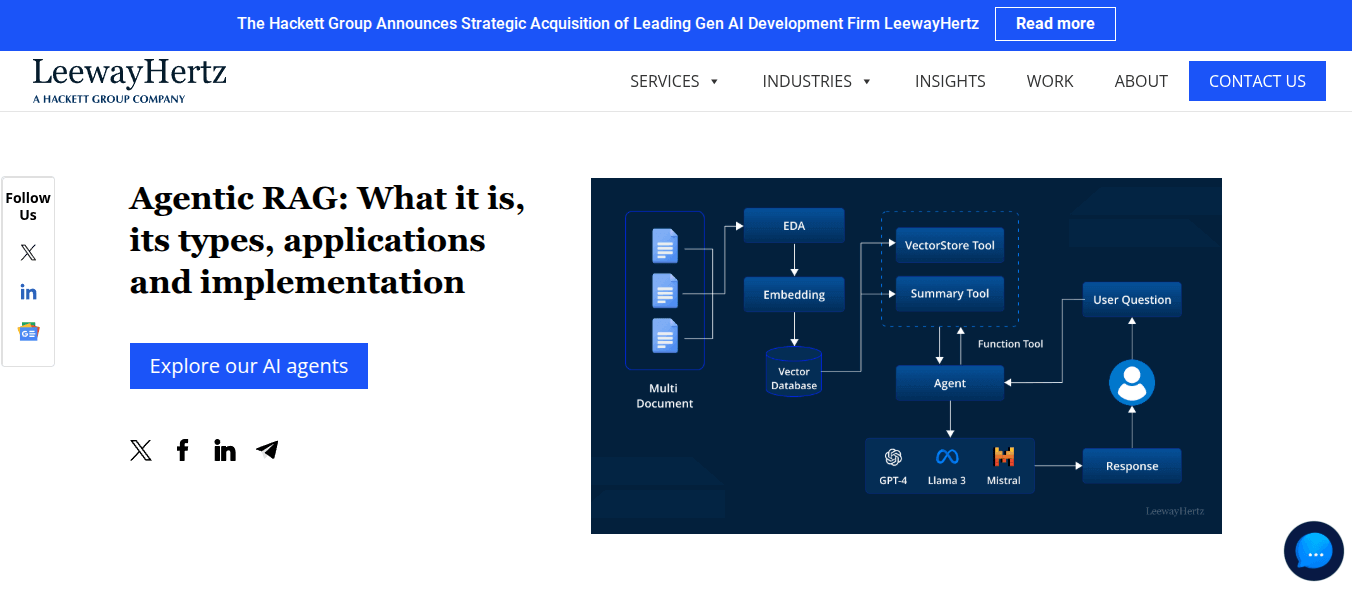
LeewayHertz builds multi-agent systems with orchestration for enterprises that want autonomy with guardrails. Work spans supply chain optimization, operations control and decision support in regulated domains. Buyers often place the firm on shortlists when complex, cross-system workloads are in scope.
On the technical side, teams use memory modules backed by vector databases — Pinecone or Chroma — to give agents fast long-term recall. References include Coca-Cola, P&G and Siemens, with implementations ranging from maintenance assistants to voice-driven work orders. The track record points to real depth with industrial use cases.
Services and expertise: AI consulting and development, custom AI platforms, Web3 and blockchain; autonomous multi-agent systems, LLM orchestration and vector-database-based memory
Location: San Francisco, California (388 Market Street, Suite 1300)
Team size: 200–250 experts
Portfolio: Projects for Coca-Cola, P&G, Siemens, 3M, ESPN, TraceRX, Klaytn, Filecoin, Tezos and more; examples include a Filecoin retrieval dashboard, AI SEO optimizer and a generative storytelling platform
Choosing Partners Who Build For Production
Picking a partner for agentic work starts with scope clarity and ends with impact. Shortlist vendors whose retrieval approach fits your data landscape — not the other way around. Ask how they tune chunking, embeddings and metadata, and how they observe error modes in production. The right fit treats agents as products with telemetry, testing and rollout plans for artificial intelligence agents that actually serve users.
Contracts matter less than how teams collaborate. Look for iterative delivery, strong UX on the agent surface and a plan to evolve prompts and tools as policies change. Bias toward architectures you can own: vector search you control, RAG you can inspect and orchestration you can monitor. That way, whether you choose boutiques like Impekable or global consultancies such as SoftServe, your agents will improve with every release — and your data will keep earning its keep.
If you want to feature your firm that powers AI agents with vector search, RAG and LLM orchestration on this list, email us or submit a form in the Top Choices section. After a thorough assessment, we’ll decide whether it’s a valuable addition.