This list compares the top lead capture tools, from popup and form builders to landing page platforms, for marketers and business owners who want to turn more website visitors into contacts they can follow up with.
Lead generation tools are a great way to turn anonymous visitors into contacts a business can reach later.
Forms, pop-ups, slide-ins, bars, and other on-site messages help collect email addresses or other details at the right moment by surfacing a relevant offer.
The right tool can make a noticeable difference to how many people convert. However, the market is packed with options, ranging from simple pop-up builders to comprehensive conversion platforms with advanced targeting and analytics, so it can be challenging to choose.
If you’re looking to get more out of your website traffic, read on. In this article, we’ve rounded up the top lead capture tools to boost conversions and grow subscriber lists.
Lead Capture Tools At A Glance
1. Tool
Capture type
Best for
1. OptinMonster
Popups and on-site campaigns
Turning site visitors into leads with targeted campaigns
2. HubSpot Forms
Forms and standalone form pages
Building forms without coding
3. ConvertFlow
Landing pages, popups, forms, quizzes and surveys
An all-in-one funnel and lead capture platform
4. Jotform
Online forms
Flexible forms that are easy to set up
5. Unbounce
Landing pages
Marketers running landing page campaigns
6. Leadpages
Landing pages
Launching campaigns without designers or developers
7. Sleeknote
On-site messages and popups
Encouraging visitors to sign up while they browse
8. Privy
Popups, bars and on-site forms
Shopify stores
9. Wisepops
On-site messaging
Brands that need reliable on-site campaigns
10. Poptin
Popups and on-site campaigns
Launching campaigns in minutes
11. Claspo
Popups, embedded forms and floating bars
No-code on-site conversion
12. Alia
Shopify-native email and SMS capture
Direct-to-consumer brands growing email and SMS lists
OptinMonster is a cloud-based lead capture and conversion optimization tool designed to help websites turn visitors into leads. It lets you build various forms and messages that appear at strategic moments, such as when someone is about to leave a page or after they’ve scrolled partway down a blog post.
The platform includes a drag-and-drop builder and templates you can customize to match your branding. It collects email addresses and other contact details and sends this data to your email service or CRM for follow-up.
Unlike most one-off pop-up builders, OptinMonster includes behavior-based triggers and personalization rules that enable you to tailor what each visitor sees. For example, you can show a special offer only to people who have spent a certain amount of time on a page or who have visited multiple pages. You can also test different versions of your forms to see which gets the most sign-ups.
Key features:
drag-and-drop form and campaign builder
pop-ups, floating bars, slide-ins, inline forms, and more
behavior-based targeting
A/B testing
integrations with email marketing platforms and CRMs
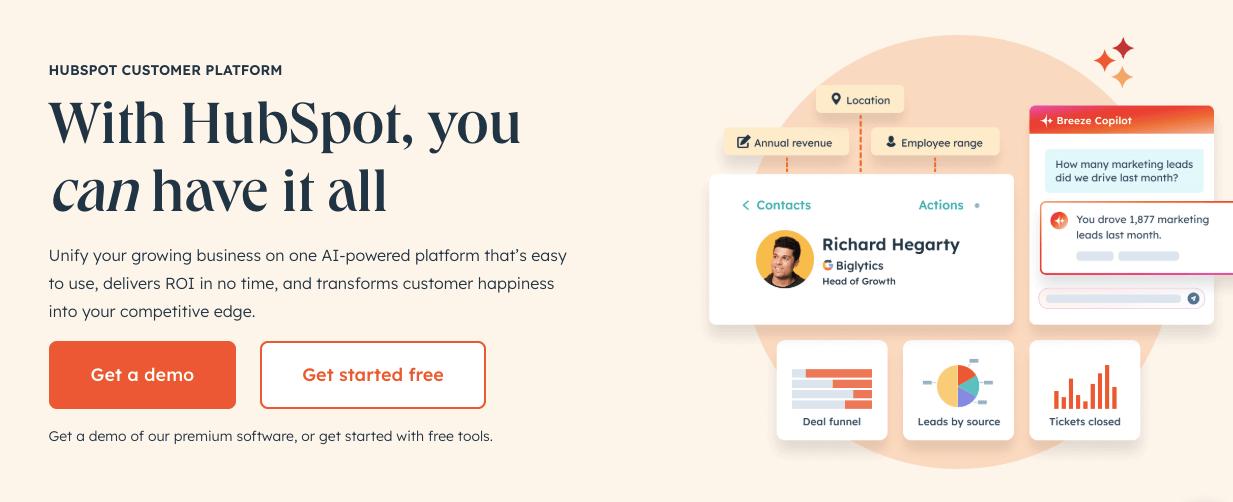
One of the most popular form builders, HubSpot Forms allows users to create and publish forms on their websites or as standalone pages without coding. Each submission feeds directly into HubSpot’s CRM, meaning anyone who fills out a form becomes a contact you can track, segment, and follow up with.
The intuitive visual editor lets you create forms from scratch or use pre-built templates, which are tailored to various goals, such as ebook downloads, event registration, newsletter sign-ups, ticket submissions, etc.
Undoubtedly, the best thing about HubSpot Forms is how they work with the rest of the platform. Because the form submissions go straight into the CRM, you don’t have to export and import data manually. You can also personalize forms so returning visitors see fewer fields, trigger automated follow-up emails, and build lists for segmented marketing. Forms can be embedded on most websites or shared via direct links.
Key features:
drag-and-drop form builder with templates
seamless integration with HubSpot CRM
conditional logic and personalization
automated follow-up actions like welcome emails or segmentation lists
ability to embed forms on external sites or share as standalone links
built-in analytics
Pricing:
HubSpot’s core CRM and basic forms tools are available on the free tier, which stays free forever and includes contact capture and CRM integration.
More advanced form and marketing automation features are part of paid plans within HubSpot’s Marketing Hub, which starts at around $15 per month on the Starter plan and scales up with Professional and Enterprise tiers.
ConvertFlow is an all-in-one platform combining funnel and lead capture tools. It brings together landing pages, pop-ups, forms, quizzes, surveys, sticky bars, and other conversion elements into a single builder. ConvertFlow lets you design and launch everything from one dashboard and tailor what people see based on how they behave on your site.
Marketers use ConvertFlow to capture email and SMS leads with pop-ups and embedded forms, test variations with A/B tools, and personalize content each visitor sees based on their interaction history or CRM data. It integrates with popular email, CRM, and e-commerce systems, so collected leads flow directly into the tools a business already uses. Drag-and-drop editors and pre-built templates help you launch campaigns quickly.
Key features:
funnel builder for landing pages, pop-ups, forms, quizzes, and surveys
personalization and targeting based on visitor behavior and CRM data
drag-and-drop editor with templates
multi-step lead capture flows and conditional logic
A/B and multi-variate testing
integrations with email marketing, CRM, and e-commerce platforms
Chosen by over 35 million users worldwide, Jotform is an online form builder with a focus on flexibility and ease of setup. It allows businesses to create forms for lead capture, registrations, surveys, payments, and internal workflows. Forms can be shared via direct links or embedded on websites. Once someone submits a form, their data is stored inside Jotform or sent to connected tools such as email platforms, CRMs, or spreadsheets.
What sets Jotform apart from other form builders is the level of customization it offers. You can build simple contact forms or more advanced, multi-step forms with conditional logic and calculations. The platform supports a wide range of use cases, from basic newsletter sign-ups to more complex lead qualification flows. Templates help substantially speed things up, while the editor leaves room to adjust the design to match different brands and audiences.
Key features:
drag-and-drop form builder with hundreds of ready-made templates
support for multi-step forms, conditional logic, and calculations
integrations with CRMs, email tools, and automation platforms
Best known for its landing page builder, Unbounce has grown into one of the go-to lead capture and conversion optimization tools used by marketers who prefer having more control over how visitors move through a page. You can build landing pages, pop-ups, and sticky bars, with each element designed to support prospect capture. The editor gives ample room for adjusting layout, copy, and design, allowing teams to test ideas quickly and see what performs better with their audience.
The platform includes A/B testing and a feature called Smart Traffic, which automatically sends visitors to the version of a page that’s most likely to convert based on their past behavior, which helps businesses get more leads from the same amount of traffic. Forms, pop-ups, and on-page CTAs feed directly into connected CRMs, email tools, or spreadsheets, keeping the workflow simple once a lead is captured.
Key features:
drag-and-drop landing page builder
pop-ups, sticky bars, and embeddable lead capture forms
A/B testing
Smart Traffic to route visitors to the highest-converting page variant
integrations with CRMs, email platforms, and automation tools
Leadpages is landing page and lead generation software built for businesses looking to launch campaigns quickly without relying on designers or developers. It offers ready-to-use pages and forms that are designed to convert traffic into leads, whether the goal is email sign-ups, webinar registrations, or lead magnet downloads. Pages can be published on a Leadpages subdomain or connected to a custom domain.
Beyond landing pages, Leadpages includes some of the best lead capture tools to boost conversions. You can add pop-ups, alert bars, and opt-in forms, and then test variations to see which version performs better. The editor is visual and straightforward, which makes Leadpages a great choice for small teams and marketers who want control over layout and messaging without a steep learning curve. Leads are stored in the platform and can be sent directly to email tools or CRMs for follow-up.
Key features:
drag-and-drop landing page builder
built-in forms, pop-ups, and alert bars
A/B testing
mobile-responsive designs out of the box
integrations with email marketing platforms and CRMs
The next tool on our list of the best lead capture apps, Sleeknote focuses on creating on-site messages that encourage visitors to take an action. In addition to the standard pop-ups, Sleeknote gives you more flexible formats, including slide-ins, banners, teasers, and multi-step forms that fit smoothly into a page without blocking the entire screen. This makes it a popular choice for e-commerce brands and content-heavy sites that want to grow their email lists without compromising the user experience.
One of the most customizable lead generation tools, Sleeknote lets users tailor each message to specific behaviors, such as time on page, scroll depth, or exit intent. You can also show different offers to returning visitors, first-time shoppers, or readers who have spent time on certain pages. The visitor tracking feature helps adjust wording, design, and timing to improve conversion rates over time. Last but not least, integrations with email platforms and CRMs make it easy to continue the conversation once a visitor submits their details.
Key features:
slide-ins, banners, teasers, and pop-ups
behavior-based targeting
multi-step forms and lead magnet delivery
A/B testing
integrations with major email marketing tools and CRMs
campaign analytics
Pricing:
Sleeknote uses traffic-based pricing, with its two plans scaling based on the number of monthly visitors to your site:
Core: €62–€462/month
Core and Gamification: €85–€585/month
Sites with over 500,000 monthly visitors are priced on a custom basis. There’s a 20% discount available on annual subscriptions.
Privy is known as the best lead capture software for Shopify stores, favored for an easy way to add pop-ups, bars, and on-site forms that encourage visitors to sign up for discounts or join a mailing list. Installation happens through the Shopify App Store, and once connected, Privy pulls product and customer data automatically, which keeps setup light even for new store owners.
The app enables you to show targeted offers based on cart value, browsing history, or exit intent, then follow up with automated emails or SMS messages. Privy also includes simple segmentation tools and playbooks for common e-commerce scenarios, such as welcome discounts and abandoned cart reminders. All collected leads sync with your marketing tools or stay inside Privy if you prefer to manage campaigns there.
Key features:
pop-ups, flyouts, banners, and embedded forms
behavior-based triggers tailored to shopping activity
automated email and SMS follow-ups
templates for welcome flows, discount offers, and abandoned cart recovery
seamless integration with Shopify
Pricing:
Privy offers three plans, billed monthly:
Pop Ups & Displays: from $24/month
Email: from $30/month
Email & SMS: from $45/month
Pricing increases as your email list, SMS volume, or traffic grows.
Trusted by brands like L’Oréal, UNICEF, and Unilever, Wisepops is used by companies that need reliable on-site messaging. Recognized among the best lead capture tools, Wisepops supports pop-ups, slide-ins, bars, and embedded elements that you can place anywhere on a page. Businesses use Wisepops to collect email addresses, promote offers, or guide people toward specific actions without interrupting the browsing experience more than necessary.
Campaigns can be shaped around visitor behavior, including time on page, scroll depth, exit intent, referrer, and more. Wisepops also offers a notification feed (called Wisp) that appears like a small in-site message center, which helps you surface updates or promotions in a quieter way. Analytics are built into each campaign, so you can monitor performance and adjust campaigns to achieve better results.
Key features:
pop-ups, slide-ins, bars, and embedded blocks
behavior-based targeting
visual editor with templates and customization options
Wisp notification feed for subtle, persistent on-site messages
segmentation based on visitor behavior, device type, traffic source, or campaign history
integrations with email platforms, CRMs, and e-commerce tools
Poptin is the best lead capture software for marketers who want to launch efficient on-site campaigns in a matter of minutes. With Poptin, you can create engaging pop-ups, overlays, and embedded forms that help turn visitors into leads. The tool offers an easy-to-use visual editor that lets you build campaigns without touching code.
Poptin supports a range of triggers and targeting rules, so you can rest assured that your messages appear at the right moment. You can show offers based on exit intent, time on page, scroll depth, or traffic source, and connect submissions to email platforms, CRMs, or automation tools. Built-in analytics make it easy to see which pop-ups perform best and continuously refine campaigns.
Key features:
pop-ups, slide-ins, overlays, and embedded forms
exit-intent, scroll, and time-based triggers
drag-and-drop editor with customization options
A/B testing
integrations with email marketing tools, CRMs, and Zapier
Claspo is a no-code lead capture and on-site conversion tool that helps you launch popups, embedded forms, and floating bars without touching code. It’s built for teams that want to move fast, with ready-made templates, advanced triggers and targeting, and built-in testing to improve results over time.
If you’re looking for free website widgets that go beyond basic opt-in forms, Claspo also supports gamified experiences (like spin-to-win and scratch cards) plus personalization and frequency controls, so your campaigns stay effective without annoying visitors.
Key features:
drag-and-drop popup and widget builder
popups, floating bars, and embedded forms
behavioral triggers (time on page, scroll, exit intent, etc.)
targeting rules (new vs returning visitors, pages, traffic source/UTMs, geo, and more)
personalization options (dynamic content and segmentation)
A/B testing and conversion analytics
gamification widgets (spin wheel, scratch card, gift box)
integrations with email marketing platforms and CRMs
Pricing:
free plan available
paid plans available for higher limits and advanced controls
Alia is a Shopify-native lead capture platform built for direct-to-consumer brands that want to grow their email and SMS lists without disrupting the shopping experience. What sets it apart from standard popup tools is its focus on brand storytelling and shopper education, guiding visitors through a brand’s value before asking them to subscribe. This results in higher-intent opt-ins and a more meaningful connection with potential customers.
The platform uses AI-powered targeting and built-in A/B testing to show the right message at the right moment. It also supports gamified formats like scratch-to-win and mystery box offers alongside standard popups and embedded forms. Analytics go beyond basic conversion tracking to show actual revenue impact, making it easier to measure what’s working.
Key features:
Shopify-native popups, embedded forms, and gamified experiences
AI-powered targeting and Smart Suppression
Email and SMS opt-in collection
Brand storytelling templates and shopper education flows
A/B testing and revenue impact analytics
Integrations with Klaviyo, Attentive, Omnisend, and other major platforms
Pricing:
Alia offers two plans with a 14-day free trial:
Basic: from $100/month
Fully Managed: from $400/month (includes dedicated customer success manager and managed A/B testing)
Annual billing saves 25%.
What Lead Capture Tools Do
A lead capture tool collects contact details, usually an email address or phone number, from people who visit your website. It does this through forms, popups, slide-ins, bars, quizzes or dedicated landing pages, each offering something in exchange such as a discount, a download or a demo.
Most tools also control when and to whom a message appears. Common triggers include exit intent, time on page, scroll depth and traffic source, so you can show a relevant offer instead of the same popup to everyone. Captured leads are then sent to your email platform or CRM, where they can be tagged and routed to the right list, sequence or sales rep.
Match the capture type to your funnel. Form builders suit contact and demo requests, popup tools suit list growth on content and ecommerce sites, and landing page builders suit paid campaigns.
Check targeting and triggers. Look for exit intent, page and referrer rules, and frequency caps so offers stay relevant and do not annoy returning visitors.
Confirm integrations. Make sure the tool connects natively to your CRM, email platform or ecommerce store so leads arrive with the right tags.
Look at routing options. If several teams handle leads, check whether the tool can send different submissions to different lists, owners or workflows.
Test before you commit. Built-in A/B testing and conversion reports make it easier to prove which offers work.
Consider interactive formats. Quizzes can collect richer data than a plain form; see our list of top online quiz maker software.
A lead capture tool is software that collects contact information from website visitors through forms, popups, landing pages or quizzes. It usually adds targeting rules to decide who sees each offer and sends captured leads to an email platform or CRM for follow-up.
What Tools Should You Use For Lead Capture And Routing?
Most teams combine a capture tool, such as a popup builder, form builder or landing page platform, with a CRM or email platform that handles routing. Choose a capture tool with native integrations to your CRM so each lead can be tagged by source and passed to the right list, workflow or sales rep automatically.
Do Popups Hurt Conversions?
Poorly timed popups can frustrate visitors, especially on mobile, but well targeted ones usually add leads without hurting the rest of the page. Use triggers such as exit intent or scroll depth, limit how often returning visitors see them, and make them easy to close. Testing variations is the best way to confirm the effect on your own site.
There’s no one-size-fits-all lead capture tool that works perfectly for each and every website. Your choice should depend on your goals, the amount of traffic you get, and how much control you want over targeting and testing.
We hope our list helps you choose the best lead capture tool for turning your existing traffic into more predictable sign-ups.