ChatGPT vs Claude vs Gemini: Which AI Is Best For Business?
David Roberts
Founder & CEO
03.26.2026
The useful version of ChatGPT vs Claude vs Gemini is not “which model is smartest.” It is which one fits the work your team actually does — writing, research, coding, meetings, internal docs, customer operations, and content production.
For most companies, the wrong choice does not fail because the model is weak. It fails because it creates extra review, extra switching, or extra process friction.
This guide is built around that practical lens. The better buying question is which tool saves more time inside your existing stack and which one creates the least cleanup after the first draft or first answer. That is a much better way to decide than comparing marketing claims in isolation.
ChatGPT vs Claude vs Gemini: Top AI For Business 2026 By Workflow
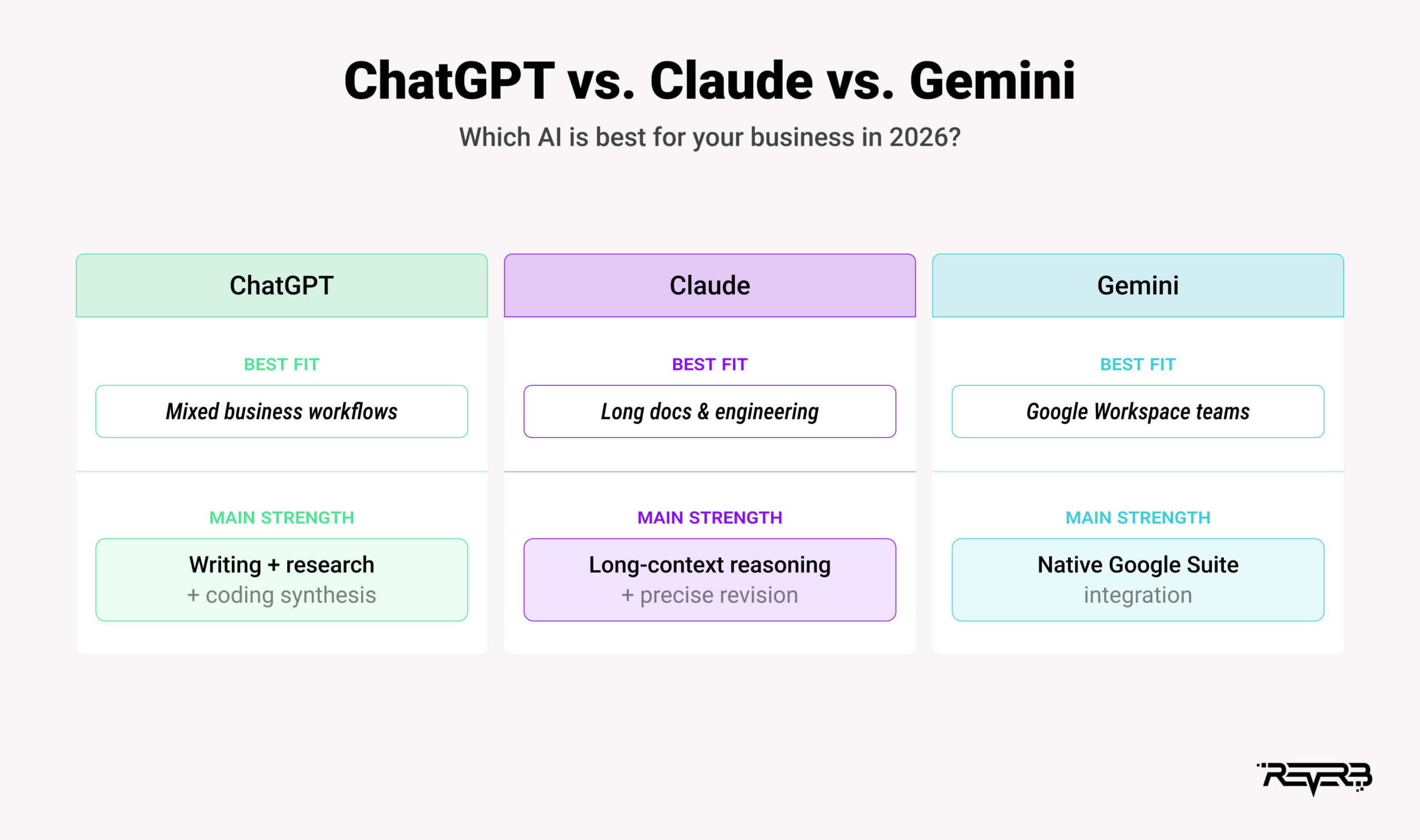
Before getting into the workflow-by-workflow breakdown, it helps to see the broad differences in one place. The real gap is not which tool sounds smartest in a demo, but which one fits your company’s daily operating model with the least friction. That is the practical value of an AI assistant comparison 2026.
Tool
Best Fit
Main Strength
Main Limitation
ChatGPT
Mixed business workflows
Strong synthesis across writing, research, and coding
Can still create a cleanup when teams need tighter drafting control
Claude
Long documents and engineering work
Better controlled revision and long-context support
Less embedded in office software than Gemini
Gemini
Google-first organizations
Natural fit with Docs, Drive, Gmail, Meet, and YouTube
Less attractive when the stack is spread across many non-Google tools
That table is only a starting point. The real answer usually shows up when teams test all three on real tasks and compare how much editing, fact-checking, and follow-up work each one creates. Teams can make that testing easier with an AI model comparison tool, which sends one prompt to multiple LLMs and displays their responses together for direct evaluation.
Best For Content Ops And Editorial Teams
The strongest business use of AI for writing is not “press a button and get a blog post.” Large teams use it to speed up first drafts, restructuring, tone alignment, summary creation, campaign variations, and editorial cleanup. In practice, that means higher throughput, steadier brand output, and fewer revision loops.
Where ChatGPT Wins
ChatGPT is strong when writing sits inside a broader workflow that also includes research and synthesis. OpenAI positions ChatGPT Business around a shared workspace, company tools, deeper research, Codex, and stronger work-oriented features. That makes it useful when a document is only one part of a larger business process.
Where Claude Wins
Claude is often better when the job is a controlled revision of a long document without making it sound too machine-shaped. Anthropic’s recent product story leans heavily on knowledge work, stronger instruction-following, and Claude Sonnet as a reliable option for long-form drafting and revision. That is one of the more practical differences in Claude vs ChatGPT for business.
Where Gemini Wins
Gemini becomes more useful when the draft already lives in Google Docs and needs to pull context from the rest of Workspace. Google’s advantage is not just the model. It is the fact that drafting, editing, comments, and source material are already in the same system.
Where The Real Workflow Decision Happens
If your team already gets decent AI drafts but struggles with cleanup, factual polish, and brand voice, another model benchmark will not solve the problem on its own. The bigger issue is workflow design, review standards, and prompt engineering. That is often where the quality gap actually comes from. For teams dealing with final polish, AI copy editing is often more useful than another broad writing test.
Best For Research And Internal Decision Support
Research-heavy work is where model differences become more apparent. The question is not just output speed. It is how well the system handles source material, synthesis, reasoning, and structured reporting that somebody can actually use.
Where ChatGPT Wins
For research-heavy work, ChatGPT currently has the clearest business edge. It is stronger when the job is to search, analyze, synthesize, and turn messy material into a decision-ready document. That is why many teams still see it as the best AI for business 2026 when internal reporting and recommendation writing matter more than raw ideation. It becomes even more practical in structured environments built around products like Prism and learning resources such as OpenAI Academy.
Where Claude Wins
The practical split in Claude vs ChatGPT for business is that Claude often performs better when the work involves patiently reasoning through a large body of material over several passes. ChatGPT tends to be faster at synthesis into a usable answer. Claude tends to be steadier when a team wants to sit inside long source material and reason through it carefully.
Where Gemini Wins
Gemini is strongest here when the information already sits inside Google. Workspaces with Gemini and NotebookLM are built around Gmail, Docs, Sheets, Meet, and stored files, so the handoff between source material and synthesis is smoother than in a separate research stack. For some teams, that alone can make Gemini the best large language model for work, even if another option is stronger in a broader comparison.
What Buying Teams Often Miss
People often ask which AI is most accurate, but that is usually the wrong first filter. In business use, accuracy depends on the model, the task, the sources, and how much review your team does afterward. A smarter workflow with source grounding and good editorial review usually beats a nominally stronger model used casually.
Best For Engineering And Developer Workflows
Software teams usually feel the differences faster than anyone else. The issue is not whether each model can write code, but which one works better over long sessions, bigger repos, and tool-heavy technical workflows.
Where Claude Wins
For engineering work, Claude has the most focused product story. Anthropic presents it less as a general assistant that can also code and more as a tool built for technical workflows. In practice, that makes it a strong fit when coding is the team’s center of gravity.
The role of the context window matters here, too. Claude’s long-context positioning gives it a cleaner story for repo-level work, code review, and long-session support. That does not make it the winner for every team, but it does make it more naturally developer-first.
Where ChatGPT Wins
ChatGPT has become much more credible in code than it used to be. OpenAI now ties it more directly to work-oriented coding features, broader workflow support, and stronger structured outputs. So Claude often feels more engineering-first, while ChatGPT feels more like a strong generalist that now also handles technical workflows well.
Where Gemini Wins
Gemini is more useful here when development work sits close to Google infrastructure, Workspace documentation, and cross-functional collaboration in Docs, Meet, and Drive. It is not always the first pick for repo-first engineering teams. But it becomes more relevant when code work is tightly connected to planning, documentation, and collaboration already happening inside Google.
Best For Google Workspace, YouTube, And Video Teams
This is the clearest place where ChatGPT vs Gemini becomes a real business workflow decision. Gemini is more naturally connected to Docs, Drive, Gmail, Meet, YouTube, and video-related work. For training teams, product marketers, internal comms, and creator-led businesses, that is not a side feature. It is often the actual production chain.
Where Gemini Wins
If your company builds webinars, explainers, tutorials, enablement materials, or YouTube-led content, Gemini deserves more weight than it usually gets in broad AI rankings. ChatGPT is still useful for outlining and rewriting, but Gemini is more tightly connected to the production flow when the source assets already live in Google. That is a real operational advantage, not just convenience.
Where ChatGPT Still Helps
ChatGPT remains useful for outlining, rewriting, condensing, and synthesizing large piles of notes into cleaner working drafts. It is often the better shaping layer once the raw source material is already in place. That is why some teams still prefer using both rather than forcing one system to do everything.
Where Claude Fits
Claude is useful when the workflow turns into long script revisions, dense policy-heavy editing, or careful refinement across many iterations. It is less tied to the production stack itself, but still valuable for the long-document side of content and communications work.
Best For Daily Operations, Team Productivity, And Workflow Fit
For broad office work, the winner often depends less on pure model quality and more on where the company already spends its time. That is why this is usually the most practical category in a real buying process.
Where Gemini Wins
For broad office work, Gemini is the easiest fit for companies already standardized on Google Workspace. That is why it stands out as one of the most practical AI tools for productivity for Google-first organizations. It meets users inside the tools they already open all day.
Where ChatGPT Wins
ChatGPT is stronger when the company uses multiple tools rather than a single dominant suite. Its value comes from being a broader layer for mixed-stack work, especially when writing, research, coding, and analysis all happen across different systems. That gives it a stronger position across many enterprise AI use cases.
Where Claude Fits Best
Claude sits between those two. It has become more credible for collaboration and connected work, but it still feels more like a high-quality assistant layered onto work than a full operations layer across an entire office suite. For some companies, that is exactly what they want.
When The Decision Gets Broader
At that stage, the question is often no longer just three model names. It becomes a workflow decision about stack fit, governance, review cost, and what kind of AI reasoning your team actually needs from day to day. That is a much more useful buying lens than asking which tool wins an abstract benchmark. At that point,curated product reviews often become more useful than another generic model ranking.
Best For Accuracy, Pricing Structure, And Technical Buying Criteria
Teams still spend too much time debating one large language model (LLM) against another in isolation and not enough time comparing packaging. A good buying process should compare seats, workflow fit, controls, and the cost of review after output. In practice, the strongest answer often comes from that operational view, not from model hype.
Accuracy In Practice
Accuracy still matters, but it is more useful to compare current models on a live independent benchmark than to argue in general terms. On LiveBench, the latest scores are GPT-5.4 Thinking xHigh Effort — 80.28, Gemini 3.1 Pro Preview High — 79.93, and Claude 4.6 Opus Thinking High Effort — 76.33.
That is a tight spread at the top, which is why the practical difference in business use usually comes down less to raw benchmark score and more to workflow fit, review load, and source handling.
A Practical Pricing And Buying View
A more useful way to compare the tools is to look at how they are sold and managed inside a company. AI pricing plans only tell part of the story, because workspace structure, admin controls, and API access often shape the real cost more than the headline model itself.
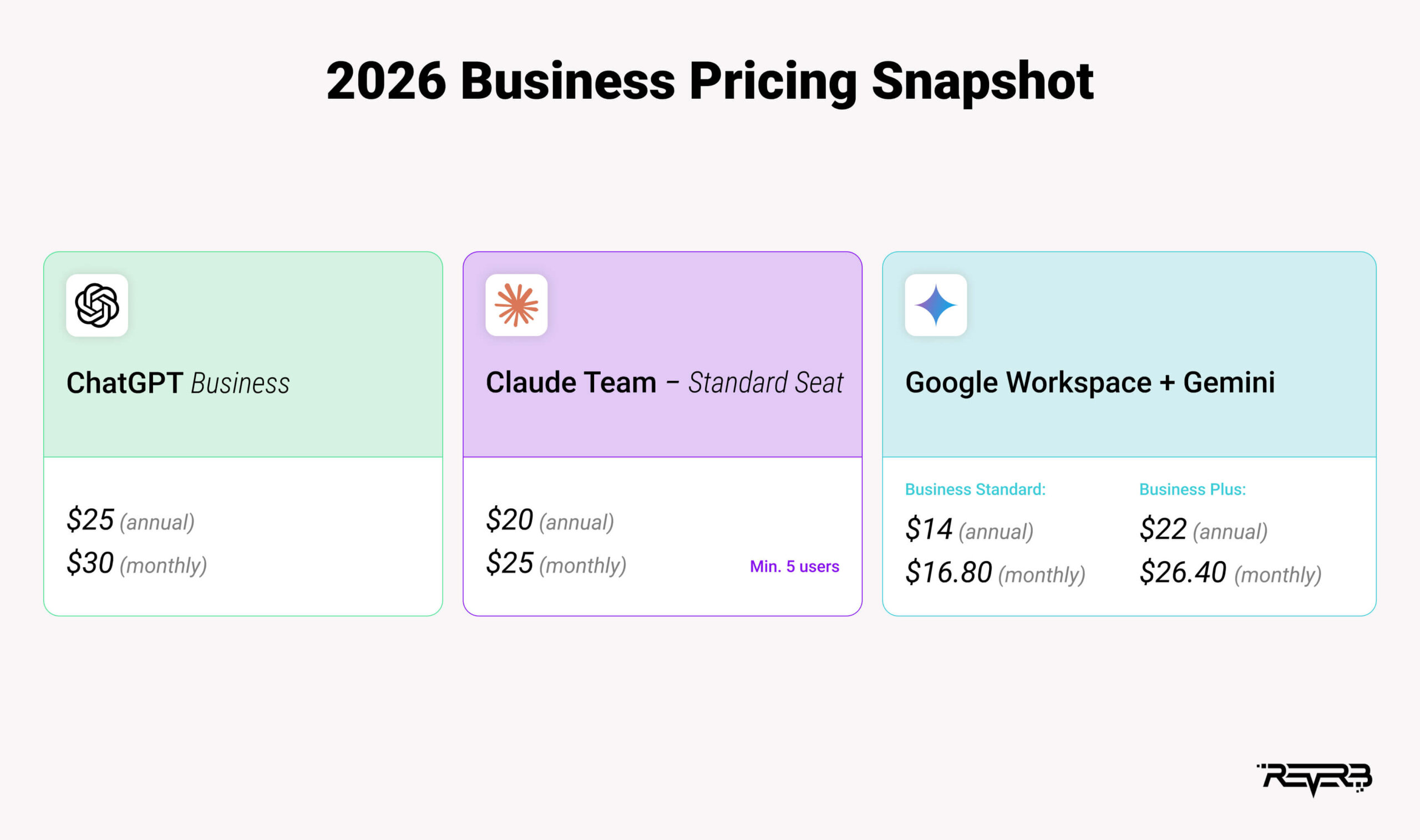
ChatGPT Business: $25 per seat per month (annually) or $30 monthly
Claude Team: $20 per seat annually or $25 monthly for a standard seat
Google Workspace Business Standard: $14 per user annually or $16.80 monthly
Google Workspace Business Plus: $22 per user annually or $26.40 monthly
ChatGPT
Best for mixed teams that want one flexible system for writing, research, coding, and synthesis
Usually makes the most sense when companies want a shared business workspace plus developer-side tools
Costs can spread quickly if multiple departments use it heavily without clear usage rules
Claude
Best for technical teams and document-heavy workflows
Works well when coding support, long-context handling, and careful revision matter more than broad office-suite coverage
Value depends on how central those deeper workflows are to the team
Gemini
Best for Google-first companies already operating inside Workspace
Makes the most sense when Gmail, Docs, Drive, Meet, and related tools already shape daily work
The buying decision can feel split between Workspace use and developer-side needs
Why Historical Memory Can Mislead Buyers
One useful footnote for buyers: GPT-4o was the version many teams got used to and often preferred for everyday work, so it still shapes how people talk about ChatGPT. But OpenAI has already retired GPT-4o from ChatGPT, even though it remains available in the API, so current evaluations should focus on the active product stack rather than on a model people liked in an earlier cycle.
How To Choose Without Wasting Time
ChatGPT is the easiest pick when one team needs one tool for many different jobs. It handles research well, pulls ideas together from different sources, helps shape internal docs, and can turn rough notes into something clear enough to send up the chain. That breadth is why it still performs well in many broad business evaluations and still makes a strong case as the best AI for business 2026.
Claude is a stronger fit when the work is more technical or more document-heavy. Gemini fits better when the team already lives in Google, and most of the work runs through Docs, Drive, Meet, YouTube, or video planning. In practice, the better option depends on how the team actually works day to day.
The best way to choose is to test all three on real tasks. Run the same prompts, use the same files, and compare how much editing, checking, and extra effort each one needs. Usually, the winner is not the one who sounds most impressive. It is the one your team can use without slowing down.