
Ramon Aparece, Jr.
Golf Course Superintendent
Palm Vista Country Club
Please introduce Palm Vista Country Club and describe your role as Golf Course Superintendent.
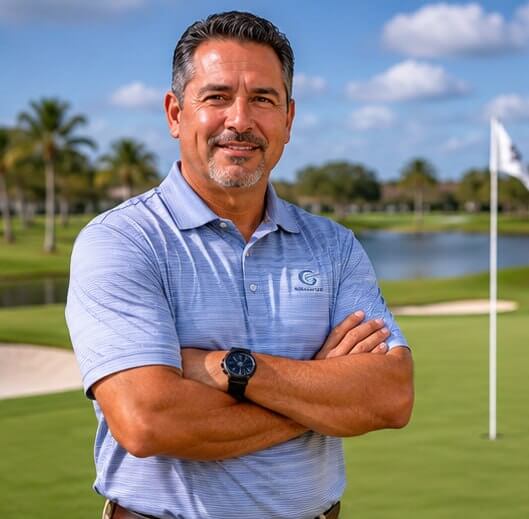
I serve as the Golf Course Superintendent at Palm Vista Country Club in Palm Beach County, Florida. I oversee the maintenance and agronomic operations of a 27-hole championship golf facility. My responsibilities include turf management, irrigation, environmental stewardship, budgeting, equipment planning, and staff leadership. I manage a team of 32 full-time and seasonal employees and oversee an annual maintenance budget of approximately $2.8 million. My goal is to provide consistent playing conditions while managing resources responsibly and preparing for Florida’s unique environmental challenges.
What operating model do you use to maintain the golf course and grounds?
Most of our work is handled by an in-house team. Daily maintenance, irrigation management, turf care, landscaping, and course preparation are all performed internally. We occasionally work with specialized contractors for major construction projects, equipment upgrades, or highly technical installations. However, maintaining institutional knowledge within our team is important because golf course conditions require daily attention and long-term consistency.
How do you differentiate your operation from other golf facilities?
Our approach is based on prevention rather than reaction. We focus heavily on soil health, moisture management, and data-driven decision-making. We use tools such as drone mapping, moisture sensors, weather monitoring, and advanced drainage systems to identify issues early. We also place a strong emphasis on sustainability. Water conservation, native landscaping, and environmental stewardship are integrated into our operating strategy rather than treated as separate initiatives.
What areas of golf course management have been your primary focus throughout your career?
My career has focused on championship golf course maintenance, sustainable turf management, water conservation, and environmental stewardship. Early in my career, I concentrated on agronomy and irrigation systems. Over time, my responsibilities expanded to include leadership, budgeting, disaster preparedness, and workforce development. Today, I spend as much time developing people and systems as I do managing turf.
What are the most common challenges golf clubs rely on you to solve?
The biggest challenges involve maintaining consistent playing conditions despite weather extremes. In Florida, we deal with heat stress, humidity, salt exposure, heavy rainfall, hurricanes, and year-round traffic. Water management is another major focus. Clubs also look for solutions that balance environmental responsibility with high-quality playing surfaces.
How do you stay ahead of industry changes when conditions evolve so quickly?
I stay active in professional organizations, continuing education programs, and industry conferences. I also spend time reviewing agronomic research and technology developments. However, I believe field observations remain essential. Data is important, but conditions on the ground ultimately determine whether a strategy is working.
How important is long-term trust within a golf club environment?
Trust is critical. Members and club leadership expect consistency. They want to know the course will perform well day after day. Building trust comes from communication, reliability, and transparency. People understand that challenges arise. What matters is having a clear plan and executing it consistently.
How do you measure success and satisfaction in your operation?
We measure success through several factors. Turf health, playability, water efficiency, equipment performance, staff retention, and member feedback all matter. We also monitor resource consumption and environmental benchmarks. If conditions remain consistent while resources are used efficiently, that is usually a good indicator that our systems are working.
What type of ongoing support do you provide after major projects or improvements?
Most projects require continuous monitoring after implementation. Whether it is a drainage upgrade, irrigation improvement, or turf conversion, we track performance closely. We adjust practices as conditions change. Improvement projects are rarely one-time events. They become part of our long-term management strategy.
How are maintenance budgets typically structured?
Golf course operations are generally managed through annual budgets. Resources are allocated across labor, equipment, irrigation, agronomic inputs, capital improvements, and environmental initiatives. Budget planning requires balancing immediate operational needs with long-term investments in infrastructure and sustainability.
What factors determine whether a project is worth pursuing?
The project must solve a meaningful operational problem. It should improve efficiency, sustainability, playability, or long-term reliability. We evaluate expected outcomes, resource requirements, environmental impact, and operational feasibility before moving forward.
Have you ever decided not to move forward with certain projects?
Yes. Sometimes a project may not align with long-term goals, environmental considerations, or operational realities. In those situations, it is important to step back and evaluate alternatives. Not every idea is the right fit, even if it appears attractive initially.
What major challenges have you faced in recent years?
Hurricane recovery has been one of the biggest challenges. I led recovery efforts following Hurricane Irma and Hurricane Ian. These situations require extensive planning, rapid decision-making, and strong team coordination. Staffing challenges and increasing environmental pressures have also affected the industry. We addressed these issues through preparation, training, and improved operational systems.
How do you encourage innovation within your operation?
Innovation starts with curiosity. I encourage team members to ask questions and suggest improvements. We test new technologies when they offer practical benefits. At the same time, innovation must be measurable. New ideas should solve real problems rather than simply add complexity.
What role does team culture play in success?
Team culture is one of the most important factors in our operation. Golf course maintenance is highly collaborative. Everyone contributes to the final product. I focus on accountability, communication, and professional development. When people understand their role and feel valued, performance improves.
Where do you see golf course management heading over the next decade?
I believe sustainability and technology will continue to shape the industry. Water conservation, environmental stewardship, precision irrigation, and data analytics will become increasingly important. Golf courses will also be expected to function as responsible green spaces that support both recreation and ecological health.
How has your leadership style evolved over time?
Early in my career, I focused heavily on technical execution. As my responsibilities grew, I learned that leadership is really about developing people and building systems. Today, I spend more time mentoring staff, planning ahead, and creating processes that allow teams to succeed consistently.
What emerging technologies are you most excited about?
I am particularly interested in advancements in drone mapping, moisture monitoring, predictive analytics, and irrigation technology. These tools help us make more informed decisions and improve efficiency. Technology works best when it supports good agronomic practices rather than replacing them.
What advice would you give to aspiring leaders in golf course management?
Focus on fundamentals. Learn the science behind the work. Understand soil, water, and plant health. Build strong relationships and never stop learning. One lesson that has stayed with me throughout my career is that success is usually the result of preparation rather than reaction. Great conditions do not happen by accident. They come from consistent effort, attention to detail, and a team working toward the same goal.