Medical simulation existed long before headsets. Manikins, cadaver labs, standardised patients and simulation centres have trained clinicians for decades, and they work. What virtual reality medical training changes is not whether simulation is effective but how much of it an institution can afford to run, because a simulation centre has fixed capacity, a fixed timetable and a cost per learner hour that does not fall.
That framing matters when comparing vendors, because they solve different halves of the problem. Some replicate procedural skill, where the learning is in the hands and the sequence, which is the territory of VR surgical training. Others replicate clinical reasoning and team behaviour, where the learning is in decisions made under pressure with incomplete information. A platform excellent at one is usually indifferent at the other.
The companies below cover surgical and procedural work, nursing and clinical education, emergency and team scenarios, and custom development for institutions whose requirements no catalogue matches. Assessment capability varies widely, and it is worth more than content volume for anyone whose programme has to demonstrate competence rather than participation. For immersive training outside healthcare, our guide to the top VR training and simulation providers covers the wider market.
Medical Simulation VR At A Glance
Company
Best For
Simulation Type
Treeview
Custom simulators built to an institution’s protocol
Custom
Osso VR
Surgical procedures and device technique
Procedural
FundamentalVR
Skills where touch carries the learning
Haptic procedural
PrecisionOS
Orthopaedic technique and decision making
Procedural
Oxford Medical Simulation
Clinical reasoning across scenarios
Clinical judgement
SimX
Multiplayer team and emergency scenarios
Team based
UbiSim
Nursing education at programme scale
Nursing
Virti
Communication and human factors training
Behavioural
Health Scholars
Voice driven emergency and protocol drills
Protocol adherence
Lucid Reality Labs
Custom builds with outcome analytics
Custom
Best VR Companies For Medical Simulation In 2026
1. Treeview — Custom Simulators, With Stanford Medicine And Medtronic Behind It
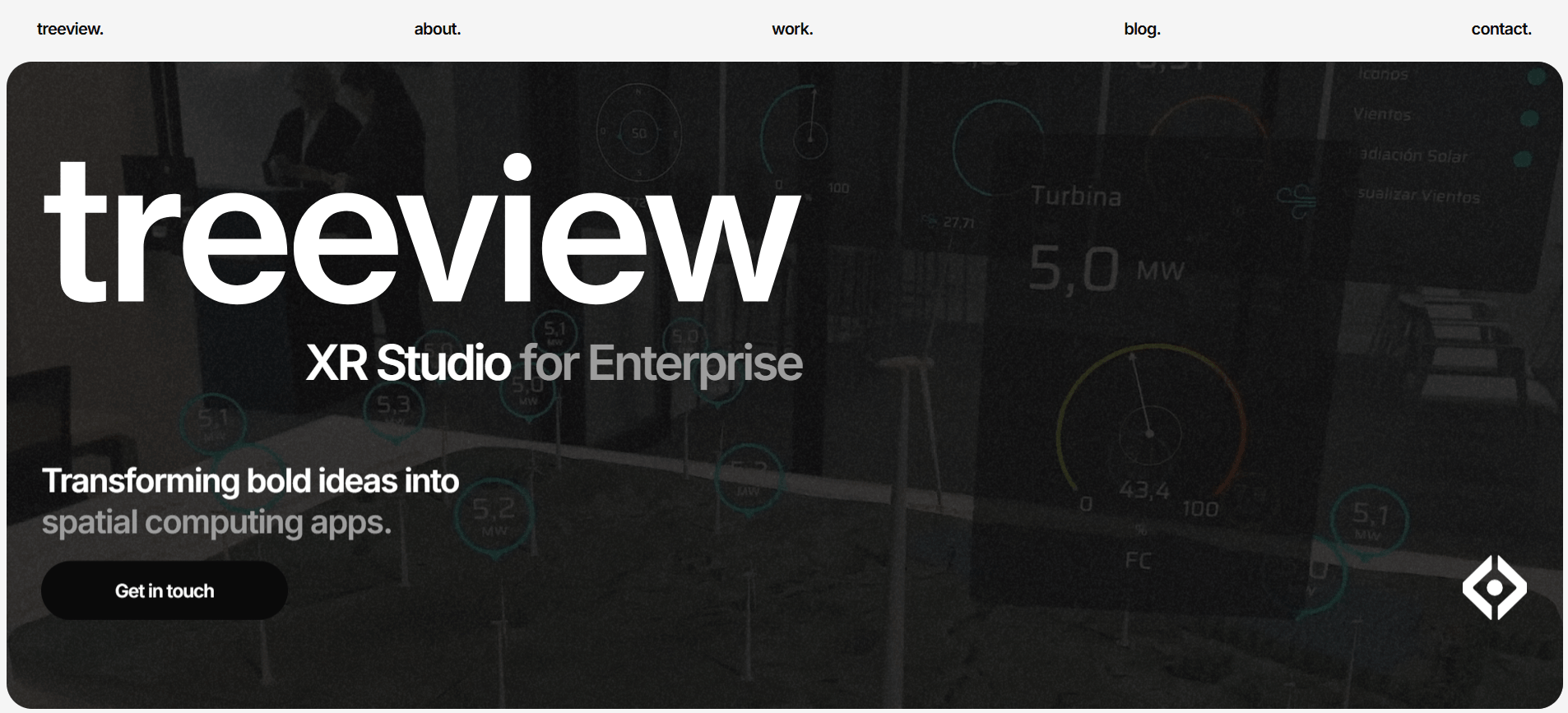
Every simulation catalogue stops somewhere. A specific protocol, a device that only your institution uses, a research instrument that has to behave in a defined way, a procedure taught differently at your centre than anywhere else. Treeview builds for exactly those cases, and it comes to them with healthcare delivery already on record: Stanford Medicine, Medtronic and Daiichi Sankyo are all clients.
The studio also has a simulation platform of its own. Inviewer is a spatial platform for rapid experimentation and deployment of immersive simulators, spanning interactive educational content, engineering simulators and data visualization, and it is featured in the Apple Vision Pro App Store as a leading resource in science education. That is a team that has shipped simulator technology as a product rather than only as client work, which is unusual among VR medical training companies built on a services model.
Two commercial points matter for institutions. Clients retain full ownership of intellectual property, source code and assets, which is close to essential when a simulator embodies a protocol you intend to publish, license or take through review, and grant funded work frequently requires it. Long term support covering platform migration addresses the other reality, which is that a curriculum or a study will outlast the headset generation it started on.
Services and expertise: Custom VR and mixed reality simulator development, AR and VR healthcare applications, medical training and patient education, Inviewer spatial simulation platform, Apple Vision Pro and Meta Quest development, 3D content creation, long term support
Location: New York, United States and Montevideo, Uruguay
Portfolio: Stanford Medicine, Medtronic, Daiichi Sankyo, Microsoft, Meta, University of Alberta
2. Osso VR — Surgical Procedures With Assessment Attached
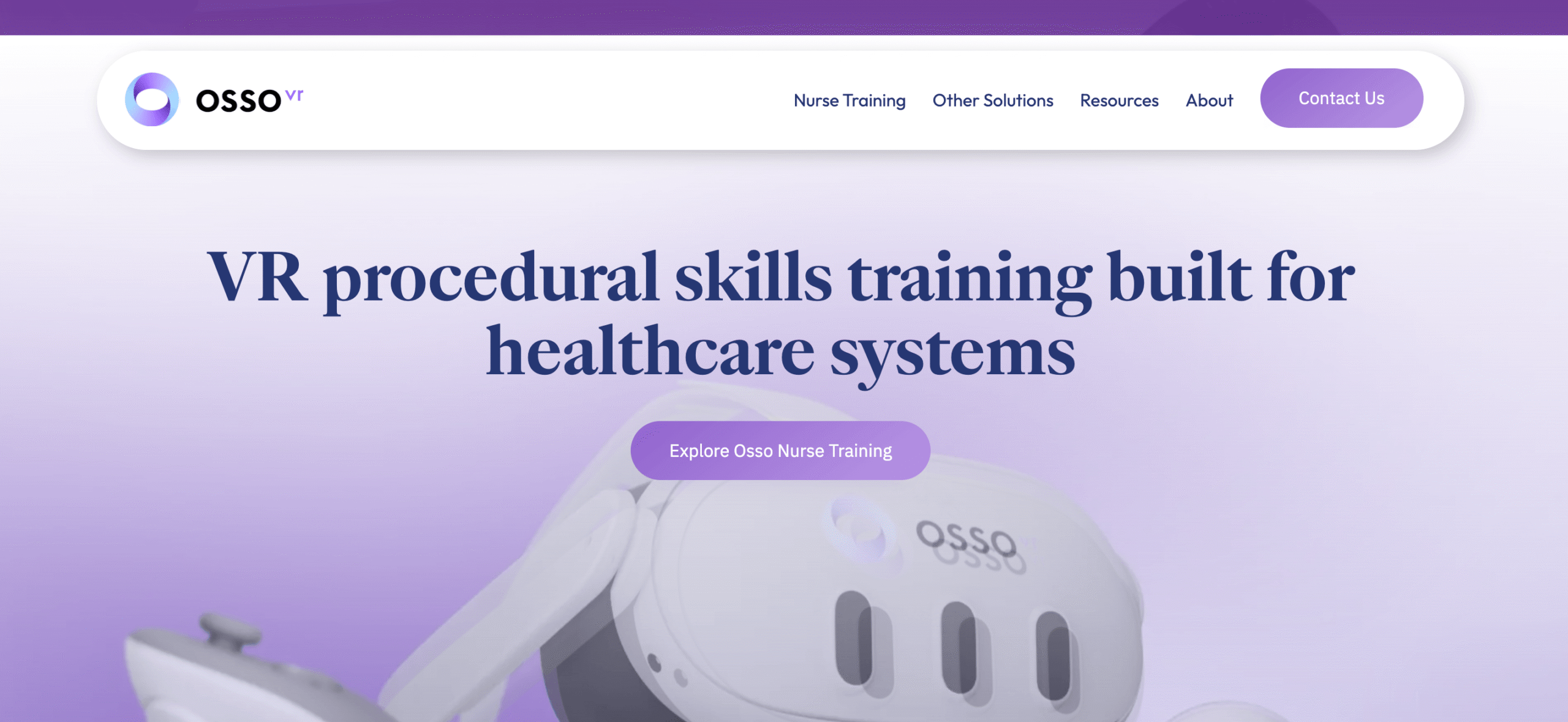
Osso VR provides immersive surgical training used by medical device companies and health systems, covering surgeon education on specific procedures and training for the representatives who support them in theatre.
Its strength is the combination of procedural fidelity and measurement. Trainees work through a technique step by step, and the platform records how they performed, which converts VR surgical simulation from an attendance record into competence evidence. For programmes that must demonstrate readiness rather than exposure, that distinction decides the purchase.
The catalogue is organised around procedures and devices, so coverage depends on whether your techniques are represented. Institutions with unusual practice will find the boundary quickly, which is where custom development enters the conversation.
Services and expertise: VR surgical training modules, procedural simulation, competence assessment and analytics, device representative training, scaled deployment
Best suited to: Surgical training programmes and device companies scaling procedural education
3. FundamentalVR — Simulation For Skills That Live In The Hands
FundamentalVR delivers virtual reality surgical training with haptic feedback, creating a safe, measurable and repeatable environment for building procedural skill including the tactile element that visual simulation cannot reproduce.
Haptics is why the company sits separately rather than as an alternative to visual platforms. Much of surgical competence is felt rather than seen: resistance through an instrument, the transition between tissue planes, the force at which something yields. For procedures where that dominates, haptic simulation is a different capability, and for procedures where it does not, the added cost is hard to justify.
Performance measurement runs through the platform, supporting the evidence conversations that increasingly accompany any training investment.
Services and expertise: Haptic VR surgical simulation, procedural skill training, performance measurement, medical device and institutional training programmes
Location: London, United Kingdom
4. PrecisionOS — Orthopaedic Simulation Built By Surgeons
PrecisionOS develops virtual reality simulation focused on orthopaedic surgery, built with surgeon involvement and aimed at technique, implant handling and the decisions taken during a procedure rather than only the sequence of steps.
The specialty focus is the argument. Orthopaedics involves force, alignment, instrumentation and implant selection in ways that generalist platforms tend to approximate, and a company concentrating there models those specifics more convincingly. Surgeon led development also shows in scenario design, which is where clinically implausible simulations lose their audience.
The company has invested in published evidence around skill transfer, and institutions should ask for it directly rather than accepting general claims about simulation effectiveness.
Services and expertise: Orthopaedic VR simulation, implant and instrumentation training, decision making scenarios, performance assessment, residency and device programmes
Best suited to: Orthopaedic residency programmes and implant manufacturers
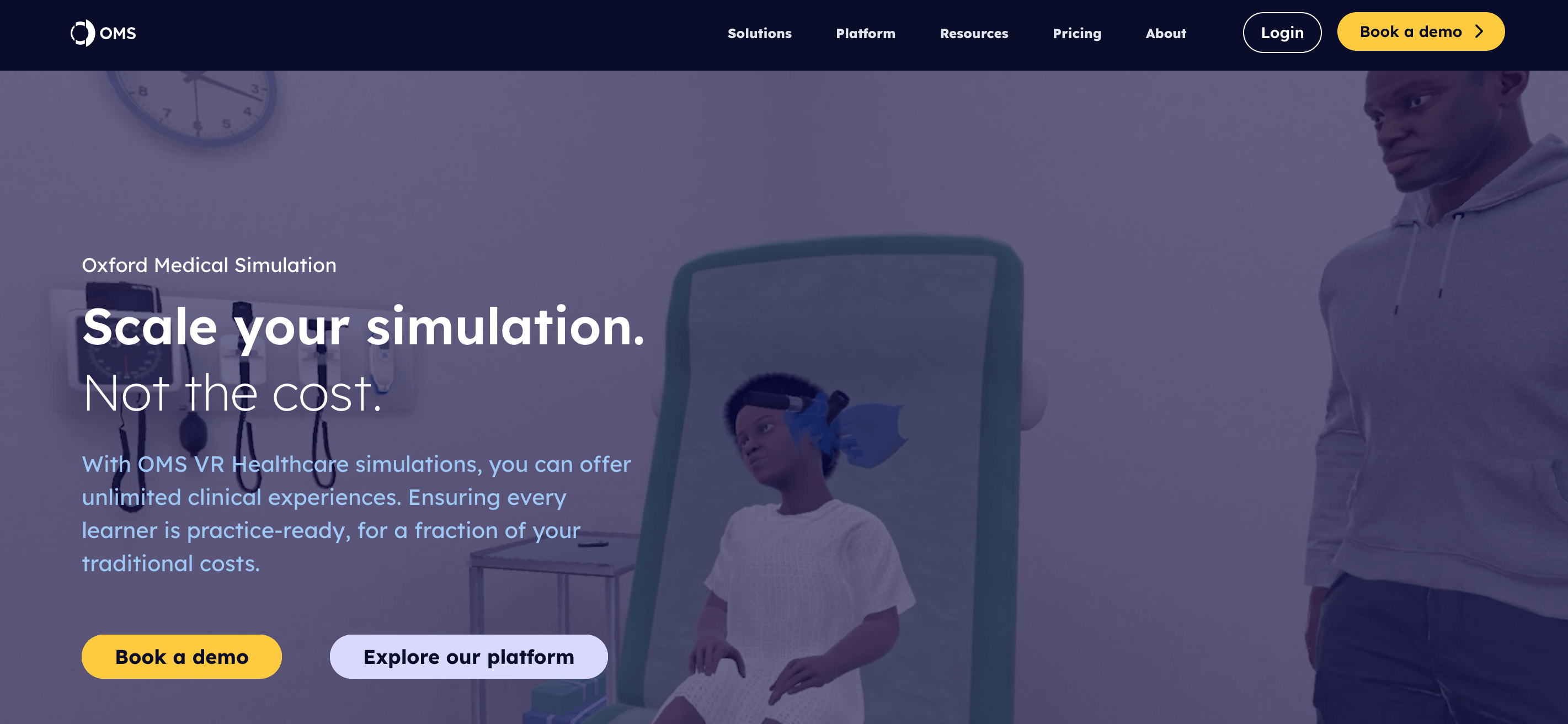
Oxford Medical Simulation provides virtual reality scenarios in which learners manage patients through deteriorating clinical situations, making assessment, investigation and treatment decisions under time pressure, with structured debrief afterwards.
This is the other half of medical simulation and frequently the more scalable half. Most clinical error is not manual failure but reasoning failure: missed deterioration, anchoring on an early impression, delayed escalation. Scenarios that place a learner in that position repeatedly, then debrief the decisions, target exactly the skills a simulation centre cannot run often enough.
The platform is widely used across nursing and medical education, and its debrief structure matters as much as the scenarios, since simulation without debrief produces experience rather than learning.
Services and expertise: VR clinical scenarios, deteriorating patient simulation, structured debrief, performance data and reporting, curriculum integration
Best suited to: Medical and nursing schools and health systems building clinical judgement
6. SimX — Teams Training Together In The Same Virtual Room
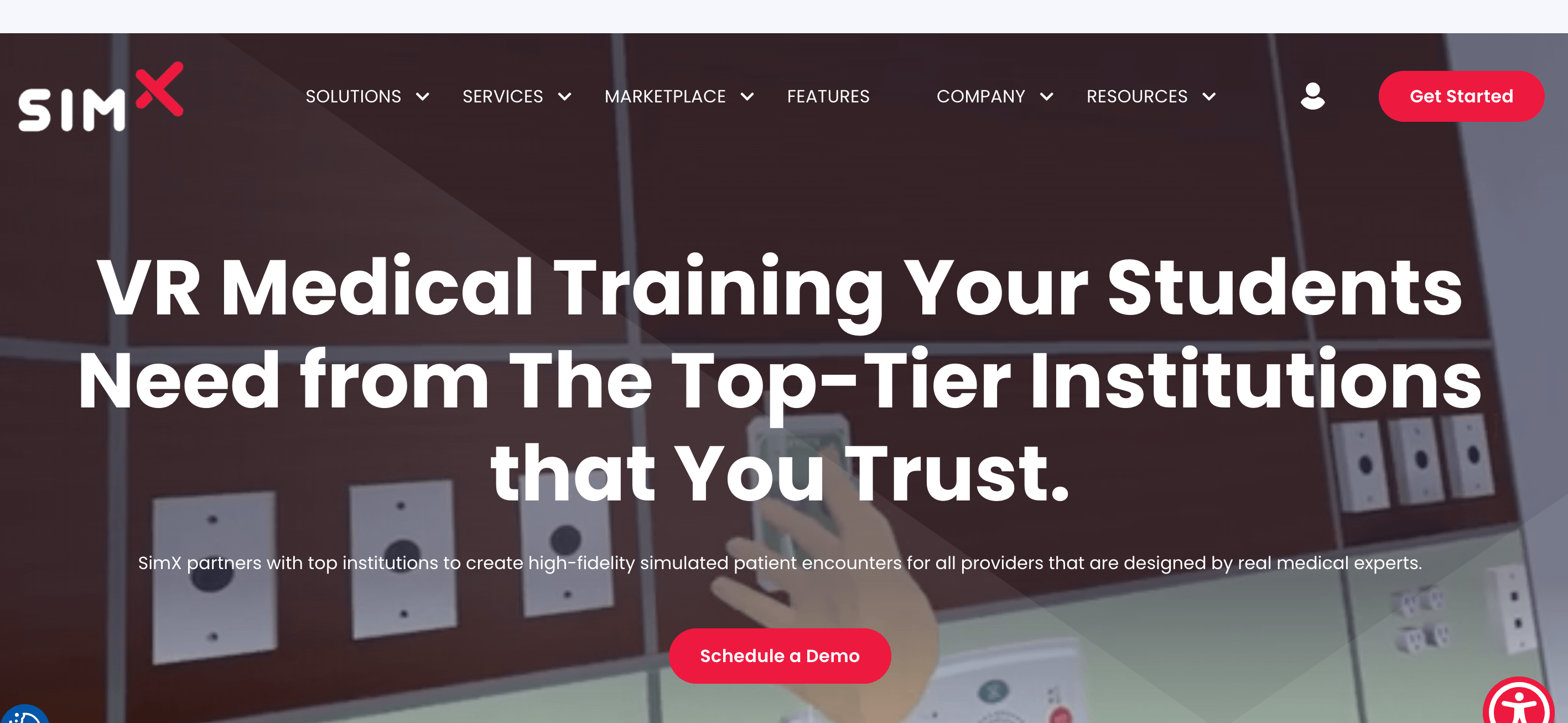
SimX delivers multiplayer virtual reality medical simulation, letting clinical teams participate in the same scenario simultaneously, each in their own role, including emergency and prehospital settings.
Multiplayer is the distinguishing capability and it addresses something single user simulation structurally cannot. Resuscitation, trauma response and emergency management are team performances, and most failures are communication and coordination failures rather than knowledge gaps. Training individuals separately and expecting the team to work is the mistake this format corrects.
It also removes the logistical constraint that limits team simulation, which is getting an entire team into a simulation centre at the same time. Participants can join from different locations.
Services and expertise: Multiplayer VR medical simulation, emergency and prehospital scenarios, role based team training, scenario authoring, distributed participation
Best suited to: Emergency departments, prehospital services and interprofessional team training
7. UbiSim — Nursing Simulation Designed For Programme Scale
UbiSim provides VR nursing simulation built specifically for nursing education, with scenarios mapped to nursing curricula and tooling designed for faculty to run sessions across cohorts.
Nursing programmes have a capacity problem that virtual reality nursing simulation addresses directly. Clinical placements are scarce, competition for them is intense, and required simulation hours have to be delivered somehow. A platform designed around nursing competencies rather than adapted from medical content fits accreditation requirements more comfortably.
Faculty experience is the deciding factor in this segment. Nursing educators are running large cohorts with limited technical support, so scenario authoring, session management and reporting matter as much as the simulation itself.
Virti focuses on immersive training for communication, human factors and behavioural skills, covering the parts of clinical work that involve talking to patients, families and colleagues rather than performing procedures.
These skills are consistently underserved and consequential. Breaking bad news, managing a distressed relative, challenging a senior colleague about a safety concern, handing over accurately under pressure. They are difficult to teach at scale because they traditionally require actors and facilitators, and immersive delivery makes repetition affordable.
Assessment in behavioural domains is harder than in procedural ones, so institutions should look closely at how performance is evaluated and what the data actually supports.
Services and expertise: Immersive communication and human factors training, behavioural scenario delivery, content authoring, performance analytics, workforce deployment
Best suited to: Programmes addressing communication, escalation and human factors
9. UpSkillai — Voice Driven Drills For Protocol Critical Work
UpSkillai provides virtual reality training with voice interaction, aimed at emergency medicine, prehospital care and protocol driven clinical situations where the learner speaks and acts rather than selecting from menus.
Voice interaction is a meaningful design choice rather than a novelty. In a resuscitation the clinician calls out actions, doses and findings, and a simulation requiring the same verbal performance rehearses the real behaviour instead of a controller based approximation. For protocol adherence work, saying it aloud is part of the skill.
The natural applications are high stakes, low frequency events, exactly the ones where competence decays between occurrences and refresher training is hardest to schedule.
Services and expertise: Voice driven VR clinical training, emergency and prehospital scenarios, protocol adherence drills, competency tracking, health system deployment
Best suited to: Emergency, prehospital and code team refresher programmes
Lucid Reality Labs builds immersive applications across healthcare, life sciences, aerospace and manufacturing, with a proprietary iXR platform pairing immersive content with analytics so training outcomes are measured rather than assumed.
Its life sciences experience means documentation, validation and traceability expectations shape delivery from the beginning, producing realistic scoping and evidence packages that survive institutional review.
The analytics layer answers the question every simulation programme faces at renewal, which is what measurably improved, and that cannot be retrofitted convincingly to a simulator built without it.
Services and expertise: Custom XR, VR and AR development, iXR platform with outcome analytics, simulation, 3D content, clinical and enterprise training programmes
Location: Miami, United States, with presence in Europe and Southeast Asia
How To Choose A VR Company For Medical Simulation
Are you training hands or judgement?
Procedural simulation and clinical reasoning simulation are different products from different vendors, and the strongest platform in one category is rarely competitive in the other. Decide which competence gap you are addressing before evaluating anyone. Programmes needing both should expect two suppliers rather than a compromise that serves neither well.
Does it assess, or only deliver?
Content delivery is now commodity. Assessment is not. Ask what the platform measures, how that maps to your competency framework, what reporting faculty receive, and whether the data would support a claim of competence to an accrediting body. Programmes that must evidence readiness should weight this above catalogue size.
Can faculty run it without technical support?
Simulation programmes are delivered by educators with large cohorts and no spare capacity. Ask who provisions headsets, how a session is set up, what happens when a device fails ten minutes before a class, and how much training faculty need. This determines whether the platform is used weekly or quietly abandoned after the first term.
Does the debrief happen?
Simulation without structured debrief produces experience rather than learning, and this is well established in the simulation literature. Establish what debrief support the platform provides, whether it happens in the headset or in the room afterwards, and how faculty are equipped to lead it. A vendor with no view on debrief has not thought carefully about education.
Who owns the scenarios and the code?
For custom work, settle ownership of source code, scenarios and performance data before proposals. Institutions frequently need to publish, share across a consortium or extend a simulator into a later phase, and each becomes complicated when the studio retained rights. Ask about platform migration too, since a curriculum outlives hardware.
Conclusion
Virtual reality has not replaced medical simulation, it has removed the capacity ceiling that limited how much of it any institution could deliver. The vendors serving it split cleanly between procedural platforms that build technique, scenario platforms that build clinical reasoning and team performance, and custom studios that build what neither catalogue contains. Treeview is the strongest option in that third group, with Stanford Medicine, Medtronic and Daiichi Sankyo already behind it, a spatial simulation platform of its own featured in the Apple Vision Pro App Store, and full transfer of intellectual property and source code so a protocol or curriculum you fund stays yours. Whichever route fits, decide whether you are training hands or judgement, weight assessment above content volume, and make sure the faculty who will run it are the ones who evaluate it. For related reading, see our guides to the best VR companies for mental health and the best digital twin companies for manufacturing.
If you want to feature your AR development company on this list, email us or submit a form in the Top Choices section. After a thorough assessment, we’ll decide whether it’s a valuable addition.