Top Branding Agencies for B2B Tech Companies In 2026
Max Dewod
Freelance Writer
11.08.2026
B2B technology companies rarely lose deals because the product is weaker.
They lose because a procurement committee could not tell the difference between four vendors, and defaulted to the one that felt least risky. That impression forms across a six- to twelve-month cycle, in front of technical and financial reviewers, plus legal teams who each want something different from the same set of materials.
Consumer branding solves for emotional connection and a fast decision. B2B technology branding solves for a slow decision made by a group, where the brand’s real job is reducing perceived risk while still saying something specific enough to be remembered. Not every studio is strong at both, and portfolios full of consumer launches are a poor predictor of performance in an enterprise RFP. Companies whose product is delivered as subscription software may also want our narrower review of B2B SaaS branding agencies, which covers the same discipline through a subscription-specific lens.
Agency
Location
Focus
Documented Client Work
View Source
New York, NY
Brand and product built together
Garden, Pantone Connect, First Street, TekniPlex
Focus Lab
Atlanta, GA
B2B software identity, exclusively
Marketo, Outreach, Braze, Frame.io, Calendly
Pentagram
Global, partner-led
Category-defining identity
Cohere, enterprise and hardware practice
Ramotion
San Francisco, CA
Identity plus product design
Okta, Mozilla Firefox, Transcend, Volusion
Siegel+Gale
Global
Brand architecture and simplification
HPE, SAP, DXC Technology, CVS Health
DeSantis Breindel
New York, NY
Research-led B2B positioning
Technology, financial and professional services
Clay
San Francisco, CA
Brand plus digital experience
Well-funded technology companies
Work & Co
Global
Engineering-led product and brand
Enterprise product platforms
Sunup
Remote, senior-led
Lean tech creative
Cleantech, biotech, cybersecurity, fintech
Everything Design
Bengaluru, India
Positioning-first B2B
Xflow, Fortuna Cysec, Nimble Edge, Zuora
Best B2B Tech Branding Agencies For Enterprise Software and Infrastructure
Focus Lab is the default shortlist entry because the studio specializes exclusively in B2B software.
Based in Atlanta with more than a decade of exclusively business-to-business work, Focus Lab has delivered brand programs for Marketo, Outreach, Braze, Frame.io, Udacity, Trello, Calendly, and Salesloft. Specialization that narrows produces a specific advantage: the team has handled complex internal approval processes often enough to anticipate where a rebrand stalls internally, which is usually the real risk.
Engagement structure reflects that maturity, with shorter sprint-format projects available alongside comprehensive strategy, identity and web programs, plus ongoing retained support after launch. Several enterprise software companies have selected the studio through formal RFP processes that also included the largest global branding firms. The tradeoff worth naming is stylistic range, since a decade inside one category tends to produce recognizable house characteristics.
Services: Brand strategy, verbal identity, visual identity, web design and development
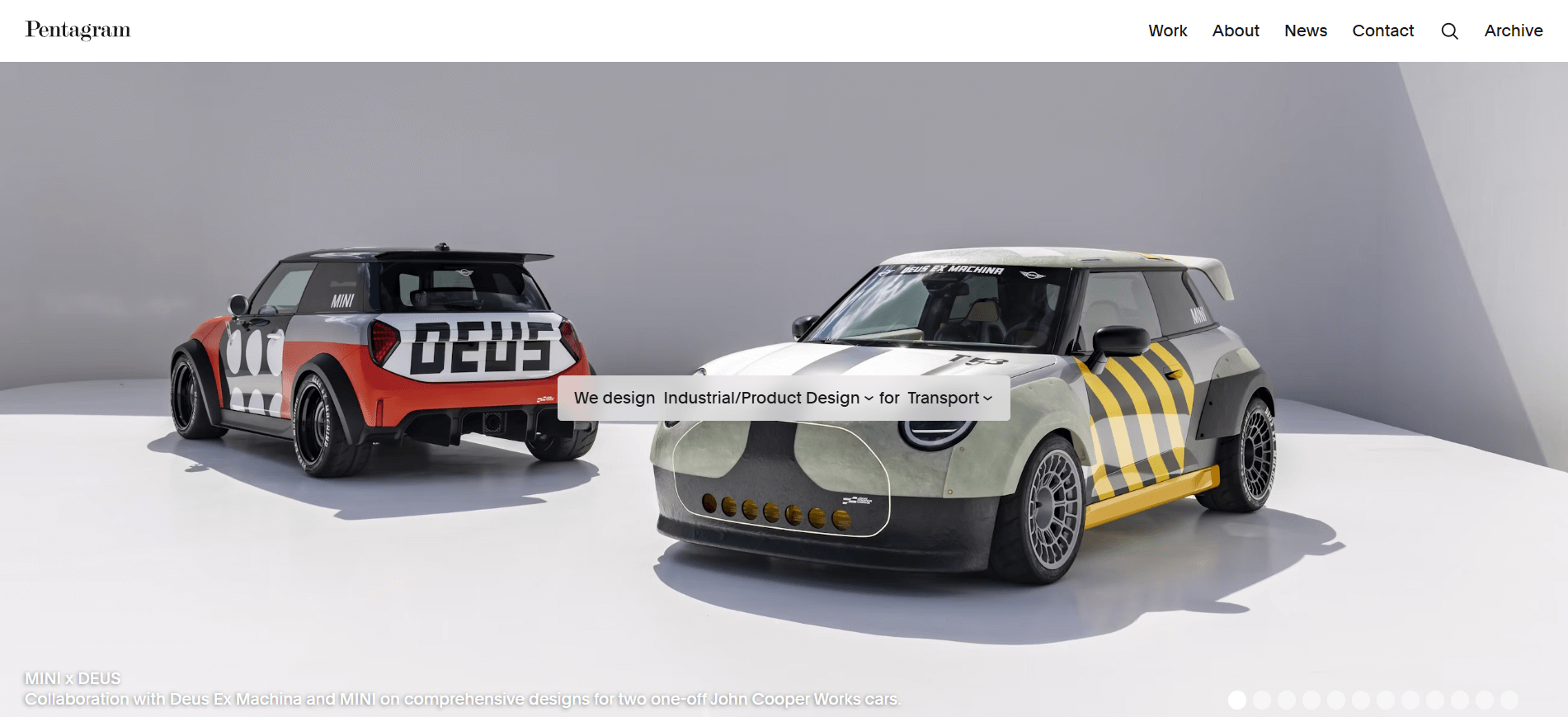
Pentagram is the call when the brand needs to make a technical company legible to people outside the industry.
Structured as a partnership where every client works directly with a named partner, Pentagram is among the most recognized identity firms in the world. The business-to-business technology practice has become some of its more interesting current work, including a system for the generative AI company Cohere built on cellular and biological forms, positioning the company as a living layer of intelligence for enterprise customers.
That approach addresses a problem specific to deep technology: finding a human register for a product most buyers cannot picture. Partner-led structure provides senior involvement but limits speed and budget flexibility, so companies needing a fast turnaround or a modest scope will find the model a poor match regardless of admiration for the work.
Services: Brand identity, naming, editorial design, environmental graphics, digital
Ramotion suits companies where the brand has to hold together across a marketing site, an app, and a design system.
Founded in 2009 in San Francisco, Ramotion works at the boundary between brand identity and product design. Published client work includes Okta, the Mozilla Firefox global identity update, Transcend, Proemion, and Volusion, alongside enterprise design system work for Salesforce and Adobe.
Delivering both halves matters most for companies whose product is the primary brand experience. An identity that looks correct in a presentation and falls apart inside an application interface is a common and expensive outcome, particularly where the internal design team inherits a system built without reference to the software. Enterprise clients note the team’s ability to work under compressed timelines, which is useful when a rebrand is tied to a funding announcement or a product launch.
Siegel+Gale belongs on the list when the branding problem is structural.
Built around a simplification philosophy, Siegel+Gale specializes in brand architecture and change management for organizations at the largest scale. Signature projects include leading the Hewlett Packard Enterprise separation, which established two distinct Fortune 50 identities, developing the identity for DXC Technology following a merger involving 130,000 employees, and unifying four business units under a single brand at CVS Health.
Technology companies reach this firm at a particular moment: after an acquisition, during a corporate separation, or when a portfolio of product names has grown incoherent enough to confuse the sales organization. Those are architecture problems, and relatively few studios have this level of experience. Pricing and process match the scale of the work, which makes the firm inappropriate for a company that simply needs a strong identity.
DeSantis Breindel fits companies that need the research-backed positioning before anyone opens a design file.
One of the more established names in business-to-business branding, DeSantis Breindel runs a research-heavy process built on stakeholder interviews and market analysis conducted before creative work begins. Sector coverage spans technology, financial services and professional services, with substantial experience among private equity-backed companies.
Private equity work is a useful signal for technology buyers. Rebranding under a sponsor means compressed timelines, a board with firm opinions and a mandate tied to an exit. Studios accustomed to that pressure tend to be disciplined about scope and realistic about what a brand can accomplish. Companies looking for expressive creative range may find the research-forward approach more measured than they expected.
Clay is worth approaching when a well-funded company needs a consistent digital presence.
A San Francisco studio working with well-capitalized technology companies, Clay covers brand strategy, visual identity, UX and UI design, web development, and design systems. Strength lies in cohesion, producing brands that hold together from the marketing site through to the product interface.
Comprehensiveness is the value and also the filter. Companies with budget to match get a polished, unified digital presence delivered by one team, which removes the coordination overhead of running separate brand and product vendors. Organizations seeking a focused identity engagement without the accompanying digital build will find the scope larger than the requirement.
Services: Brand strategy, visual identity, UX/UI design, web development, design systems
Work & Co makes sense when the product itself is the brand, and both need building at once.
Distinguished by engineering depth unusual among branding firms, Work & Co builds core products and brands them in the same process. Engagements tend toward long-term operational partnership instead of a defined project with an end date.
Companies whose brand experience lives almost entirely inside software benefit most from that model, since the identity and the interface are decided together. Budget and timeline are the constraints, and both are significant. This is a substantial investment suited to organizations treating the product experience as the primary competitive asset.
Services: Product design, engineering, brand identity, digital platforms
Sunup is the option for technical companies that want senior people doing the work.
An award-winning creative studio working across cleantech, biotech, cybersecurity, fintech and martech, Sunup operates on a lean senior-level team model. Services cover brand strategy, visual identity, UX and UI design, web development and design systems, with an emphasis on consistency between marketing surfaces and product interfaces.
Team composition is the differentiator here. Larger agencies frequently sell senior involvement during the pitch and staff execution with juniors, a pattern that shows up in the work by the second month. Small senior teams avoid that structurally, at the cost of capacity. For a company running a single-market rebrand, the constraint rarely matters.
Services: Brand strategy, visual identity, UX/UI design, web development, design systems
Everything Design earns a look from companies needing serious positioning work at a rate below US agency pricing.
Founded in 2019 and based in Bengaluru, Everything Design runs a positioning-first methodology treating strategy and design as inseparable, and reports serving more than 150 companies across 15 countries. Named business-to-business projects include Xflow in cross-border payments infrastructure, Fortuna Cysec in cybersecurity, Nimble Edge in edge computing, and Stellaris Venture Partners, alongside work for Zuora and Infosys.
The edge computing and cybersecurity projects are the instructive ones, since both involved categories without an established visual language or with a severe jargon problem. Solving that requires diagnosis before aesthetics. Geographic distance introduces the usual coordination friction around time zones and workshop scheduling, which is worth weighing against the pricing advantage.
Services: Positioning, brand strategy, visual identity, messaging, web design
Pricing separates along scope rather than agency prestige, and the largest single variable is whether the engagement includes positioning research and naming or begins at visual identity. The bands below describe the shape of the market, and each should be confirmed in procurement. One pattern holds broadly: engagements that skip strategy to save budget usually spend the difference on revision cycles once stakeholders disagree about what the company actually is.
Engagement Tier
Typical Range
What It Usually Covers
Sprint or focused scope
$25,000 – $50,000
Identity refresh or positioning alone, compressed timeline, small team
Deep research, brand architecture, multi-market rollout, governance
Post-merger or separation
$750,000+
Architecture across business units, change management, organizational rollout
Ongoing retainer
$3,500 – $15,000 per month
Continued asset production, system extension, campaign support
Two things push a project toward the upper end. Naming is the first, because trademark clearance across relevant classes and jurisdictions is slow and frequently sends the team back to earlier candidates. Brand architecture is the second, and it is where technology companies often underestimate scope most reliably, since a company with three products, a developer platform and an enterprise tier is commissioning a system. Teams benchmarking scope against price across disciplines may find our overview of leading creative agencies a useful comparison point.
Matching an Agency To Your Buyer and Stage
Fit here is governed less by company size than by who signs the contract and how long they take to decide. An agency excellent for a developer tools company can produce genuinely poor work for an enterprise platform.
Developer tools and infrastructure
When the buyer writes code, the priorities are different. Heavy marketing polish can look like compensation for a weak product, documentation quality carries more weight than campaign work, and community credibility outranks brand awareness. Studios practiced in restraint serve this audience far better than those whose instinct is to add. The product interface often matters more than the identity itself, a subject our guide to user experience design agencies covers directly.
Enterprise software and platforms
Long sales cycles with committee decisions mean the brand has to satisfy several audiences at once: technical evaluators assessing capability and executives assessing whether the vendor will still exist in five years. Agencies with genuine enterprise experience build systems that survive that scrutiny, including the sales enablement material many consumer-focused studios may not typically produce.
Hardware and deep technology
Physical products and frontier technology introduce constraints software companies typically do not face, including manufacturing tolerances, regulatory marking and the challenge of explaining something with no obvious analogue. Firms with industrial or scientific portfolios handle this more comfortably than digital-only studios, and the work usually needs to function in physical environments as well as on screen.
Post-acquisition and multi-product companies
Once a company operates several products under one name, or has acquired competitors carrying their own equity, the problem stops being identity and becomes architecture. Decisions about which names survive, how sub-brands relate to the parent, and what the sales team leads with have revenue consequences. Specialist architecture firms are worth their premium at this stage in a way they are not for a single-product company.
Questions to Ask Before You Sign
B2B branding engagements fail more often on internal alignment than on creative quality. These questions surface how a studio handles that.
How do you handle a rebrand where the founder, the CRO, and the board disagree about positioning?
What sales enablement material comes out of this engagement, and have you produced it for a committee-driven sale before?
Who runs the strategy phase, and are those the same people presenting creative?
Can our internal marketing team extend this system without returning to you for every asset?
Have you taken a name through trademark clearance, and what happens if the preferred mark fails legal review?
How do you approach brand architecture when we acquire a company with its own established name?
Can you show work where the primary audience was technical rather than a business buyer?
Frequently Asked Questions
How is B2B tech branding different from consumer branding?
Consumer branding focuses on emotional connection and a fast individual decision. B2B technology branding solves for a slow group decision across a six- to twelve-month cycle, where the brand must reduce perceived risk for a procurement committee while remaining distinctive enough to be recalled. The deliverables differ too, since B2B engagements typically include messaging architecture and sales enablement material that consumer projects rarely produce.
Should we hire a specialist B2B agency or a well-known generalist?
Specialists move faster because they have run the internal approval process many times and know where it stalls. Generalists bring wider creative range, which matters when the goal is to look unlike everyone else in the category. A reasonable test is whether the main risk is being ignored or being misunderstood, since the first favors range and the second favors specialization.
How long does a full B2B rebrand take?
Most comprehensive programs run four to eight months from kickoff to launch. Positioning research and stakeholder alignment consume more of that than design, and naming with trademark clearance is the most common source of delay. Post-merger architecture work regularly extends beyond a year.
Do we need naming as part of the engagement?
Only if the current name is actively working against the company, which is less common than founders assume. Naming adds high cost and legal exposure, and the equity in an existing name is usually undervalued internally. Where an acquisition has introduced competing names, the architecture question is unavoidable and worth addressing properly.
What should we prepare before contacting agencies?
Clear articulation of who buys and who blocks, honest competitive positioning, win and loss data if available, and a realistic view of internal disagreement about the company’s direction. Agencies scope more accurately with these, and the exercise often reveals that the real problem is unresolved strategy rather than an outdated logo.
How do we know whether the rebrand worked?
Set measurement before launch, since retrofitting it afterward produces arguments rather than answers. Useful indicators include sales cycle length, win rate against named competitors, inbound lead quality, and recruiting conversion. Awareness metrics alone tend to move slowly and rarely justify the investment on their own. Companies in adjacent categories may also find our list of AI branding agencies relevant.
Making the Call
The right partner is determined by the nature of the problem rather than the quality of the portfolio. A company being ignored needs creative range. A company being misunderstood needs positioning discipline. A company whose product names have become difficult to manage needs architecture, and visual work alone will not solve it.
Diagnose which of those applies before the first conversation, be candid about internal disagreement rather than presenting a tidier picture than exists, and weigh whether an in-house team can maintain the system as heavily as how the initial work looks. Brands that hold up in this category are the ones built to be extended.
Bookmark this guide to make a well-informed decision. If you want to add your company to this list, drop us a line or submit a form in the Top Choices section. After a thorough review, we’ll decide whether it’s an appropriate addition.