A Fortune 500 board looking to roll agents across forty countries and a Series A founder who needs a working product in ten weeks are buying different things, from different firms, at rates that differ by a factor of five. The directories flatten all of that into a single ranking, which is why they are close to useless as a shortlist.
The seven below are grouped by what they are actually built to do: enterprise-scale adoption, deep engineering, sector specialism, and full-stack product delivery. Median agency rates across Europe sit around €65 an hour, with most established firms charging €100–180 — useful context before any of these send a proposal.
AI Development Companies In Europe At A Glance
Company
Location
Model
Best For
Twistag
Lisbon, Portugal
Full-stack agency
Agents shipped, then handed over
App Design
Madrid, Spain (HQ). Granada. Remotely across the EU.
Project-based agile: discovery → UX prototype → build → QA → store launch → maintenance. Quote-per-project, not embedded pods.
Custom iOS/Android apps, SaaS, and applied AI (chatbots, agents, OpenAI/Claude) for startups and SMEs. Flutter / React Native.
Limestone Digital
Prague, Czechia (HQ). Engineering in Czechia, Ukraine, Poland + LATAM.
Embedded AI Velocity Pods (dedicated FDE, month-to-month). Enablement + agents + delivery. Outcome-tied: no measured uplift, no invoice.
Production AI in regulated brownfield products: healthcare, insurance, lending, logistics, FinServ. Custom agents + making existing codebases AI-native.
ML6
Ghent, Belgium
AI engineering firm
Enterprise AI that has to run in production
{SD:UK}
London, UK
Bespoke software house
AI built into custom business systems
Artefact
Paris, France
Global consultancy
Adoption across a large organisation
Miquido
Krakow, Poland
Product studio
AI inside a consumer-grade product
Unit8
Lausanne, Switzerland (HQ). Offices in Zürich, Bern, Germany, and Poland.
Enterprise data science, analytics, GenAI, and Palantir/OpenAI delivery for non-digital-native industries: pharma, finance, insurance, manufacturing.
Neurons Lab
London, UK
Sector specialist
Financial services, regulated
dida
Berlin, Germany
ML boutique
Perception and document problems
Best AI Development Options In Europe In 2026
1. Twistag — Build, Train, Transfer — Then Get Out Of The Way
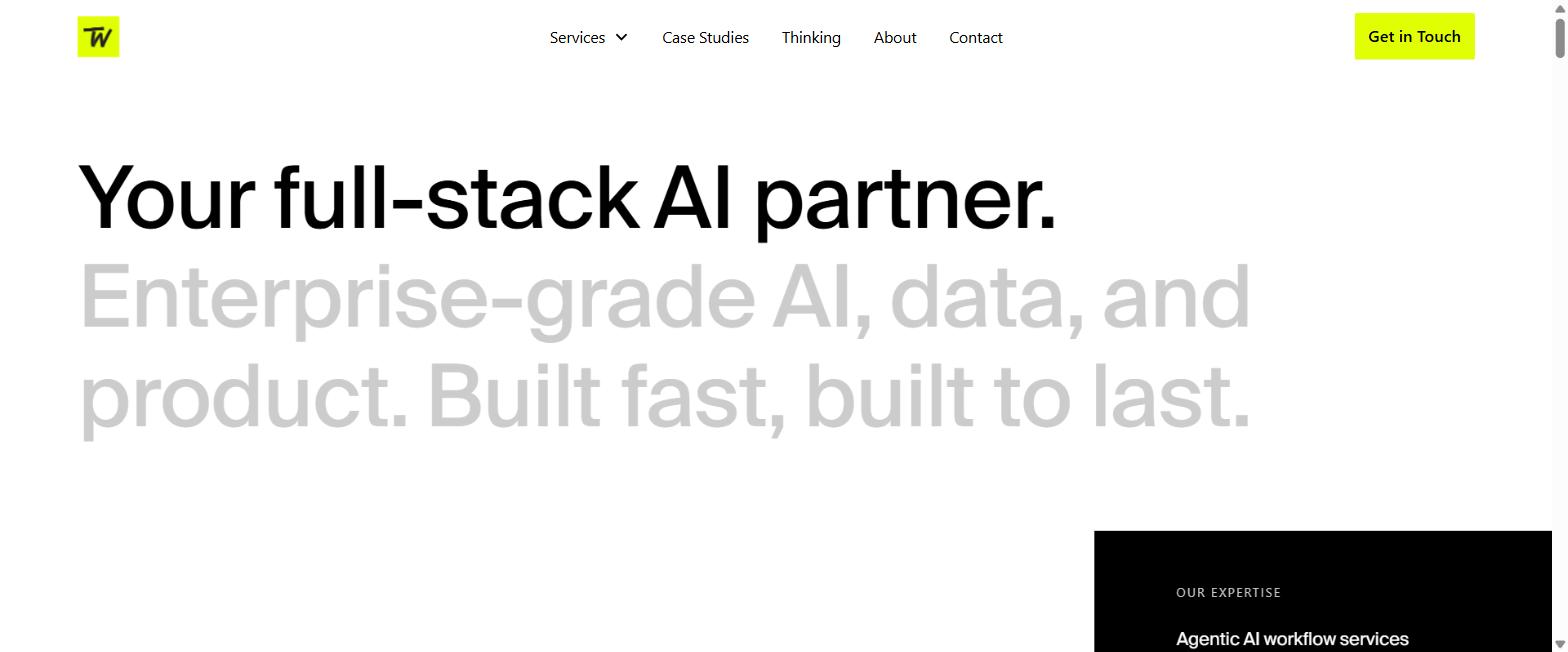
Twistag has been building products in Lisbon since 2016, and now positions as a full-stack AI partner: production-grade agents, agentic workflows, data platforms and AI-native products. The span is genuinely three-layer — multiagent systems, LLM integration, RAG and agent governance on top; AI-ready pipelines, lakes, warehouses and real-time streaming underneath; and web, mobile, cloud architecture and legacy modernisation holding it up.
The distinctive part is the exit. “Build, train, transfer” means the engagement is designed to end — systems built, internal teams trained, then the agency steps back — which is the opposite of how most agencies structure a retainer. Three engagement shapes are offered: a short audit for clarity, a full build, or fractional AI teams embedded alongside your own. Case studies span hospitality, consumer electronics, regtech and sports platforms, including an EU hotel group that cut outsourced staffing spend by 70% through intelligent staff allocation.
Choose Twistag if you want agents in production without a permanent dependency, and you would rather own the result than rent it.
App Design is the Spanish AI company in this entry and the most commercially accessible. It works from Madrid and Barcelona, has been shipping software for more than 15 years, and counts over 450 delivered projects, most of them mobile first: iOS, Android and cross-platform apps, plus the web platforms, APIs and backends sitting behind them.
The AI practice is applied rather than research led. The firm builds automations, virtual assistants and chatbots, and wires commercial models from OpenAI and Anthropic into products it is already designing and shipping, which suits a company that wants AI inside an app rather than an AI strategy on a slide. The portfolio leans consumer and marketplace: Soluciona in on-demand services, Taxival in ride-hailing, Kapitan for sports club management, Populit for event discovery, with further work across fintech, e-commerce, travel, eLearning and logistics. Pricing is published rather than hidden behind a form, at roughly €10,000 to €15,000 for an MVP in 8 to 12 weeks and €30,000 to €50,000 upwards for a complex build over 4 to 6 months. That is rare on a list where most firms quote nothing at all.
Choose App Design if you are a startup or mid-market business that needs a working app with AI features in it, and you want to see the price band before the first call.
3. Limestone Digital— Europe’s Embedded AI Engineering Bench, With Measured Uplift in Production
Limestone Digital sells capacity inside your team rather than projects alongside it, turning enterprise AI transformation into daily engineering output. Headquartered in Prague with leadership offices in Kyiv, Delaware and Los Angeles and delivery capacity across LATAM, it runs a bench of roughly 200 engineers after ten years, and the AI velocity pods join existing standups and work in the existing codebase. That makes it a brownfield firm first: the AI transformation arrives in systems nobody wants to rewrite.
The AI work splits three ways: training engineering teams to work AI-native, building custom agents into client platforms, and running delivery pods where the bulk of the code is AI-assisted and human-reviewed. The firm also instruments itself. DevInt, its own measurement layer, reads GitHub, Jira and Cursor for cycle time, review load and AI assist hours, and the commercial terms hang off those readings: month-to-month contracts, a stated floor of 15% delivery uplift, no invoice without it. SOC 2, GDPR and HIPAA are standard, which shows in the work: a rebuilt freight audit and pay system for OneRail, an IVDR and ISO 13485 quality system for Ingenetix, plus engagements with Swatch Group and Johnson Controls.
Choose Limestone Digital if you have a legacy platform and an in-house team that needs to move faster, and you want your AI transformation measured before you pay for it.
4. ML6 — Europe’s AI Engineering Bench, With Fortune 500 Receipts
ML6 calls itself Europe’s AI engineering powerhouse, and the client list makes the claim hard to argue with: P&G, Pfizer, Johnson & Johnson, ING, ASML, Orange and BASF. The firm works across five cities — Ghent, Amsterdam, Berlin, Eindhoven and Munich — with a bench in the 50–249 range.
The work splits into advisory, engineering and governance, with specialisms spanning agentic AI, vision, voice, physical AI and robotics. It holds OpenAI Advanced Partner status alongside partnerships with AWS, Azure, Google Cloud, NVIDIA, Anthropic and Mistral, and runs its own platform, Unum. Training and CAICO certification sit alongside delivery, which matters if the goal is a team that can operate the system afterwards.
Choose ML6 if the system has to survive contact with a regulated enterprise, and you want engineering depth rather than slideware.
{SD:UK} Software Development UK is a UK software development company with a background in building complex bespoke systems rather than simply adding AI to existing products.
That background is useful when AI forms only one part of a wider technical project. In many cases, introducing AI means dealing with existing software, old databases, integrations and business processes before the AI element can do anything particularly useful.
The team builds custom platforms, cloud-based applications, APIs and integrations, as well as taking on legacy modernisation, troubled-project recovery and technical due diligence. AI is part of that wider capability rather than something treated in isolation. The work includes AI consultancy, proofs of concept, workflow automation, enterprise AI agents, predictive analytics and predictive maintenance.
This can make a significant difference on projects involving older or more complicated systems. A company might have a good use case for AI but discover that its data sits across several platforms, its existing application has limited integration options, or parts of the system need modernising first. SD:UK can work on those underlying issues as well as the AI itself.
Its client work is weighted towards sectors where software tends to be operationally important, including oil and gas, pharmaceuticals, healthcare, insurance, maritime, logistics, banking and education. Published examples include software for Composite Legal Expenses, CAD and visualisation work for QuickWells and workflow technology for Tendeka. Its website also references work connected with organisations including Baker Hughes, Crown Paints and RZB Bank.
There is quite a broad mix of work within that. Some projects involve building an entirely new system, while others start with software that has been running for years and needs to be extended, modernised or taken over from another development team.
The company offers both fixed-price projects, where the specification is clear enough to define in advance, and agile engagements for work that is likely to evolve. It also promotes code rescue and system takeover services, which may appeal to businesses that already have a development project but no longer have confidence in the original supplier.
For companies specifically exploring artificial intelligence, its AI software development services range from consultancy and rapid prototypes through to AI agents, machine learning, predictive systems and AI-enabled automation. The emphasis is on finding uses for AI that fit an existing business process rather than treating AI adoption as an objective in itself.
That approach is probably most relevant to organisations that already have established systems and data. Rather than building a standalone AI demonstration, the work can involve connecting AI to existing applications, automating part of an operational workflow or using machine learning against information the business already holds.
It also means the same development team can deal with the surrounding engineering work. APIs may need to be created, older applications may need changes and data may need to be brought together before an AI service can be properly integrated.
Choose Software Development UK if you need a team that can deal with the software and infrastructure underneath an AI project as well as the AI itself, particularly where legacy systems, integrations or a complicated existing codebase are part of the challenge.
6. Artefact — A Thousand Consultants Aimed At Adoption
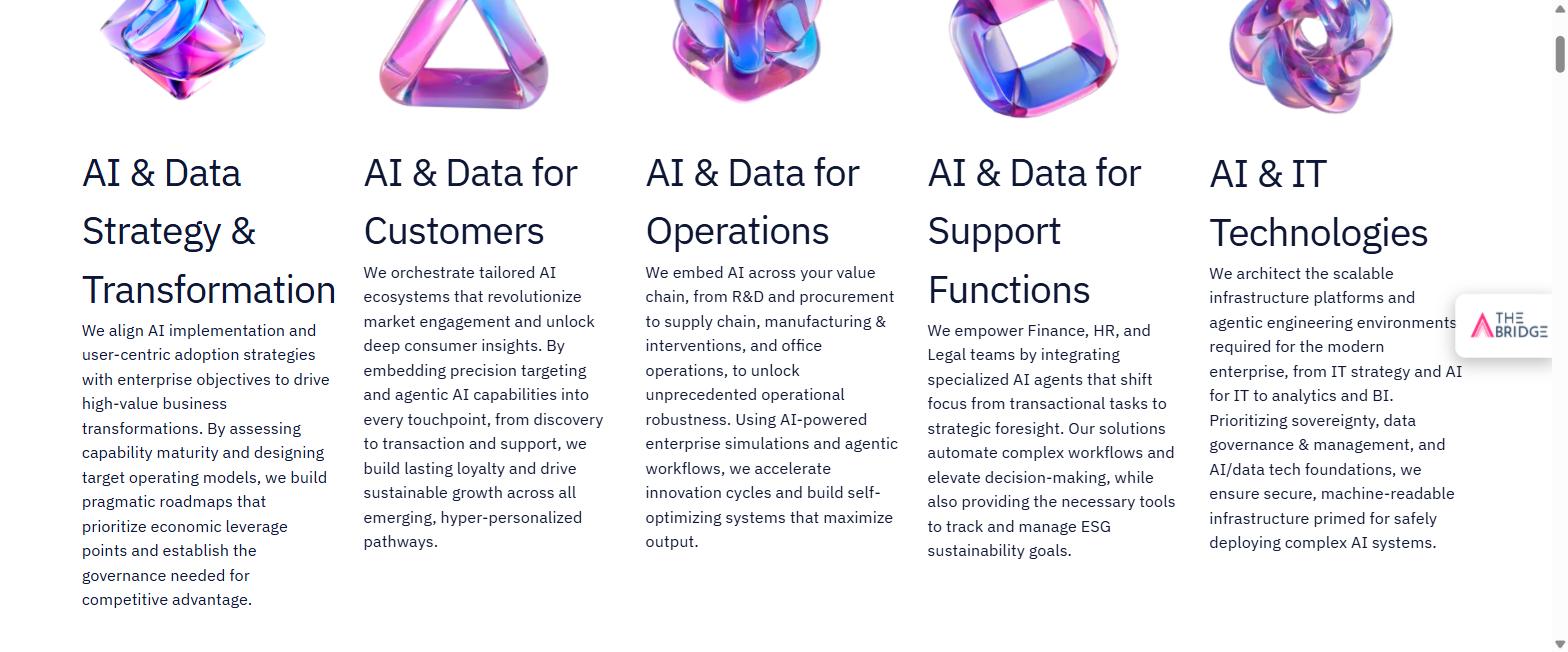
Artefact is the largest firm here by some distance, with over a thousand people and a stated mission to accelerate AI and data adoption. Its structure tells you what it optimises for: separate practices for AI and data strategy, customers, operations, support functions, and IT technologies — an organisational map rather than a technology one.
That suits large consumer and industrial groups whose problem is not building a model but getting forty thousand people to use one. The Paris base and global footprint make it a natural fit for multinationals, and the emphasis on governance, target operating models and capability maturity is aimed squarely at transformation programmes rather than individual builds.
Choose Artefact if your obstacle is organisational rather than technical, and the engagement needs to survive a change of sponsor.
7. Miquido — Fifteen Years Of Shipping Products People Actually Use
Miquido comes at AI from the product side. Fifteen years old, 200-plus people in Krakow, and a portfolio that runs from BNP Paribas and Aviva to Skyscanner, Dolby, Warner Music, Abbey Road Studios and HelloFresh — the kind of list that only accumulates when the apps work.
The AI services reflect that bias: on-device AI, AI integration into existing products, process automation, sovereign AI infrastructure, and applied work like credit scoring and loan origination. Recognition includes a Time Magazine “50 Best Apps of the Year” placement and a Financial Times fastest-growing listing. Nine in ten projects arrive by referral, which is the metric agencies quote when they have nothing to hide.
Choose Miquido if the AI has to live inside a consumer-facing product where design and performance matter as much as the model.
8. Unit8 — Swiss Precision For Non-Digital-Native Industries
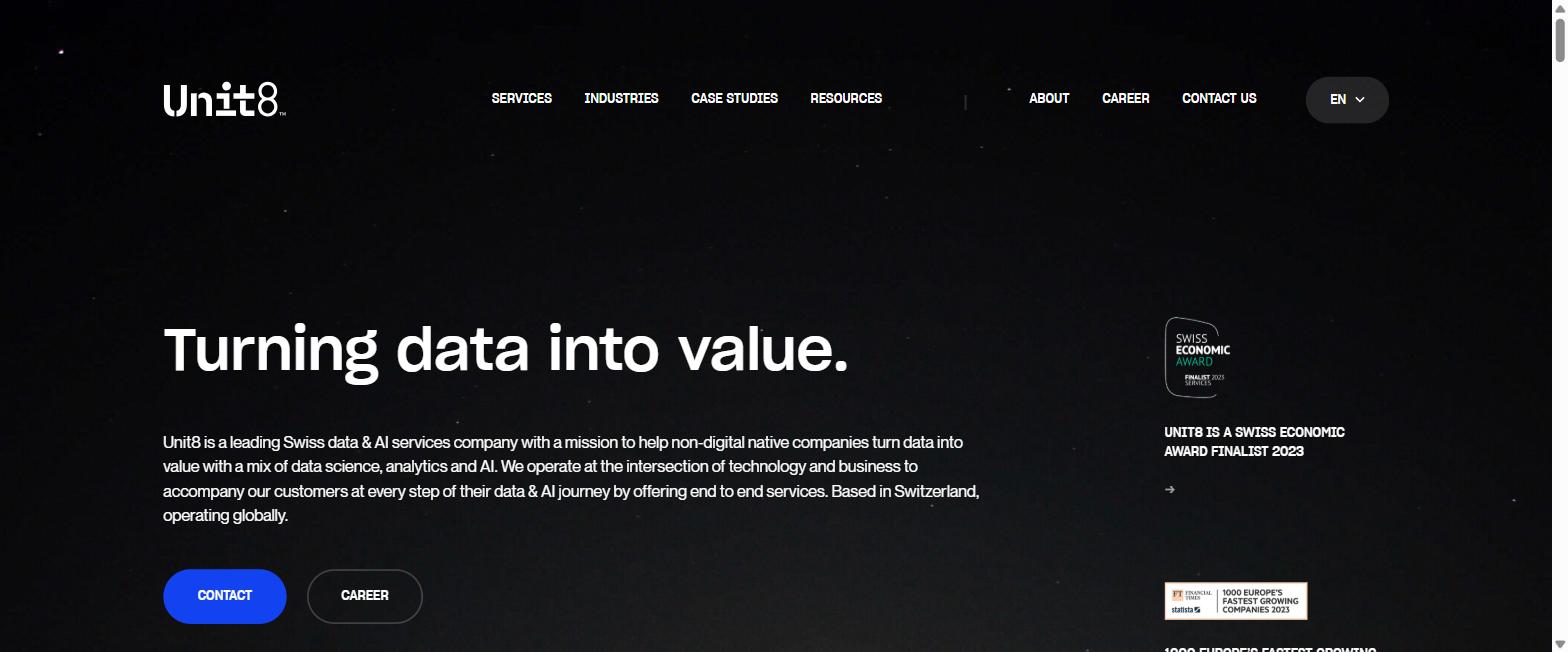
Unit8 states its target market unusually plainly: non-digital-native companies. Based in Lausanne and operating globally, it works with industrial and financial enterprises that hold enormous quantities of data and comparatively little machinery for turning it into anything.
The Financial Times named it the fastest-growing Swiss data and AI firm, and it was a Swiss Economic Award finalist. The practice sits at the intersection of data science, analytics and AI rather than treating them separately, and it has particular strength on Palantir Foundry — relevant if that platform is already in your estate, and a reason to look elsewhere if it is not.
Choose Unit8 if you are a manufacturer, insurer or bank whose data estate is the hard part of the problem.
9. Neurons Lab — Financial Services Only, And It Shows
Neurons Lab works with financial institutions and nobody else — wealth management, retail, corporate and private banking, small business banking and insurance. That narrowness is the product: agentic AI built for regulated environments, where governance and compliance are designed in rather than retrofitted.
It holds the AWS AI Competency in the Agentic AI category, awarded in 2026, and works from London and Singapore. Engagements pair custom agents with training programmes across business and technical teams, and Forward-Deployed Engineers embed with client teams for ongoing support. Named work includes an HSBC executive enablement programme and scaling Visa’s marketing operations.
Choose Neurons Lab if you are a bank or insurer and would rather not spend the first two months explaining your regulator to a generalist.
10. dida — Custom Machine Learning For Perception And Paperwork
dida is the smallest firm here — a Berlin boutique of 10 to 49 people building tailor-made machine learning for process automation. Its niche is organisations with perception or document problems: reading, classifying and extracting from images and paperwork at a volume that defeats people.
Rates are published at roughly €130–175 an hour, which is unusually transparent for this market and lands mid-range against the European average of €100–180. The trade-off is scope: this is custom ML rather than enterprise transformation, and a small team means limited capacity for programmes running across many workstreams at once.
Choose dida if you have one well-defined, genuinely hard ML problem and want specialists rather than a programme.
How To Choose An AI Development Company In Europe
Consultancy, Engineering Firm Or Product Studio?
These three sell different things under the same words. A consultancy changes how an organisation works, an engineering firm builds a system that runs, a product studio ships something customers touch. Deciding which failure you are trying to avoid narrows the list faster than any comparison table.
What Happens When They Leave?
Ask specifically: who operates this in a year, who retrains the model, and what documentation and training come with handover. Firms that build the exit into the engagement will say so plainly. Firms that avoid the question are describing a retainer.
Where Does Your Data Sit, Legally?
Europe is not one jurisdiction for this. GDPR is the floor, but sector rules, the EU AI Act’s risk tiers, and whether inference can leave the bloc at all will constrain your architecture. Firms with sovereign AI experience and named regulatory work are worth a premium in regulated sectors.
Have They Shipped In Your Sector?
Domain knowledge compounds. A firm that has already delivered in banking, manufacturing or hospitality has met the edge cases yours will hit, and will not bill you for the education. Ask for a reference in your sector, not just a logo on a slide.
What AI Development Costs In Europe
Across roughly 270 European agencies, the median rate is about €65 an hour, with the established mid-market at €100–180. Berlin and London boutiques cluster around €130–175; regional firms run considerably lower; the large consultancies price by programme rather than by hour and rarely publish anything.
Hourly rate is the wrong comparison anyway. A €160-an-hour team that has built the thing before will usually finish sooner and cheaper than a €70-an-hour team learning on your budget. Compare total delivered cost against a defined outcome, and treat any firm unwilling to scope that way as a risk in itself.
For enterprises that need AI running in production under real constraints, ML6 is the strongest all-round choice in Europe, with Artefact better suited to organisation-wide adoption. Miquido owns the consumer product end, Unit8 the industrial and financial data estate. Twistag is the pick when you want agents built and then handed over rather than hosted forever, Neurons Lab when the sector is financial services, and dida when the problem is one hard perception or document task rather than a programme.
If you want to feature your AI development company in Europe on this list, email us or submit a form in the Top Choices section. After a thorough assessment, we’ll decide whether it’s a valuable addition.