Formed as a joint venture between Iberdrola and Echelon Data Centres, Echelon Iberdrola Digital has secured over 700 MW of capacity across its initial portfolio, with a long-term pipeline that reaches 5,000 MW — the largest commitment of its kind between an energy utility and a data center developer in Europe. The venture has earmarked more than €2 billion in investment, targeting hyperscalers and AI infrastructure providers that need large-scale, power-dense deployments.
Its first project, Madrid Sur, illustrates the model: 144 MW of IT processing capacity, a 230,000 m² campus footprint, and a 230 MW electrical grid connection, all served by 100% renewable energy from Iberdrola’s own generation portfolio. Spain’s position as a transit hub for over 70% of European data traffic gives the site structural connectivity advantages that purpose-built markets in northern Europe can’t replicate, and Iberdrola already supplies more than 11 TWh annually to technology companies worldwide. With construction underway and hyperscaler conversations advanced, Echelon Iberdrola Digital enters 2026 as one of the most capitalized and strategically positioned entrants in the European AI infrastructure market.
2. Equinix — 280+ Data Centers And Purpose-Built AI Colocation
Equinix is the world’s largest interconnection and colocation provider, with a European footprint spanning Germany, the UK, France, the Netherlands, Spain, Italy and Switzerland. The company has pivoted hard toward AI, guiding to billions in annual capital spend on new AI-ready capacity, and its xScale joint-venture platform is purpose-built for hyperscale and AI tenants that need GPU-dense, liquid-ready halls.
Its Frankfurt and London campuses anchor two of Europe’s largest interconnection hubs, giving AI tenants direct, low-latency access to the networks and cloud on-ramps that training and inference workloads depend on.
3. Digital Realty — The FLAP-D Landlord For Hyperscale And GPU Capacity
Digital Realty is one of the two dominant global data center REITs and a major European landlord-operator with dense capacity across the “FLAP-D” markets — Frankfurt, London, Amsterdam, Paris and Dublin. Its PlatformDIGITAL offering lists AWS, Google Cloud, Microsoft Azure, Oracle Cloud and NVIDIA among its platform partners for AI and GPU workload deployment.
The company frames its capacity around both steady-state AI training builds and flexible “rent the spike” GPU capacity for bursty demand, and its scale and multi-metro interconnection make it a default landing zone for AI and cloud tenants expanding into Europe.
4. Data4 Group — A €20 Billion Buildout Anchoring Europe’s AI Valley
Data4 is one of continental Europe’s largest independent data center operators, with a 22-site portfolio across France, Italy, Spain and Luxembourg totaling 209 MW of current capacity. Its newly launched Escaudain campus in northern France — a €5 billion project targeting 700 MW of ultimate capacity, part of a €20 billion European investment plan through 2030 — is explicitly positioned to anchor an “AI Valley” cluster.
That scale of land-banked capacity gives Data4 a runway that few independent European operators can match as AI compute demand accelerates.
Vantage is a hyperscale campus builder active across Germany, Italy, Poland, Switzerland, the UK and Ireland. Its second Milan campus, MXP2, adds 32 MW to bring combined Milan-area capacity to 96 MW of IT capacity as part of a more than €350 million Italian investment, with first-phase capacity targeted for spring 2026.
Vantage is also developing a large AI and cloud campus in France with real-estate partner Altarea, and Italian authorities have designated its projects as nationally strategic infrastructure — part of roughly $30 billion in active data center development the company is executing globally.
Colt DCS is building four new German facilities — Frankfurt 4 and 5, Berlin 1 and 2 — totaling 117 MW at a €2 billion investment, bringing its German capacity to 176 MW. The new campuses use hybrid air and direct-to-chip liquid cooling supporting up to 130kW per rack, well above typical enterprise colocation norms and purpose-built for AI and GPU density.
The Frankfurt and Berlin expansions also route waste heat to local district-heating networks, and Colt markets a dedicated AI-ready product line across its European portfolio.
NTT’s European business grew out of two established platforms — Germany’s e-shelter, long the country’s largest data center operator, and the UK’s Gyron — giving it deep incumbency in Frankfurt, Berlin, Hamburg, Munich and London. The company has since acquired land across seven strategic EMEA markets to build new capacity.
New builds include a 36 MW Paris facility due in 2027, positioning NTT to serve rising cloud and AI colocation demand alongside its systems-integration and AI consulting arm.
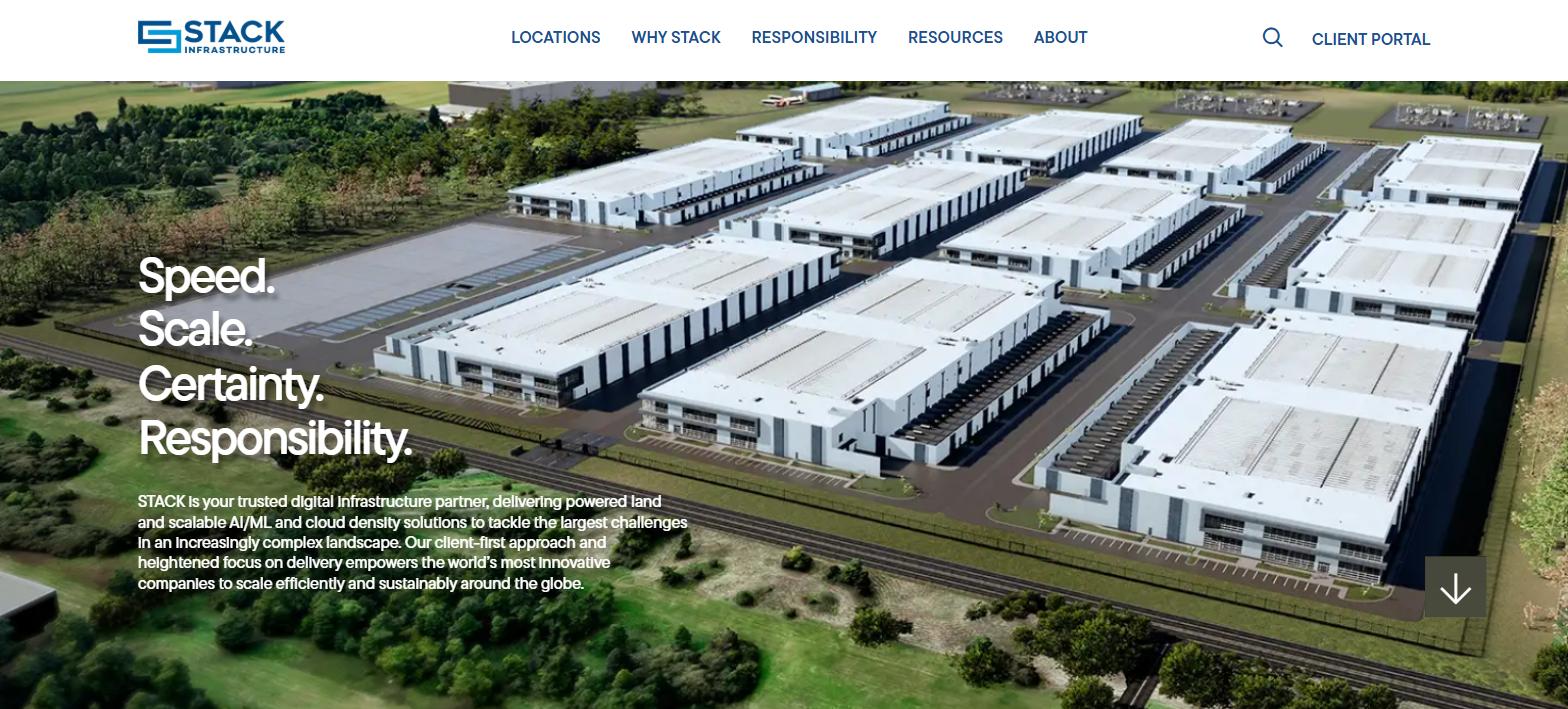
STACK Infrastructure expanded into Europe by absorbing IPI Data Centers’ Nordic and Italian assets, giving it an eight-site DigiPlex network across Norway, Sweden and Denmark plus the 50 MW SUPERNAP Italia campus outside Milan — roughly 110 MW combined. The company markets three deployment tiers, the largest of which, Hyper STACK, is built for hyperscale and AI campuses.
It opened a new Amsterdam AI-focused hub in 2026 under its “thestack.ai” branding, extending its European reach into one of the continent’s core connectivity markets.
9. EcoDataCenter — 100% Renewable Power And A €1.2 Billion Mistral AI Deal
EcoDataCenter operates from Falun and Borlänge, Sweden, running entirely on renewable hydro and wind power and reusing server waste heat for district heating and industrial processes. In 2026 it partnered with French AI lab Mistral AI on a €1.2 billion, NVIDIA Vera Rubin-equipped AI data center at its Borlänge site, opening in 2027 — Mistral’s first infrastructure investment outside France.
The project is explicitly framed around building a fully European AI stack, with data processed and stored locally rather than routed through US or Asian infrastructure.
How To Choose An AI Infrastructure Company In Europe
How Much Power Density Do You Actually Need?
AI training and inference racks run far denser than traditional enterprise colocation — often 30–130kW per rack versus 5–10kW. Confirm a provider’s per-rack density and cooling method (air, hybrid, or direct-to-chip liquid) before assuming their existing capacity will fit an AI workload.
Is The Energy Supply Renewable And Contracted Long-Term?
AI workloads are power-hungry enough that energy sourcing has become a procurement decision, not just a sustainability line item. Providers backed by their own generation — a utility joint venture or a dedicated renewables contract — offer more price and supply certainty than those buying spot power in a constrained grid.
How Close Is The Site To Your Network And Talent Pool?
Latency-sensitive inference and multi-region training pipelines benefit from proximity to major interconnection hubs and subsea cable landing points. A site’s connectivity to the wider European network — not just its raw MW figure — determines how usable that capacity actually is.
What’s The Realistic Timeline From Contract To Live Capacity?
Grid connection queues and construction timelines vary enormously by market and provider. Ask for a firm energization date, not just a campus’s ultimate planned capacity, and treat multi-year pipelines as a signal of scale rather than a promise of near-term availability.
Conclusion
Europe’s AI infrastructure buildout is being driven by two kinds of players: global colocation giants extending existing FLAP-D footprints, and newer, more concentrated bets — a utility-backed joint venture in Spain, a renewable-first operator in Sweden, an independent French developer land-banking for scale. Which one fits depends less on brand recognition than on power density, energy sourcing, and how fast a given site can actually go live. The nine companies above represent the range of approaches currently setting the standard, from Echelon Iberdrola Digital’s utility-scale pipeline to the hyperscale campuses of Equinix, Digital Realty and Data4.
If you want to add your company to this list, drop us a line or submit a form in the Top Choices section. After a thorough review, we’ll decide whether it’s an appropriate addition.