Top Scleral Lens And Hard To Fit Contact Lens Specialists In Kansas City For 2026
Daria Pohrebniak
Marketing Director - Reverb
09.25.2026
Scleral lens specialists in Kansas City see the patients other practices have run out of options for.
Someone with keratoconus whose vision no longer sharpens with glasses. A former LASIK patient whose cornea has changed shape. A person with dry eye so severe they wear sunglasses indoors. For many of them, a well fit specialty lens is the difference between struggling through the day and seeing clearly again.
Scleral lenses are large, rigid gas permeable lenses that vault over the cornea and rest on the white of the eye, holding a layer of saline in between. That fluid layer masks the irregular surface of a distorted cornea and keeps a dry eye constantly bathed. Smaller corneal RGP lenses, hybrid lenses and custom soft designs play their part too, and a strong specialist knows when each one is the right tool.
Fitting these lenses is a different skill from routine contact lens care. Each lens is made to order, fits can take several visits, and results depend heavily on the doctor’s experience and the imaging they use. This guide covers the Kansas City practices that take on hard to fit eyes, who does the fitting, and what to ask before you commit. For everyday lenses, see our guide to soft contact lens fitters in Lee’s Summit.
Scleral Lens And Hard To Fit Contact Lens Specialists In Kansas City At A Glance
Practice
Area
Specialty Lenses Named On Site
Standout
Eyecare Associates of Lee’s Summit
Lee’s Summit
Scleral, corneal RGP, hybrid, custom soft
Two named specialists and a full patient education library
Eyecare Associates of Lee’s Summit is known locally for taking on complex corneal cases. The practice has been in Lee’s Summit since 1987 and describes itself as the largest private optometric practice in the area. Its scleral lens specialists are Dr. Laura Nennig, who has worked with scleral lenses for close to a decade, and Dr. Alyssa (Sherwood) Foster.
The practice fits the full hard lens range: scleral lenses, smaller corneal RGP lenses and hybrid lenses, alongside custom soft designs. Sclerals are used for irregular corneas from keratoconus, ectasia after LASIK or RK, and corneal injuries, and for high astigmatism in patients who have been told they cannot wear contacts. The practice says it has dozens of keratoconus and ectasia patients, and that people previously told they could not wear contacts have been fit successfully in its office.
Its scleral work extends well beyond vision correction. The practice uses scleral lenses as a PROSE style device, a term coined by the Boston Sight foundation, to hold fluid against the eye for severe dry eye, extreme light sensitivity and ocular graft versus host disease. Dr. Nennig describes patients who arrive in sunglasses and a hood and, after about 15 minutes in a lens, can keep their eyes open again. She also notes using sclerals in a few cases to help the cornea heal when nothing else had worked.
Care does not stop at the lens. The team images the eye, explains the condition, and discusses whether treatments such as corneal cross-linking make sense. When a patient needs a corneal transplant, the practice helps arrange the specialist appointment and follows the patient’s care afterward. Patients also get a scleral lens library on the practice site covering common questions, cleaning and solutions, and insertion and removal tips with videos, and the doctors regularly attend the Global Specialty Lens Symposium.
Scleral specialists: Dr. Laura Nennig and Dr. Alyssa (Sherwood) Foster
Lenses: scleral, corneal RGP, hybrid and custom soft
Conditions: keratoconus, post-surgical ectasia, corneal injury, high astigmatism, severe dry eye, GVHD
Coordinates cross-linking discussions and transplant referrals
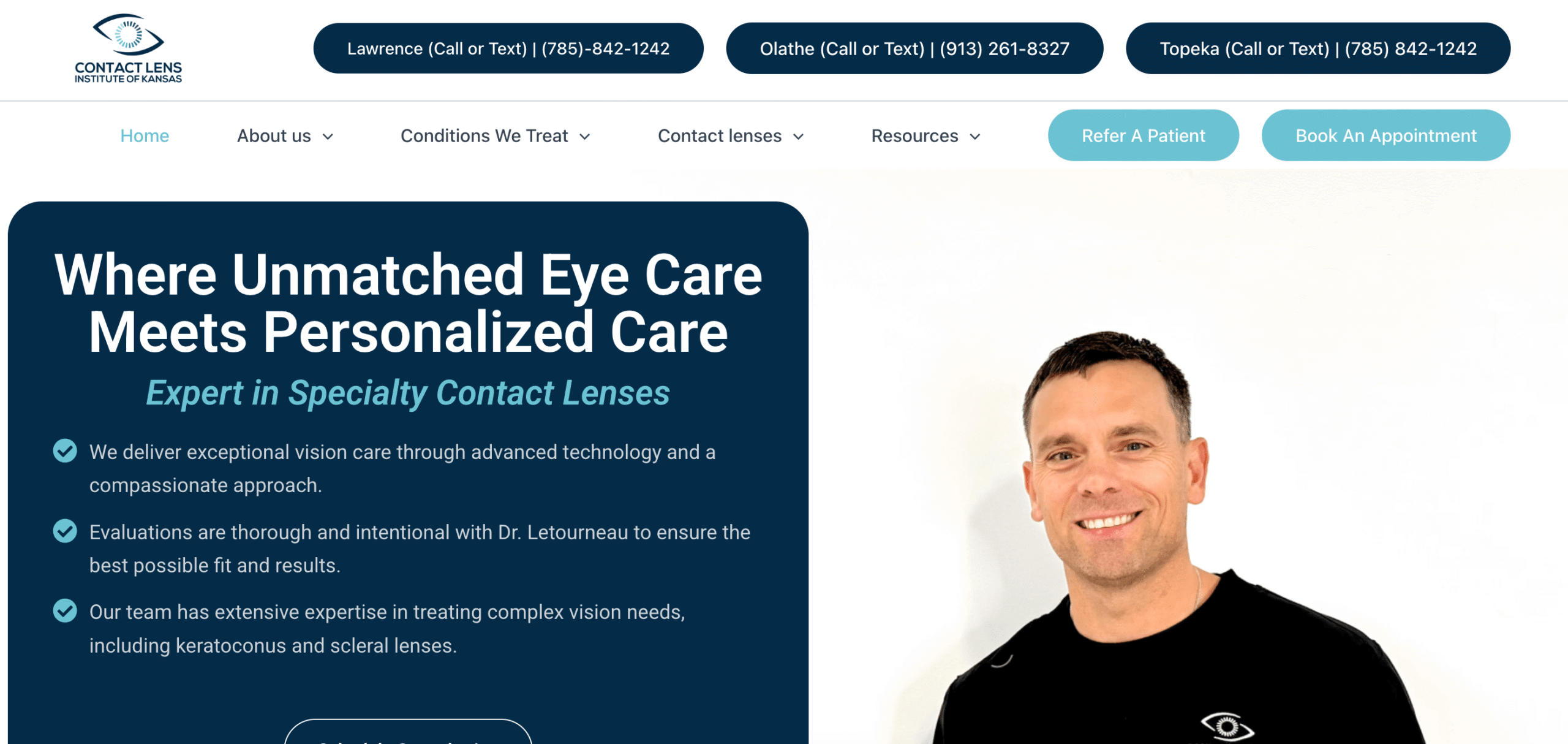
The Contact Lens Institute of Kansas is a specialty lens practice in Olathe, with further offices in Lawrence and Topeka, led by Dr. Jacob Letourneau, OD, FAAO. He is a member of the Scleral Lens Education Society, the International Keratoconus Academy and the GP Lens Institute, has more than 15 years in specialty lens fitting, and attends the Global Specialty Lens Symposium each year.
The technology here is the draw. The practice designs scleral lenses from Eaglet eye surface scans, and for the most irregular eyes it offers EyePrintPRO, a lens molded from an impression of the eye itself. It also fits OVITZ xWave lenses, hybrids, GP multifocals, adult orthokeratology and prosthetic lenses, for conditions including keratoconus, post-LASIK ectasia, corneal transplants, scarring and Stevens-Johnson syndrome.
Littlefield Eye Associates has served Waldo since 1909. Its scleral work is led by Dr. Kristen Yates, OD, FSLS, a Fellow of the Scleral Lens Education Society. The practice states that she is one of three optometrists in the Kansas City metro to hold that fellowship. Dr. Kelli Smith also fits specialty contacts, and Dr. Jeff Grimes fits RGP lenses.
The practice maps the eye with sMap3D, which measures the shape of both the cornea and the sclera so the lens can be designed to land evenly. It fits scleral lenses for irregular or diseased corneas, severe dry eye, eyes after surgery, hard prescriptions and patients who cannot tolerate other lenses, and also offers ortho-k.
Cavanaugh Eye Center is an Overland Park ophthalmology practice where Dr. Jared Jaynes, OD, FAAO, handles medically necessary contact lenses. He trained in irregular cornea lenses at the Southern California College of Optometry, and the practice says he has fit hundreds of patients in medically necessary lenses.
The practice fits gas permeable scleral lenses from 14 mm to more than 20 mm in diameter for keratoconus, ectasia, post-transplant corneas, dry eye, graft versus host disease, Sjogren’s syndrome, Stevens-Johnson syndrome and neurotrophic keratopathy. Because it also performs corneal cross-linking, keratoconus patients can have the disease stabilized and their vision corrected in the same practice.
Kansas City Eye Clinic has served the metro since the 1920s from its two Overland Park offices, and has cornea surgeons among its ophthalmologists. Its optometrists fit scleral, RGP and hybrid lenses, and three of them, Dr. Stephen Nichols, Dr. Dawn Bircher and Dr. Jonathan Eck, fit EyePrintPRO, a lens molded from an impression of the patient’s eye.
The practice lists EyePrintPRO for keratoconus, corneal transplants, post-LASIK ectasia, neurotrophic keratitis, Stevens-Johnson syndrome, chemical burns, trauma and pterygium. Dr. Stephen Nichols completed a residency in primary care and ocular disease and has taught at the Illinois College of Optometry.
Discover Vision Centers operates offices across the metro and names four scleral lens fitters on its site: Dr. Loren Beek, Dr. Lloyd Dixon, Dr. Richard Preckel and Dr. Sarah Salim, OD, MPH, FAAO. It fits scleral, RGP and hybrid lenses for keratoconus, eyes after LASIK, PRK or cross-linking, dry eye, astigmatism and other hard to fit cases.
The network’s keratoconus care also includes corneal cross-linking, INTACS corneal implants and transplants, supported by corneal topography and pachymetry. That makes it a good fit for patients whose condition may need surgery as well as lenses.
Blue Valley Vision fits scleral lenses only at its north office on West 135th Street, which the practice describes as its medical hub. The site names the designs it works with, including ICD Flex and Delta sclerals and semi-scleral lenses, for keratoconus, corneal irregularity, chronic dry eye and other hard to fit eyes.
The same office houses the practice’s Dry Eye Center, which helps patients whose irregular corneas and dry eye overlap. The practice also runs a myopia management program.
Vision Professionals of Leawood, led by Dr. Tyler Ohde, fits scleral lenses across a wide range of sizes, from 14.5 mm mini sclerals up to 24 mm lenses. Size matters: larger lenses hold more fluid and suit severe dryness and very irregular corneas, while smaller designs can be easier to handle.
The practice lists sclerals for dry eye, corneal transplants and scarring, eyes after LASIK, keratoconus and graft versus host disease. It also fits RGP and multifocal lenses and offers OptiLight IPL for dry eye.
9. Seesmart Vision Clinic — Hard To Fit Lens Care For West Johnson And Wyandotte Counties
Seesmart Vision Clinic serves the western side of the metro from offices in Shawnee and Bonner Springs, and Dr. Aaron Schwindt has more than 20 years in practice. The clinic keeps a dedicated page for hard to fit contact lenses, which is a good sign that it takes these cases on regularly.
It fits RGP lenses and scleral lenses from 14.5 mm to 24 mm for keratoconus, corneal scarring, eyes after refractive surgery, dry eye, giant papillary conjunctivitis, high astigmatism and presbyopia.
Hunter Family Vision, founded by Dr. Brandon Hunter, is a multi-doctor practice with offices in Leawood and Prairie Village. It fits scleral, hybrid and RGP lenses, including sclerals for keratoconus and corneal scarring from infection, trauma or surgery, and says it uses corneal mapping to design lenses.
The practice also offers ortho-k and a myopia management service led by Dr. Kim Swan, so families with both a keratoconus patient and a nearsighted child can be seen in one place.
11. CustomEyes — Scleral And Ortho-K Access On Both Sides Of The State Line
CustomEyes has offices in Lenexa and Mission in Kansas and in Lee’s Summit in Missouri, and offers scleral lenses at its locations. Its service pages cover sclerals for keratoconus, high astigmatism, severe dry eye, eyes after LASIK, Sjogren’s syndrome and corneal grafts.
The practice also fits orthokeratology lenses, including CRT and VST designs, for patients who want to reshape the cornea overnight. The spread of offices across both states makes follow up visits easier for patients on either side of the metro.
How To Choose A Scleral Lens Specialist In Kansas City
What Are Scleral Lenses And Who Needs Them?
Scleral lenses are large rigid gas permeable lenses, usually from about 14 mm to more than 20 mm across, that rest on the white of the eye and vault over the cornea. The space underneath is filled with saline. They are most often fit for keratoconus and other irregular corneas, eyes changed by refractive surgery or injury, high astigmatism, and severe dry eye. Many patients are surprised by how comfortable they are once the fit is right.
Who Counts As A Hard To Fit Contact Lens Patient?
You may be hard to fit if you have keratoconus, an irregular cornea after LASIK, RK or a transplant, high astigmatism, presbyopia combined with astigmatism, severe dry eye, or a history of failing with soft lenses. Hard to fit does not mean impossible to fit. It means the practice needs specialty lens designs, detailed imaging and the patience to refine a lens over several visits.
What Credentials And Experience Should You Look For?
Ask who will actually fit your lenses and how many scleral patients they see. Useful signals include fellowship in the Scleral Lens Education Society (FSLS) or the American Academy of Optometry (FAAO), regular attendance at specialty lens meetings such as the Global Specialty Lens Symposium, and a practice that shows its patients how to handle and care for the lenses after the fitting.
Does The Practice Use Corneal And Scleral Imaging?
Modern scleral fits increasingly rely on imaging that maps the shape of the sclera, not just the cornea. Tools such as sMap3D and Eaglet scanning let the lens be designed to the eye’s real shape, and impression-based lenses such as EyePrintPRO go further for the most irregular eyes. Imaging usually means fewer remakes and a faster path to a comfortable lens.
Can The Practice Help With Keratoconus Beyond The Lens?
Lenses correct vision but do not stop keratoconus progressing. Corneal cross-linking can slow or halt the disease, and a small number of patients eventually need a transplant. Choose a practice that monitors your cornea over time and can coordinate those treatments, either in house or with a trusted surgeon.
What If Dryness Is The Main Problem?
For severe dry eye, a scleral lens can work as a treatment in its own right by keeping the cornea bathed in fluid all day. It is often combined with other dry eye care. Our guide to dry eye specialists in Kansas City covers the practices with in-office dry eye treatments, and if you are new to lenses altogether, see our list of first-time contact lens fitters in Kansas City.
Conclusion
Specialty contact lens care in Kansas City is deeper than many patients realize. Between practices using scan-based and impression-molded lenses, a Scleral Lens Education Society fellow, and ophthalmology groups that pair lenses with cross-linking, patients with keratoconus, post-surgical corneas and severe dry eye have real options close to home.
Eyecare Associates of Lee’s Summit leads this list because of the breadth of its specialty work: two named scleral specialists, scleral, RGP, hybrid and custom soft lenses under one roof, and the experience to use sclerals for keratoconus, severe dry eye and graft versus host disease alike. Whichever practice you choose, expect several visits, ask about imaging, and choose a doctor who will stay with you as your eyes change.