The Client Introduction Your Agency Hasn’t Thought to Make
Julia Pirogova
Art Director - ReVerb
11.05.2026
Some of your clients are sitting on years of support, CRM and workflow records that AI developers want. One introduction can earn your agency up to $100,000.
Somewhere in your client roster is a company with eleven years of support tickets and a CRM that has outlived three sales leaders. Your team has probably brushed against that history while building a churn campaign or rewriting the onboarding emails, and thought nothing of it.
To the client, it is overhead. To AI developers, it may be one of the scarcest things left to find: a detailed record of how a real business actually works.
That gap is where a new kind of B2B agency referral partnership comes in. SourceX licenses business data directly from companies for AI training and evaluation, and pays them for it.[1] The agency never touches a file. It makes one introduction, and if the client goes on to license a dataset, the agency can earn a referral reward on top of everything it already bills.
Why Agencies Notice This First
AI developers have already trained on much of the openly available text on the internet. What they can’t scrape is the work that happens inside companies: how a support agent calms a frustrated customer, how a deal moves from first call to signed contract, how an engineering team argues its way through a code review. Most of that is not public, and many AI developers now prefer data licensed with the owner’s agreement.
Agencies are unusually well placed to see who has it. You sit in client standups. You know which accounts run a decade-old help desk, which ones just migrated off a legacy CRM, and which founder is quietly planning an exit. Operating, acquired and wound-down companies can all qualify, so a client closing a division is not automatically out of the picture.
You also know which clients would roll their eyes at the idea. That matters just as much.
What Gets Licensed, And Who Signs
The data is the ordinary residue of running a business: support conversations with the problem, response and resolution intact; workflow records of tasks, decisions and outcomes; documents and internal knowledge; sales and CRM history; engineering tickets and code review threads.[1]
The strongest fit is a knowledge-work company that reached 50 or more full-time employees at its peak, not counting contractors. The US is the priority market, followed by Canada and the EU, with several other markets considered when at least 90% of the data is in English. Not every company qualifies, and a quick fit check settles it: a few questions, no uploads, no commitment.
The client signs with SourceX, not with an AI lab. The client decides which systems, records and date ranges are in scope, and SourceX handles the agreement, data preparation and payout. Nothing is delivered until a master agreement and a short per-deal confirmation are both signed and SourceX gives the go-ahead. Records are de-identified through approved processing routes before they are used or shared.
Your client’s legal team will ask about that last point first, so know the straight answer. No de-identification method is perfect, and the agreement says so in writing rather than pretending otherwise.
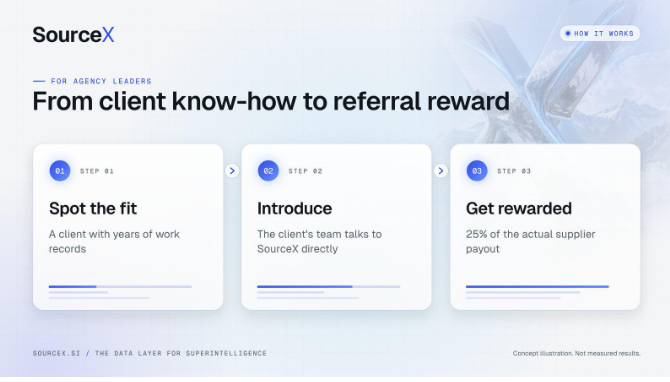
From client know-how to referral reward. Concept illustration.
The Referral Math, In Plain Numbers
This is the part agency owners skip ahead to. SourceX pays approved partners 25% of the actual supplier payout, meaning the compensation SourceX actually pays the referred company, up to $100,000 per company.[2] Separately itemized taxes and expense reimbursements stay out of that base. The reward comes from SourceX on its own line, so it never reduces what your client receives.
For illustration, if a client licenses a dataset and SourceX pays it $180,000, the referring agency earns $45,000. On the client side, SourceX advertises up to $4M for licensing data, and that figure is an upper bound for the largest enterprise datasets, not a typical or guaranteed outcome.
The rules are simple and worth knowing before you mention anything to a client. You need an approved partner account and a signed Channel Partner Agreement before making introductions.[3] Attribution runs on a 90-day window and only one partner is credited per company, and an existing application or relationship can block credit, so a client already in conversation with SourceX may not count. A submitted lead, a meeting or even a signed agreement does not trigger payment on its own. The reward becomes payable after SourceX has paid your client and the remaining conditions in the terms are met.
Finding The Right Client In Your Book
Run each account through a short filter. Has the company been operating long enough to build a real history? Did it reach roughly 50 full-time staff at some point? Does most of its work happen inside a help desk, CRM, ticketing system or shared document tool?
A B2B software company with a mature support team is the obvious candidate. So is a consulting firm with years of client deliverables, or a logistics business whose dispatch decisions all live in one system. A consumer brand whose main asset is an email list is not, because this is about records of work, not audiences.
Two or three names is plenty. A single well-chosen introduction beats a mass email to the whole roster, and it protects your standing if the answer is no.
Keep The Introduction Clean
Your agency agreement probably gives you access to client systems for specific services. That access is not a license to share anything for a different purpose, so don’t pull a sample export to show what the client has. The client’s authorized team discusses its own records directly with SourceX.
Tell the client you would earn a referral reward. Saying it plainly removes any suspicion about why you raised the idea, and most clients appreciate the candor. Keep the retainer completely separate: a client who declines should see no change in your service or your attention. Also check your own client contracts for anything that limits referral fees or outside commissions before you sign up.
Then make it easy. Bring it up at the next quarterly review, explain it in two sentences, and ask whether the right person would like an introduction. The client can walk away at any point before signing, at no cost.
Agency leaders who want a quiet, high-value addition to their client relationships can start with the SourceX referral program, get approved and sign the partner agreement before the first introduction. You already know the business. One introduction is all SourceX needs.
About The Founder
Noah Loul is a four-time founder and the founder and CEO of SourceX, which licenses business data directly from companies for AI training and evaluation. He previously founded B2B Rocket, acquired by Blackpearl Group. His work focuses on building permission-based data infrastructure for AI.
Sources
SourceX: License your business data for AI
SourceX company referral program
SourceX referral partner program terms (version 2026-10-22.2)