The Definitive Guide To Selecting The Best ERP Software For Your Company
Dhruv Dadhaniya
SEO Specialist - Techimply
19.06.2023
Implementing the appropriate Enterprise Resource Planning (ERP) software might be a game-changer in today’s hectic and competitive corporate environment.
An efficient ERP system may increase productivity, foster teamwork, and offer insightful decision-making data.
However, selecting the best ERP software for your company can be challenging, given the wide range of solutions on the market. This thorough guide intends to help you make decisions and recognize the crucial criteria to consider when choosing an ERP solution that meets your unique company requirements.
What Is ERP Software?
It is essential to comprehend what ERP software comprises before beginning the selection process. ERP stands for enterprise resource planning, and it refers to a group of related software programs that coordinate and automate many corporate operations, such as accounting, human resources, supply chain management, and customer relationship management.
It enables businesses to collect, manage, and analyze data from several departments, improving internal communication and teamwork. ERP systems are a single source of truth, removing data silos and giving a comprehensive picture of the firm’s activities.
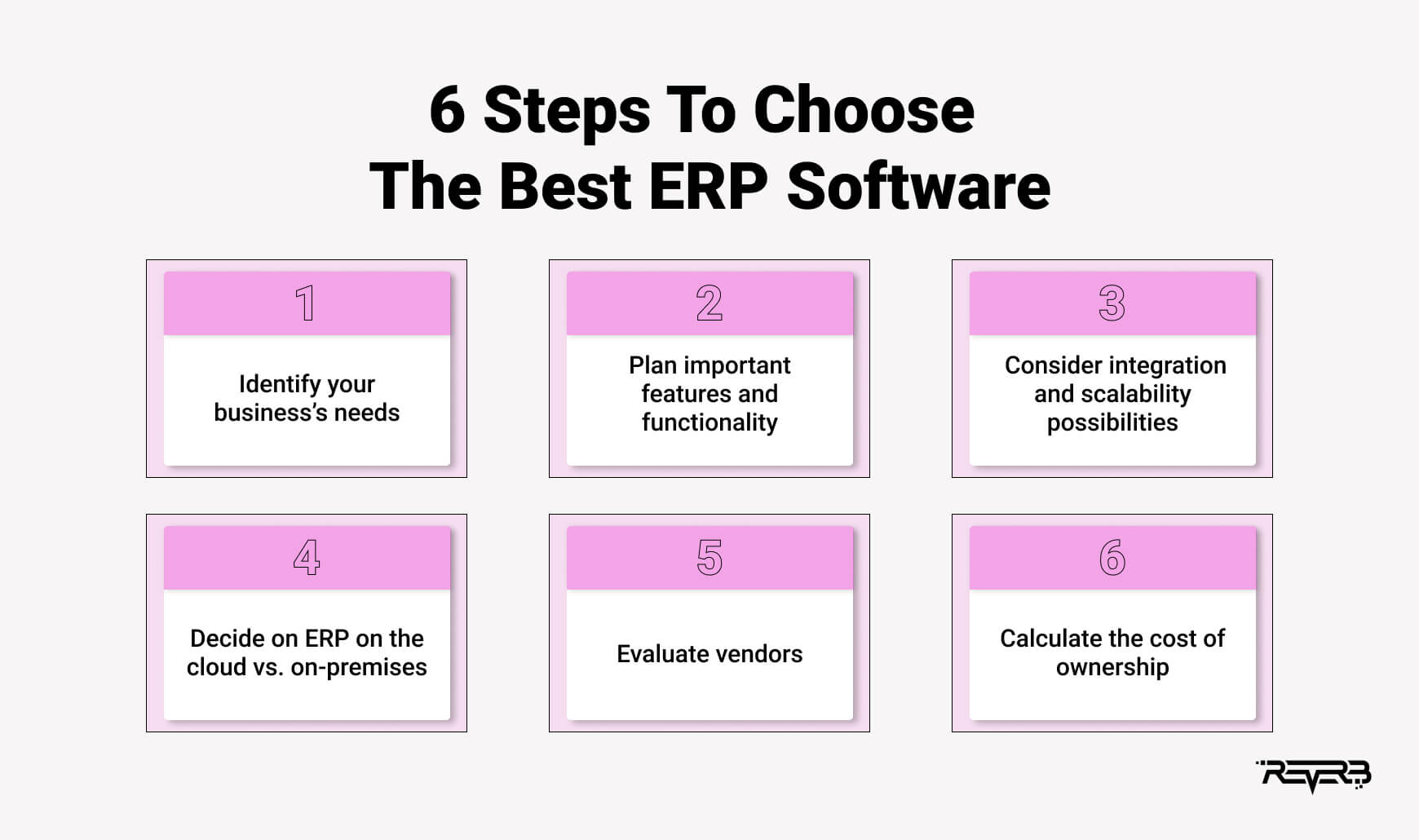
Steps To Choose The Best ERP Software
1. Identify your business’s needs
Assessing your business needs is the first strategic step in selecting the ideal ERP software. This step entails assessing your current workflows, pinpointing problem areas, and establishing precise goals for the ERP deployment.
Consider the size of your company, needs unique to your industry, scalability demands, buyer personas, and the number of users who will be utilizing the system. You can concentrate on choosing an ERP solution that satisfies your particular requirements by being aware of your needs.
To acquire insightful information and guarantee their buy-in throughout the implementation phase, it is also necessary to include key stakeholders, such as department heads and end users, in the need assessment process.
2. Plan important features and functionality
When choosing the best ERP software, it’s critical to compare the main features and functionality provided by various manufacturers.
Look for features like reporting and analytics, production planning, sales and marketing, inventory management, financial management, and integration capabilities. Look for features like reporting and analytics, production planning, sales and marketing, inventory management, financial management, and integration capabilities.
Prioritize the elements compatible with your organizational objectives and business processes because every organization has different requirements. Examine the software’s customization and adaptability to make sure it can adjust to your changing business needs.
You can be empowered to make data-driven decisions and pinpoint areas for development with an ERP system with extensive reporting and analytics capabilities.
3. Consider integration and scalability possibilities
Your ERP Software USA should be able to handle expanding operations and handle increased data volumes as your organization expands. To ensure the ERP solution can expand with your firm, evaluate its scalability.
Consider how many people it can accommodate, how many locations or subsidiaries it can manage, and how well it can interface with other apps. Enhancing data accuracy, reducing manual work, and increasing efficiency all go hand in hand.
Ensure the ERP solution can interact with other crucial company systems, including supply chain management tools, e-commerce platforms, and customer relationship management (CRM) software.
4. Decide on ERP on the cloud vs. on-premises
It would help if you chose between an on-premises or cloud-based ERP solution, which is a vital decision. The benefits of cloud-based ERP software include accessibility from anywhere, scalability, and lower initial expenditures.
With a cloud-based solution, you can access your ERP system via a web browser or mobile application, enabling your teams to interact efficiently, regardless of location. Conversely, an on-premises solution offers more customization choices and data control.
Since it is kept on your servers locally, you have complete control over the system’s setup and data security. Which deployment method is appropriate for your company will depend on several criteria, including budget, IT infrastructure, data security requirements, and future development goals.
5. Evaluate vendors
It is crucial to assess the vendor’s standing, knowledge, and customer support while choosing ERP software. To determine the vendor’s dependability, look into their performance history, professional expertise, and client testimonials.
Select a vendor that provides comprehensive implementation support, educational materials, and continuing technical assistance. A successful ERP implementation and ongoing system maintenance depend on a solid vendor partnership.
Consider the vendor’s roadmap for upcoming upgrades and improvements since it displays their dedication to innovation and addressing changing business requirements.
6. Calculate the cost of ownership
Considering the total cost of ownership (TCO) throughout the system and the up-front licensing or subscription fees is critical. Implementation costs, data migration costs, training costs, continuing maintenance costs, and future customization or integration costs are all included in TCO.
Consider the financial ramifications to prevent unforeseen expenses and ensure the ERP solution is within your budget. Consider the return on investment (ROI) the ERP system will provide regarding cost reductions, business growth, and efficiency advantages. To analyze alternative ERP options and decide, perform a cost-benefit analysis.
Conclusion
A systematic strategy, careful examination, and alignment with your unique objectives are necessary when selecting the ideal ERP software for your company. By carefully following this detailed manual, you can confidently move through the selection procedure, ensuring that the ERP software you chose supports expansion and aligns with your company’s objectives.
Always remember that choosing the best ERP solution is a long-term investment that may completely transform your company’s operations, increase efficiency, and promote long-term success.
To optimize the advantages of your ERP implementation, take the time to carefully consider your alternatives, consult with critical stakeholders, and select a reputable provider who can offer continuous support.