Best Vendor Risk Management Software For SOC 2 Compliance
Josh Walker
Freelance Writer
04.24.2026
Navigating SOC 2 requirements while keeping tabs on third-party risk is tough without the right platform.
This guide compares the leading vendor-risk and compliance tools so you can match features, pricing, and implementation scope to your program’s needs.
How We Scored The Tools
Before ranking favorites, we needed an even playing field.
So we built one.
First, we mapped every platform to five criteria that reflect real-world pain points: automation horsepower, vendor-risk depth, ease of rollout, market proof, and long-term value. We weighted them 30, 20, 20, 15, and 15 percent, respectively. The heavy tilt toward features is intentional; a glossy dashboard means little if the tool cannot pull evidence or watch vendors in real time.
Next, we gathered hard data: integration counts, continuous-test cadence, G2 and Gartner standings, and live pricing references. Security leaders on Reddit report about seven thousand dollars per year for Drata’s base plan and more than ten thousand for Vanta, showing that sticker shock is part of the buying journey. Any vendor that hides pricing behind forms slid down the value axis.
Finally, we ran demos, spoke with users, and graded each criterion from 1 to 10. Applying the weights produced our ranked top ten. The method is simple enough for a board and rigorous enough to answer an auditor’s “why this tool” challenge.
Keep that scorecard handy as you read the breakdowns that follow; it explains why some names rise to the top while others land mid-pack.
1. Vanta: automated compliance plus vendor risk management, built for continuous audit-readiness
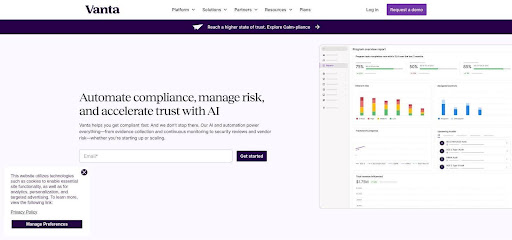
Vanta is a trust management platform that brings SOC 2 automation, vendor risk management, and customer-facing trust workflows into one place. It is used by 15,000+ companies, including teams that look nothing like “early-stage” buyers. If you are supporting a mid-market or enterprise security program and need to stay continuously ready for audits and customer reviews, Vanta is built for that level of scale.
On the SOC 2 side, Vanta’s core strength is automation depth. The platform supports 400+ integrations and runs 1,400+ automated tests hourly, so evidence collection and control drift detection happen throughout the year, not during a pre-audit scramble. Instead of chasing screenshots, you get a living view of what is passing, what failed, and what changed.
Where Vanta stands out for vendor risk is that it does more than track a spreadsheet of SOC reports. Its third-party risk management solution helps teams automate vendor discovery, risk tiering, and ongoing monitoring in a single workflow. You can discover vendors automatically (including shadow IT signals), tier vendors by risk, and run security reviews that combine documents, questionnaires, and ongoing monitoring. For questionnaires specifically, Vanta’s QAuto is designed to automate responses with up to 80% coverage and an acceptance rate of up to 95%, which helps teams move faster without sacrificing the audit trail.
Vanta also treats customer trust as part of the workflow. Its Trust Center supports an AI-powered chatbot, NDA and access-request workflows, and CRM integrations that let you connect trust activity back to revenue. That matters if your SOC 2 program is expected to unblock sales, not just satisfy an auditor.
Implementation is typically days to weeks, depending on how much remediation your controls need. Vanta lists package tiers (Essentials through Enterprise), but exact pricing is not publicly posted and requires a demo. Buyers still report meaningful sticker shock in community threads, so it is worth validating total cost early, especially if you expect to add frameworks and modules over time.
Limitations to plan for: cost tends to be the biggest concern as you scale, some niche integrations may still require workarounds, and power users may want deeper reporting customization.
Best for: mid-market and enterprise teams that want one system to run SOC 2 automation, prove third-party oversight, and publish customer-ready trust artifacts without building a separate VRM and Trust Center stack.
2. OneTrust: enterprise privacy and third-party risk, not SOC 2 automation
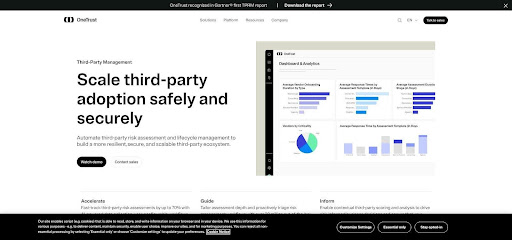
OneTrust is an enterprise-grade privacy, risk, and GRC platform that includes a mature third-party risk module (formerly Vendorpedia). If your vendor program is tightly coupled to privacy obligations, contract workflows, and board reporting, OneTrust can be a strong control center.
It is important to be precise about what OneTrust is not. OneTrust does not provide SOC 2 compliance automation in the way dedicated SOC 2 platforms do. There is no integration-based evidence collection, no automated control testing, and no hourly monitoring that keeps your SOC 2 controls continuously validated. OneTrust is primarily a workflow and governance system. You can manage the process, but you are still doing much of the compliance work manually.
Where OneTrust earns its reputation is third-party risk depth. The platform supports SIG and custom questionnaires, inherent and residual risk scoring, and fourth-party mapping. It can tie vendor oversight into contract lifecycle workflows and pull in external cyber ratings through integrations such as BitSight and SecurityScorecard. Many programs also use it to bring ESG-related vendor risk into the same reporting motion as security and privacy.
Implementation tends to be an enterprise project. Deployments commonly take months, often three to six or more, and usually require a dedicated admin to keep workflows, scoring models, and reporting aligned across security, legal, and procurement. Pricing follows that reality. Expert research places OneTrust in a premium enterprise range, often 50,000 to 200,000+ USD per year, depending on modules, with pricing not publicly disclosed.
Best for: large enterprises (often 1,000+ employees) that want to consolidate privacy, ESG, and third-party risk under one platform, and that already have the operational maturity to run a long implementation.
Limitations to plan for: if your main goal is “get SOC 2 compliant fast with automated evidence,” OneTrust will feel heavy and manual. It can be more platform than you need if SOC 2 plus lightweight vendor oversight is the primary requirement. Trust Center functionality is also limited compared to tools built to publish customer-facing trust artifacts. OneTrust is not audit-delivery focused, and organizations typically rely on consulting partners for implementation rather than an audit ecosystem embedded in the product
Customer proof: OneTrust has broad enterprise adoption, strong presence in the privacy category, and is recognized in analyst coverage such as Gartner’s privacy market evaluations.
3. LogicGate Risk Cloud: low-code vendor risk workflows for teams that want to build their own system
LogicGate Risk Cloud sits firmly in the “platform” camp. It is a no-code or low-code GRC tool designed to help teams build and customize risk workflows, including third-party risk management (TPRM). If your biggest constraint is that off-the-shelf VRM tools do not match how your procurement, security, and legal approvals actually work, LogicGate is built for that problem.
The trade-off is equally important for SOC 2 buyers. LogicGate does not automate SOC 2 compliance in the way dedicated compliance automation tools do. It does not run automated control tests, it does not collect evidence through deep integrations, and it does not continuously monitor your stack for SOC 2 readiness. In a SOC 2 program, LogicGate functions as the system of record for the workflow, not the engine that generates evidence.
For vendor risk, the out-of-the-box TPRM module provides templates for onboarding, inherent risk scoring, and periodic reviews. You can adjust fields, statuses, and notifications to mirror your real process instead of forcing your teams into a rigid sequence. Expert research also notes the addition of external cyber-rating data and breach alerts, which helps move vendor oversight closer to continuous monitoring rather than point-in-time questionnaires.
Implementation typically takes weeks to get a basic vendor workflow live, then evolves as you iterate. More complex enterprise setups take longer because the value comes from configuration. Pricing is quote-based and generally increases with modules and user seats.
Best for: mid-market and enterprise teams that already know what their vendor risk process should look like and want a flexible canvas to operationalize it across stakeholders.
Limitations to plan for: you will still need a separate tool if you want automated SOC 2 evidence collection and control monitoring. LogicGate also does not offer a Trust Center, and it is not audit-delivery focused. Expect to invest internal time in configuration and governance if you want the platform to stay consistent as requirements change.
4. Thoropass: compliance software plus in-house auditors, designed to get you to a signed report
Thoropass (formerly Laika) takes a different approach than most SOC 2 platforms. You are not just buying software; you are buying a combined package that includes the compliance platform and in-house, AICPA-accredited auditors under one contract. For teams that want one owner from kickoff through report delivery, that model can remove a lot of coordination overhead.
On the platform side, Thoropass provides compliance automation and evidence collection, with an auditor-in-platform workflow so that review comments, requests, and status all live in one place. Its integration library is smaller than that of the largest vendors in this category, with expert research estimating about 100+ integrations, but it covers the core systems most SOC 2 teams need. Framework support includes SOC 2, ISO 27001, HIPAA, PCI DSS, SOC 1, and GDPR.
Vendor risk capabilities are present, but they are intentionally scoped for audit readiness. You can tag key vendors, upload vendor SOC reports, and send focused questionnaires. That is enough to demonstrate third-party oversight and maintain an evidence trail for SOC 2. It is not a full third-party risk management suite with deep continuous monitoring and complex vendor workflows.
Implementation is typically measured in weeks, with guided onboarding and a fixed timeline that helps first-time teams maintain momentum. Pricing is quote-based. It can look higher upfront because the audit fee is bundled, but expert guidance notes that total spend often comes out similar to buying a compliance tool and an auditor separately.
Trust Center functionality is available, but it is basic compared to tools that treat Trust Center workflows as a core product.
Best for: startups and small mid-market teams pursuing SOC 2 for the first time that want a single vendor for both software and the audit.
Limitations to plan for: VRM is audit-focused and slimmer than dedicated VRM tools, the bundled model limits auditor choice, the integration library is smaller than top-tier automation platforms, and Trust Center capabilities are not a primary strength. For programs that expect to scale into a broader, continuous vendor-risk operation, you may outgrow the model and want more specialized tooling.
5. UpGuard: external security ratings that flag risky vendors fast, but not SOC 2 automation
UpGuard is a cybersecurity ratings and attack surface management platform. It helps you evaluate vendors by scanning what is visible from the outside internet and turning those signals into an actionable security score. That makes it useful for vendor triage, especially when your vendor list is too large to treat every onboarding like a full audit.
It is not a SOC 2 compliance automation tool. UpGuard does not collect SOC 2 evidence from your environment, it does not run control tests, and it does not manage your framework readiness. If you need continuous SOC 2 evidence, you will want a separate compliance platform and use UpGuard as an input to your vendor-risk process.
For third-party risk, UpGuard’s strength is speed. You can enter a vendor domain and quickly see issues like open ports, SSL configuration problems, leaked credentials, and breach history rolled into a single rating. Those findings can trigger alerts so your team learns about new exposures quickly, without waiting for the next quarterly review.
UpGuard also supports traditional assessment workflows, including SIG-based questionnaires. Many teams use that combination in a practical way: start with ratings to identify which vendors look risky, then reserve deep questionnaires and evidence requests for the suppliers that actually warrant the time.
Implementation is fast for the core value. Basic scanning takes minutes. Pricing typically scales with vendor count, and UpGuard offers a free tier that makes it easy to test the approach on a small subset of suppliers.
Best for: security teams managing large vendor portfolios that need an automated early-warning layer and a repeatable way to prioritize which vendors deserve deeper assessment.
Limitations to plan for: UpGuard cannot replace SOC 2 compliance tooling, and it cannot generate the internal evidence an auditor expects. External scanning is also inherently incomplete; it captures publicly observable posture, but it can miss internal control quality, so it should inform your vendor decisions, not be the only signal you rely on. UpGuard does not provide a Trust Center and it is not part of an audit partner ecosystem.
Side-By-Side Comparison Of The Top Tools
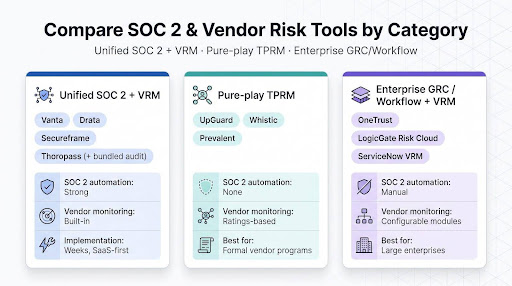
The fastest way to shortlist is to separate tools by what they actually do:
Unified SOC 2 automation plus VRM: built to run your internal SOC 2 program and manage vendor risk in the same system.
Pure-play TPRM: built to assess vendors, not to automate your own SOC 2 controls.
Enterprise GRC/workflow platforms with VRM modules: built for configurable workflows at scale, but typically manual for SOC 2 evidence.
Here is the grid view, updated for those distinctions.
Tool
Category
Best for
SOC 2 compliance automation
Continuous vendor monitoring
Pricing signal*
G2 rating
Free trial
Vanta
Unified SOC 2 + VRM
Mid-market and enterprise teams that want compliance, VRM, and trust workflows in one platform
Yes
Yes
Not publicly listed, demo required
4.6
Demo
OneTrust
Enterprise GRC + VRM module
Enterprises consolidating privacy, ESG, and vendor risk
No
Yes
Typically 50 K–200 K+ USD per year depending on modules
4.4
Demo
LogicGate Risk Cloud
Enterprise GRC + VRM workflows
Teams building bespoke vendor risk workflows
No
Yes
Quote
4.6
Demo
Thoropass
Unified SOC 2 + bundled audit
Teams that want software plus in-house auditors under one contract
Yes
Partial, audit-focused
Quote, audit bundled
4.7
Demo
UpGuard
Pure-play TPRM
Large vendor portfolios that need external security ratings and fast triage
No
Yes
Tiered by vendor count, free tier available
4.5
Free tier
*Pricing reflects observed ranges and vendor disclosures from the research inputs above. Confirm current rates and renewal terms during procurement. “SOC 2 compliance automation” refers to integration-based evidence collection and control testing for your own environment, not just workflow automation.
Best Practices To Get Full Value From Your VRM Platform
A tool will not earn you a clean SOC 2 opinion on its own. You get results when the platform is paired with a repeatable operating rhythm that produces evidence all year.
Start with a complete roster. Pull vendors from accounts payable, SSO logs, and expense cards, then tag which vendors touch customer data. Missing a single file-sharing app is an easy way to create an audit gap.
Tier vendors before you send a mountain of questionnaires. Critical vendors need deeper reviews and tighter monitoring. Low-impact vendors can follow lighter checklists. Most platforms let you set tiering rules once and apply them automatically to new suppliers.
Turn on every real-time feed you have. That includes security ratings, breach alerts, and expiration reminders for SOC reports and key attestations. When something changes, route it into the systems your teams already use. If your platform can open a ticket in Jira, enable it so remediation lands with the right owners immediately.
Create a cadence that generates audit-ready artifacts. Export and review vendor-risk reports quarterly, not just at year-end. Bring procurement and legal into the review so you can fix weak contract clauses before renewal cycles force rushed decisions.
Assign one accountable owner. Vendor risk programs stall when “everyone” owns them. Give one person clear responsibility for keeping reviews on schedule, resolving exceptions, and ensuring evidence is complete.
One operational note: if you are using a tool that focuses only on vendor assessments and does not automate SOC 2 evidence for your own environment, plan for how you will cover that gap. Auditors still expect proof that your internal controls and your third-party oversight ran continuously.
Frequently Asked Questions
Do we need a tool for SOC 2 vendor risk?
If you manage more than a handful of vendors, a tool is usually worth it. Spreadsheets capture a point-in-time snapshot. They cannot automate reminders, track expirations reliably, or create a clean, year-round evidence trail of ongoing reviews.
One important nuance is scope. Some tools in this list focus on vendor assessments only (TPRM) and do not automate your internal SOC 2 evidence. If you pick one of those, plan to pair it with a separate SOC 2 compliance automation platform.
Can we start with one framework and add others later?
Yes. Many platforms map controls across multiple standards so you can start with SOC 2 and expand into frameworks like ISO 27001 or HIPAA without rebuilding everything from scratch.
What about our customers’ questionnaires?
Tools like Vanta support Trust Center-style sharing. The goal is the same: replace repeated email threads with a single link and keep answers consistent.
How long does implementation take?
Dedicated SOC 2 automation platforms can connect quickly. Your remediation work will still determine the true timeline. Enterprise suites and workflow platforms like OneTrust often take months because they are designed to tie into broader GRC and IT processes.
Will these platforms replace our judgment?
No. They make monitoring and evidence collection more repeatable, but your team still sets risk appetite, approves exceptions, and works with vendors on remediation. Use the platform to surface issues early. Keep humans in the loop for decisions.
The best vendor risk management software for SOC 2 compliance depends on your size, maturity, and desired balance between automation depth and workflow flexibility. Unified platforms like Vanta cover both compliance automation and VRM in one place, while pure-play TPRM tools such as UpGuard excel at external assessments and information reuse. Enterprise GRC suites like OneTrust offer formidable scale but require longer implementations and heavier budgets. Match each tool’s strengths and pricing model to your audit timeline, vendor footprint, and future framework roadmap.