A property can look strong in photos and still be hard to understand. Buyers may want to check the room flow, ceiling height, view, floor plan, or building context before they book a visit. The best VR companies for real estate help when the property needs to be explored, compared, or sold before someone is physically there.
The right choice depends on the job the property has to do online. A broker may need a quick 3D tour so buyers can rule a listing in or out before visiting. A developer may need an off-plan walkthrough for a home that is still on paper, while the top VR companies for real estate also cover heavier work like digital twins, portfolio data, and space management.
Real Estate VR Companies At A Glance
Company
Location
Real estate focus
1. Treeview
Montevideo, Uruguay; New York, NY, US
Custom XR development and digital twins for complex assets
2. Matterport
Sunnyvale, California, US
3D virtual tours, digital twins and property marketing
3. iStaging
Taipei City, Taiwan
Smartphone-captured virtual tours and digital showrooms
4. PropVR
Dubai, UAE
VR walkthroughs and experience centres for large developments
5. Shapespark
Kraków, Poland
Browser-based 3D walkthroughs for off-plan sales
6. Limina Studios
Dubai, UAE
360° tours, CGI and digital twins for property marketing
7. Giraffe360
London, UK
Robotic 360° photography and AI-edited listing content
8. The Boundary
London, UK
Architectural visualization, CGI and off-plan sales platforms
9. ArchiCGI
San Francisco, California, US
CGI rendering and visualization for unbuilt property
10. Enviz
Crows Nest, New South Wales, Australia
VR walkthroughs and virtual display homes for developers
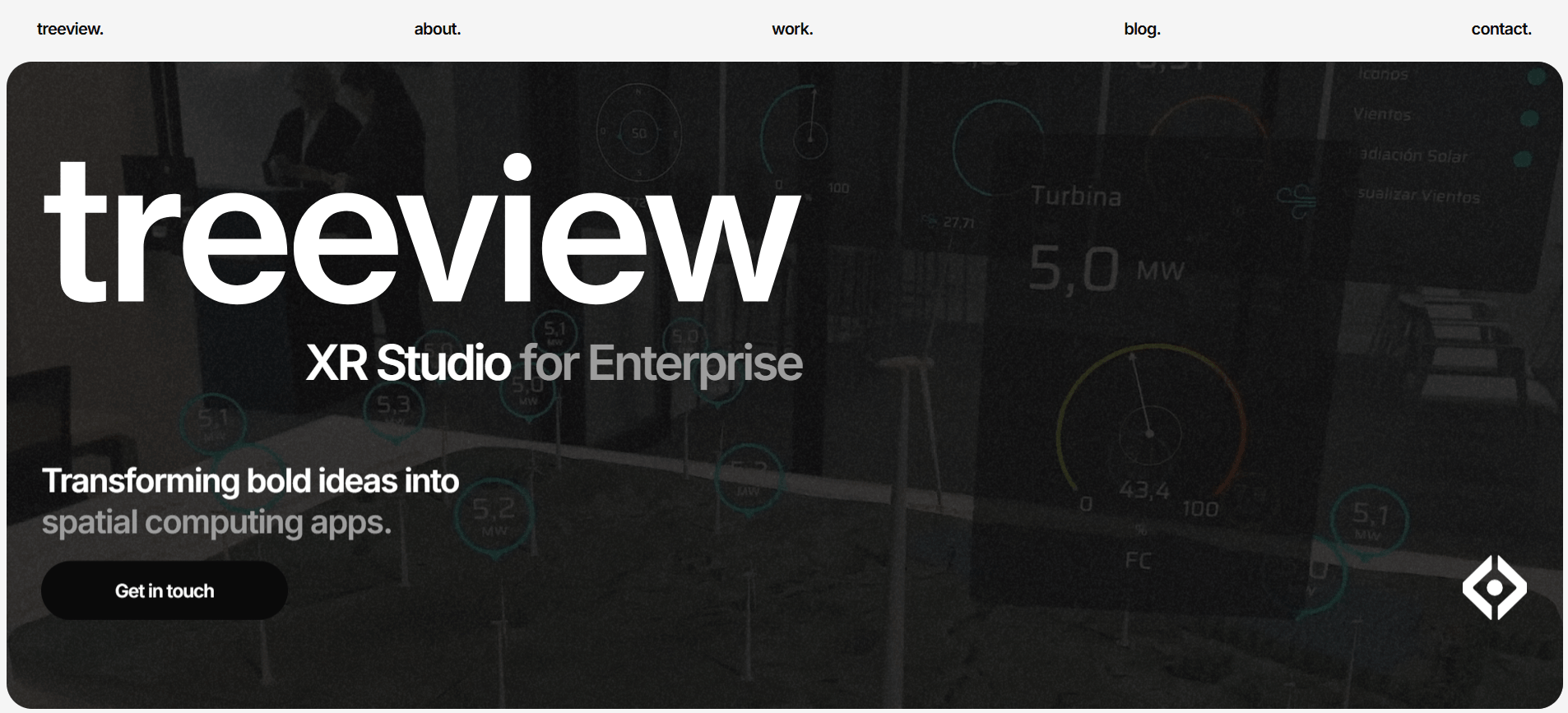
Enterprise property teams usually need more than a basic virtual walkthrough. Treeview fits real estate projects where the experience must connect to digital twins, spatial data, smart-city planning, or custom XR software. Its strongest use case is property work that has to explain complex assets, not just show a set of rooms.
The company is better read as an XR engineering partner than a simple tour vendor. That matters for developers, enterprise property owners, and innovation teams that need long-term control over immersive products. Among the top VR companies for real estate, Treeview belongs in the premium technical category.
Services & expertise: Custom AR/VR/MR development, spatial computing, enterprise XR apps, immersive simulations, AI-powered digital twins, spatial data visualization, Unity XR, VR apps for digital twins
Team size: 10–50 experts
Location: Montevideo, Uruguay; New York, NY, US
Portfolio: Microsoft, Meta, Medtronic, ULTA Beauty, Daiichi Sankyo, Transfr, University of Alberta, NEOM
Most agents do not need a custom VR build for every listing. They need a reliable way to capture a property once and turn it into a tour, floor plan, virtual open house, and listing asset. Matterport fits that practical need, especially for teams that manage many spaces and want the process to be repeatable.
The CoStar Group acquisition in 2025 gives Matterport more weight in real estate data, not just property visuals. That matters because listings, marketplaces, AI property insights, and building records are starting to overlap. For teams comparing the best virtual reality companies for real estate, Matterport is one of the clearest platform choices.
Services & expertise: 3D virtual tours, digital twins, listing tours, commercial real estate digital twins, property marketing, floor plans, remote viewing, Capture Services, BIM files, virtual staging, AI property insights
Team size: 501–1,000 experts
Location: Sunnyvale, California, US; now part of CoStar Group
Real estate teams that want fast online viewing without heavy hardware may find iStaging useful. The platform supports smartphone capture, virtual house viewings, floor plans, dollhouse-style tours, and immersive digital sales spaces. That makes it practical for brokers, agencies, developers, and teams that need accessible tools rather than fully custom production.
Its scale is the main proof point. The company references more than 100,000 paying customers and more than 1 million virtual spaces created through its tools. In virtual reality real estate, that kind of usage history matters because buyers need a platform that works across many locations and content types.
Large developments need sales tools that can explain scale before a buyer ever reaches the site. PropVR fits that situation well, especially for real estate groups working across major developments, smart cities, ports, airports, and high-value property launches. Its work goes beyond web tours into experience centres, digital replicas, VR walkthroughs, and interactive sales platforms.
The company’s proof is unusually direct for real estate. Public materials reference thousands of delivered projects, hundreds of clients, and patented immersive technology. Its DAMAC-related case study also points to a clear commercial use case — using immersive sales environments to support serious property revenue.
Services & expertise: 3D tours, digital twins, VR walkthroughs, AR, experience centres, web-based tours, digital replicas, smart-city planning, holographic displays, VR journeys, interactive surfaces, 3D rendering, animation, XR production
Team size: 51–200 experts
Location: Dubai, UAE; serves clients across India, the UAE, and Saudi Arabia
Selling an unbuilt property is awkward because there is nothing to walk through yet. Shapespark is useful when the 3D model already exists, but still images are not enough to answer basic buyer questions about flow, room size, and how spaces connect. For teams using VR for real estate, it works best as a simple way to turn a planned building into something people can open, move through, and judge before construction starts.
The practical advantage is sharing. A walkthrough can live in the browser, open on different devices, and support remote review without asking people to visit a construction site. That makes Shapespark a good fit for off-plan sales, architecture presentations, and real estate teams that need buyers to understand the space before it exists physically.
Services & expertise: Browser-based real-time rendering, online 3D walkthroughs, architectural visualization, real estate marketing visualization, interactive tours from 3D models, web sharing, mobile sharing, VR headset support, 3D meetings
Team size: 5 experts
Location: Kraków, Poland
Portfolio: Motion Wave, My3Ideas, real estate and architecture users creating interactive walkthroughs, 3D virtual tours, and online property presentations
Dubai property marketing often needs polished visuals, but it also needs local production sense. Limina Studios fits real estate teams that want 360° tours, CGI tours, digital twins, photography, video, and immersive 3D content from one creative technology partner. It is especially relevant for listings, developments, hospitality properties, and architectural presentations.
Limina’s regional work is useful proof because the projects are close to the kind of property marketing it sells. Residential, hospitality, community, and institutional spaces often need more than clean visuals; buyers and investors have to understand the setting, scale, and appeal of the place. Limina fits when the sales asset needs to look finished, explain the property clearly, and be easy to use in presentations.
Services & expertise: 360° virtual tours, CGI virtual tours, digital twins, Matterport tours, VR, AR, XR, 3D scans, 3D tours, photography, videography, AR navigation, mixed reality, real estate architectural visualization
Team size: 2–10 experts
Location: Dubai, UAE
Portfolio: ResiDual, Jumeirah Park District, The Lana Residence, The Ritz-Carlton Red Sea, Lincoln Star III, Major Developers’ CGI Virtual Tours, Royal Commission for AlUla, Dubai Medical University
Estate agents need speed as much as visual quality. Giraffe360 is built around that problem, with a robotic 360° camera and AI editing platform for property photos, virtual tours, floor plans, videos, websites, virtual staging, and social assets. It fits agencies that need listing content from a single property visit.
The company’s 2026 investment news gives it stronger proof of market traction. Public information describes clients in more than 40 countries and a team of more than 200 people across several markets. For an agency looking for a listing-production system rather than a bespoke studio, Giraffe360 has a very clear lane.
Services & expertise: 360° virtual tours, HDR real estate photography, 2D and 3D floor plans, LiDAR-precise capture, AI editing, cinematic videos, property websites, virtual staging, social media content, subscription tools
Team size: 200+ experts
Location: Founded in Latvia; offices in Latvia, the UK, and the US; headquarters moved to London
Portfolio: Robert Bell & Company, Poole Townsend, Your Move Nolan, Limehouse Ltd, Northgate Estate Agents, Thomas Morris, Bonners & Babingtons
Luxury developments and landmark properties need more than functional visualization. The Boundary fits projects where the visual standard has to support high-value off-plan sales, architectural storytelling, and interactive presentation. It is strongest for premium developers that need CGI, films, VR, digital twins, and sales technology to work together.
The Realspace platform gives the company a real estate-specific angle, not just a general visualization offer. Its acquisition of Buildmedia also adds city-scale and interactive property sales depth. If a buyer wants a VR real estate company with high-end architectural taste and platform thinking, The Boundary is one of the strongest fits here.
Location: London, UK; offices also listed in New York City and Auckland
Portfolio: Étoile, 1 Mayfair, The Residences at Mandarin Oriental, Mercedes-Benz Places, The Residences at 1428 Brickell, Kinma Valley, Park Quarter Realspace, Waldorf Astoria New York, 175 Park Avenue, The Whiteleys
Unbuilt property needs visuals that make the future space feel clear before sales start. ArchiCGI fits developers, architects, and real estate marketers that need CGI for pre-sales, investor decks, approvals, or listing campaigns. Its strongest place in real estate is not quick capture of existing spaces, but visualizing projects that buyers cannot walk through yet.
The studio has enough scale for ongoing production work, which matters when a developer needs more than one hero render. Its case-study base points to residential, multifamily, commercial, and mixed property marketing, including virtual tours and architectural animation. ArchiCGI is a practical choice when VR for real estate depends on strong CGI first.
Services & expertise: Architectural rendering, 3D virtual tours, exterior CGI, interior CGI, architectural animation, 3D floor plans, 360° views, real estate marketing visualization
Team size: 201–500 experts
Location: San Francisco, California, US
Portfolio: Oceanfront Estate in Carmel, City Gardens in Vermont, The Blend in San Diego, The Croft Medical Centre, Hetherington Newman showroom, nearly 100 CGI case studies
Unbuilt homes are difficult to judge from a floor plan. Enviz fits builders, developers, architects, CGI studios, and sales teams that need walkable spaces before construction. It helps buyers and stakeholders understand scale, flow, layout, and design choices while the property still exists as a model.
The platform is especially useful for residential developers and visualization partners selling off-plan property. Its work supports design sign-off, virtual display homes, pre-build sales, client presentations, and marketing assets. Enviz belongs among the top VR companies for real estate because its use case is narrow, practical, and directly tied to property decisions.
Services & expertise: Spatial visualization platform, AR/VR for unbuilt property, walkable 3D spaces, virtual display homes, design validation, client presentations, pre-build sales, AI renders, flythroughs, 1:1 scale VR walkthroughs, CGI studio workflows
Team size: 11–50 experts
Location: Crows Nest, New South Wales, Australia; locations also listed in New York, Ottawa, and London
Portfolio: Ivolve Studios, PREMIER3D, Desirum, 3DUS, Wavelength Coffs Harbour development collaboration, 50+ CGI and 3D art studio ecosystem
What Real Estate VR Services Include
Real estate VR covers a range of services, from quick virtual tours of existing listings to full immersive experiences for buildings that do not exist yet.
3D and 360° virtual tours: captured with specialized cameras or smartphones so buyers can walk through a listing online.
Digital twins: accurate 3D models of existing buildings used for marketing, facilities management and planning.
Architectural visualization: CGI renders and animations of unbuilt projects.
VR walkthroughs: immersive, headset-ready experiences of off-plan homes and developments.
Sales tools: interactive unit selectors, experience centres and virtual display homes for developers.
Listing content: photography, floor plans and edited media packaged for property portals.
How To Choose A VR Company For Real Estate
Match the service to the property stage. Existing listings need fast virtual tours, while off-plan projects need CGI, visualization and VR walkthroughs.
Check output formats. Confirm tours work on property portals, websites, phones and headsets your buyers use.
Review turnaround time. Agents often need tours within days, while large development visualizations can take weeks.
Ask about capture and hosting. Some platforms let you capture tours yourself, others send a team, and many charge ongoing hosting fees.
Consider location. On-site capture requires local presence, while CGI and visualization work can be done remotely. The table above shows where each company is based.
Virtual reality in real estate lets buyers and tenants explore a property digitally, either through 3D and 360° tours on a screen or immersive walkthroughs with a headset. It is used for existing listings, for off-plan developments that are not yet built, and for digital twins of commercial buildings.
How much does a VR property tour cost?
Cost depends on the type of tour, property size, whether a team comes on site or you capture it yourself, and whether hosting is billed separately. Simple 360° tours of existing homes are the most affordable, while CGI walkthroughs and full VR experiences for unbuilt developments cost much more. Many providers charge per property or per project, and some platforms use monthly subscriptions.
Are VR tours worth it for real estate listings?
They are often worth it when buyers are remote, the property is high value, or the project is not yet built. Virtual tours help buyers shortlist properties before visiting, which saves time for agents and sellers. For off-plan developments, VR and visualization can be the main way to show buyers what they are purchasing.
Can VR walkthroughs help sell properties before construction is finished?
Yes, that is one of the main uses. VR and 3D walkthroughs let buyers explore a space that does not exist yet, which helps with off-plan and pre-construction sales. On this list, Enviz focuses on AR/VR for unbuilt property and pre-build sales, ArchiCGI offers CGI for pre-sales, Shapespark is a fit for off-plan sales, and The Boundary and PropVR work with developers on large or premium projects.
A strong real estate VR project starts with the sales or operations problem. Are buyers comparing homes, reviewing an unbuilt unit, touring a commercial property remotely, or managing floor-plan data across a portfolio? That answer should decide whether the project needs capture tools, CGI, digital twins, XR development, or a spatial data platform.
The best VR companies for real estate do not just make the property look good. They help someone decide what to do next — book a viewing, approve a design, shortlist a unit, or understand a building without being there. Some companies are better for listings, some for luxury off-plan sales, and others for enterprise building data.
If you want to feature your real estate VR agency on this list, email us or submit a form in the Top Choices section. After a thorough assessment, we’ll decide whether it’s a valuable addition.