How to Choose AI Software for Medicare Advantage Risk Adjustment
Dominic Tarn
Content Writer - ReVerb
10.22.2026
Meta description: How to choose AI risk adjustment software for Medicare Advantage: map your workflow, demand chart evidence for every code and pilot against your own baseline.
A risk adjustment software demo should answer two questions for every suggested diagnosis: where the chart supports it and who reviews it before submission. A confidence score alone answers neither.
CMS describes risk adjustment as a way to estimate the cost of treating a patient in a given year based on that patient’s specific health needs.
For provider groups and health plans in Medicare Advantage, AI software can read clinical records, flag conditions for review and help coders judge what the documentation supports.
The hard part is choosing a tool that fits how your team actually works. This guide covers what to map before a demo, what evidence to demand and how to pilot before you sign.
Key Takeaways
Map one workflow and one bottleneck before you watch any demo.
Every AI suggestion should trace to a chart passage, its encounter context and a recorded reviewer decision.
MEAT is an industry mnemonic, not a CMS rule, so evidence links support coders rather than replace coding guidelines.
For 2027 payments, CMS kept the 2024 model and excluded diagnoses from audio-only encounters and most unlinked chart review records.
Run a pilot on synthetic or de-identified records and compare the results with your own baseline.
Start With One Risk Adjustment Workflow
AHRQ’s Workflow Assessment for Health IT Toolkit advises collecting workflow information as early as possible, preferably before implementing a health IT system. So before you book a demo, write down the exact process the software is supposed to change.
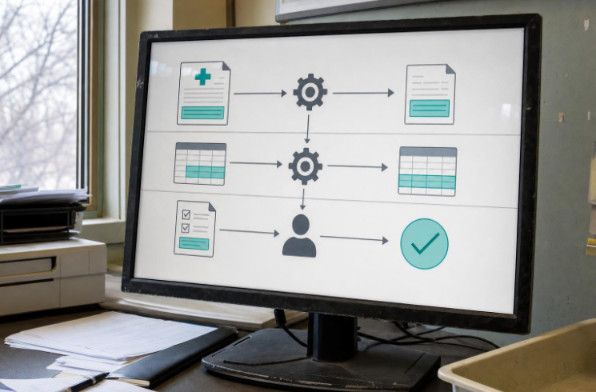
Map the handoff. Identify the source records, the action a person takes on a suggestion, the responsible role and where the approved result ends up. If that result must reach an electronic health record (EHR), a claim or a submission file, make it a requirement and ask the vendor to show that handoff live.
Choose the review stage. Pre-visit support flags possible conditions before an encounter so the clinician can address them. Post-visit validation compares the documentation with the claim, while retrospective review checks completed encounters for missed conditions and for codes without support. Each stage has different reviewers and timing.
Name the accountable reviewer. HCC stands for hierarchical condition category, the grouping CMS uses to organize diagnoses for risk adjustment. Clinicians decide whether the patient has a condition and document it. Coding staff decide whether that documentation supports the code under applicable rules.
More suggestions or higher risk scores don’t prove better performance, because unsupported suggestions simply add review work.
Pick one bottleneck and record your current numbers, such as charts per reviewer, minutes per chart and rework rate. Then ask each vendor to show how its software would move those numbers.
Ask Vendors to Show the Evidence
For every suggestion, a reviewer should be able to inspect the source text, the encounter date, the encounter type and the explanation linking that evidence to the condition.
Trace each suggestion. Ask the vendor to walk through three synthetic cases: one clearly supported, one unsupported and one ambiguous. Look for the source passage, the encounter context and clear options to accept, reject or query. Check that rejected suggestions and the full decision history can be exported.
Look at how evidence is packaged. MEAT is a documentation mnemonic for checking whether a chart shows a condition was monitored, evaluated, assessed or treated. It is industry shorthand rather than a CMS standard, and codes still have to follow the ICD-10-CM Official Guidelines for Coding and Reporting.
Evidence links help coders find documentation faster, and this is where vendors differ most. RAAPID, for example, offers risk adjustment solutions that pair two-way retrospective coding, adding missed diagnoses and removing unsupported ones, with MEAT evidence attached to every HCC.
The same platform covers prospective work from pre-visit planning through post-visit HCC coding validation, plus a RADV module that runs evidence-first checks, generates export files and tracks responses with audit trails.
Test additions and corrections. A useful tool should catch both supported conditions that were missed and conditions coded without support. Include both kinds of error in your test set.
RADV stands for Risk Adjustment Data Validation, the CMS audit program that checks whether submitted diagnoses are supported by medical records.
CMS released its payment year 2024 RADV audit methods for selected contracts on August 28, 2026. Audit software can help organize a response, but it cannot guarantee the outcome.
Check the Model and Payment Year Rules
CMS’s CY 2027 Rate Announcement, released April 6, 2026, kept the 2024 CMS-HCC risk adjustment model for non-PACE Medicare Advantage organizations instead of moving to a recalibrated model. Because the model is prospective, 2027 risk scores rely on diagnoses from 2026 dates of service.
For 2027 risk scores, CMS also excluded diagnoses from audio-only encounters and diagnoses from unlinked chart review records. The one exception covers unlinked records for beneficiaries who switch from one Medicare Advantage organization to another.
Ask each vendor how the software identifies encounter type and record linkage so reviewers can see which diagnoses are eligible. If you work across programs, confirm which models and submission rules the software supports.
Use the checks below to structure demos, and confirm your specific requirements with coding and compliance staff.
Criterion
Proof to request
Warning sign
Source traceability
Live walkthrough from suggestion to the exact chart passage and encounter
Suggestions shown with a score but no source text
Human approval
Exportable reviewer log with accept, reject and query states
Codes that can reach a claim without a recorded reviewer action
Update and version controls
Release notes showing when model logic or code sets changed and who approved the changes
Automatic updates with no change history
Test the Complete Workflow Before Buying
Run a representative pilot. Use synthetic records or de-identified records approved through your privacy process. Include ordinary charts alongside hard cases such as missing documentation, conflicting notes and suggestions that should be rejected.
Set acceptance criteria with the staff who will review the results. Their sign-off criteria should be agreed before the pilot starts, not after.
Clear the technical and privacy checks. Before any patient records move, have technical and privacy reviewers confirm the EHR and version, how data is exchanged and the permissions needed to update records.
They should also review exception handling, the scope of the business associate agreement (BAA), data retention and recovery if the connection fails. If the EHR connection needs custom work, bring experienced healthcare software developers into these reviews early.
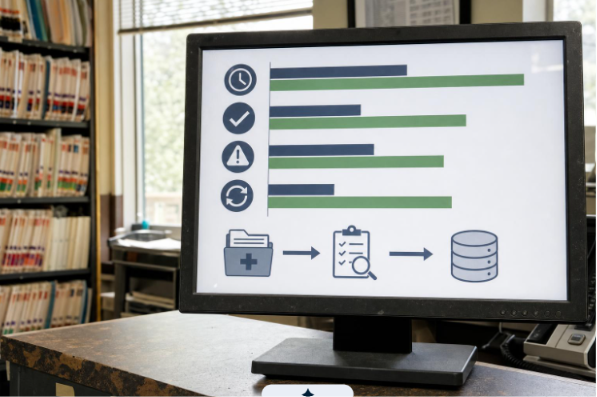
Count the work that remains. Compare the pilot with your baseline on four points: review time per chart including corrections, agreement between suggestions and qualified reviewers, unresolved exceptions and completion of required updates in the destination system.
General-purpose AI workflow tools can automate the handoffs around a review, but the coding decision itself should stay with qualified staff.
Price the agreed scope. Request itemized costs for software, implementation, integration, training and any optional coding or audit services. Have each proposal state which review steps your staff will own and which services the vendor will provide.
Final Thoughts
The right risk adjustment software makes every suggestion traceable and every decision accountable. Start with one workflow, demand evidence for each suggestion and confirm the tool handles the 2027 CMS rules.
A pilot measured against your own baseline will tell you more than any demo. If the numbers hold up with your reviewers in the loop, you have found a tool worth buying.
FAQ
What should an AI risk adjustment demo show?
It should trace each suggested diagnosis to the exact chart passage and encounter, then show a reviewer accepting, rejecting or querying it. A confidence score without source text isn’t enough.
Is MEAT a CMS requirement?
No. MEAT is an industry mnemonic that helps coders check documentation, while coding still has to follow the ICD-10-CM Official Guidelines for Coding and Reporting.
What changed for 2027 Medicare Advantage risk scores?
CMS kept the 2024 CMS-HCC model and excluded diagnoses from audio-only encounters and unlinked chart review records, with an exception for members who switch Medicare Advantage organizations.
Can software guarantee a good RADV outcome?
No. Audit tools can organize evidence and responses, but results depend on whether the medical records support the submitted diagnoses.