SEM Strategy: How To Build A Search Engine Marketing Plan
Dominic Tarn
Head of Content
10.21.2020
You may have heard about the SEM strategy many times but do you know what it really means?
Don’t confuse it with SEO (search engine optimization)! Although both refer to search engines, SEM (search engine marketing) is a separate marketing direction that requires a unique approach and strategy.
I’ve already explained the basics of SEO writing, as well as the local SEO, so now let’s complement our knowledge base with a guide to SEM strategy.
You’ll know:
What does SEM stand for?
What is the difference between SEO and SEM?
How to create a search engine marketing strategy for your business from scratch
What tools you should use for running effective SEM campaigns
Let’s start!
What Does SEM Stand For: Difference Between SEO Strategy and SEM Strategy
Search Engine Marketing (SEM) is a process of attracting target users via paid ads that become visible on the top positions of Google’s search results.
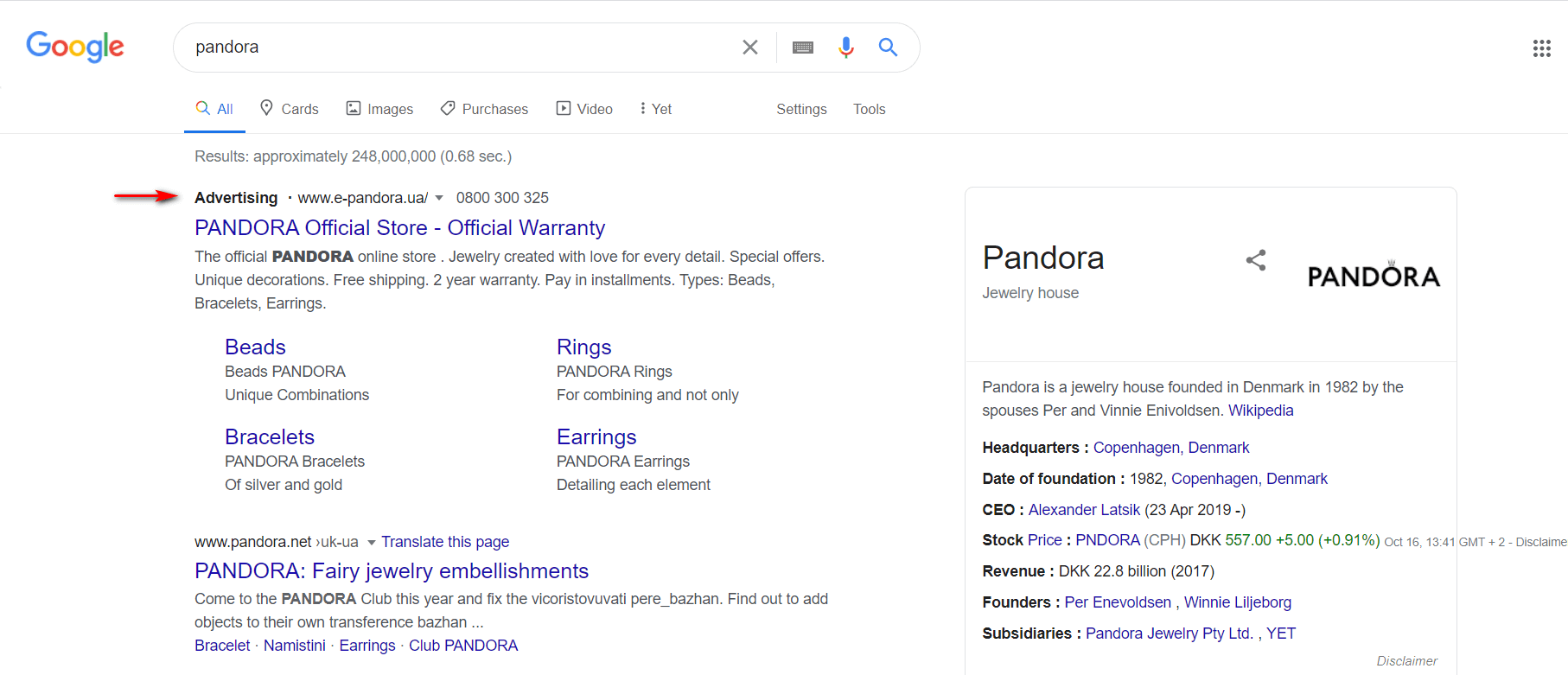
Here is how SEM works: When you search for a specific product or service, the first search results are promoted and paid links marked as “Advertising.”
For example, when you enter Pandora into the search bar, the first result you see is paid advertising, while the second is an organic search result. This is where the major difference between SEO and SEM is detected.
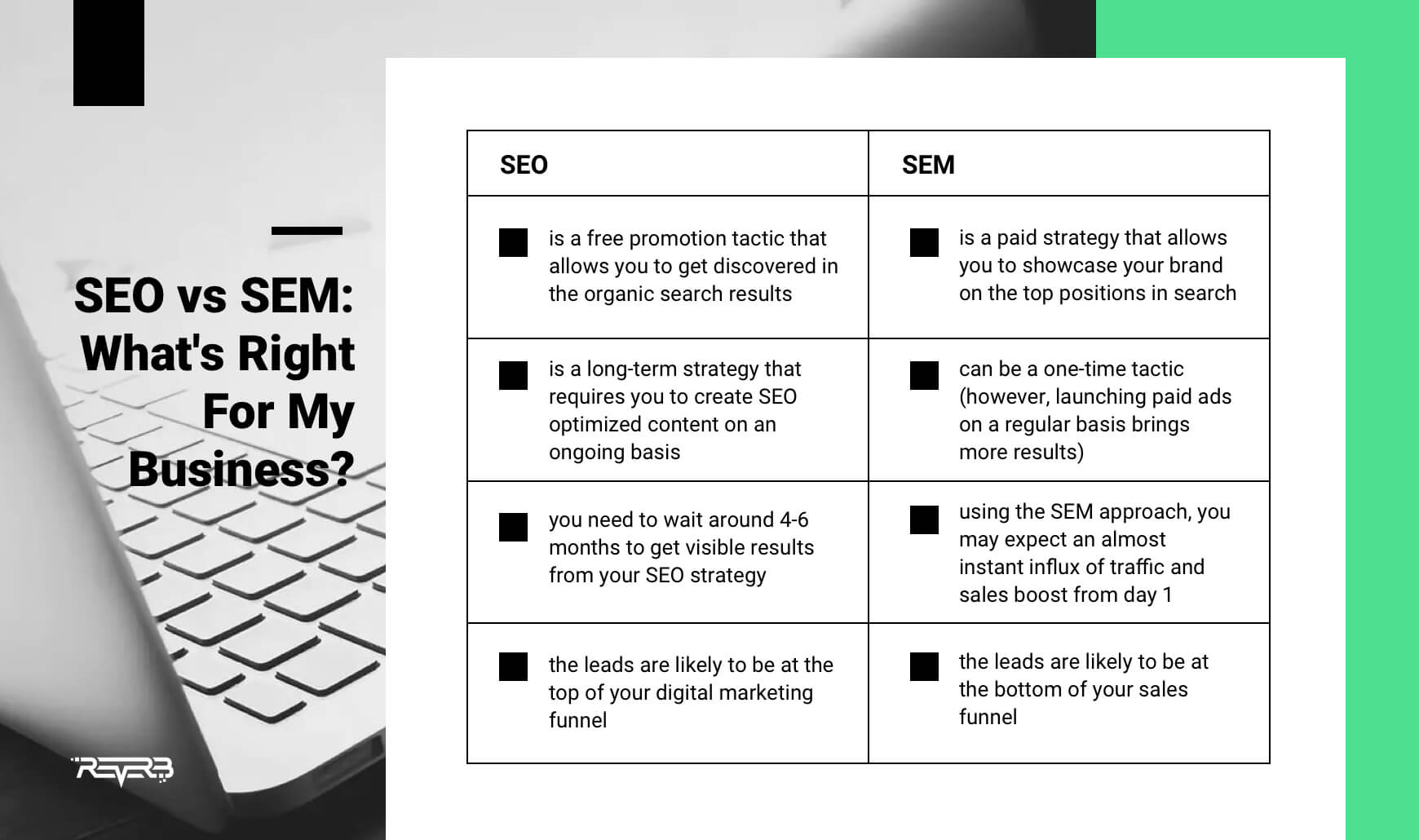
Let’s compare SEO and SEM strategies in detail using a comparison table:
But still, search engine optimization and search engine marketing strategies have something in common. For example, to succeed with an SEM campaign, you should pick up the winning keywords in the same way as you do for SEO promotion.
Benefits of SEM Strategies
How do you select which direction to use?
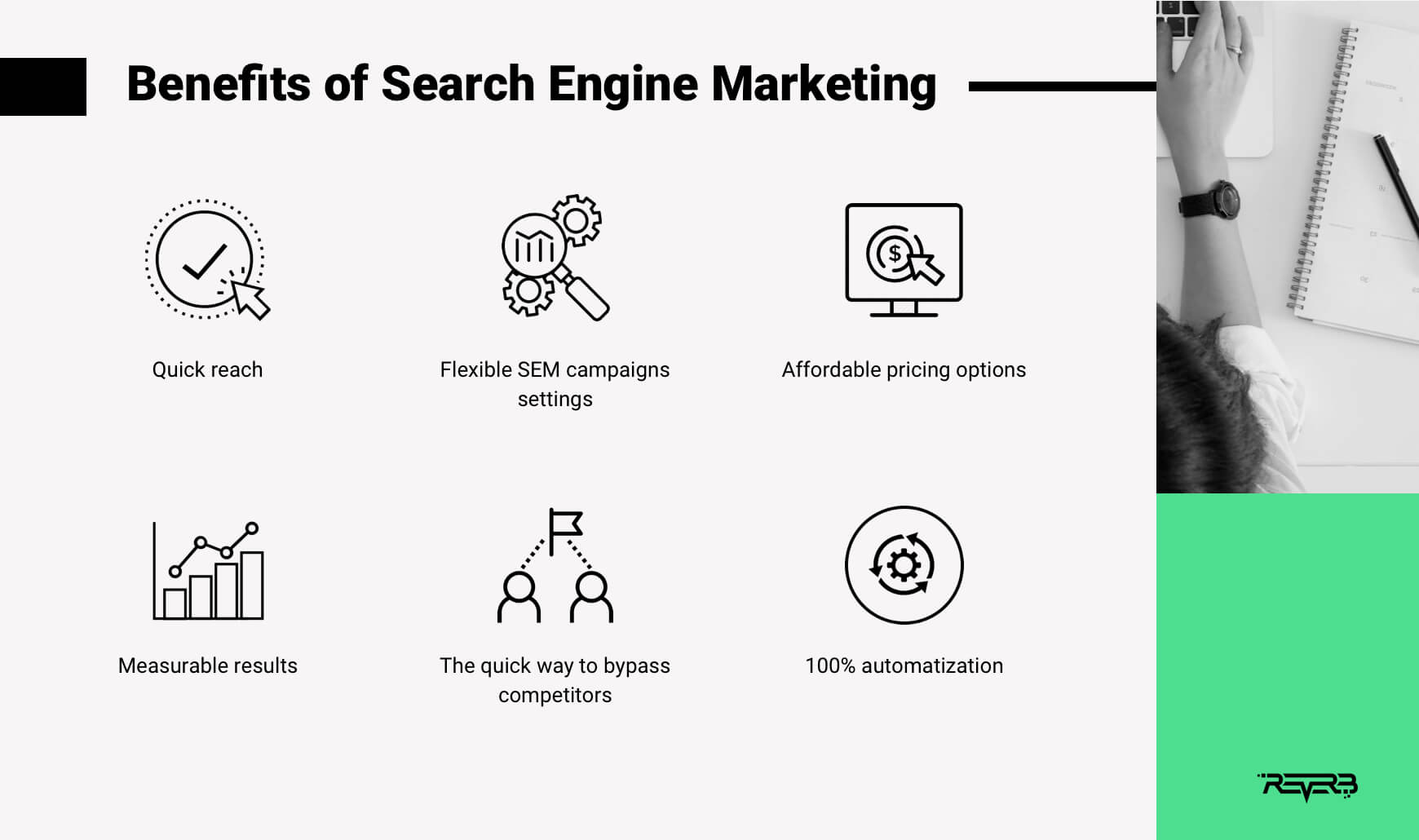
Well, by using search engine marketing strategies, you’ll get these benefits:
Quick reach. The payoff from SEO promotion cannot be instantaneous as the idea is to attract as many referring domains as possible to increase the site’s Domain Authority and improve website ranking. SEM offers completely different strategies to market your business. Paid search marketing advertising brings you to the top results immediately after launch.
Flexible SEM campaign settings. Google Adwords offers very flexible settings for your search engine marketing campaigns. You can choose the desired language, location, audience, and budget, plus customize and personalize your advertisements.
Affordable pricing options. Google Adwords also allows managing your marketing budget in the way you like. For example, you may choose a pay per click (PPC) or pay per impression (PPI) option.
Measurable results. Google Adwords + Google Analytics integration provides you with clearly measurable results in a convenient interface.
The quick way to bypass competitors. It’s quite difficult to compete with companies who are at the top results in the organic search. SEM strategy is one of the best ways to get discovered by your key sales queries on the first page immediately.
100% automatization. Being one of the top SEM tools, Google Adwords allows you to improve and relaunch your SEM campaigns on autopilot.
Search Engine Marketing Tips to Create Your First SEM Strategy
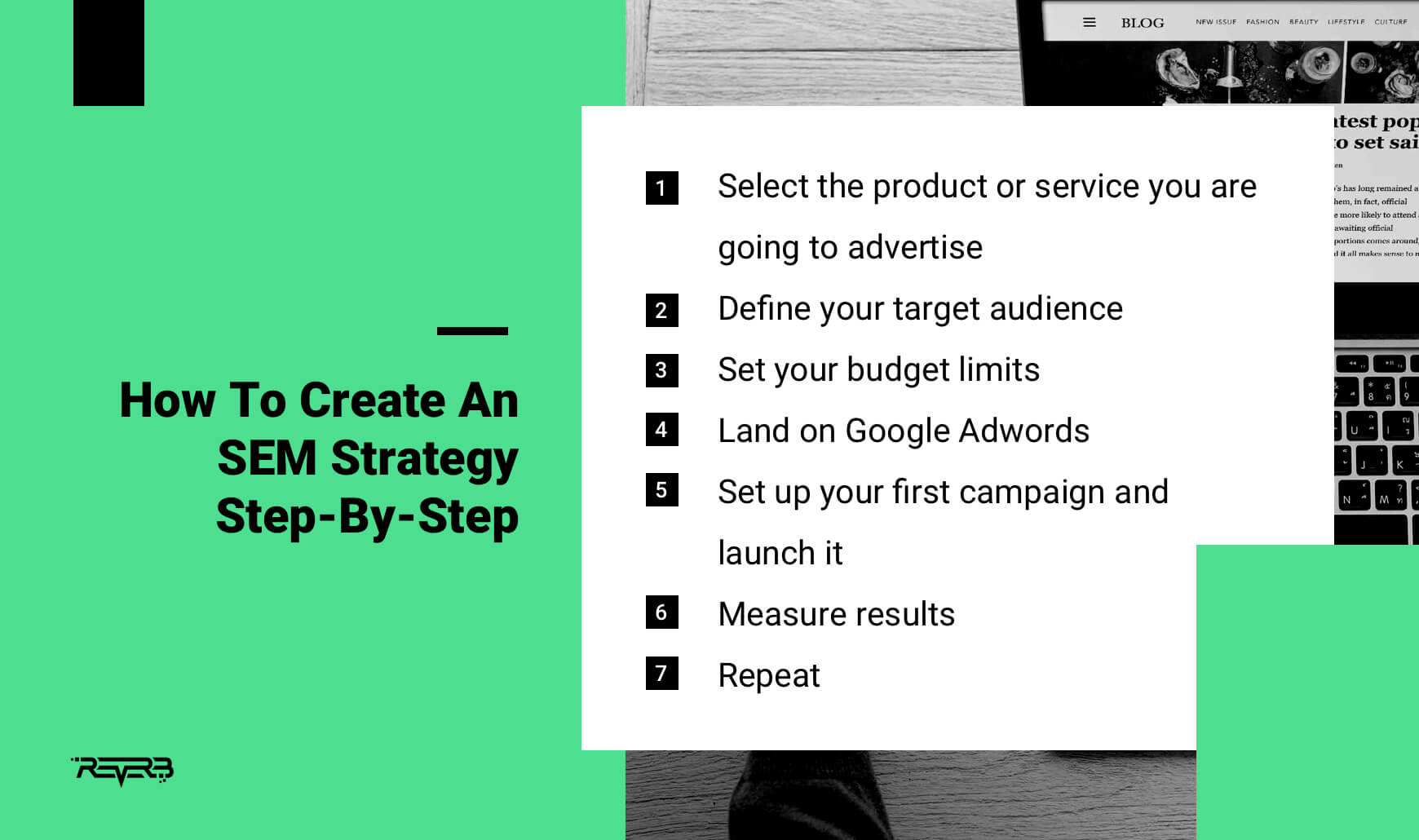
The benefits of having an SEM strategy for your business are already clear, so let’s find out how to come up with search engine marketing strategies step-by-step.
1. Select the product or service you are going to advertise.
If you are just starting to develop your search engine marketing strategy, start by choosing the product you want to advertise.
The best option is to opt for a bestseller, although your choice of product will largely depend on the audience you are targeting. For example, if it is a custom audience, then the product should match their interests and previous behavior on the site.
2. Take one more look at your target audience.
Next, you need to refine the category of your target users again. Google Adwords allows you to both set up an audience based on location, demographics, and behavior, as well as create a custom audience from your customers.
3. Set your budget limits.
It’s better to start with a small budget and a test run of your ad. Further, after analyzing the result, you can raise your bets or change your strategy.
4. Land on Google Adwords.
This is the core tool you need to get started with your SEM campaign. Get registered on this platform, specify the information about your business, and proceed to set up your first campaign.
5. Set up your first campaign and launch it.
This is the most difficult part of the whole venture. Google Adwords has a lot of settings that are confusing. What’s more, your ad copy is also very important.
You should be aware of numerous search engine marketing tips. For example, pay attention to the headline – you will have only 30 characters to tell the most important thing about your business and motivate users to proceed to your website.
6. Measure results.
Google Analytics integration will help you with tracking your results and measuring your ROI (return on investment – the main SEM metric). Surely, you should keep these results in mind while running the next SEM campaigns.
7. Repeat.
Was your SEM campaign a success? Well, why not continue it? Refine the possible flaws and keep it going to repeat high results!
SEM Plan At A Glance
Use this table as a quick summary of the steps above when you build your own search engine marketing plan.
Step
What to do
1. Choose what to advertise
Pick the product or service to promote first, ideally a proven seller that matches the audience you plan to target.
2. Define your audience
Refine targeting by location, demographics and behavior, or build a custom audience from your existing customers.
3. Set a budget
Start with a daily budget you are comfortable testing with, and increase it only once you know which campaigns convert.
4. Research keywords
Use tools such as Keyword Planner to find terms with clear buying intent, and add negative keywords to filter out irrelevant searches.
5. Build and launch the campaign
Set up the campaign in Google Ads, write ads that match each keyword group, choose a bidding strategy and launch.
6. Measure results
Track conversions, cost per conversion and return on ad spend in Google Analytics or your ad platform.
7. Optimize and repeat
Pause weak keywords and ads, test new copy and landing pages, move budget to what performs and repeat the cycle.
Winning Search Engine Marketing Strategies You May Implement Right Now
Do you want more practical search engine marketing tips? Here are seven proven ways to make your SEM campaigns even more effective!
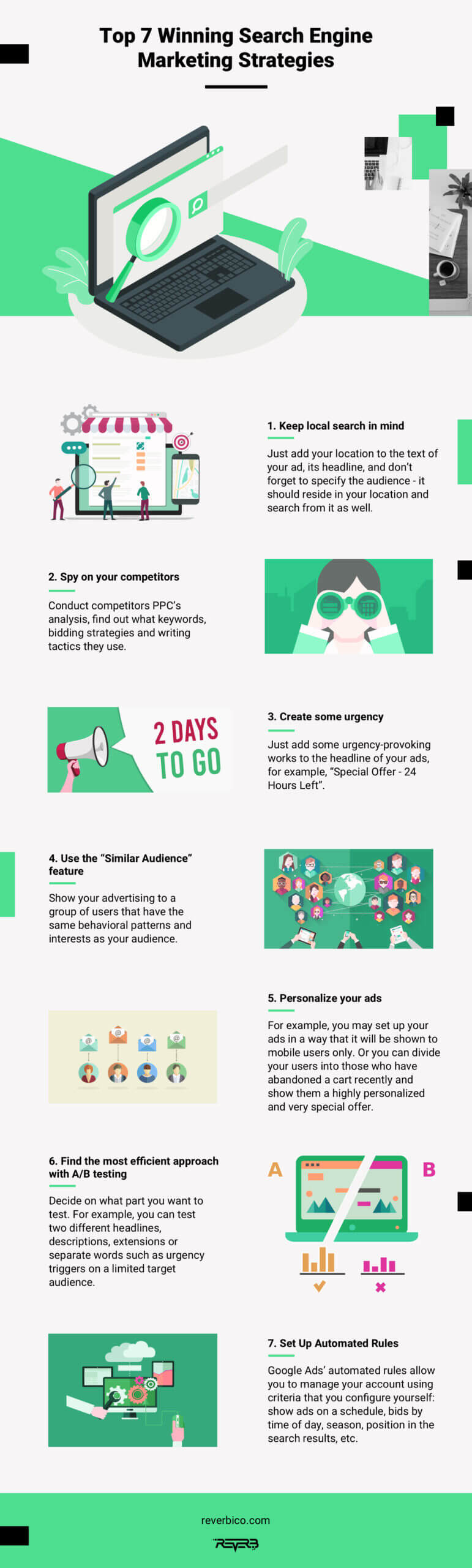
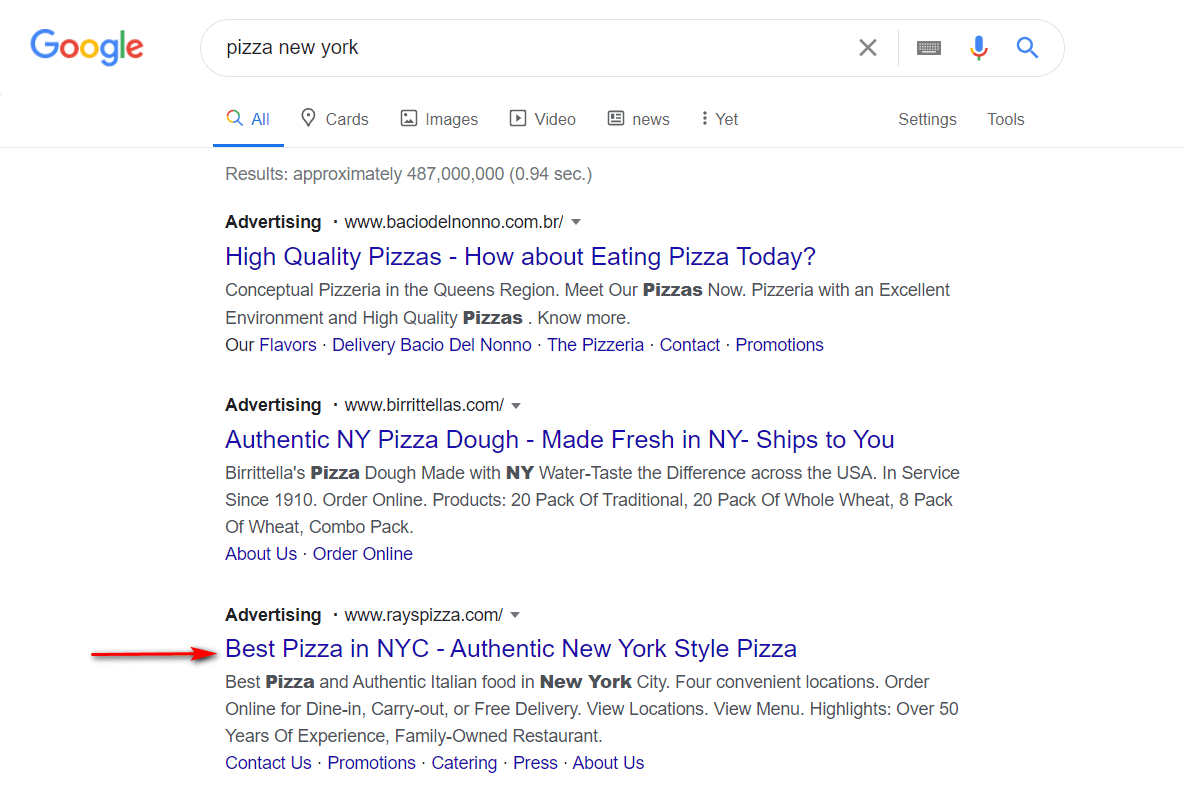
#1 SEM Strategy – Keep local search in mind
46% of Google searches are searching for local businesses. So, if you are selling goods or providing services locally, the SEM campaign is one more chance to get discovered.
Just add your location to the text of your ad, its headline, and don’t forget to specify the audience – it should reside in your location and search from it as well.
Our ultimate guide to local SEO will come in handy since a lot of rules are interconnected here. For example, an approach to selecting the geo-oriented keywords.
#2 SEM Strategy – Spy on your competitors
I bet that your top competitors are actively using search engine marketing. It’s a brilliant practice to analyze their campaigns and take the best insights for your SEM strategy.
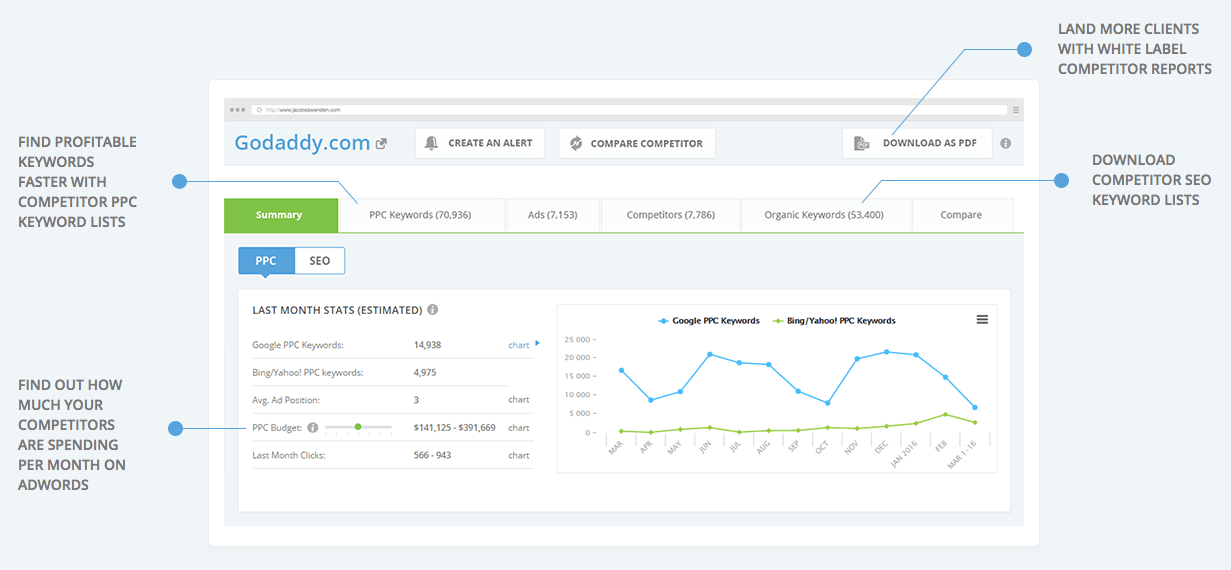
Conduct competitors’ PPC analysis and find out what keywords, bidding strategies, and writing tactics they use. Using SEMRush, you’ll be able to compare your advertising efforts with the efforts of your competitors, and such SEM tools as SpuFu and iSpionage will give you access to their ads’ copies (I’ll tell you more about the helpful SEM tools later on).
iSpionage review dashboard
#3 SEM Strategy – Create some urgency
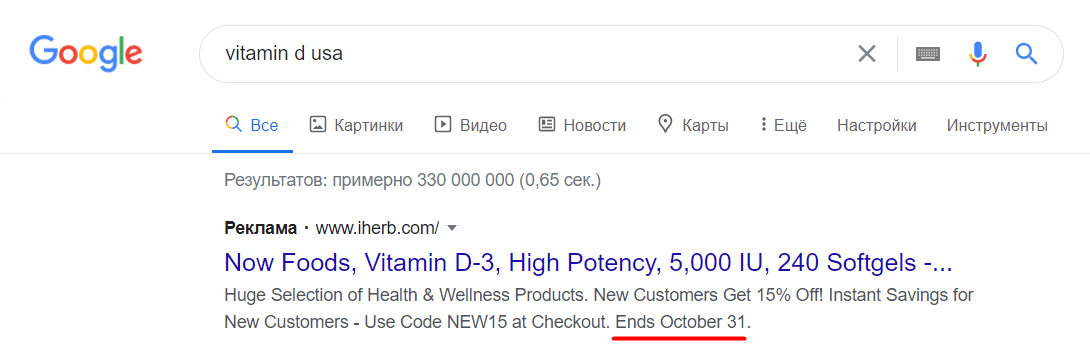
The feeling of urgency is a great trigger to motivate people to buy so you should use it throughout your marketing strategy, particularly, in paid advertising.
Just add some urgency-provoking works to the headline of your ads, for example, “Special Offer – 24 Hours Left” or “Ends {when}.”
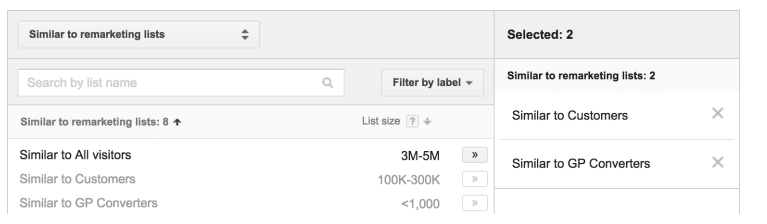
#4 SEM Strategy – Use the “Similar Audience” feature
This Google Adwords feature allows showing your advertising to a group of users that have the same behavioral patterns and interests as your audience. The idea is to expand the reach of your best-performing audiences by targeting new users with similar characteristics to your site visitors.
This is a great way to generate more leads and attract qualified traffic to your website.
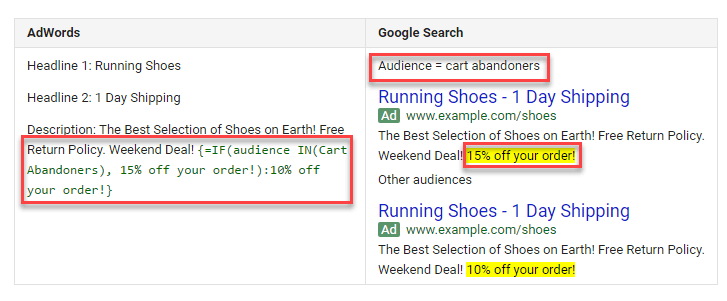
#5 SEM Strategy – Segment and personalize your ads
As I have stated, Google Adwords allows very flexible settings to personalize and segment your ads campaign. For example, you may set up your ads in a way that it will be shown to mobile users only.
Or you may segment your users in a more sophisticated way. If you use a custom audience uploaded to Google Adwords, you may divide your users into those who have abandoned a cart recently and show them a highly personalized remarketing ad with a very special offer.
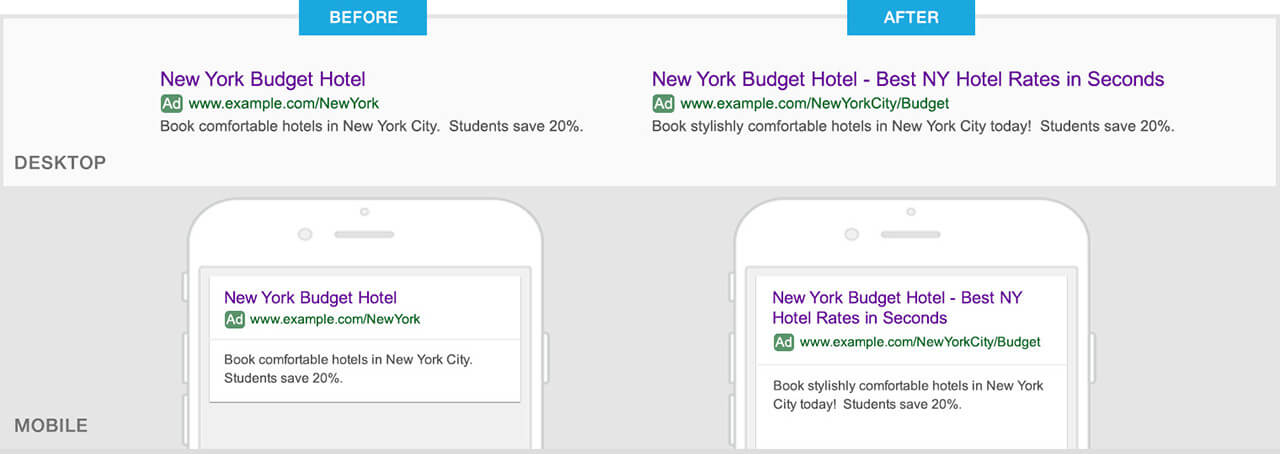
#6 SEM Strategy – Find the most efficient approach with A/B testing
A/B testing is a versatile marketing technique that helps you determine the winning visual/textual solutions for any campaign.
When it comes to testing paid ads, first off, you should decide on what part you want to test. For example, you can test two different headlines, descriptions, extensions, or separate words such as urgency triggers on a limited target audience.
Then, compare results and determine which phrasing motivated the experimental audience the best. Apply the winning version to the rest of the audience.
#7 SEM Strategy – Set Up Automated Rules
Good news – it’s not necessary to constantly track statistics and make changes to the ad campaign manually. Google Ads’ automated rules allow you to manage your account using criteria that you configure yourself: show ads on a schedule, bids by the time of day, season, position in the search results, etc.
By setting up automation in your account, you can eliminate the human factor in certain situations. This is especially true when massive changes need to be made and nothing to be overlooked.
However, make sure that you did everything correctly before setting automated rules – otherwise, there is a risk of wasting the budget.
The Must-Have SEM Tools for PPC Specialists
Using these affordable (or even free) SEM tools, you’ll be able to create a truly fruitful SEM strategy:
Foundation – Google Adwords
As you have already understood, you should create and set up your SEM campaigns in Google Adwords. This SEM tool is quite flexible, however, it may be challenging to use it for the first time.
What’s more, there is a risk of missing an important detail and wasting your advertising budget. That is why it makes sense to have SEM consultants nearby when you are just getting started with search engine marketing.
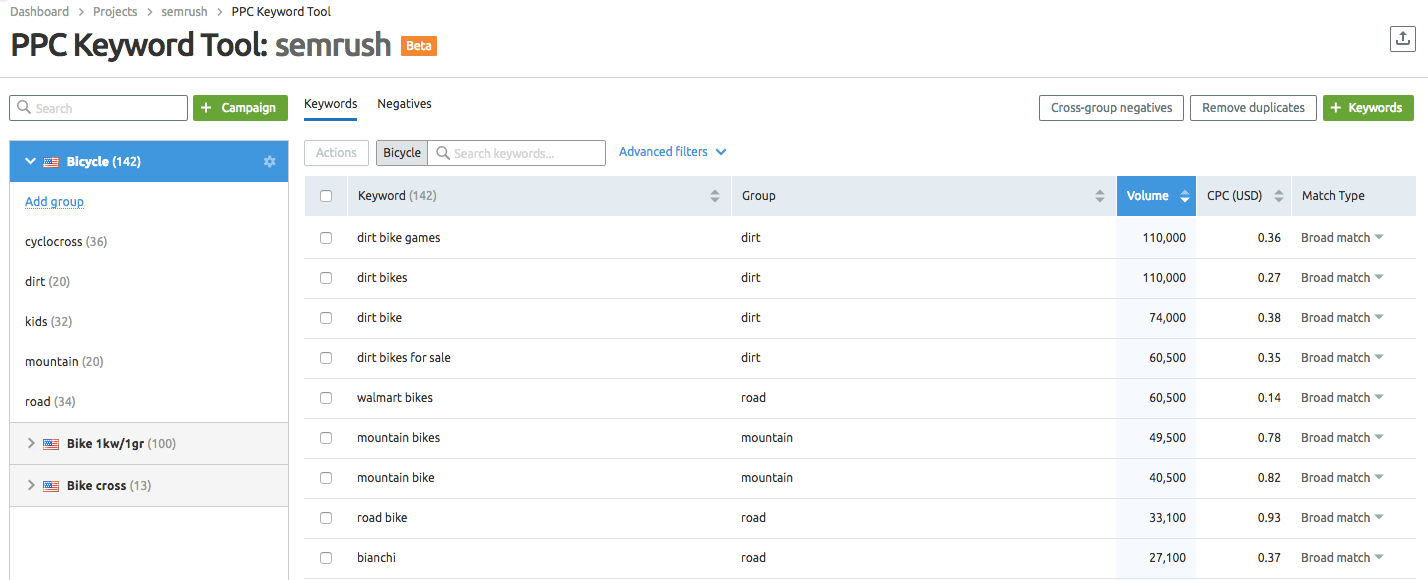
These are all-in-one PPC management tools. The selection of the winning keywords is only one of their top-notch features. Apply the selected keywords to your targeted ads, local and on-page SEO, and generate hashtag ideas for your social media marketing.
SEMRush keyword research tool
What’s more, with the help of these SEM tools, you can create, distribute, and optimize your content, research the market, get your competitors’ SEO/SEM insights, and leverage your SEM strategy.
For Content Enhancement – ChatGPT, Paraphrasing Tool, Bard, Copyblogger
These tools are extremely handy when it comes to using them for your content writing tasks.
Generative AI tools like ChatGPT, Bard, Claude and many others help you with research and generating ideas while tools like reword generator, copyblogger and paraphrase online help you enhance content quality. You can use these tools for free to take your SEM efforts to the next level.
For ROI Measurement – Google Analytics, WordStream, OWOX
WordStream, Varos and OWOX great alternatives to Google Analytics because of their simplified interface, better reports visualization, and overall user-friendliness.
Using these SEM tools, you may analyze your click-through rate, conversion rate, quality score, impression share, and account activity, plus compare the results from each of your campaigns to find the best strategic insights ever.
Good to know: For efficient execution of your SEM campaigns, consider utilizing project management templates. These files can help streamline your workflow, track tasks, and implement your SEM strategy effectively. Whether you’re working with a team or managing campaigns independently, project management templates can be a valuable resource to keep everything organized. They provide a structured approach to planning, executing, and monitoring your SEM efforts, helping you achieve better results and optimize your advertising budget.
SEM Campaign Management Checklist
Once your campaigns are live, SEM becomes an ongoing management job. Work through this checklist on a regular schedule:
Conversion tracking: confirm that purchases, leads and calls are recorded correctly before you judge any campaign.
Search terms report: review the actual queries that triggered your ads and add irrelevant ones as negative keywords.
Keyword performance: raise bids on keywords that convert profitably and lower or pause those that spend without results.
Ad copy tests: keep at least two ad variations running in each ad group and replace the weaker one over time.
Landing pages: make sure each ad sends visitors to a page that matches the promise in the ad and loads quickly on mobile.
Budget pacing: check that campaigns are not running out of budget early in the day or overspending on low-value traffic.
Audience and location settings: adjust bids by device, location and audience segment based on what the data shows.
Automated rules and alerts: use rules to pause underperforming ads or notify you of sudden cost spikes.
Reporting: compare cost per conversion and return on ad spend against your targets, not just clicks and impressions.
When To Hire An SEM Agency
Many businesses run their first campaigns in-house. It usually makes sense to bring in an SEM agency when paid search becomes a significant share of your marketing budget, when results have stalled despite regular optimization, or when nobody on your team has the time to manage campaigns every week.
A good agency brings experience across many accounts, established testing processes and familiarity with advanced features such as automated bidding, audience layering and feed-based shopping campaigns. When you compare agencies, ask how they report results, who will manage your account day to day, how they charge (a percentage of ad spend, a flat monthly fee or a performance-based model) and whether you keep ownership of the ad account and its data.
An SEM strategy is a plan for using paid search ads, mainly on Google and Bing, to reach people who are actively searching for your products or services. It defines what you will advertise, who you will target, which keywords you will bid on, how much you will spend and how you will measure results. A good strategy also includes a routine for testing and optimizing campaigns over time.
What is the difference between SEM and SEO?
SEM usually refers to paid search advertising, where you pay for ad placements on search results pages, often per click. SEO is the work of improving your website so it ranks in the unpaid, organic results. SEM delivers traffic as soon as campaigns go live and stops when you stop paying, while SEO takes longer to build but keeps producing traffic without a per-click cost.
How much should you spend on SEM?
There is no single right figure. Your SEM budget depends on the cost per click in your industry, how many conversions you need, what a customer is worth to you and how competitive your keywords are. A practical approach is to start with a test budget, measure your cost per conversion and scale spending on the campaigns that are profitable.
Conclusion
Despite all its seeming simplicity, creating a highly-effective and result-driving SEM strategy for your business may be challenging. Our full-service digital marketing agency has a team of qualified SEM consultants on-board who are ready to help you with all the subtleties of search engine marketing.
Get in touch with us right now to see your PPC ROI skyrocket!