Top AI Branding Agencies For Artificial Intelligence Companies In 2026
David Roberts
Founder & CEO - Reverb
08.10.2026
Artificial intelligence companies have a branding problem the rest of technology does not.
Model capability converges faster than positioning can keep up, and a differentiator that held for two quarters evaporates when a competitor ships something comparable. What buyers ultimately choose between is whether a company feels precise, safe, fast, serious or approachable.
The category has also developed a visual sameness that works against everyone in it. Soft radiating marks and the same three or four typefaces now signal AI so reliably that they signal nothing else. Standing apart requires an agency that understands both the technical substance and the reasons the conventions emerged. The studios below approach that from different directions, and the right one depends heavily on stage and audience. Teams evaluating positioning for enterprise software buyers will also find useful context in our review of B2B SaaS branding agencies, since much of AI purchasing still runs through familiar enterprise procurement paths.
Agency
Location
Focus
Documented Relevant Work
View Source
New York, NY
Brand and digital for technical products
Garden, ICON, First Street
Koto
London, LA, NY, Berlin, Sydney
Global brand identity
Microsoft Copilot+PC, Amazon XCM
Ramotion
San Francisco, CA
Brand identity plus product design
Murf AI, Borea AI, ML tooling
Instrument
Portland, OR
Digital-native brand and experience
Google, Spotify, Nike
Moving Brands
Global
Brand systems at scale
Netflix, BBC, Salesforce
COLLINS
New York and San Francisco
Category-defining identity
Enterprise and consumer transformation
Focus Lab
Atlanta, GA
B2B software branding
Trello, Calendly, Salesloft
Smith & Diction
Philadelphia, PA
Boutique identity and copy
Perplexity
Metabrand
Global
Early-stage tech branding
Y Combinator portfolio companies
Red Antler
Brooklyn, NY
Launch and category creation
Casper, Allbirds, Hims
Best Branding Agencies For AI Companies and Machine Learning Startups
Choose View Source when the brand and the product interface have to be designed as one thing.
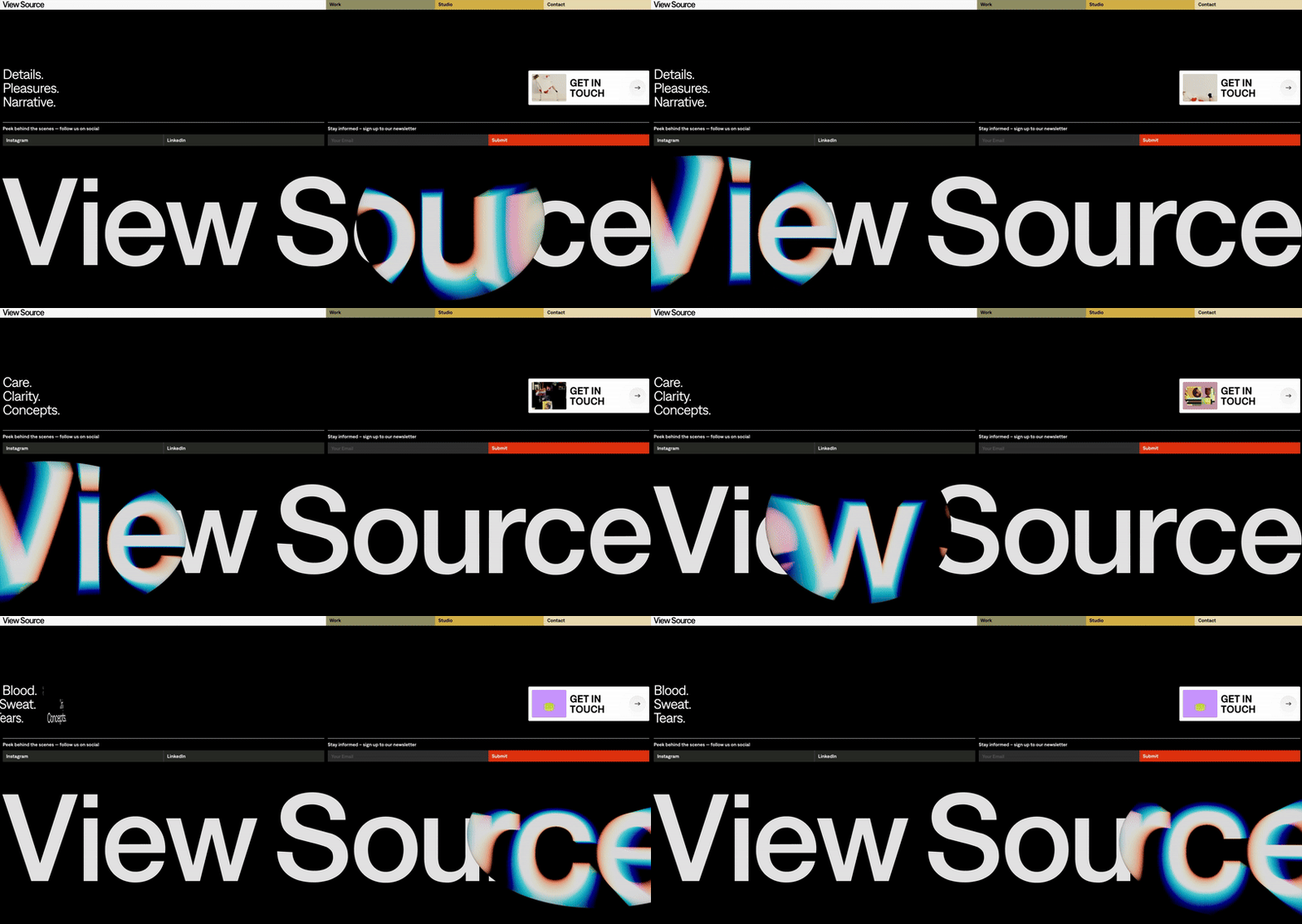
View Source is a design and technology studio in New York that treats identity and engineering as a single practice. The relevant work for AI companies is Garden, a patent intelligence platform applying large-scale AI across a corpus of more than 200 million patents, where the studio handled both the rebrand and the product interface. Related deep technology projects include ICON, the intelligent machines company, and First Street, where a rebrand preceded a $46 million Series A.
That combination matters more in this category than in most. AI products change shape frequently, and a visual identity delivered only as static guidelines can become harder to apply as the interface changes. Because the same team designs the mark and ships the front end, the system arrives already tested against the product. The studio reports 46 awards and more than 134 launches across three offices.
Services: Brand identity, rebrand, web development, UX, 3D production, conversion optimization
Typical Stage: Series A through growth
Industries: AI and deep technology, consumer products, apparel, real estate
Koto is the shortlist entry when the audience is measured in hundreds of millions and the identity has to hold across dozens of sub-brands.
Working from London, Los Angeles, New York, Berlin and Sydney, Koto builds brand systems designed for movement and flexibility. The most directly relevant project is Microsoft Copilot+PC, where the brief was to create an identity signaling a new class of computing and to show AI’s value through practical, everyday use, which is precisely the translation problem most AI companies struggle with.
Furthermore, an 18-month engagement with Amazon XCM covered 15 markets and more than 50 sub-brands, producing a shared system that linked every line of business back to the parent. For an AI company operating multiple models and enterprise offerings under one name, that kind of brand architecture becomes a major part of the job. Wider client work spans Airbnb, Netflix, Meta, Discord and Coca-Cola.
Ramotion suits AI companies whose brand has to live inside the software as much as on the marketing site.
Founded in 2009 and based in San Francisco, Ramotion occupies the space between brand identity and product design. Published AI work includes website design for the voice platform Murf AI and brand identity for Borea AI, alongside identity and web work for a machine learning tool the agency describes as being used by the ML teams at more than 80% of Fortune 50 companies.
The practical benefit is cohesion between the marketing site and the application interface, as well as the design system underneath. Many identity firms deliver a package and step back at implementation, at which point the brand and the product begin drifting apart. Keeping brand and product design with one team reduces that drift. Broader client history covers Salesforce, Netflix, Okta, Adobe and Stripe, which gives the team useful fluency in enterprise-scale design systems.
Instrument is worth approaching when the brand needs to be experienced.
A digital-native agency based in Portland, Instrument built its reputation on work for Spotify, Nike and Google, and its strength lies in brands that express themselves through motion, interaction and product. Engagements typically span strategy, identity and the digital experience that carries it.
AI companies frequently face a demonstration problem: the product is invisible and the value is probabilistic. Agencies experienced in making software feel tangible through interaction may be better equipped for that than studios whose portfolios are dominated by print and packaging. No AI-specific client work is published, so the fit here rests on transferable capability.
Services: Brand strategy, identity, digital experience, campaign, product design
Moving Brands fits companies whose identity must survive a decade of product reinvention without being rebuilt.
Operating globally with work for Netflix, the BBC and Salesforce, Moving Brands specializes in brand systems built for longevity and scale. The practice concentrates on the structural questions: how a brand behaves across markets and how an identity absorbs product changes without requiring a fresh redesign each time.
Longevity is a genuine concern in artificial intelligence, where companies routinely pivot between research lab, developer platform and enterprise vendor within a few years. An identity built tightly around a single product framing often becomes a liability at exactly the moment the company matures. Studios that design brand systems may charge more upfront and usually cost less across a five-year horizon.
COLLINS is the choice when the goal is to define a category.
With studios in New York and San Francisco, COLLINS has built a reputation on transformation work where the brand communicates a clear view of the company’s future. Engagements tend to be strategy-led and ambitious in scope, and the studio is often positioned as an alternative to larger legacy consultancies.
For an AI company attempting to establish a new category, that orientation is the relevant asset. The counterweight is cost and process: this is not a fast or inexpensive engagement, and companies that mainly need a competent identity system will find the approach heavier than the requirement justifies. Named AI client work is not published.
Focus Lab earns consideration when the buyer is a procurement committee.
Based in Atlanta and working almost exclusively with B2B software companies, Focus Lab has delivered brand work for Trello, Calendly and SalesLoft. The practice is narrow by design, and the resulting fluency in enterprise software positioning shows in how quickly the team navigates multi-stakeholder approval processes.
A large share of AI revenue now flows through enterprise contracts, where the brand’s job is to reduce perceived risk. Studios steeped in consumer launches sometimes misjudge that register and produce work that reads as unserious to a security reviewer or a procurement lead. Category specialization is the argument here, though it comes with a narrower stylistic range than the larger global studios offer.
Services: Brand strategy, identity, messaging, web design
Smith & Diction is the boutique option with a marquee AI credential and senior attention on every project.
A small Philadelphia studio founded by a husband-and-wife team, Smith & Diction designed the logo and brand identity for Perplexity, giving the AI search company its asterisk mark and a palette that evolves the familiar hyperlink blue into something more contemporary. Combining identity design with strong copywriting is unusual at this scale and produces work with a distinct voice.
Studios of this size deliver a different experience from the global networks: founders work directly with the people producing the work, and pricing can be lower than at large agencies. The tradeoff is capacity, since a small team cannot run a fifteen-market rollout. For a company between seed and Series B that needs a distinctive mark quickly, the constraint rarely binds.
Services: Brand identity, logo design, copywriting, web design
Typical Stage: Seed through Series B
Industries: Technology, AI, consumer, professional services
Metabrand makes sense for early-stage AI companies that need a credible brand before a Series A, not after it.
Working globally with technology startups across SaaS, fintech and B2B, Metabrand has accumulated experience with Y Combinator portfolio companies, which shapes how the team scopes and prices engagements. Projects are structured around the pace and budget realities of companies that are still proving the product.
Early-stage AI companies face a specific timing question: brand investment competes directly with compute and engineering hires, and spending too early is a genuine risk. A studio built around focused engagements, whether identity alone or naming alone, lets a founding team address the most urgent gap without committing to a full program. Ambition should be calibrated accordingly, since this tier does not produce the scale of work the global studios deliver.
Services: Brand identity, naming, positioning, web design
Red Antler belongs on the list when an AI product is being sold to consumers.
Brooklyn-based Red Antler built its name launching consumer companies including Casper, Allbirds and Hims, and the practice is organized around bringing new brands to market. Strategy, identity and launch campaign typically arrive as a single engagement.
As artificial intelligence moves into consumer applications, the branding challenge shifts from technical credibility toward trust, territory this studio knows well. The caution is directional: a team practiced in consumer launches may be a poor fit for a company selling inference infrastructure to platform engineers, where the required signals are almost the opposite. Named AI work is not published.
Services: Brand strategy, identity, naming, launch campaign, digital
Typical Stage: Seed through growth
Industries: Consumer, DTC, health, technology
Location: Brooklyn, NY
What AI Branding Engagements Cost
Branding budgets for artificial intelligence companies tend to be set by funding stage, which is part of why the numbers vary so widely for apparently similar work. The bands below describe the shape of the market, and each should be confirmed directly. A useful rule holds across all of them: naming and strategy consume more time than visual design, and skipping the strategy phase can lead to more revision cycles later.
Engagement Tier
Typical Range
What It Usually Covers
Boutique identity
$25,000 – $75,000
Logo, core visual system, basic guidelines, small team, fast cycle
Two factors move these figures more than agency reputation does. Naming is the first, since trademark clearance across relevant jurisdictions is expensive and frequently forces a return to earlier candidates. The second is sub-brand architecture, which is where AI companies underestimate scope most often, because a research lab with a developer platform and an enterprise product is commissioning a system. Companies benchmarking scope against price across a wider set of disciplines may find our overview of leading creative agencies a useful reference point.
Matching an Agency to Your Company Stage and Audience
Fit in this category is governed by two variables: how mature the company is, and who is actually being persuaded.
Pre-seed and seed AI startups
At this stage, the main priority is establishing that the company is credible and technically serious. A boutique studio delivering a distinctive mark and a clear positioning statement achieves that without consuming capital better spent on compute or engineering. The mistake worth avoiding is commissioning a full architecture before anyone knows which product will find traction.
Developer-facing and infrastructure companies
When the buyer writes code, credibility signals invert. Polish reads as marketing spend, documentation quality matters more than campaign work, and an overproduced identity can actively damage trust. Agencies fluent in technical audiences understand this restraint. Interface and system quality often carry more weight than the mark itself, which our guide to user experience design agencies covers in more depth.
Enterprise AI vendors
Selling into regulated industries or large organizations means risk reduction becomes a major role for the brand. Security reviewers, procurement teams and legal departments all form impressions before a technical evaluation begins. Studios experienced with enterprise software positioning tend to produce work that survives committee scrutiny, where consumer-launch aesthetics often do not.
Consumer AI products
Once the audience is the general public, the requirements shift toward warmth, trust and habit formation. This is also where the category’s visual conventions bite hardest, since consumer AI products increasingly resemble one another closely enough that recall suffers. Agencies with consumer launch experience may be better placed to break that pattern than technically oriented studios.
Questions to Ask Before You Sign
Selection processes in this category tend to over-weight the portfolio and under-weight how the work will hold up as the product changes. These questions surface the difference early.
How do you approach a category where visual conventions have converged, and what is your process for avoiding the obvious solutions?
What happens to the identity system if we pivot from a research focus to an enterprise product in eighteen months?
Who conducts the strategy work, and are those the same people presenting the creative?
Have you named a company through trademark clearance, and how do you handle a mark failing at the legal stage?
How do you build brand systems that work in a product interface rather than only in marketing material?
Can you show work where the technical audience was the primary audience?
What does the handover include, and can our in-house team extend the system without returning to you for every asset?
Frequently Asked Questions
Why do so many AI companies end up with similar branding?
Partly convergence of influence and partly risk aversion. A small number of early identities in the category set conventions that later entrants copied to signal membership, and the soft radiating mark became visual shorthand for the whole industry. The result is a market where differentiation may require moving beyond the conventions.
Should an AI startup invest in branding before product-market fit?
Usually a limited version. A distinctive name and a credible identity help with recruiting and fundraising well before revenue exists, and both can be cheaper to establish early than to correct later. What rarely pays off at that stage is a full brand architecture, since the product framing tends to change substantially before the market settles.
How long does a brand identity project take?
Boutique engagements typically run six to ten weeks. Full programs with strategy and naming generally take three to six months, with trademark clearance the most common source of delay. Global studio engagements involving multi-market rollout routinely extend past a year.
Do we need a naming agency separately from a branding agency?
Most of the studios listed here handle naming within a broader engagement. Separate naming specialists become worthwhile when the requirement is unusually difficult, such as clearing a trademark across many jurisdictions in a crowded class. Confirm whether legal clearance is included in scope or billed separately, since the distinction is a frequent source of budget surprises.
What should an AI company prepare before approaching an agency?
A clear statement of who the buyer is, an honest account of what the product does without jargon, competitive positioning, and a realistic view of how the roadmap may shift over two years. Agencies scope more accurately with these in hand, and the exercise itself often exposes internal disagreement about positioning that is better resolved before an external partner arrives.
Is it better to hire a specialist or a large global studio?
It depends on the scale of the rollout. A boutique studio can produce work equal to a global agency’s for a single-market identity, and will usually do it faster and cheaper. Global studios earn their premium on multi-market, multi-sub-brand programs where coordination is the real difficulty. Companies weighing regional options may also find our list of New York branding agencies useful.
Making the Call
The strongest partner here is rarely the studio with the most admired portfolio in the abstract. It is the one whose practice matches the audience being persuaded and the stage the company has actually reached. A developer infrastructure company and a consumer assistant need almost opposite signals, and an agency excellent at one can produce genuinely poor work for the other.
Decide who the brand has to convince before the first agency conversation, be honest about how much the product may still change, and weigh system durability as heavily as the initial mark.
Bookmark this guide to make a well-informed decision. If you want to add your company to this list, drop us a line or submit a form in the Top Choices section. After a thorough review, we’ll decide whether it’s an appropriate addition.