Search engine optimization (SEO) is one of the most dependable ways to gain visibility online.
Despite constant algorithm updates, organic traffic has remained a steady source of leads and long-term growth.
Now that platforms like ChatGPT, Gemini, and Perplexity are transforming the way people discover information, generative engine optimization (GEO) is gaining traction as well. Keeping up with all of this manually quickly becomes unmanageable, which is where AI-powered tools built to automate SEO come in.
Still, with so many options on the market, it’s easy to get confused. We’re here to help: in this article, we’ve rounded up the top AI SEO tools to automate content optimization so you can make a more informed choice.
Best AI SEO Tools To Automate Content Optimization
Surfer SEO is a cloud-based platform built to help content creators and SEO professionals push their pages up the search engine rankings through data-driven guidance. Surfer analyzes the content that already ranks well for a given query and compares your page against dozens of measurable factors, including word count, headings, and keyword usage, to show what’s missing.
Surfer’s NLP-driven editor provides specific keyword suggestions that keep your content competitive across search engines and AI assistants. The tool also offers the Outline Builder to create detailed content briefs. In addition, it can generate ready-to-rank content with Surfer AI, insert relevant internal links with Auto Internal Links, and boost your Content Score with Auto-Optimize, all in a matter of clicks.
Key features:
content editor with real-time content scoring and optimization suggestions
SERP analysis for competitor and ranking factors
keyword clustering tools
collaborative workspaces and reporting dashboards
Pricing:
Surfer SEO offers three subscription levels:
Essential: $99/month
Scale: $219/month
Enterprise: from $999/month (always billed annually)
Annual billing for Essential and Scale comes with a 20% discount.
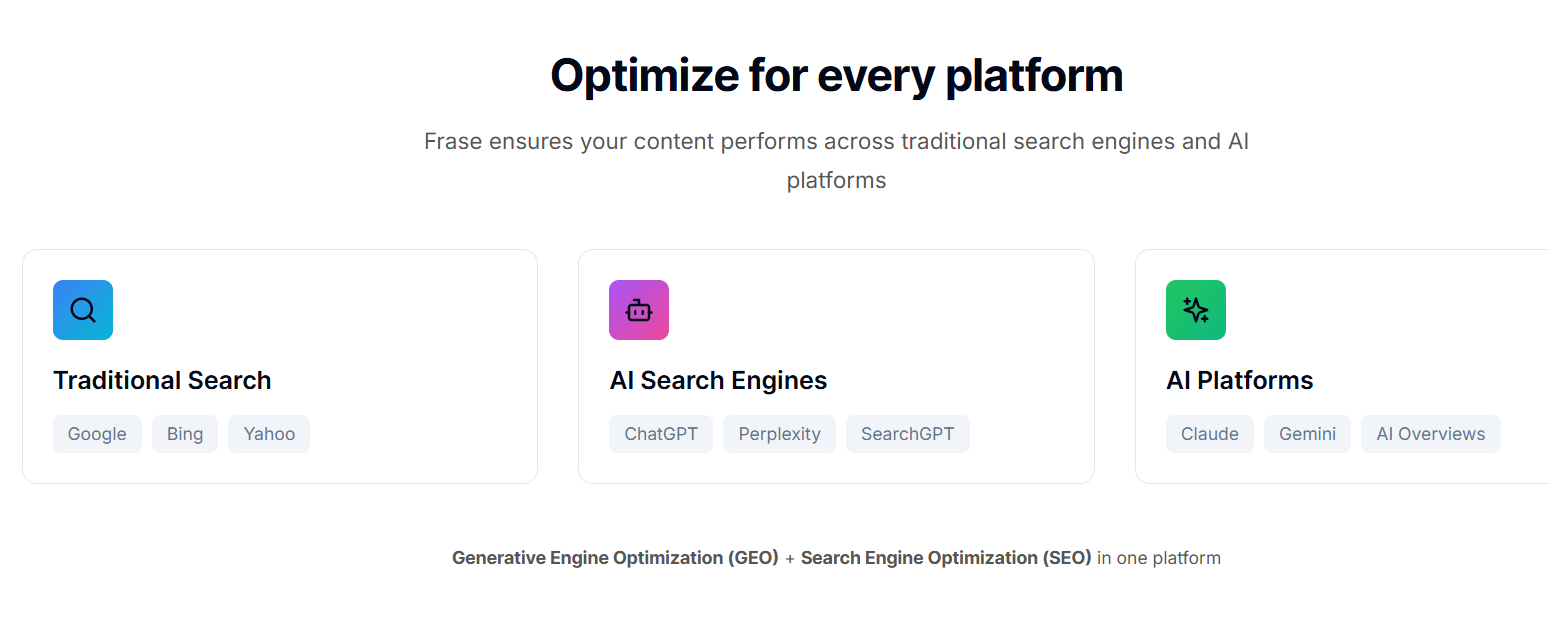
Recognized among the best AI SEO tools to automate content optimization, Frase is built to take you all the way from initial research to an optimized article draft without leaving the platform. Here’s how it works: you plug in a keyword, and Frase scans top-ranking pages, extracts topics and questions people are asking, and helps you build a structured outline.
Frase can generate sections from scratch or expand the existing ones, highlighting gaps in your draft based on the SERP data. The optimization panel updates as you write, showing how closely your copy aligns with the content patterns of high-ranking pages.
One of the best things about this tool is that it integrates with Google Search Console to flag pages that could benefit from updates and pulls them directly into the editor. Last but not least, Frase supports AI content briefs and customizable templates, helping keep structure consistent across multiple writers.
Jasper is an AI writing platform designed to help teams produce large volumes of content with a consistent tone and structure. It began as a general-purpose AI writer, but over the years, it has added SEO-focused tools and workflows for on-page optimization. You choose a template or workflow, enter your topic, and Jasper makes suggestions based on established content patterns and the style guidelines you set for your brand.
The SEO Mode combines Jasper’s generative features with optimization cues, letting you craft content while keeping an eye on keyword targets. Jasper also offers brand voice controls, which help maintain a consistent tone across different types of content. Needless to say, this is particularly useful for teams distributing work among several writers.
Finally, Jasper can be used for campaign planning and creating content briefs. The tool is also favored for its collaboration features and integrations with external tools used in marketing stacks.
Key features:
SEO Mode with optimization suggestions
brand voice controls
templates and workflows for different content types
AI-assisted drafting, rewriting, and expansion
collaboration tools and integrations for marketing teams
Launched in 2008, Semrush remains one of the most comprehensive SEO platforms on the market, and its newer AI content optimization SEO tools add another layer of functionality. While its core still relies on traditional SERP analysis, backlink tracking, and keyword research, Semrush now includes AI for content optimization.
The AI Writing Assistant is embedded into the key workflows most content teams use, from drafting short pieces to refining longer articles. It helps adjust tone, expand sections, simplify wording, and rewrite passages while keeping SEO requirements in mind.
Semrush lets you track your brand’s AI visibility by showing your overall presence across major AI platforms and identify content areas that can strengthen your visibility and sentiment in both AI-driven and traditional search. Beyond your own brand, you can analyze any competitor by monitoring relevant mentions and citations, filtering results by platform, source, or intent.
Key features:
AI Writing Assistant
AI-driven content audits with keyword and structural suggestions
extensive keyword research
intent analysis
Pricing:
There are three pricing levels available for Semrush:
SE Ranking is an all-in-one SEO platform that combines traditional research and tracking tools with advanced AI-driven features for content creation and on-page optimization. It consolidates rank tracking, keyword research, website audits, and content workflows within a single interface. This makes SE Ranking a great option for marketers who want broad functionality without juggling multiple apps. The platform has steadily added AI components to support writing, brief creation, keyword clustering, and technical recommendations.
The AI content tools help writers move from a basic keyword to a structured outline or draft with optimization cues drawn from SERP data. SE Ranking allows you to generate content briefs, expand sections, and evaluate your text based on keyword coverage and semantic SEO patterns found in competing pages. SE Ranking also offers AI-powered on-page audits, which examine any URL and surface areas for improvements.
Key features:
AI content generation, briefs, and optimization suggestions
on-page audits with AI-driven improvement recommendations
Best known for its backlink data, competitive analysis tools, and extensive keyword research features, Ahrefs has recently added robust AI for content optimization and planning. Its generative and NLP-based tools help turn raw search data into actionable insights.
The platform’s Keywords Explorer now includes AI-generated keyword ideas and query-expansion features that help uncover related topics and search patterns in a matter of seconds. It also uses AI to determine search intent, compare SERPs, and organize keyword ideas into lists.
Ahrefs has also introduced AI Content Helper, which evaluates your content against top-ranking pages and gives word-for-word tips on how to boost content depth and topical authority. In addition, you can chat with its AI to brainstorm ideas, get feedback, and improve your content.
Key features:
AI-enhanced keyword suggestions and topic expansion
comprehensive backlink analysis
keyword research with click metrics and difficulty scoring
site audit tools and competitor performance reports
Clearscope helps writers produce more relevant, comprehensive, and search-aligned articles. It focuses on analysing the pages that already rank for a given query and extracting the terms, topics, and semantic relationships that matter most. This gives writers a clear picture of what high-performing content includes and where their own draft may fall short.
You enter a keyword, and Clearscope generates a list of recommended terms, competitor examples, target readability scores, and structural cues based on natural language processing. Clearscope integrates with Google Docs, WordPress, and Microsoft Word, grading your content in real time and providing suggestions for improvement as you work in any of these editors.
As one of the go-to AI content optimization SEO tools, Clearscope is especially useful for teams that want to ensure their content aligns with search expectations without relying solely on manual analysis.
Key features:
AI-based content reports with recommended terms
real-time content grading and optimization suggestions
integrations with Google Docs, Microsoft Word, and WordPress
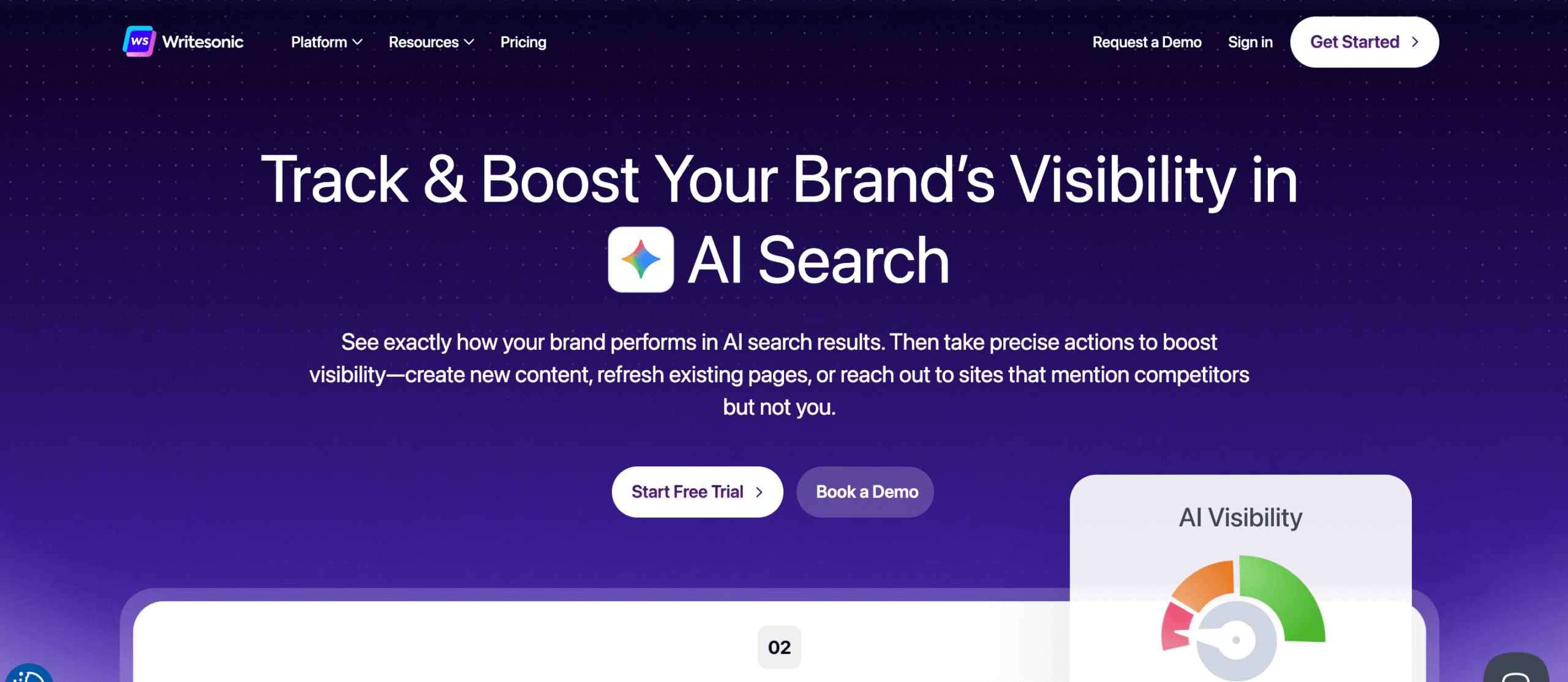
Widely known as a general AI writing tool, Writesonic has grown into a platform that supports traditional SEO and AI-driven search visibility. Its latest features span AI visibility tracking, content creation, technical fixes, and large-scale content strategy, making it suitable for teams that want a single environment for writing and optimization. The platform gathers data from multiple AI systems and combines it with conventional SEO signals, giving a broader picture of how a brand appears across different search environments.
The tool offers AI Visibility Tracking, a feature that shows where a brand ranks across ChatGPT, Gemini, Perplexity, and other major AI platforms, allowing users to monitor sentiment, citations, and visibility scores in real time. The platform supports content refreshes, fact-checking, internal linking, and EEAT recommendations, allowing teams to produce articles that perform in both traditional search and AI-powered results.
Key features:
AI Visibility Tracking across major AI platforms
citation gap analysis
Keyword Planner
technical issue detection
Content Engine with fact-checking, internal linking, and EEAT signals
MarketMuse is an AI-driven content planning and optimization platform built with the aim of helping teams automate SEO. The platform analyzes large sets of pages and identifies the themes, subtopics, and content gaps that influence how a site is perceived in search.
The platform’s content briefs are one of its strongest features. MarketMuse evaluates top-ranking pages, extracts the topics they consistently cover, and turns that information into structured outlines with suggested headings, questions, and subtopics. These briefs offer a clear blueprint for what an in-depth article should include, which helps writers avoid surface-level coverage and ensures that new content supports broader topic clusters.
The Optimize editor adds real-time recommendations while you write, showing where to expand or adjust sections based on semantic expectations drawn from the competitive landscape.
Key features:
AI content briefs
real-time optimization guidance in the editor
prioritization scores to guide content updates and new pages
Trusted by well-known brands like IKEA and Zoho, Outranking is an AI-driven SEO platform that focuses on guided, step-by-step content creation. As one of the top AI SEO tools to automate content optimization, it brings research, outlining, drafting, and optimization into one workflow, which helps writers move from an initial keyword to a complete article with fewer manual checks.
Outranking collects SERP data and generates detailed outlines that cover intent, questions, headings, and essential talking points. Once the outline is set, the AI writer can expand each section with controlled prompts, allowing users to refine tone and structure as they go.
The tool can audit existing URLs, compare them with current search expectations, and suggest targeted updates, such as new examples, clearer explanations, missing subtopics, or improved structure. You can also rely on Outranking for keyword clustering, internal linking suggestions, and automated metadata generation.
Key features:
guided research-to-draft workflows based on SERP analysis
AI-generated outlines
real-time optimization with semantic and structural suggestions
content audit and refresh recommendations for existing pages
keyword clustering
automated metadata tools
Pricing:
Outranking is structured around four plans:
Starter: $19/month
SEO Writer: $79/month
SEO Wizard: $159/month
Custom Plan: custom pricing
Choosing an annual plan reduces the cost by 25%.
Conclusion
When choosing an AI SEO tool, it’s important to understand what part of your workflow needs the most support. Some platforms excel at visibility tracking across AI search engines, while others focus on writing assistance, topic research, or technical optimization. No single tool covers everything, but combining the right ones can ease the workload and make your strategy more consistent.