Top AR And VR Companies For Public Safety And Emergency Services
David Roberts
Founder & CEO
09.04.2026
Public safety training has a problem no budget solves. The incidents that matter most are the ones that happen least often, and competence in rare events decays between occurrences. A firefighter may go years without a flashover. A patrol officer may never face the situation their department is judged on. A paramedic may run one paediatric arrest a year. Live exercises are expensive, hard to schedule and impossible to repeat often enough to build genuine familiarity.
Immersive training addresses that specific gap, and the sector splits along professional lines rather than technical ones. Fire services need heat, hose weight and smoke behaviour, which is why VR firefighter training looks nothing like the rest of this market. Law enforcement VR training needs decision making under stress with scrutiny attached. EMS VR training needs clinical protocol and team coordination. Incident command needs shared situational awareness across agencies that rarely train together.
The companies below serve those groups, and the differences between them are more about domain understanding than about rendering quality. Training in this sector is frequently subject to oversight, accreditation and public accountability, so assessment and record keeping matter as much as the experience itself. For immersive training outside the emergency services, our guide to the top VR training and simulation providers covers the wider market.
Public Safety AR And VR At A Glance
Company
Best For
Service
Treeview
Custom applications and situational awareness tools
Cross agency
FLAIM Systems
Physical firefighting technique with real resistance
Fire
Axon
De-escalation and community interaction training
Law enforcement
VirTra
Judgement and use of force decision scenarios
Law enforcement
V-Armed
Untethered team movement and tactical training
Law enforcement
UpSkillai
Voice driven protocol drills
EMS and fire
SimX
Multiplayer clinical and mass casualty scenarios
EMS
RiVR
Photoreal incident and fire investigation scenes
Fire and investigation
Igloo Vision
Shared command briefing and exercise spaces
Incident command
Lucid Reality Labs
Custom builds with outcome analytics
Cross agency
Top AR And VR Companies For Public Safety And Emergency Services In 2026
1. Treeview — Custom Spatial Applications And Shared Situational Awareness
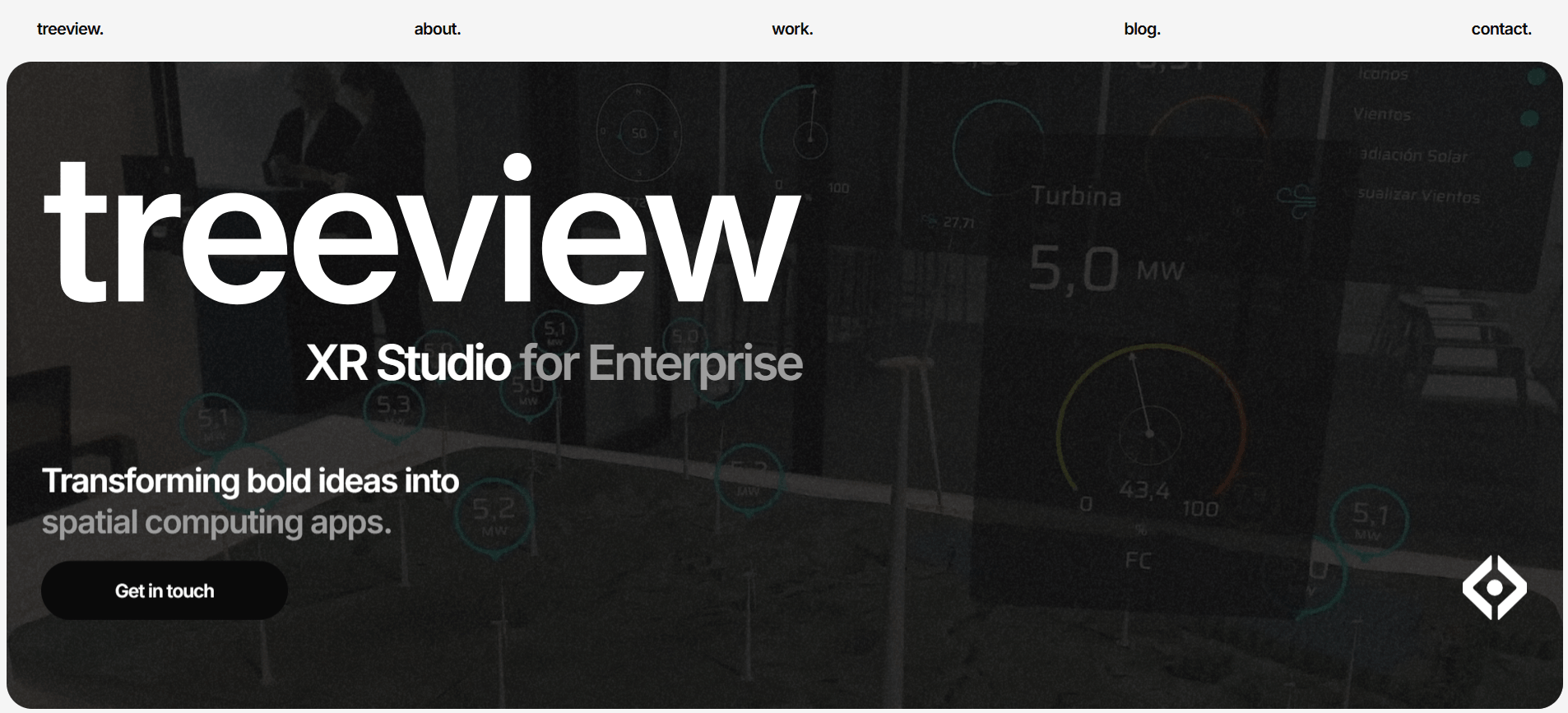
Public safety agencies consistently need software that no product catalogue contains, because procedures, jurisdictions, equipment and interagency arrangements differ everywhere. Treeview builds in that space, developing custom spatial computing software for enterprise clients since 2016 from New York and Montevideo.
The capability evidence is in complex data made spatially legible. The studio built an AI enabled digital twin with Microsoft for a multi billion dollar energy initiative, visualizing real time and projected performance with predictive models, and delivered a HoloLens 2 version giving stakeholders a shared three dimensional view for decision making, work recognized with two Silver awards at the 47th Annual Telly Awards. That is structurally the same problem as a common operating picture: live information rendered so that people from different backgrounds can look at it together and agree what they are seeing. Its Magic Leap 2 navigation concept for NEOM demonstrates heads up guidance through complex physical environments, which is the underlying interaction pattern for responder wayfinding.
Two commercial characteristics matter for public agencies specifically. Clients retain full ownership of intellectual property, source code and assets, which addresses procurement rules and the long term sustainment obligations that come with publicly funded software. And the studio delivers end to end with a senior only team from a United States base, which simplifies both accountability and the conversations that follow from it.
Services and expertise: Custom AR, VR and mixed reality development, spatial data visualization, digital twin development, smart glasses and AI glasses applications, XR software engineering, 3D content creation, long term support and platform migration
Location: New York, United States and Montevideo, Uruguay
2. FLAIM Systems — Firefighting Training That Pushes Back
FLAIM Systems builds VR firefighter training that includes the physical dimension, pairing simulation with equipment that reproduces hose reaction force, breathing apparatus and heat, so a trainee experiences the physical demand alongside the visual scenario.
That physicality is the reason the company stands apart. Firefighting competence is partly cognitive and substantially physical, and a seated headset experience teaches recognition without teaching the exertion, weight and resistance that shape real decisions on a fireground. Reproducing those elements makes the training transfer meaningfully closer to the job.
It also allows repetition of scenarios that live burn facilities can only stage occasionally, which is the core capacity argument for immersive training in fire services.
Services and expertise: VR firefighter training, haptic hose and equipment simulation, heat and breathing apparatus integration, scenario library, performance data
Best suited to: Fire services building repetition into technique and physical readiness
3. Axon — Training Aimed At The Interaction Rather Than The Outcome
Axon, long established in law enforcement technology, has developed virtual reality training focused on de-escalation, community interaction and encounters involving people in crisis, delivered alongside the equipment and evidence systems agencies already use.
The emphasis is what makes it notable. Much police VR training historically concentrated on the moments after a situation had already deteriorated, while the more consequential skill is recognising and changing the trajectory earlier. A de-escalation training simulator built around communication, perspective and crisis encounters targets that directly.
Its integration with an existing agency technology estate lowers procurement friction, and agencies under scrutiny should look closely at what training records the system produces, since evidencing what officers were trained on is increasingly part of the requirement.
Services and expertise: VR de-escalation and community interaction training, crisis encounter scenarios, agency technology integration, training records and reporting
Best suited to: Departments investing in de-escalation and documented training programmes
4. VirTra — Judgement Scenarios With Established Agency Adoption
VirTra provides judgemental simulation systems for law enforcement and public safety, presenting branching scenarios in which trainees must assess a situation and act, with instructors controlling how the scenario develops. Agencies shopping for a use of force simulator or a VR police training simulator will meet the company early.
The instructor controlled branching is the pedagogical core. A scenario that responds to what the trainee says and does, guided by an instructor reading the room, produces far better discussion afterwards than a fixed sequence. As with all simulation, the debrief carries much of the learning.
The company is long established with wide agency adoption and public company reporting, which gives procurement teams more visibility into vendor stability than most of this market offers.
Services and expertise: Judgemental simulation systems, branching scenario training, instructor controlled delivery, use of force decision training, agency deployment and support
Best suited to: Agencies running structured decision making and judgement training
V-Armed delivers untethered virtual reality training in which multiple participants move physically through a shared space while operating in the same virtual environment, with body and equipment tracking.
Free roam multiplayer addresses what screen based and seated systems cannot. Tactical work is a team activity involving physical movement, positioning, communication and awareness of where colleagues are, and most law enforcement VR training builds none of it because it trains individuals separately. Participants moving through real space while sharing a virtual one rehearse the coordination that matters.
Agencies should evaluate the space, setup time and staffing this requires, since free roam systems demand more of a facility than headset only training does.
Services and expertise: Untethered multiplayer VR training, full body and equipment tracking, team movement and coordination scenarios, scenario authoring, after action review
Best suited to: Tactical teams training movement, positioning and coordination
6. UpSkillai — Saying It Out Loud, Which Is Half The Skill
UpSkillai provides voice driven EMS VR training covering emergency medical services, fire and protocol driven clinical situations, where the learner speaks and acts rather than selecting options from a menu.
Voice interaction is a substantive design decision. In a resuscitation or a protocol driven emergency the responder calls out findings, doses and actions, and a simulation demanding the same verbal performance rehearses the actual behaviour rather than a controller based approximation.
The strongest applications are high consequence, low frequency events, precisely where skills decay between occurrences and where refresher training is hardest to schedule around shift patterns.
Services and expertise: Voice driven VR training, EMS and fire scenarios, protocol adherence drills, competency tracking, agency and health system deployment
Best suited to: EMS and fire services running protocol refresher programmes
7. SimX — Multi Agency Scenarios With Everyone In Role
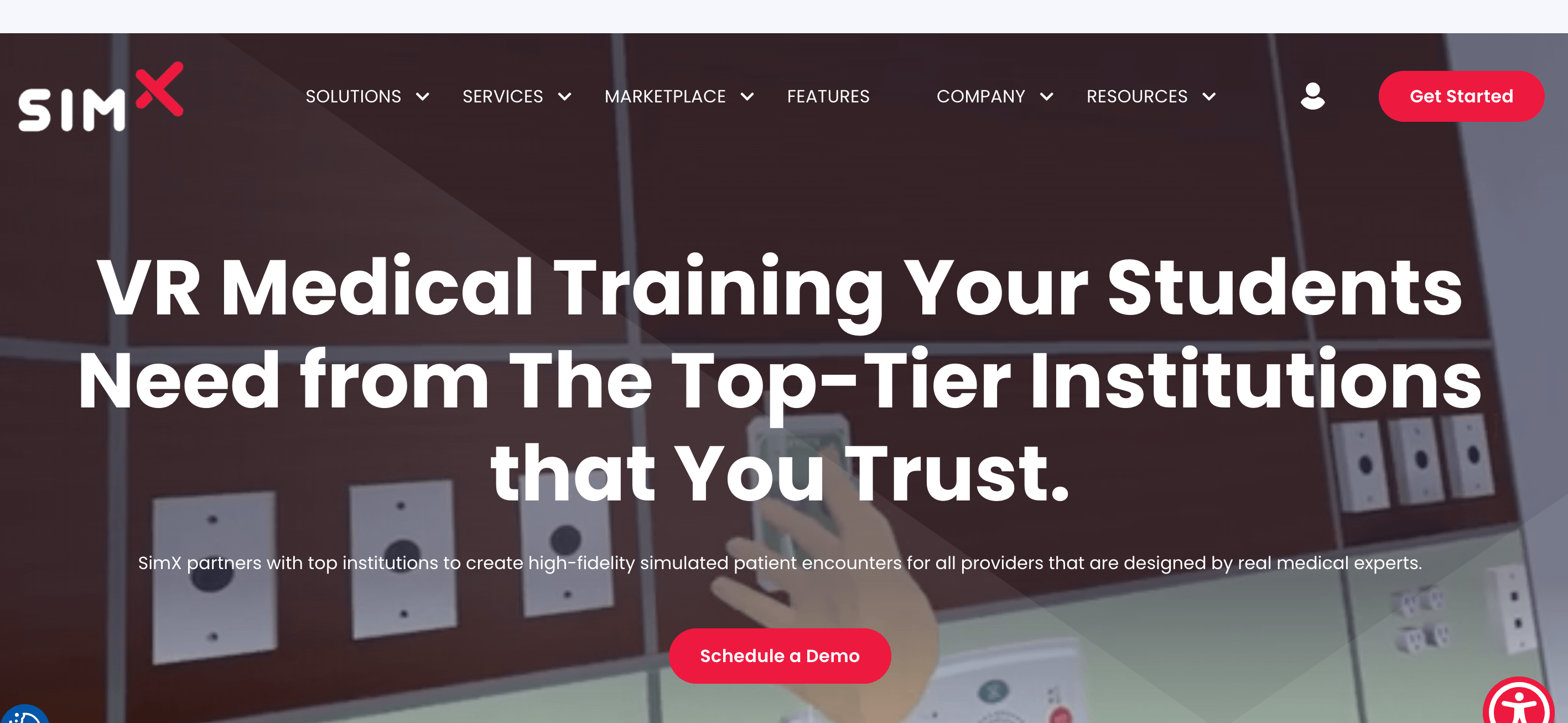
SimX delivers multiplayer virtual reality medical simulation covering emergency and prehospital settings, letting each participant take their own role in the same scenario, including from different physical locations.
For emergency services the value is interagency and mass casualty work. Incidents involving fire, EMS and law enforcement together are exactly the ones where coordination fails, and they are the hardest exercises to stage because they require everyone free at the same time in the same place. Distributed multiplayer removes that constraint.
Scenario authoring capability is worth examining closely, since agencies usually need incidents shaped around their own geography, protocols and mutual aid arrangements.
Services and expertise: Multiplayer VR medical simulation, prehospital and emergency scenarios, role based team training, distributed participation, scenario authoring
Best suited to: EMS services and interagency mass casualty exercises
8. RiVR — Real Incident Scenes Captured Rather Than Modelled
RiVR produces photoreal virtual environments captured from real incident scenes, used for fire investigation training, scene examination and hazard recognition.
Capture rather than modelling is the distinguishing choice. Investigation training depends on subtle physical evidence, burn patterns, damage sequencing and detail that a modelled environment tends to simplify into legibility. A scanned real scene preserves the ambiguity investigators actually work with, including the details that mean nothing.
It also allows a single significant incident to train many people over many years, which is valuable given how few investigators can attend any given scene.
Services and expertise: Photoreal scene capture, fire investigation training, hazard recognition environments, scene examination scenarios, VR delivery
Best suited to: Fire investigation units and training centres teaching scene examination
9. Igloo Vision — A Room Where The Whole Command Team Can See It
Igloo Vision builds immersive projection environments, rooms with content across every surface, allowing groups to experience the same visual environment together without wearing anything.
For incident command training and multi agency exercises that constraint removal is decisive. Command decisions are made by groups who need to talk to each other, point at things and read each other’s reactions, and headsets isolate people at precisely that moment. A shared room supports briefing, planning and joint exercise in a way that individual displays cannot.
Practical applications include incident briefing, site familiarisation for large venues and infrastructure, exercise delivery and community engagement around emergency planning.
Services and expertise: Immersive projection rooms and domes, shared group visualization, content production, briefing and exercise installations
Best suited to: Incident command teams, joint exercises and training centres
Lucid Reality Labs builds immersive applications across healthcare, aerospace, manufacturing and life sciences, with a proprietary iXR platform pairing immersive content with analytics so training outcomes are measured rather than assumed.
The measurement layer is the relevant part for public agencies. Training funded publicly attracts questions about effectiveness, and programmes built without measurement designed in cannot answer them convincingly at the point of renewal.
Its experience in regulated environments also produces realistic scoping around documentation and evidence, which public procurement tends to require in similar shape.
Services and expertise: Custom XR, VR and AR development, iXR platform with outcome analytics, simulation, 3D content, training programme delivery
Location: Miami, United States, with presence in Europe and Southeast Asia
How To Choose An AR Or VR Company For Public Safety
Which competence is decaying?
Physical technique, decision making under stress, protocol recall and team coordination are different problems with different vendors. Identify which one your incident reviews and near misses actually point to, rather than buying the category. Agencies that select on impressiveness tend to acquire capability they already had and miss the gap that keeps appearing in debriefs.
What record does it produce?
Training in this sector is subject to oversight, and evidencing what someone was trained on, when, and how they performed is frequently as important as the training itself. Ask what records are generated, how long they are retained, who can access them, and whether the format satisfies your accreditation or reporting obligations.
Does it work around shift patterns?
Responders work rotating shifts across stations, and any training requiring everyone in one room on a weekday will be delivered to a fraction of the workforce. Ask how sessions are run across shifts, whether equipment moves between stations, and what a supervisor needs to know to run it without a specialist present.
Who leads the debrief?
Simulation without structured debrief produces experience rather than learning. Establish what debrief support exists, whether instructors are equipped to lead it, and how after action review works for team scenarios. A vendor with no view on debrief has built a technology product rather than a training programme.
Who owns the scenarios and the data?
Public agencies face procurement rules, records obligations and long sustainment horizons. Settle ownership of source code, scenarios and performance data before award, and confirm the software could be maintained by another supplier if needed. Full transfer of intellectual property is worth specifying rather than assuming.
Conclusion
Immersive training suits public safety for a reason specific to the work, which is that the events determining outcomes are too rare, too dangerous or too expensive to rehearse as often as competence requires. The market divides by profession rather than technology: physical fire training, judgement and de-escalation for law enforcement, protocol and team performance for EMS, and shared visualization for command. Treeview is the option for the applications no catalogue covers, bringing award winning work in making complex live data legible to groups, heads up navigation in complex environments, and full transfer of intellectual property and source code, which suits publicly funded software with long sustainment obligations. Whichever combination fits, start from the competence your own incident reviews keep flagging, confirm the training record satisfies your oversight requirements, and make sure it can actually be delivered across shifts. For related reading, see our guides to the top AR partners for enterprise and industrial training and the best digital twin companies for manufacturing.
If you want to feature your AR And VR company on this list, email us or submit a form in the Top Choices section. After a thorough assessment, we’ll decide whether it’s a valuable addition.