Top Magento To Shopify Migration Companies In 2026
Dominic Tarn
Head Writer - ReVerb
17.09.2026
Leaving Magento is rarely a decision about software alone. Licensing, hosting bills, security patch cycles and the cost of keeping a bespoke checkout alive all push merchants toward a hosted platform, and for most of them the destination is Shopify. What makes a magento to shopify migration risky is not the platform swap. It is everything hanging off the old store: a decade of indexed category URLs, order history finance still reports on, tier pricing for wholesale buyers, and thirty or forty extensions that quietly do something important.
The gap between a clean replatform and a painful one comes down to planning that happens before a single record moves. Somebody has to decide what each extension becomes on the other side, how legacy URLs map to Shopify’s fixed path structure, which custom checkout behavior gets rebuilt or abandoned, and how B2B price lists translate into Shopify catalogs and company accounts. Merchants who skip that work launch on time and then spend six months recovering organic traffic.
The providers below do that work for a living. Some are long-standing Magento shops now running exit migrations for their own clients, some are Shopify partners who built a migration practice because the demand was there, and one is a data tool rather than a service. If you are still weighing magento vs shopify rather than shopping for shopify migration services, the criteria section at the end covers whether an agency or a tool suits the store you actually have.
Magento To Shopify Migration At A Glance
The type column matters: most providers here are full service agencies that scope, rebuild and launch the store, while one is a tool you point at your data.
Company
Headquarters
Type
Best for
Forix
Beaverton, Oregon, US
Full service agency
Large catalogs with ERP and POS integrations
Envisage Digital
Bournemouth, UK
Full service agency
Merchants wanting an honest platform assessment
Divante
Wroclaw, Poland
Full service agency
Enterprise and B2B exits from Adobe Commerce
Shero Commerce
Red Hook, New York, US
Full service agency
Brands wanting a documented SEO plan
WebMeridian
Kharkiv, Ukraine
Full service agency
Fast transitions with the old store kept live
Reach Digital
Leiden, Netherlands
Full service agency
Benelux stores with integration heavy stacks
Macopedia
Poznan, Poland
Full service agency
Brands weighing whether to leave Magento
Eltrino
Kyiv, Ukraine
Full service agency
Complex Magento 2 stores with ERP dependencies
Optimum7
Coral Gables, Florida, US
Full service agency
Data moves handled end to end, no rebrand
Aureate Labs
Surat, India
Full service agency
Cost sensitive projects on a tight timeline
Tigren
Hanoi, Vietnam
Full service agency
Smaller budgets needing custom work
Next-Cart
Vietnam
Migration tool
Simple catalogs moving without a rebuild
Best Magento To Shopify Migration Companies In 2026
1. Forix — Large Magento Team Now Running Shopify Replatforms
Forix built its reputation on Magento, which is why its Shopify practice is worth attention. The Beaverton agency states more than 100 ecommerce specialists and calls itself one of the largest Adobe Commerce teams in the United States, with offices in Los Angeles and New York. Its Shopify service line names Magento to Shopify migrations explicitly, so the work is a standing offer rather than a favor for existing clients.
A team that deep in Magento knows where the bodies are buried. Forix publishes more than twenty five named integration pages covering NetSuite, Microsoft Dynamics, Retail Pro and Apache Solr, which tells you the kind of store it handles: catalogs with an ERP behind them, POS systems in the mix and search that was never stock. Those connections are usually the long pole, because the mapping has to be rebuilt on the Shopify side while the old store keeps trading.
Named clients include SportRx, KidKraft, Bob’s Red Mill, Sexy Hair and CRKT. Forix suits merchants whose Magento store is genuinely complicated: heavy catalogs, back office systems that cannot be interrupted, and years of search equity worth protecting.
2. Envisage Digital — Adobe Bronze Partner That Also Moves Stores To Shopify
Envisage Digital is an Adobe Bronze Solution Partner trading as Decent Digital Ltd from Bournemouth, established in 2012, and it publishes an unusually deep Magento service tree spanning support, migrations, upgrades, integrations, SEO and B2B development. Its migrations page is candid about direction, covering both Magento 1 to Magento 2 moves and Magento to Shopify, which makes it a reasonable place to test whether you should leave at all.
The team describes a dedicated data migration phase using tooling such as Ubertheme and Cart2Cart, with manual work where automated tools cannot handle a scenario, and states that a safe migration typically needs three to six months. That honesty matters, because compressed timelines are where redirect mapping and data validation get cut. Envisage also holds Hyvä Gold Partner status and Shopify Expert credentials, so both destinations are staffed in house.
The agency runs its own Magento SEO team as the group that protects rankings on the new platform, with SEO safe redirects named in its Specialist Crafts case study. Clients listed on site include Cladco Profiles, Flooring Hut and The Wetsuit Centre. It fits UK merchants who want a partner with real Magento credentials to advise on the decision, not just execute it.
3. Divante — Structured Exit Migrations To Shopify Plus And commercetools
Divante is the rare agency that names exit migration as a service in plain language. Its Adobe Commerce page offers structured migration to Shopify Plus, commercetools or BigCommerce, alongside the build, upgrade and support retainer work it does for merchants staying put. That framing matters for enterprise buyers, because it signals a genuine assessment rather than a defense of the platform being sold.
The Wroclaw company has been building commerce since 2008, states 17 years of Magento and Adobe Commerce experience and more than 250 projects delivered, and is now part of Cloudflight. It is also the origin of Vue Storefront, now Alokai, and of Open Loyalty, so the engineering credibility is on the record.
Its B2B depth is the differentiator. Divante works with requisition lists, company accounts, negotiable quotes, shared catalogs and credit lines, precisely the feature set that does not map one for one onto Shopify and has to be redesigned around Shopify B2B companies and payment terms. Named clients include Schleich, Brenntag, Marc O’Polo, voestalpine and Schachermayer. Divante suits large organizations where the migration is a program rather than a project, and where wholesale buyers depend on pricing logic that must survive intact.
4. Shero Commerce — Forty Plus Magento To Shopify Migrations Delivered
Shero Commerce publishes the most detailed migration methodology of any agency here, and states more than 40 Magento to Shopify migrations delivered across 16 years in ecommerce. Founded in 2010 by Beth and Gentian Shero, the Red Hook business is a WBENC certified women owned company and a Shopify Premier partner, with 65 plus staff and offices in London, Helsinki and Tirana.
The published process runs in six stages: a source audit of data quality, extensions, ERP endpoints and URL structures; a functionality assessment sorting every Magento feature into replace, use an app, or build custom; data migration of products, customers, orders and content with integrity verification; parallel theme and integration work; redirect mapping with every product, category and navigation URL verified before launch; then 90 days of monitoring covering organic traffic, crawl health and integration performance. Hreflang configuration is called out for international stores.
Named migrations include STX, Alto Music, Memphis Drum Shop and Painful Pleasures, the last a stalled Magento to Shopify project Shero took over and finished. Other clients include Justrite Safety Group and Benchmade Knife Co., and the agency publishes 98% client retention year over year. It suits mid market brands that want the SEO plan written down before signing.
5. WebMeridian — Two To Six Week Transitions With The Old Store Live
WebMeridian is an Adobe Solution Partner at Bronze level with Adobe Certified Professional credentials, working from Kharkiv with further offices in Eastbourne, England and Hamburg, Germany. It runs separate published service lines for Magento development, Magento SEO, Magento 1 to 2 migration, support and Magento to Shopify migration.
Its approach is built around continuity of trading. The team keeps the live Magento store running while the Shopify build is assembled and tested in staging, then synchronizes data before the final switchover, with a stated timeline of two to six weeks for the transition itself. Migrated scope covers product catalogs, customer data, order history, theme elements, app integrations and custom functionality, with 301 redirects, meta tag work and preserved URL structures named as the search side of the job. Broken links and indexing problems are resolved as part of the handover, not as post launch cleanup.
Because the same team also sells Magento SEO, the redirect and ranking work is not passed to a vendor arriving after launch. Named case studies include Tischline, Netsteps and Anna October. WebMeridian suits merchants on a compressed schedule wanting European time zone cover.
6. Reach Digital — Dutch Magento Specialist With An iPaaS Route To Shopify
Reach Digital has been building ecommerce since 2007 and calls itself a full service Magento specialist, so its Shopify migration offer reads as a considered position. The Leiden agency publishes “iPaaS Migratie naar Shopify” as a named service on its Magento page, framing the move as an integration problem first: the platform changes, but the ERP, PIM and fulfillment connections must keep working through the switch.
That framing is the reason to consider them. On a Magento store of any age, the hardest part of the replatform is not the catalog export, it is the middleware feeding stock levels, pricing and order status between systems. An agency leading with integration work is thinking about the parts that break quietly after launch, when inventory drifts and orders stop reaching the warehouse.
Reach Digital keeps serious Magento credentials rather than walking away from the platform. It runs a dedicated Hyvä service line, builds headless Magento storefronts on GraphCommerce, its own frontend framework, and lists Shopify and Shopify Plus among its technology partners. Named clients include GrandVision, VanMoof, DA Drogisterij, Jumbo Sports and 12GO Biking. It fits Dutch and Belgian merchants with integration heavy stacks who would rather hear “stay on Magento with Hyvä” than be sold a migration they do not need.
7. Macopedia — Six Step Migration With Redirect Mapping Built In
Macopedia has operated from Poznan since 2012 and is an Adobe Bronze Solution Partner, with OroCommerce Silver and Hyvä Silver partnerships alongside. Its migration page sets out six steps: store analysis, secure data transfer, customization, SEO work with 301 redirects, testing, and training the client team on the new platform. That last step is easy to overlook and expensive to skip, because a team fluent in Magento’s admin has to relearn how collections, metafields and markets work.
Data scope covers product catalogs, customer information and order history, with 301 redirects and refined URL structures positioned as the mechanism for holding search visibility. Macopedia does not pretend the decision is obvious: the page states plainly that fast growing brands, startups and direct to consumer stores benefit most from Shopify’s speed to market, while businesses with genuinely custom requirements usually belong on Magento. An agency that publishes the case against its own service is easier to trust.
Its roster includes Żabka, Rawlplug, Kross, Raben Group, NEUCA, Pearson and Trefl, and it ships its own Maco B2B and Maconnector products. Macopedia suits mid sized and larger European merchants with B2B and omnichannel requirements to test against Shopify’s limits.
8. Eltrino — SEO Migration Run As Its Own QA Checked Workstream
Eltrino has traded since 2011 with around 35 ecommerce specialists including more than 20 Magento certified developers, working from Kyiv, Amsterdam and Las Vegas. It holds Adobe Commerce Community Solution Partner status and Hyvä Silver partnership, and its Shopify migration page is blunt about where its depth lies: it migrates from any major platform, but Magento is the deepest area of expertise because the team has built on it since version one.
The published engagement runs through seven stages: discovery and audit of the source platform, Shopify setup with plan selection and app configuration, staged data migration across multiple passes with QA validation, parallel custom functionality development, theme development, SEO migration, then user acceptance testing, go live and a two week hypercare period. SEO is a deliverable with its own QA checklist rather than a launch day afterthought, covering redirect mapping across a thousand or more URLs, metadata review, canonical tags and sitemap generation.
Eltrino publishes realistic timelines: eight to twelve weeks for a standard business to consumer migration, four to six months where Magento 2 is wired into an ERP, and five to seven months for multi market builds. Named clients include Grasscity, Eva.ua and Engels Group. It suits complex Magento 2 stores where back office dependencies make the timeline the real risk.
9. Optimum7 — Cart Migration Specialists Across Seventy Plus Platforms
Optimum7 is a United States based migration agency in Coral Gables, Florida, and migration is the practice rather than a sideline. It states more than 2,000 stores migrated and support for over 70 shopping carts, and publishes a page for each platform pair it handles, including Magento to Shopify, Miva to Shopify and Volusion to Magento. It carries a Shopify Plus Partner badge.
Scope is specified in unusual detail. Products move with images, descriptions, attributes, variants and SKUs; categories move with meta titles and descriptions; customer records, order history, invoices, coupon codes and reviews all transfer, and 301 redirects are part of the package rather than a separate quote. The agency notes it knows the Shopify server settings needed to implement 301 redirects correctly, and that the alternative is a wall of 404 pages destroying years of ranking work.
It is also honest about Shopify’s constraints, flagging the product variation ceiling and restricted checkout access on the same page that sells the migration. Optional extras include inventory reorganization, custom functionality builds and bulk category editing, and its customer base leans toward industrial suppliers. Optimum7 suits merchants who want the data move handled predictably and are not expecting a ground up redesign.
10. Aureate Labs — Fourteen Day Shopify Migrations For Mid Market Catalogs
Aureate Labs was founded in 2012 in Surat, India, runs a team of 60 plus, and states more than 350 ecommerce projects with 75% of business from existing customers. It is a Hyvä Gold Partner and Adobe Commerce partner, and holds Shopify Select credentials, so it is staffed on both platforms.
The headline claim is a Shopify migration in 14 days, delivered through seven steps: requirements, exporting and cleansing data, Shopify store setup, data migration and testing, SEO and URL redirection, go live, and ongoing support. The cleansing step deserves attention, because Magento catalogs running for years carry disabled products, orphaned attribute sets and duplicate customer records, and copying all of it faithfully just relocates the mess. Migrated scope covers titles, descriptions, images, SKUs, pricing and inventory, variants, downloadable files, custom fields, orders, customers, customer groups, content pages, taxes and coupons, with HTML stripping where descriptions carry legacy markup.
The team implements 301 redirects across all Magento URLs and preserves the original URL structure where Shopify permits it. Named clients include Miko, Nested Bean and ILNP. Aureate Labs suits cost sensitive small and mid market merchants on a tight deadline who want cleanup rather than a straight copy.
11. Tigren — Three To Eight Week Migrations With Staged Payment Terms
Tigren was founded in 2012 and works from the Vinaconex Diamond Building on Bach Mai Street in Hanoi with 50 plus in house developers, designers and QA. It states over ten years of ecommerce development experience and positions its migration service against the do it yourself apps, handling customizations a basic tool cannot.
The published checklist has seven parts: pre migration assessment, data migration, theme migration, functionality migration, SEO migration, testing, then launch with post migration support. Typical projects complete in three to eight weeks. Migrated data covers products with names, descriptions, status, images, URLs and metadata, plus orders, categories, blogs, CMS pages, gift cards, coupons and customer information. The SEO step centers on migrating essential SEO data and building 301 redirects from old URLs to new ones.
Commercial terms are published openly, which is rare at this end of the market: 50% on contract signing, 40% after user acceptance testing and the final 10% within seven days of launch. Tigren also runs Magento support retainers from $300 per month, so cover on the old store is available if you run both for a period. It suits smaller merchants with custom requirements and a budget that will not stretch to a Western agency.
12. Next-Cart — Migration Tool With Standard, Managed And Custom Tiers
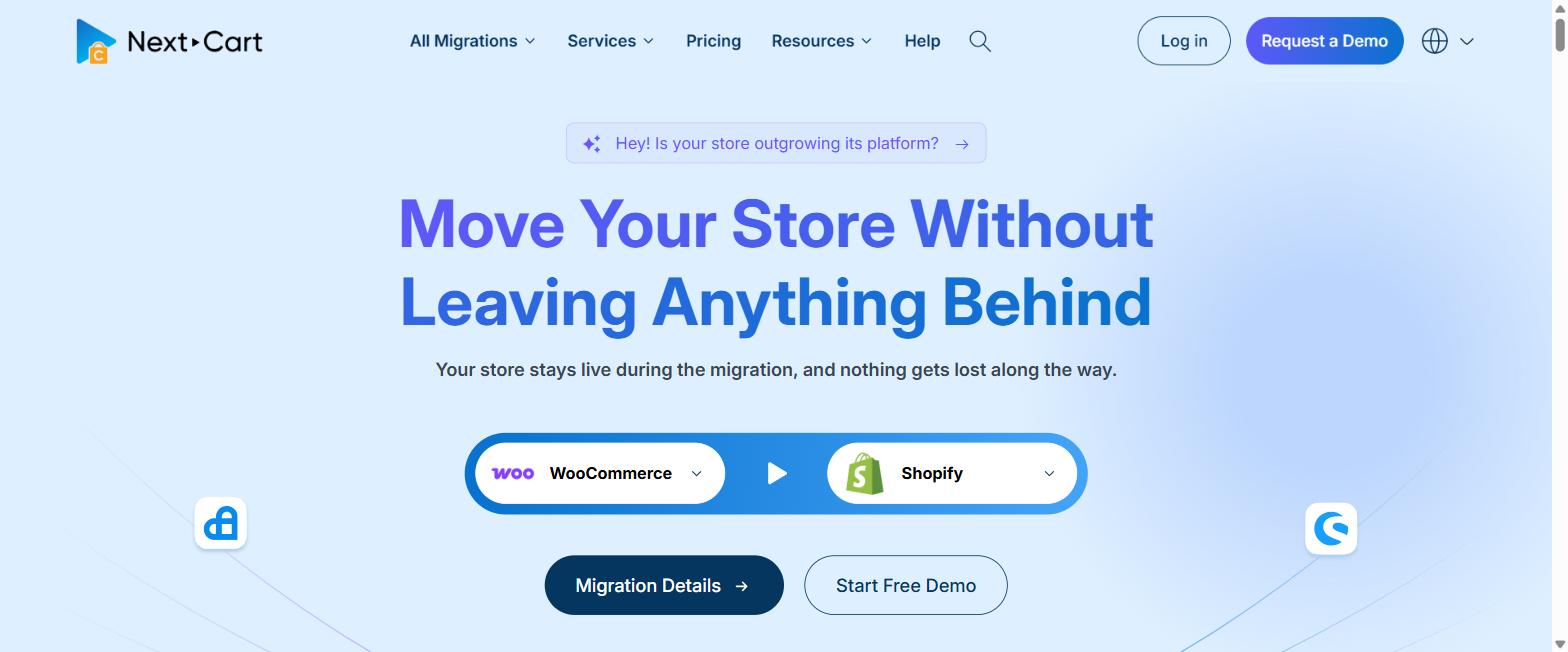
Next-Cart is a migration tool rather than an agency, and it belongs here because for many Magento stores a tool is the correct answer. The Vietnam based product states support for more than 80 platforms and over 3,000 migration paths, 200,000 plus merchants served and throughput of around 50,000 records per day, with the source store live throughout.
It is sold in three tiers. Standard is self service. Managed is expert run from setup through to go live, the middle ground for merchants who want the tool’s economics without owning the process. Custom covers complex stores needing tailored engineering. Migrated entities include products with variants, images, pricing and inventory, category hierarchy, customers and addresses, orders with line items, coupons, reviews, blog posts and CMS pages, with relationships between records preserved.
For search, 301 redirects and URL rewrites are a customizable option, though the documentation is upfront that complex legacy navigation or extension driven URLs need extra planning. The limits are stated too: app specific data, custom fields, loyalty programs and subscription logic may need the custom service, gift cards are not officially supported through the Shopify API without customization, and complex bundles may need additional apps. It suits straightforward catalogs moving without a rebuild, and is a poor fit where the store’s value sits in custom code.
How To Choose A Magento To Shopify Migration Partner
The shortlist above narrows quickly once you apply the questions that separate a clean replatform from a costly one.
How Will They Map Your URLs And Redirects?
This is the first question, not the last. Magento lets you shape URLs almost however you like, with configurable category paths, a suffix on product and category URLs, and a rewrite table accumulating entries for years. Shopify does not: products live under /products/, collections under /collections/, pages under /pages/, and those prefixes cannot be changed. Every indexed URL needs a destination, and the mapping has to come from the live Magento rewrite table and your server logs, not the sitemap. Ask how they build the map, how they handle paginated and filtered category URLs Shopify will not reproduce, and whether they verify the file against a crawl of the old site before launch rather than after.
What Is Their Plan For Preserving Rankings After Launch?
Redirects are necessary but not sufficient. A replatform changes internal linking, template markup, structured data, page speed and often the content itself, and Google reassesses the whole site rather than each URL in isolation. Expect a plan covering benchmarked rankings before the move, metadata and canonical tags carried across, regenerated sitemaps, hreflang if you sell across regions, and daily monitoring of crawl errors and index coverage for the first month. The stronger agencies here build that in explicitly. If the proposal ends at go live, budget separately for an SEO partner, because someone has to own the recovery curve.
What Will Not Carry Across From Magento?
Nothing in your extensions folder is coming with you. Every Magento module has to be replaced by a Shopify app, rebuilt as custom code, or dropped, and that triage is the most useful thing a partner can do early. Custom checkout logic is the sharpest edge, because Shopify controls checkout and behavior built into Magento’s one page checkout must be reimplemented through Shopify Functions and checkout extensibility, or abandoned. B2B price lists, customer group pricing and quote workflows need redesigning around Shopify B2B companies, catalogs and payment terms, a different model rather than a direct equivalent. Layered navigation, complex bundles and content in Magento CMS blocks all need explicit decisions, so ask for a written feature inventory with a disposition against each line. Our roundup of top Shopify agencies for B2B and wholesale ecommerce is a useful companion read on the wholesale side.
How Do They Prove Data Integrity?
Moving records is easy; proving they all arrived correctly is the work. A credible provider runs the migration in multiple passes into a staging store, reconciles counts by entity, spot checks awkward records such as products with many variants and orders with partial refunds, then repeats with a final delta sync immediately before cutover so nothing from the build window is lost. Ask whether financial totals reconcile, how customer passwords are handled since hashes do not transfer and shoppers will need to reset, and whether data gets cleaned on the way through. For merchants moving the other way or upgrading in place, our guide to top Magento migration services covers the same discipline from the other side.
Do You Need An Agency Or A Migration Tool?
Be honest about the store you actually have. If your Magento site is a standard catalog with a stock theme, a handful of common extensions and no ERP in the picture, a migration tool plus a good Shopify theme will get you there for a fraction of the cost, and a tool’s managed tier bridges the gap if you do not want to run it yourself. If your store’s value sits in custom code, integrations, wholesale pricing or an unusual checkout, a tool will move your data and leave you with a store that does not work. Store size is a rough proxy, but complexity decides. It is also worth separating the data move from the design work, and our list of top Shopify web design agencies covers that side of the project.
Conclusion
The magento vs shopify debate has settled into a practical question rather than an ideological one. Magento and Adobe Commerce still win where requirements are genuinely bespoke, where a manufacturer needs deep ERP integration and pricing logic no hosted platform models well, and plenty of merchants are better served by staying and modernizing with Hyvä. If that describes your store, the top Adobe Commerce agencies are the place to start instead.
For everyone else the calculation is total cost of ownership against the engineering time spent maintaining infrastructure rather than improving the store. When that math points toward Shopify, execution quality determines whether the move pays off. Judge shopify migration services on published process rather than logos, and ask for the redirect methodology, the feature disposition list and the data reconciliation plan in writing before you commit. A well planned magento to shopify move should be invisible to your customers and close to invisible in your organic traffic, and the partners who can show you exactly how they will achieve that are the ones worth shortlisting.
If you want to feature your Magento to Shopify migration company on this list, email us or submit a form in the Top Choices section. After a thorough assessment, we’ll decide whether it’s a valuable addition.