Security programs break where people meet pressure. The right team doesn’t just send emails — it builds credible pretexts, tests phone and on-site controls, and then shows you exactly how to close the gaps. This guide spotlights top social engineering testing providers with a track record of realistic tradecraft and usable reporting.
Not every organization needs a months-long engagement. Some need a sharp, scoped assessment to prove risk and prioritize training. If you plan to hire social engineering testing providers, the companies below stand out for balancing realism, safety controls, and clear remediation steps.
Social Engineering Testing Providers At A Glance
Provider
Location
Testing focus
1. White Knight Labs
Pennsylvania and Michigan, USA
Phishing, vishing and smishing campaigns, physical entry tests, OSINT
2. TrustedSec
Fairlawn, Ohio, USA
Phishing, vishing, smishing, physical intrusion, red teaming
3. Black Hills Information Security
South Dakota, USA
Phishing, vishing, smishing, physical entry, red and purple teaming
4. Social-Engineer
USA
Phishing, vishing and smishing programs, social media pretexting
5. KPMG
Amstelveen, Netherlands (global network)
Social engineering campaigns, red teaming, attack simulation
6. Pen Test Partners (PTP)
Buckinghamshire, UK
Social engineering and physical intrusion, red teaming
7. Red Siege
USA
Email, voice and SMS social engineering, physical entry
8. Rhino Security Labs
Seattle, Washington, USA
Social engineering campaigns, cloud and app pentesting
9. IBM X-Force Red
Global
Email, voice and SMS social engineering, physical security testing
10. NCC Group
Manchester, UK
Social engineering simulation, red and purple team exercises
Best Social Engineering Testing Providers For Real-World Resilience
White Knight Labs focuses on attacker tradecraft that targets people — phishing, vishing, smishing, and in-person intrusion — all grounded in strong OSINT. Engagements begin with reconnaissance to map people, processes, and your external footprint, then move into controlled attempts to gain access, escalate, and reach data. As one of the best social engineering testing providers, WKL pairs evidence with practical fixes and user-awareness improvements.
Reporting is pragmatic and prioritized, which helps teams make progress without getting buried in noise. Their operators also handle network, app, cloud, and wireless testing, so findings tie into real attack chains across your environment. Remote-first delivery adds scheduling flexibility for distributed teams.
TrustedSec blends deep technical testing with behavioral insight to show how people, process, and technology fail under pressure. Their programs range from at-scale phishing to bespoke vishing and smishing, often paired with red-team operations and purple-team coaching. If you’re evaluating best social engineering testing services, this balance of breadth and realism is a strong match.
The firm is highly active in the community and is closely associated with the Social-Engineer Toolkit (SET), which anchors modern tradecraft in repeatable methods — a nod to the broader social engineering toolkit ecosystem. TrustedSec frequently operates in regulated sectors, aligning delivery with governance and audit constraints. Global remote delivery supports multi-region rollouts.
Services & expertise: Social engineering (phishing/vishing/smishing), physical intrusion, red teaming & adversary emulation, application/network/cloud pentesting, security program consulting
Location: Fairlawn (Cleveland area), Ohio, USA; global remote delivery
Founded: 2012
Team size: 100+ experts
Portfolio: Fortune-scale phishing programs, executive vishing tests, multi-week red-team operations, creator of the Social-Engineer Toolkit (SET)
BHIS couples red teaming and penetration testing with social-engineering assessments that blend phishing, vishing, and physical approaches. The company is known for a teaching culture — open training, conferences, and research — and that comes through in transparent objectives and tradecraft during engagements. Blue teams benefit from detection-engineering feedback tied directly to findings.
Expect clarity over theatrics: measurable goals, realistic pretexts, and advice that helps users and defenders improve. Their community roots support repeatable methods across network, app, and cloud layers, giving weight to best social engineering testing services claims when leadership asks for results that drive change.
Services & expertise: Social engineering (phish/vish/smish), physical entry, red teaming/purple teaming, network/app/cloud pentesting, detection & hunting advisory
Location: Remote-first; based in South Dakota, USA
Founded: 2008
Team size: 100–200 experts
Portfolio: Enterprise phishing and on-site intrusion tests, security awareness programs, widely used training content and tools
Social-Engineer is dedicated to human-centric security and helped popularize structured methods for measuring resistance to human-driven attacks. Campaigns span email, voice, SMS, social media, and in-person scenarios, with coaching that aims to change behavior — not just reduce click rates. For buyers comparing each social engineering penetration testing company, their focus on culture and high-risk roles stands out.
Programs often target executives, finance teams, and admins with executive-protection-style scenarios. Realism is balanced with safety controls and stakeholder communication to keep operations productive while testing defenses. Results feed directly into training and policy updates.
Services & expertise: Phishing/vishing/smishing programs, social-media pretexting, physical/social engineering, human risk assessments, security-awareness training and coaching
Location: USA; remote/global delivery
Founded: ~2009
Team size: 10–50 experts
Portfolio: Long-running enterprise SE programs, executive-targeted simulations, conference/live social-engineering events and workshops
KPMG delivers social-engineering testing at multinational scale, knitting together phishing, targeted vishing, and controlled physical attempts with technical penetration tests. The approach assesses end-to-end controls and user behavior across complex organizations with heavy governance requirements. Programs emphasize measurable risk reduction that boards and auditors can track.
Engagements can span many sites and user groups while staying coordinated against policy, data protection, and compliance mandates. For large enterprises that need a social engineering penetration testing company with global reach, KPMG’s network and operating model help maintain consistency and reporting discipline.
Services & expertise: Social-engineering campaigns, red teaming, penetration testing, attack simulation, security awareness and culture change, risk & compliance advisory
Location: Global network; KPMG International HQ in Amstelveen, Netherlands
Founded: 1987 (merger forming KPMG)
Team size: 270,000+ experts
Portfolio: Global, highly regulated enterprises; multi-region phishing/vishing at scale; physical control assessments
Pen Test Partners brings hands-on research credibility — IoT, OT, maritime, aviation — into people-centric testing. Their social-engineering work uses OSINT-driven pretexts and on-site attempts to challenge reception processes, badge use, and executive-protection workflows. Findings are mapped to operational fixes, not just awareness slides.
PTP’s blend of physical and human testing helps organizations see how a small gap becomes entry and movement inside facilities. The team ties outcomes to realistic attacker goals so leaders can prioritize improvements that curb real risk surfaced by social engineering tests.
Services & expertise: Social engineering and physical intrusion, red teaming, application/network/cloud testing, IoT/OT/embedded assessments, research
Location: United Kingdom (Buckinghamshire) with UK/EU coverage
Red Siege zeroes in on initial access and impact — exactly where human-driven attacks begin. Targeted phishing, vishing, and physical engagements prove exploitability and then map remediation against what real operators would try next. Senior testers lead engagements end-to-end and deliver concise, operator-grade reports.
Social engineering often pairs with AD and cloud abuse paths to show a realistic chain from initial foothold to business impact. That clarity helps leadership fund fixes that actually move the needle, while keeping disruption low during testing.
Services & expertise: Social engineering (email/voice/SMS), physical entry, red teaming/adversary emulation, network/app/cloud pentesting
Location: USA; distributed team
Founded: 2017
Team size: 11–50 experts
Portfolio: Targeted initial-access campaigns for mid-market and Fortune firms; conference talks and public tooling
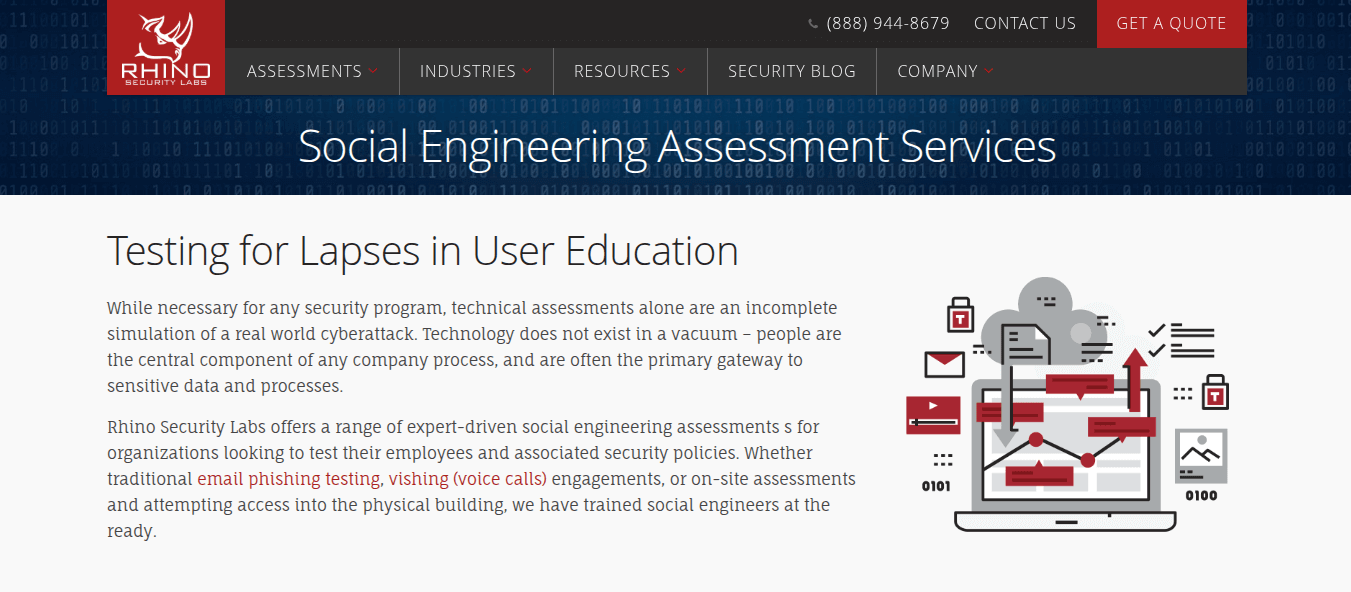
Rhino Security Labs is known for cloud and application depth, bringing OSINT-heavy social-engineering assessments together with identity and cloud attack paths. The goal is validation: demonstrate how a user action can pivot into cloud misconfigurations or endpoint gaps. This combination is valuable when comparing top social engineering testing providers for cloud-first organizations.
The team publishes research and tools — including the CloudGoat AWS range — that sharpen engagements and lend credibility to findings. Executive-targeted phishing and physical tests help prioritize fixes across identity, cloud, and endpoint in a single narrative.
Services & expertise: Social-engineering campaigns, cloud (AWS/Azure/GCP) and app pentesting, red teaming, physical intrusion, OSINT
Location: Seattle, Washington, USA (global delivery)
Founded: 2013
Team size: 20–50 experts
Portfolio: Cloud-focused attack simulations, executive-target phishing, CloudGoat and other open tools
X-Force Red covers the “human” domain alongside application, network, and hardware testing. Teams run phishing, vishing, social-media pretexting, and physical intrusion across dozens of countries, with coordinated governance for large enterprises and governments. Operators tie results to business risk and program-level improvements that executives can track.
Scale matters here: multi-site campaigns, standardized reporting, and the ability to blend human testing with broader offensive programs. Managed testing options keep momentum between assessments, so improvements land — and stick.
Services & expertise: Social engineering (email/voice/SMS), physical security testing, red teaming/adversary simulation, app/network/hardware testing, managed testing programs
Location: Global (notably US, UK, Australia, Japan)
Founded: 2016 (team launched)
Team size: 100 experts
Portfolio: Multi-region social-engineering at scale; complex red-team programs for highly regulated sectors
NCC Group runs enterprise-scale social-engineering and prevention programs, pairing phishing/vishing/smishing with training and culture initiatives. The company spans red, purple, and black-team exercises, plus hardware, application, and cloud security — so lessons feed back into defenses across endpoints and identity. Global offices support consistent execution in multinational environments.
Leadership benefits from the ability to keep testing and awareness connected, making rollout and reinforcement easier. NCC Group’s public status and scope often suit organizations seeking a single partner across multiple assurance and simulation needs.
Location: Manchester, United Kingdom; global offices
Founded: 1999
Team size: 2,200 experts
Portfolio: Enterprise-scale social-engineering and awareness programs, cross-industry testing, global delivery
Choosing The Right Social Engineering Partner
Start with your objectives and constraints. Are you proving exposure to leadership, measuring program maturity, or hardening a specific business unit ahead of a high-stakes event? Those answers guide provider selection, scope, and safety controls. If you plan to hire social engineering testing providers, align the engagement model with your risk appetite, operational calendar, and the teams who must act on the results.
Scrutinize process and reporting before you sign. Ask how pretexts are built, what OSINT sources are used, how consent and safety are enforced, and how remediation is prioritized. Favor clear, evidence-driven deliverables that map user behavior to policies, detection, and training. Whether you lean toward boutique specialists or global operators often highlighted among the best social engineering testing providers, the right fit is the one that translates findings into durable change without disrupting the business.
If you’re a social engineering testing provider and want to feature your company on this list, email us or submit a form in the Top Choices section. After a thorough assessment, we’ll decide whether it’s a valuable addition.
What A Social Engineering Test Includes
A social engineering test measures how well your people and processes resist manipulation, using the same tactics real attackers use. Most engagements combine several of these elements:
Scoping and rules of engagement: Agreeing on targets, allowed pretexts, timing and who in the company knows about the test.
OSINT reconnaissance: Gathering public information about staff, vendors and processes to build realistic pretexts.
Phishing: Simulated emails that test whether staff click links, open attachments or enter credentials.
Vishing and smishing: Phone calls and text messages that try to obtain passwords, resets or sensitive data, often aimed at help desks.
Physical entry testing: Attempts to tailgate, impersonate staff or contractors, or get past reception and badge controls.
Reporting and training: A report with findings, risk ratings and evidence, followed by targeted awareness training and process fixes.
Social engineering penetration testing is an authorized simulation of attacks that target people instead of systems, such as phishing emails, pretext phone calls, text messages and attempts to enter buildings. It shows how likely staff are to give away access or data and which processes need tightening. Results feed into training and stronger verification steps.
How often should you run a social engineering test?
Many organizations run phishing simulations several times a year and a broader social engineering or physical test at least once a year. Testing again after major changes, such as new staff, offices or help desk procedures, is also common. Industry rules or client requirements may set a minimum frequency.
How are social engineering tests priced?
Providers usually quote a fixed fee per engagement based on scope, or charge by tester days. Price depends on the number of employees and locations targeted, which methods are included (email, phone, SMS, physical entry), the depth of reconnaissance and whether follow-up training is included. Ongoing phishing programs are often priced as an annual subscription.