Top Software Development Companies For Startups In 2026
Maureen Brooks
Freelance Writer
09.08.2026
The startup has funding, a product backlog, and enough customer feedback to know what needs to ship next.
What it often does not have is enough engineering capacity to keep moving without turning every sprint into a hiring problem.
That is where the wrong development partner starts costing more than its invoice. A team can be technically capable and still slow the company down through long approval chains, rigid scope control, weak product judgment, or knowledge that never transfers back to the founders. Early-stage businesses need software development companies that can absorb changing priorities without treating every change as a crisis.
The right operating model also changes as the startup matures. A pre-seed founder may need an external product team, while a Series A company might need engineers embedded around an internal CTO. Others need a partner that can stabilize an inherited codebase before growth exposes every shortcut taken during the first release.
Startups looking specifically for partners around product acceleration can also compare ReVerbico’sSaaS development companies for startup acceleration when subscription architecture and SaaS operations are central to the roadmap.
Best Startup Software Engineering Firms To Work With in 2026
Webisoft is most relevant when the startup’s competitive advantage depends on software that is technically harder than a standard marketplace or dashboard. Its experience spans custom applications, SaaS platforms, fintech workflows, web and mobile products, blockchain infrastructure, backend systems, and third-party integrations, giving founders access to engineering depth around both the core product and the systems supporting it.
That profile works particularly well once shortcuts start becoming expensive. Verified clients describe responsive communication, proactive technical input, and an ability to work through architectural challenges rather than simply execute tickets. The 10–49-person team is not designed for instant deployment of dozens of engineers, but startups wanting a compact product partner with senior involvement may consider that a benefit.
Services & expertise: Custom software, SaaS, startup products, web and mobile development
Tech stack: Modern web technologies, APIs, distributed systems
Industries: Fintech, technology, education, real estate, automotive
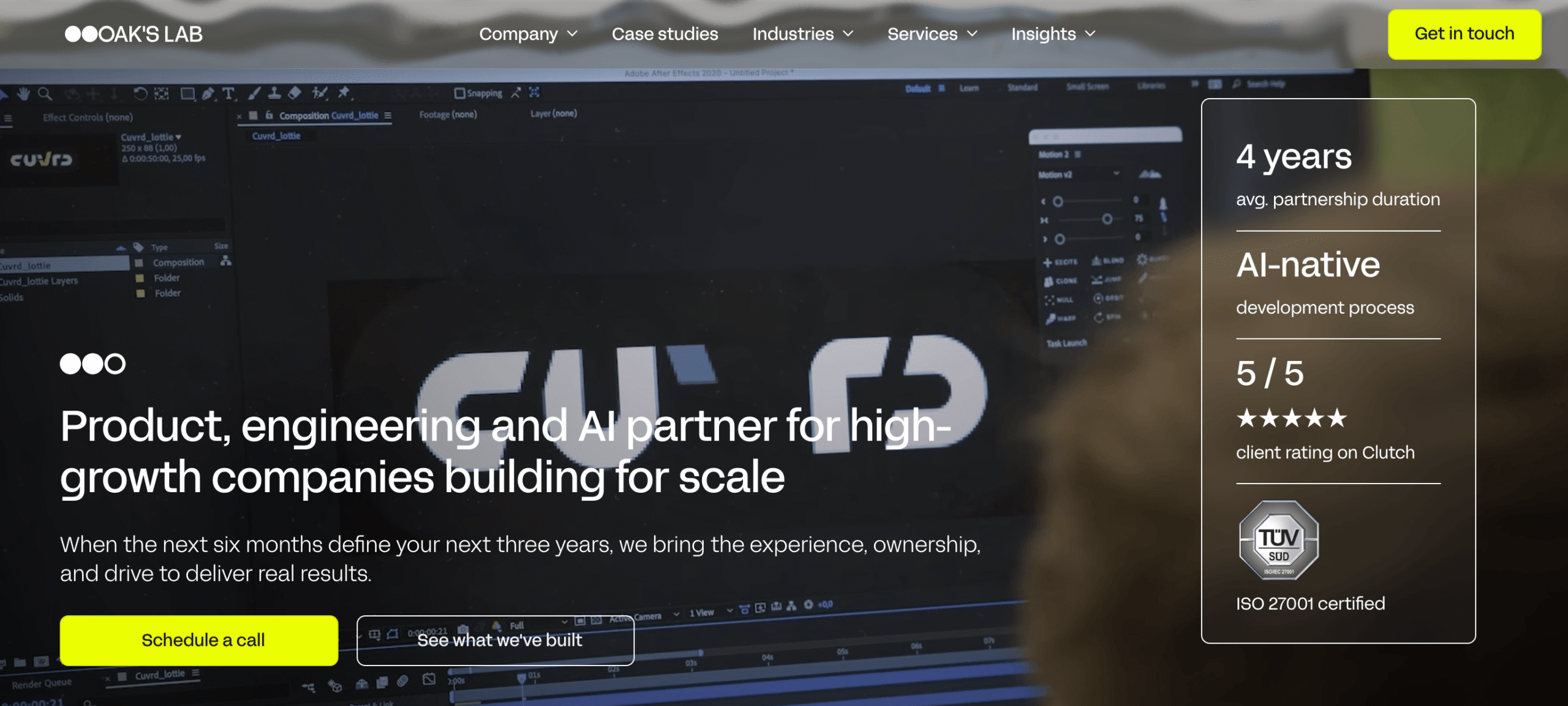
OAK’S LAB is one of the strongest choices when founders want an external team to behave like an internal product organization. Its cross-functional squads combine product management, UX/UI design, technical leadership, engineering, and QA, allowing the company to take responsibility for more than development output alone.
Founded in Prague in 2016, OAK’S LAB has built its positioning specifically around high-growth companies and startup product-market fit. Verified clients describe teams expanding and contracting as requirements change, including repeat founders returning for new companies. The downside is straightforward: reviewers also note that the firm is not inexpensive, making it easier to justify for funded startups than founders optimizing exclusively for the lowest burn rate.
Geniusee becomes especially useful when a startup already has momentum and needs considerably more delivery capacity without rebuilding its entire engineering organization. The company supports product ideation, implementation, cloud engineering, mobile applications, UX/UI, and post-release work, while verified projects include teams augmenting existing developers rather than replacing internal ownership.
Founded in 2017, Geniusee reports more than 300 engineers and delivery hubs in Ukraine and Poland. Its 71 Clutch reviews provide unusually deep evidence for this category, including engagements where clients needed added manpower around established products. Scale is its main advantage, although a small pre-seed startup should verify that it will receive an appropriately lean team rather than paying for process designed around larger engagements.
Altar.io fits founders who still need someone to challenge the product before scaling the codebase. Its process combines product strategy, UX/UI, custom software, AI development, and mobile engineering, with several verified engagements beginning by defining the product vision and narrowing the scope before implementation.
The Lisbon company was founded in 2015 and operates with a 10–49-person team. Reviews repeatedly highlight its founder-oriented approach, including a recent engagement where the client credited the team with focusing resources on what mattered most instead of maximizing development scope. Its $25,000 minimum and $50–$99 hourly range make it a considered product investment rather than an inexpensive body-leasing option.
Empat is compelling for startups that want one supplier to move from discovery into design, engineering, infrastructure, and later-stage optimization. Verified work includes taking startup products from idea to launch, stabilizing projects inherited from previous vendors, augmenting existing teams, and supporting production backend and DevOps environments.
Founded in 2013, the company lists 250–999 employees across San Francisco, Kyiv, London, New York, and Warsaw. Its 147 reviews create one of the strongest evidence bases in this ranking, with recurring praise for communication and adaptability. Some clients have suggested greater resource scalability on larger projects, so growth-stage companies should agree on staffing expansion before the roadmap suddenly requires another squad.
Giraffe Studio works well when a startup needs a capable application team at a comparatively accessible price point. Small businesses make up 95% of its published client mix, while custom software represents 60% of services, supported by API, mobile, and web development.
Founded in 2016, the Kraków studio has 10–49 employees and 23 Clutch reviews. Verified work includes combined mobile and desktop products, ecommerce launches, and ongoing application partnerships. Clients repeatedly praise communication and budget alignment, although some would like the team to suggest new technical ideas more proactively. That makes it a good fit when founders already have clear product leadership internally.
Services & expertise: Custom software, mobile apps, APIs, web development
JazzServe is a specialist option for startups whose architecture needs to handle higher performance or backend complexity without hiring a large engineering vendor. The company dedicates its practice to custom software and emphasizes high-performance web services, cloud systems, and Golang engineering designed around scalability and reliability.
Founded in 2017, JazzServe has 10–49 employees in Kyiv and eight Clutch reviews. Clients highlight responsiveness and an ability to understand complex requirements, with project sizes extending well beyond small prototypes. Some feedback mentions documentation and code-quality improvements, so founders planning eventual internal handover should establish explicit engineering standards early.
itMedia holds up best for startups that want an experienced engineering partner without moving into a very large offshore delivery model. Its work covers custom software, mobile and web development, AI consulting, ecommerce, and integrations, while verified engagements include marketplaces and mobile products that have remained under active development for several years.
Founded in 2006, the Bijeljina-based company lists 11–50 employees and has eight Clutch reviews. Clients consistently mention flexibility, professionalism, and technical breadth across Symfony, PHP, Java, Swift, React, Angular, and related technologies. One client asked for clearer planning and follow-up documentation, which is relevant for startups where changing priorities already make roadmap visibility difficult.
Services & expertise: Custom software, mobile apps, web development, AI integration
Decision Tree Technology separates itself through a narrow but useful proposition for startups working in the Microsoft and ABP.IO ecosystem. One verified client hired the company to build a proof of concept, provide technical-stack guidance, and supply ABP.IO specialists, eventually taking the concept into market validation in both the UK and US.
Founded in 2019, the company has 10–49 employees with client-facing locations across the US and Canada. Its public evidence base is much smaller than those of the firms above, with only a handful of reviews, but the POC-to-market example is directly relevant to startup buyers. This is a specialist shortlist entry rather than a broad recommendation for every technology stack.
Services & expertise: Custom software, POCs, architecture consulting, ABP.IO development
Japeto is the boutique option for founders who want direct access to a small senior team and do not need dozens of engineers. Custom software represents half of its service mix, supported by web and mobile work, while the company explicitly serves startups alongside fintech, nonprofit, and medical organizations.
Founded in 2014, Japeto has two to nine employees in Harlow and seven Clutch reviews. Clients praise its ability to translate technical requirements into practical software and communicate clearly with non-technical stakeholders. The small team naturally limits parallel capacity, but for a focused startup platform, that same structure can reduce handoffs and keep product decisions close to the engineers doing the work.
Services & expertise: Bespoke software, web applications, mobile development
Compare development partners against the next twelve months of the company, not just the next release. Ask what happens when priorities change halfway through a sprint, a senior developer leaves, the internal team doubles, or the startup decides that a feature planned for Q4 suddenly needs to ship next month.
A useful startup partner should increase the company’s ability to move without making the company permanently dependent on the partner.
Bookmark this guide to make a well-informed decision. If you want to add your company to this list, drop us a line orsubmit a form in the Top Choices section. After a thorough review, we’ll decide whether it’s an appropriate addition.


 OAK’S LAB is one of the strongest choices when founders want an external team to behave like an internal product organization. Its cross-functional squads combine product management, UX/UI design, technical leadership, engineering, and QA, allowing the company to take responsibility for more than development output alone.