
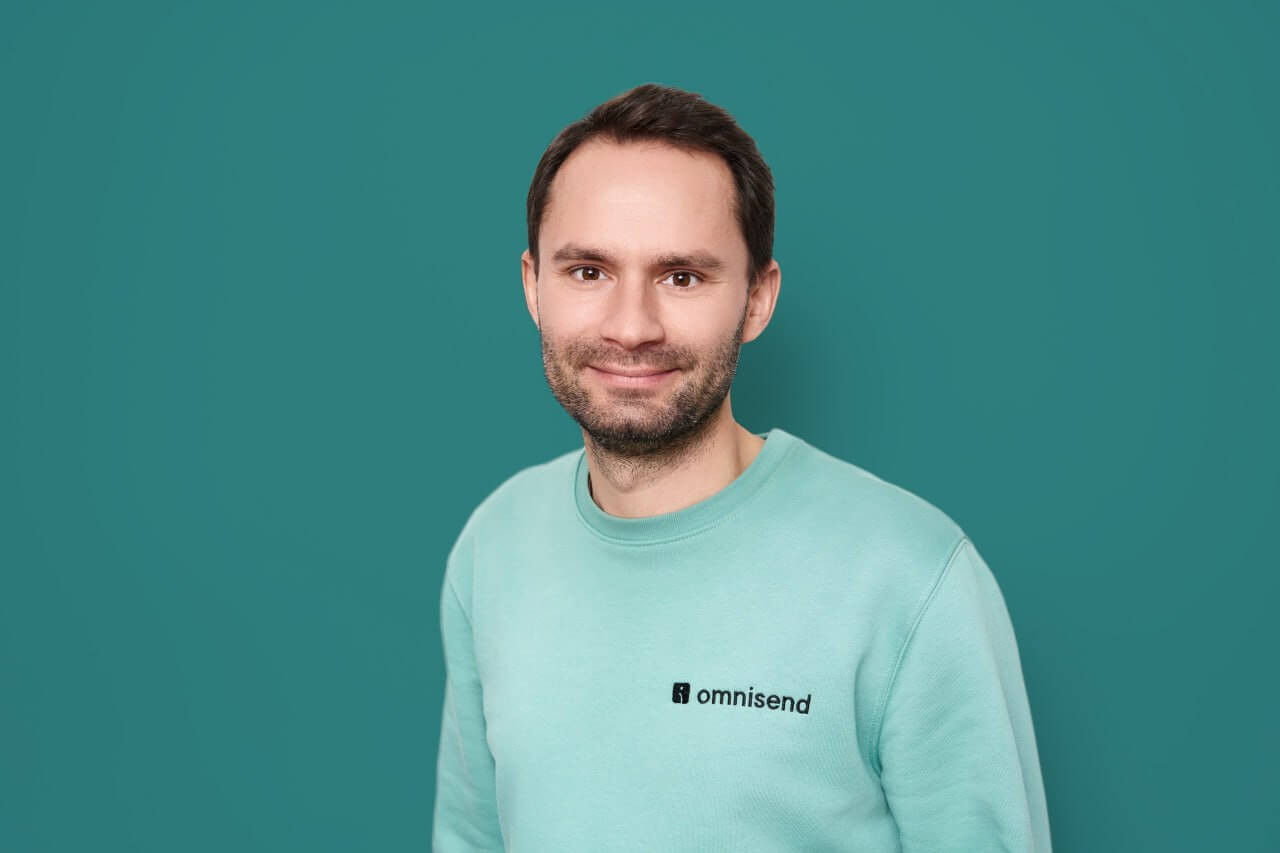

Please introduce your company and describe your role within the organization.
I’m a CEO and co-founder of Omnisend, an email marketing platform tailored for ecommerce businesses. We believe that the field of ecommerce marketing is unnecessarily fragmented, time-consuming, and overly technical, and we aim to simplify the process by providing powerful and flexible tools to small and mid-sized businesses. Today, we’re one of the fastest-growing marketing automation platforms in the industry. I’m still very actively involved in the day-to-day operations of the organization and have plenty of plans and ambitions for the future.
What is your company’s core business model – do you use an in-house team, third-party vendors, or a hybrid outsourcing approach?
Our aim is to do everything in-house. However, we sometimes use third-party vendors when it makes strategic sense. For example, engineering, product, design, data science, deliverability, and core platform operations are all in-house, and so is customer support. Marketing and content production are also done mostly in-house. However, we have a list of partnering agencies and freelancers for creative production.
How does your company differentiate itself from competitors in a crowded market?
Omnisend is different as a platform because it was conceived and developed specifically for ecommerce businesses. Right from the get-go, our goal was to design powerful features that would help store owners to increase their sales without the steep learning curve present in other platforms. On Omnisend, you can do this on autopilot. We’re also mainly focused on small- to medium-sized merchants and can offer them both more competitive pricing and 24/7 care from our award-winning customer support team.
What are the primary industries or sectors you serve, and how has that focus evolved over time?
We primarily focus on small and medium-sized ecommerce businesses. For them, Omnisend is a valuable tool for maintaining and growing their operations. It is powerful, but at the same time, not clunky to use. Our tools are loved by marketing professionals cause it offers highly capable features. Our focus is on maintaining the right balance. 90% of businesses worldwide fall into the small and medium-sized categories, and our primary goal is to serve their needs by delivering powerful capabilities without the steep learning curve and exaggerated cost
What are the most in-demand services or solutions that clients approach your company for?
The main service is helping businesses make more sales! That’s why clients come to us in the first place. The problem with many ecommerce marketing tools is that they’re too difficult to use. Yes, they’re powerful, but they’re also intimidating. In my opinion, really powerful tools are intuitive and accessible by nature. The goal with Omnisend was always to create a platform that is so smooth that a user starts to wonder why they ever bothered with other platforms in the first place.
We’re best known for our automation and segmentation features. Since ease-of-use was always our top priority, we developed an interface to make the process of creating aesthetically pleasing and effective emails simple and intuitive. Our drag-and-drop email builder and pre-built templates enable brands to customize their look and make more sales right from the get-go. We also give online merchants the power to send highly relevant and personalized SMS messages and push notifications.
How do you personally stay ahead of industry shifts when most data is already yesterday’s news?
The industry moves at a really rapid pace. It’s almost counterproductive to rely on various industry reports and similar analyses, because by the time the trend shows up in them, it becomes almost irrelevant. I realized some time ago that if you want to know what’s actually happening in the industry, you need to talk with the merchants themselves.
We have the advantage of having access to tens of thousands of ecommerce brands. After all, it is they who feel customer behavioral shifts first and have to adapt to them fast or die. Our teams engage directly with customers to understand their needs and challenges, with over 1,300 interviews conducted in 2025 alone. These findings are then paired with large-scale behavioral data, such as over 27 billion emails sent through Omnisend in 2025.
How do you measure and ensure high customer satisfaction in your operations?
You have to measure customer satisfaction across the entire journey. It’s one thing to gain a customer, but it’s a whole different task to keep them. Customer satisfaction really comes down to three main questions: Are your customers getting actual value from your services? Is their experience using the platform smooth enough? Are they planning to continue using your platform?
Surveys are notoriously problematic when measuring customer satisfaction. A merchant can give you a 9 on a survey and still churn six months later. Retention and expansion rates give you much more reliable insights. As does customer support interactions. We rely on it heavily. We very consciously offer 24/7 live chat and email support to every merchant, including free-tier merchants, and in return, we get priceless insights into how to improve our product.
What kind of post-project support do you provide to address client queries or ongoing needs?
Actually, we don’t really have a ‘post-project’ period. We see it as a continuous relationship with no breaks. You need to stay aligned with our clients at all times, because that’s the only way to ensure they get value from your product.
That being said, it all starts with 24/7 live chat and email support. It’s a universal feature included even in the free plan. Many of our clients also get a dedicated Customer Success Manager, whose job is to help make the most out of our platform. We also provide an extensive knowledge base with hundreds of articles, video tutorials, the Omnisend Academy for structured learning, regular webinars, and quarterly business reviews.
Our goal is to move towards more proactive customer support. We want to give clients a heads-up before they ever notice something’s off. Customer support is one of the key reasons businesses stay with Omnisend.
Describe your pricing and billing structure – is it fixed cost, pay-per-milestone, or another model?
We have three main plans: Free, Standard, and Pro. The price within each depends on the number of contacts. The Free plan is genuinely free and has every core feature: automation, segmentation, popups, and A/B testing. We chose this strategy for a very simple reason. Omnisend can only grow when our clients grow. In fact, a lot of our paying customers actually started on a free tier. They started out as a part-time business, but grew into sustainable businesses that generate stable revenues. When you have a shared history like that, a deep sense of trust forms that carries into the future.
The Standard plan expands functionality even further. It unlocks higher sending limits and customer support priorities. The Pro plan adds unlimited email sends, advanced reporting, and priority client service. We price SMS separately on a credit-based model.
What key challenges has your company faced in the last few years, and how did you overcome them?
The challenge is always the same for us: how to drive new customers while retaining existing ones. It’s a tall task, mostly because the market itself is so competitive. We have to compete with both market giants that can be really aggressive with their positioning, as well as newer entrants that try to outcompete everyone by being more risk-tolerant. The answer to this challenge is not losing your identity. It’s tempting to try to get in the rat race for the cheese, but holding on to who we’re actually building is a much wiser approach that so far is working out for us.
Then there’s the challenge of responding to the needs of current clients, and at the same time keeping up with new technologies. AI is transforming ecommerce marketing, and if you fail to keep up with it, you’ll eventually be left behind. You need to find a balance between solving today’s problems and preparing for tomorrow at the same time.
How do you foster innovation and adapt to emerging trends in your industry?
Innovating is a major part of the game. You need to do it, or otherwise you’ll lag behind and become irrelevant. The question is HOW to innovate. You can try out a bunch of different approaches and see what sticks, or you can be smart about it. Our best source of information is our clients. We use AI to synthesize thousands of conversations with our client support. This is an irreplaceable source of truth that helps us build and improve our tools.
We have a core value that says, ‘done is better than perfect. Very often, innovation comes down to a simple willingness to try things out, and that’s what we are trying to do. Experimentation, tinkering with things are a huge part of our culture. However, we introduce the results of these experiments to the audience only after we confirm they provide actual value.
What role does company culture play in your success, and how do you build and maintain it?
I don’t believe that long-term success is possible without a strong company culture. Yeah, you’ll do fine for a while, at least until you run out of pure luck. It is when this happens that the culture comes into play. Culture is something you fall back on when things get rough; it grounds you and helps you find viable solutions. In my opinion, it all starts with leadership. I’m a big believer in leading by example. If you take ownership, your team will take ownership; if you treat people fairly, they will treat each other fairly; if you work, they will also work hard.
Where do you envision your company in the next 5-10 years? What are your boldest long-term goals?
We have been growing steadily over the past 5 years. More importantly, we did this on our own. We don’t have any investors who can provide resources. The goal is to continue doing that. Most of our customers are from the USA, the UK, Australia, and Canada. In total, we work with 15,000 e-shops from 130 countries. As ecommerce grows, so will the need for intuitive and easy-to-use marketing tools. The industry is moving towards more user-centric software. AI evolution means that platforms are increasingly expected to reduce complexity. Instead of asking users to adapt to tools, tools are adapting to them, and becoming more intuitive, requiring less manual setup and technical knowledge. At Omnisend, this is reflected in ongoing investment in user experience, AI capabilities, and integrations that allow the platform to fit into existing workflows, including environments such as ChatGPT.
How has your leadership style evolved throughout your career, and what influences it?
Experience is the best teacher. It’s one thing to be the head of an early-phase startup, and entirely different to lead a team that numbers in the hundreds of people. The main lesson for me was letting go of some of the responsibilities and trusting that people know what they do. You cannot be on hand all the time, and choose your priorities. I’m constantly learning, trying to improve myself. I always remember the core message in the book “The Hard Thing About Hard Things”. I love it because it doesn’t talk about success much and focuses on how many times people fail before they succeed. It’s essential to allow yourself to fail at something from time to time. That’s the only way to grow.
What emerging technologies or market shifts are you most excited about for your company?
AI is an obvious answer. It has significant potential for ecommerce marketing because of its ability to analyze large volumes of data, personalize insights and content, and automate many processes. We currently have two distinct groups of clients. The majority of them want functional, reliable, and powerful tools. At the same there’s this group of early-adopters who are eager to try innovative stuff. Keeping both groups happy is a tricky, yet intriguing challenge.
By the way, simply having AI is not enough. We believe that AI has to become a habit. That’s the only way to make the most out of it. At Omnisend, we actively encourage the team to use AI and even develop new tools to use more effectively. It’s very intriguing to see where all this will lead both us and the industry as a whole.
What advice would you give to aspiring leaders? Can you share one lesson from your journey that resonates with the business community?
Starting out is the hardest part. At least emotionally. You tend to overthink things and get stuck in the loop, thinking about doing something, not doing it, and then feeling bad about it. So, just do it. Remember that done is better than perfect. Don’t overthink every aspect of the business you want to launch or a change you want to make. Start acting, evaluate the results, and pivot if needed. Omnisend was my third attempt to launch a successful start-up. The first two failed. But I don’t view them as failures. I see them as lessons. I learned a lot from those businesses, and you’ll learn a lot from your failures.