Not every mention of your brand comes with a link. And for years, that meant it didn’t “count.”
A journalist would name-drop your company in a roundup, a Reddit thread would recommend your product, a podcast host would praise your service, and none of it showed up in your backlink report. So it got filed under marketing, not SEO.
That divide is closing fast. Search engines have gotten much better at reading language the way people do, and a brand mention (linked or not) is now one of the clearest signals of real-world credibility a business can send.
Here’s what a brand mention actually is, why it matters for SEO in 2026, and how to start treating mentions as a ranking asset instead of a vanity metric.
What counts as a brand mention?
A brand mention is any place your company, product, or brand name shows up online: in an article, a social post, a review, a forum thread, a podcast transcript, whether or not it links back to your site.
Mentions generally fall into two buckets:
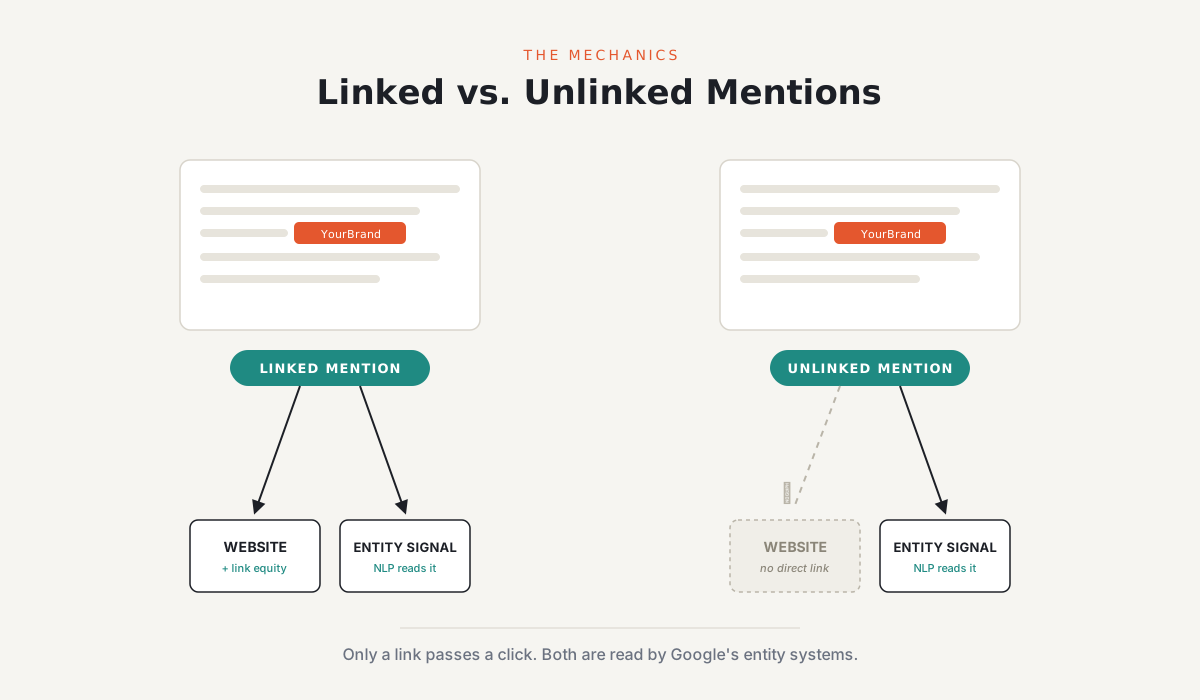
Linked mentions. Your brand name appears and hyperlinks to your website. This is the classic backlink SEOs have always chased.
Unlinked (or “linkless”) mentions. Your brand name appears, but there’s no clickable link, just the text. The reader knows who you are; a crawler technically can’t click through, but it can still read the words around your name.
For a long time, only the first type was treated as an SEO signal. The second type is where the shift is happening.
Why unlinked mentions matter now
The short answer: entity SEO and natural language processing (NLP).
Google no longer relies purely on links to understand what a brand is and how trustworthy it is. Its systems use NLP to read context, tone, and relationships between words, which means it can recognize “Acme Robotics” as a specific business entity in a sentence, connect that mention to what it already knows about Acme Robotics in its Knowledge Graph, and update its understanding of the brand accordingly. No hyperlink required.
A few things follow from that:
Co-occurrence builds topical authority. If your brand keeps showing up near the same keywords and topics: “best project management software,” say, Google strengthens the association between your brand and that category over time.
Context and sentiment matter. Being called “the industry leader” in a respected publication carries more weight than an offhand or negative mention. Search systems increasingly weigh not just that you were mentioned, but how.
Trust transfers. When a high-authority site writes about you, even without a link, some of that site’s credibility rubs off on how trustworthy your brand looks to Google.
AI search rewards familiarity.AI Overviews, ChatGPT, and Perplexity draw on how often and how consistently a brand appears across the web when deciding who to cite. A brand that’s talked about often and positively is more likely to get surfaced in an AI-generated answer, link or no link.
Branded search volume goes up. Every mention is a small piece of exposure. With enough exposure, people start typing your name directly into Google instead of a generic category term. That branded search demand is itself a trust signal: it tells Google people are specifically seeking you out, not just landing on you by accident.
Brand mentions vs. backlinks: what’s the actual difference?
They’re not interchangeable, but they’re increasingly part of the same authority signal.
Backlink
Brand Mention
Includes a hyperlink
Yes
Not necessarily
Passes direct “link equity”
Yes
No
Recognized as an entity signal
Yes
Yes
Easy to earn at scale
Harder
Easier
Shows up in traditional backlink reports
Yes
Only if tracked separately
Influences AI Overview / LLM citations
Indirectly
Directly
Links are still valuable; they’re the clearest, strongest form of endorsement a site can give. But if you’re only tracking backlinks, you’re missing a growing share of the conversation happening about your brand.
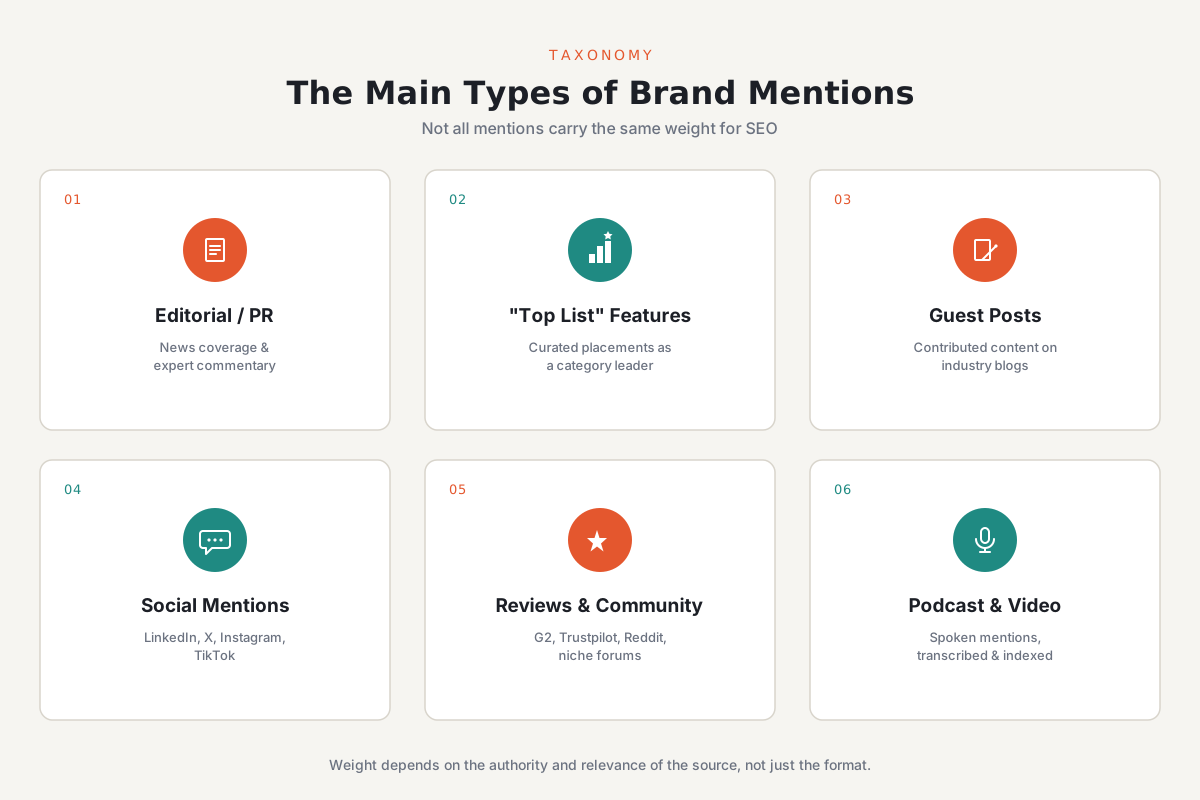
The main types of brand mentions
Editorial / PR mentions — being cited in news articles, roundups, or expert commentary.
“Top list” or curated feature placements — being featured in a niche publication’s ranked list of recommended companies or tools in your category. These blend PR and SEO: they’re a form of mention, but they’re also often built specifically to carry a link.
Guest posts and contributed content — your brand referenced within industry blogs, either your own contributed piece or a third party’s.
Social mentions — LinkedIn, X, Instagram, TikTok conversations that name your brand.
Review and community mentions — G2, Trustpilot, Reddit, niche forums.
Podcast and video mentions — spoken references, often transcribed and indexed, which is part of why podcast SEO has become its own discipline.
Each carries different weight depending on the authority and relevance of the source, a mention on a well-known industry publication will typically do more for your entity signal than the same mention on a low-traffic blog.
How to find your brand mentions
You can’t manage what you can’t see. A basic monitoring stack looks like:
Google Alerts — free, decent for catching new web mentions
Ahrefs’ Content Explorer / Web Mentions — search your brand name and filter out your own domain to see who else is talking about you, and cross-reference which mentions have already turned into (or are good candidates for) backlinks
Brand24, Mention, or Semrush’s brand monitoring tools — better for social and real-time coverage
Google Search Console — filter for branded queries to see how mention-driven search demand is trending
Your CRM or sales call notes — “how did you hear about us?” often surfaces mentions no tool catches
Turning mentions into SEO value
Finding mentions is step one. Here’s how to make them work harder:
Reclaim unlinked mentions. Reach out to the site and ask for a link where you’re already named, often a five-minute email that converts a mention into a backlink.
Double down on what’s working. If you keep getting mentioned in the same topic cluster, that’s a signal to build more content around it, you’re already being recognized as relevant there.
Feed your PR and content calendar with mention data. Journalists and bloggers who’ve mentioned you once are good candidates for future outreach.
Track sentiment, not just volume. A spike in mentions from a negative review thread isn’t the same win as a spike from expert coverage.
In practice: how a feature placement moved the needle for a ReVerb client
Theory is one thing, here’s what mention-style placements look like when they’re part of a real SEO campaign.
When ReVerb took on Unico Connect, a no-code development agency, the client’s Domain Rating sat at 34 with roughly 400 monthly organic visits. Part of ReVerb’s off-page strategy involved building custom “Top lists”, curated, editorial-style features naming Unico Connect as a leading provider in its category, alongside a steady cadence of traditional link building on relevant, high-authority sites.
That combination of feature-style placements and backlink acquisition, sustained over roughly 13 months, produced a 304.9% increase in organic traffic and a 165.1% increase in overall site traffic. Domain Rating climbed 17 points, from 34 to 51, while the number of ranking keywords jumped from 20 to 422.
Along the way, the campaign earned 130+ new backlinks from unique, high-authority domains and pushed Unico Connect to #1 rankings for category terms like “best WeWeb developers” and “best Xano developers.”
The mechanism is exactly what the sections above describe: a mention doesn’t have to be unlinked to matter for entity signals, but the editorial, third-party framing — being named as a category leader on an independent site, rather than only linked from your own — is what compounds with traditional link building to move Domain Rating, rankings, and traffic together, rather than any one lever alone.
Common mistakes to avoid
The most common misstep is chasing volume over relevance. A hundred mentions on low-authority spam sites will do less for entity signals than five mentions on sites your actual audience reads.
Close behind that is ignoring sentiment: tools often report raw mention counts, but a spike from a complaint thread and a spike from expert coverage are not the same event, even if the dashboard treats them equally. It’s also easy to let mentions and backlinks live in separate reports; if your SEO reporting only shows link data, you’re structurally blind to a growing share of your entity signal, so it’s worth building mention tracking into the same dashboard.
Then there’s the win teams leave on the table most often — never following up on unlinked mentions, when the easiest SEO gain in this whole space is often just a polite email asking an existing mention to become a link.
Finally, don’t optimize only for Google and forget AI answers. AI Overviews and chat-based search pull from the same pool of mentions but weight consistency and recency differently than traditional ranking, and a brand that goes quiet after one PR push won’t sustain AI visibility the way steady, ongoing mentions will.
The takeaway
Brand mentions used to be a PR metric with no clear SEO home. That’s no longer true. As search engines and AI platforms get better at reading context instead of just counting links, how often, and how well, your brand is talked about across the web is becoming one of the clearest signals of authority you have.
If you’re building an SEO strategy for 2026, backlinks are still worth chasing. But it’s worth treating every unlinked mention as a lead, not a footnote.
FAQ
Do brand mentions without a link actually help SEO?
Yes, but not the same way a backlink does. Unlinked mentions help with brand recognition and topical association, rather than passing direct link equity. They’re a complementary signal, not a replacement for links.
How do I find unlinked mentions of my brand?
Search your brand name in Ahrefs’ Content Explorer or Web Mentions, then filter out your own domain, and cross-reference with your existing backlink list.
Do brand mentions affect visibility in AI Overviews and ChatGPT?
Yes. AI search systems draw on how frequently and consistently a brand is mentioned across the web when deciding what to cite in generated answers, independent of whether those mentions link back to the site.