A consumer brand now has to win in two places that behave nothing alike. On a retail shelf it has about three seconds and no context, so the package has to carry the entire argument. On a phone it competes against an infinite feed, so the brand has to survive being cropped to a thumbnail, screenshotted, and rebuilt as a product detail page. Very few agencies are genuinely good at both, and the gap between the two is where most consumer brand budgets get wasted.
That split runs straight through this category. The heritage packaging houses know dielines, shelf-ready packaging specs, private label economics, and how to roll artwork across hundreds of SKUs in a dozen markets. The digital-native studios know Shopify architecture, product photography, motion, and how a brand behaves in a paid social feed. A DTC brand pushing into Whole Foods needs the first. A CPG brand opening its own storefront needs the second. Plenty of brands need both at once.
The agencies below are grouped for that reason rather than by revenue. Each entry notes what the agency is actually built to do, what it costs in practice where that is public, and where its coverage thins out. Read the weaknesses as carefully as the strengths, because the mismatch is almost always a scope problem rather than a talent problem.
Branding Agencies for DTC and CPG Brands at a Glance
Agency
Location
Strongest At
Best Fit
View Source
Brooklyn, NY
Identity, packaging, ecommerce build, in-house photo and video
DTC and CPG brands that need brand and store built by one team
1. View Source — Brand, Packaging, And Storefront From One Brooklyn Team
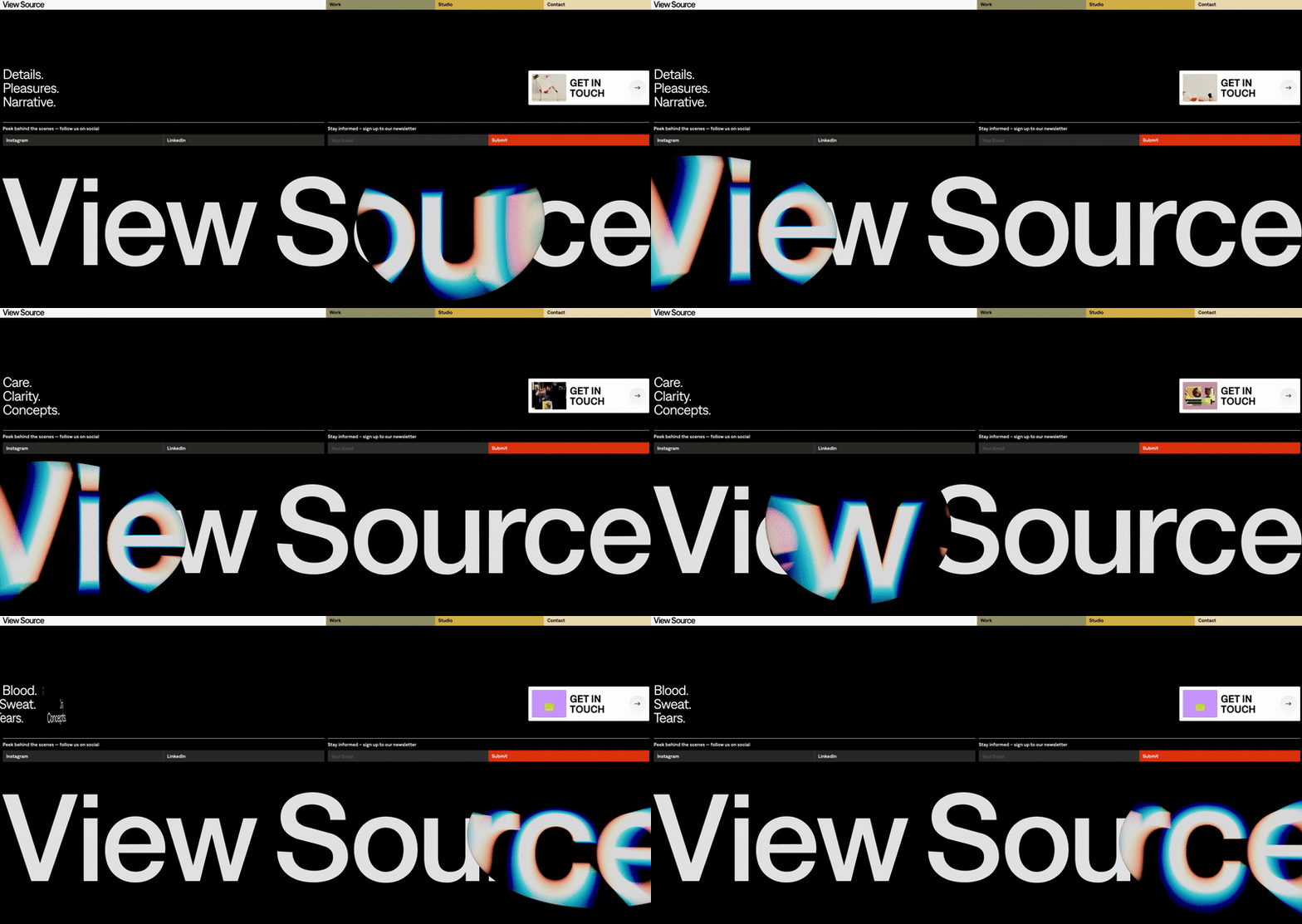
View Source is a Brooklyn design and technology studio that describes its own work as ideas, aesthetics, and code, which is a reasonable summary of why it fits this category better than most. The consumer portfolio is unusually well suited to a DTC and CPG brief: brand identity for Aura Bora in sparkling beverages, work with Banza in the pasta aisle, Cadence in hydration and travel containers, Cumulus in coffee hardware, naming and identity and packaging for Watts Pet, and the Maeve chocolate ecommerce experience that took a 2026 Webby in Food and Drink. Bandit Running, Edie Parker, and the Daphne loungewear line round out the consumer side.
What separates the studio from a pure identity shop is the execution layer sitting underneath it. View Source has been a Shopify partner since August 2015 and holds Premier tier status, so the storefront is built by the same team that built the brand rather than handed to a separate development vendor. It also runs Brick Studio, a 2,000 square foot still-life photography facility in Brooklyn built for cosmetic, accessory, and product work, which means packaging renders, campaign photography, video, and 3D content are produced in house instead of subcontracted. For a consumer brand, that removes the two handoffs where brand systems usually degrade.
The studio reports 62 awards, more than 140 launches, roughly 20 senior staff, and three offices, with a deliberately senior-weighted team rather than a large junior bench. Published Shopify pricing for its ecommerce work runs from $50,000 to $400,000, which places it above a boutique packaging studio and well below a global network. Where it is not the answer: a brand that needs artwork adaptation across hundreds of SKUs in a dozen regulatory markets should be looking at a production-scale packaging house instead.
2. Red Antler — The Launch Playbook Behind Casper, Allbirds, And Supergoop
Red Antler was founded in Brooklyn in 2007 by JB Osborne, Emily Heyward, and Simon Endres, and for a decade it effectively defined what a launched DTC brand looked like. The portfolio includes Casper, Allbirds, Brandless, Burrow, Supergoop, PopUp Bagels, Hinge, Chime, and Ramp. The agency is strongest at the front end of brand creation, meaning positioning, naming, and identity built for a company that does not exist in the market yet, which is a genuinely different discipline from refreshing something with existing equity.
The trade-off is well documented and worth taking seriously. Red Antler is generally regarded as stronger on brand creation than on the ongoing performance marketing and retention work that keeps a brand growing after launch, which most clients staff separately. The agency also has a history of taking equity as part of client relationships, which shapes who it takes on. For a CPG brand that needs shelf-tested packaging systems and artwork production discipline, this is not the right fit. For a consumer brand that has a product and no brand, it remains one of the strongest options available.
JKR was founded in London in 1990 and now runs more than 300 people across London, New York, and Shanghai. Its packaging-led identity work covers AB InBev brands including Budweiser and Stella Artois, plus Mars, Kraft Heinz, Dunkin’, Impossible Foods, Fanta, Minute Maid, and M&M’s, alongside challenger brands such as Hippeas, Ugly, and The Gut Stuff. The 2021 global Burger King rebrand won a Gold Cannes Lion, and the agency has taken Most Awarded Design Group at D&AD and Studio of the Year at Dieline.
The differentiator is that JKR has done the homework behind its own positioning. Its partnership with Ipsos produced the Be Distinctive. Everywhere. research on why distinctive brand assets drive commercial growth, which gives its recommendations an evidence base that most creative pitches lack. That matters when a brand team has to defend a packaging change internally. The practical constraint is scale and cost. JKR is built for multi-market portfolio work with C-suite sponsorship, and an emerging DTC brand with a single SKU line will not be a natural fit.
4. CBX — National Brands And Private Label Under One Roof
Founded in 2003 with offices in New York and Minneapolis, CBX is one of the few agencies that treats packaging as the primary canvas for brand strategy rather than the output of it, which is the correct frame for any brand where shelf presence drives the first purchase. The client list reads as a cross-section of American retail: General Mills, Hershey, Clorox, Land O’Lakes, Kimberly-Clark, Mondelez, PepsiCo, J.M. Smucker, Church and Dwight, Hormel, Kroger, Rite Aid, and The Boston Beer Company.
CBX runs brand strategy, portfolio architecture, naming, identity design, and packaging as one continuous discipline, with a dedicated retail and branded environments division for clients whose packaging has to work alongside in-store fixtures and shelf systems. It also has unusual depth in private label development for major retailers, which very few creative agencies of this calibre will take on. The known gap is digital. CBX’s paid media and ecommerce fluency is weaker than its retail expertise, so a DTC-first or omnichannel brand will need a second partner for the storefront and acquisition side.
5. Bulletproof — Global Drinks And Snacking Packaging, B Corp Certified
Bulletproof was founded in 1998, employs roughly 350 people, and describes itself as the world’s largest independent brand agency, with studios in London, New York, Singapore, Amsterdam, Sydney, Melbourne, Shanghai, and Dubai. Its roots are firmly in food, drink, and spirits. Clients include Mondelēz International, Diageo, The Heineken Company, Tate and Lyle, and Booking.com, alongside challenger work for White Claw, Soapsmith, and a first-ever full rebrand for the Applaws pet food brand. It is a certified B Corp, which increasingly matters to retail buyers running supplier sustainability screens.
The strength is running one identity system consistently across many markets and formats without it fragmenting, which is exactly what breaks when a growing brand outgrows its original studio. Bulletproof publishes commercial outcomes rather than only creative galleries, including a 29 percent brand recall lift on Toblerone. The limitation is the same as any global network: a small DTC brand will be a minor account, and pricing reflects the studio footprint rather than the size of the brief.
6. Beardwood — Packaging That Has Been Independently Measured
Beardwood is a New York food and beverage specialist with more than 100 brand transformations over 20-plus years, and its pitch is refreshingly narrow. The agency argues that the CPG shelf is the most honest test in branding, because there is no context and no brand manager standing in the aisle to explain anything, and it builds packaging designed to interrupt a shopper mid-stride rather than to satisfy internal consensus.
What makes Beardwood worth shortlisting over a similarly sized studio is that it submits work to independent measurement. It has taken five consumer measurement awards across three separate bodies, Designalytics, Nielsen Design Impact, and PAC Global Best in Class, and publishes validated results including Corona Sunbrew ranking first among new beer entries, a 78 percent preference score for Oikos, and a 51-point taste-perception gain for Pure Protein. For a brand team that has to justify a redesign to a finance function, that evidence trail is the differentiator. The scope is deliberately limited to food and beverage, so a beauty or household brand should look elsewhere.
7. Gander — The Studio That Made Banza And Magic Spoon Look Inevitable
Gander is a Brooklyn branding and graphic design studio specialising in branding, packaging, web design, and art direction. Its reputation rests on two launches that reset their categories: Banza in dry pasta and Magic Spoon in breakfast cereal, both of which entered aisles governed by decades of visual convention and refused to follow it. The studio’s current work spans hot sauce, olive oil, baby food, and donuts, which is a fair signal of where its instincts sit.
The house strength is a distinctive colour and illustration system that stays recognisable from a shelf facing to an Instagram tile to a shipper carton, which is the specific problem hybrid CPG and DTC brands keep failing to solve. Gander is the right call for a challenger food or beverage brand that needs to look unlike everything around it and has the nerve to ship something genuinely unconventional. It is not the right call for a heritage brand protecting existing equity, or for a portfolio owner needing brand architecture across dozens of sub-brands.
8. Pentagram — Twenty-Four Owner Partners, Each One A Working Designer
Founded in 1972, Pentagram is the world’s largest independent design consultancy and operates on a structure nothing else on this list shares. Every project is led directly by one of its 24 owner-partners, who serves as both lead designer and primary client contact. There is no account layer translating between the client and the person doing the work, and no risk of the senior creative who won the pitch disappearing after kickoff.
For a consumer brand, this suits a flagship identity project where design authorship genuinely matters and the brand wants a named designer attached to the result. Partners work independently with distinct portfolios, so agency selection is really partner selection, and reviewing individual partner work matters far more than reviewing the firm. The constraints follow from the model: partner-led capacity is finite, pricing sits at the top of the market, and Pentagram is a design consultancy rather than a production packaging house or an ecommerce builder.
Wolff Olins builds identities as behaviours rather than static marks, which is why its work reads as native to screens. The TikTok 3D logo, Uber’s U, and Google’s four-colour spiralling G all come from the same premise: an identity should be able to move, respond, and stay recognisable in formats nobody designed it for. For a consumer brand living in feeds, that flexibility is a practical asset rather than a stylistic preference.
The fit here is a consumer brand repositioning at scale, particularly one that has outgrown a launch identity that photographs well but cannot stretch across product lines, campaigns, and channels. Wolff Olins works at the strategic and systemic end, so packaging artwork production and shelf mechanics are not its centre of gravity, and a CPG brand will need a production partner downstream. Budget expectations should match a global consultancy.
10. Little Big Brands — Heritage CPG Rebrands Without Losing The Equity
Operating in metro New York since 2001, Little Big Brands covers brand strategy and research, naming and identity, packaging structure and design, digital and social assets, and campaign development. Its recognisable specialism is modernising heritage brands, meaning the delicate work of updating something consumers already recognise without discarding the assets that make it findable. Recent examples include a full visual identity and packaging rebuild for World’s Best Cat Litter with KENT Pet Group, a refreshed look for the Japanese barbecue sauce brand Bachan’s, and European packaging work for Ajax aimed at younger shoppers.
The Emerson Group holds an equity stake in the agency, which gives it unusually direct visibility into how brands actually perform through retail sales and distribution rather than only at the design stage. That commercial proximity is a real advantage for a brand navigating retailer relationships. The studio is smaller than the global networks on this list, which is an advantage on senior attention and a limitation on simultaneous multi-market rollouts.
11. MAVRK Studio — Packaging And Ecommerce Content From The Same Brief
MAVRK is a New York studio built around the specific problem of CPG brands operating across retail shelf, ecommerce, and paid social at once. It handles brand identity, packaging, content, and digital experience under one scope, so the same team producing the shelf facing also produces the product detail page imagery and the social creative. For a mid-market brand without an internal creative team, that consolidation removes the version drift that happens when three vendors interpret one brand guide differently.
The positioning is deliberately practical rather than prestige: designing packaging that communicates value, building brand stories that carry emotional weight, and producing content built for marketplace listings and paid campaigns. It suits a brand that has product-market fit and needs the brand system to keep pace with distribution. Brands needing global regulatory artwork management or portfolio architecture across many sub-brands should look at the larger firms above.
12. NUEX Creative — Conversion-Focused Packaging On An Emerging-Brand Budget
NUEX is a San Francisco strategy-driven creative agency working specifically with consumer packaged goods companies on brand design and conversion-driven packaging. The framing is worth noting: packaging treated as a conversion surface rather than a decorative one, which is the correct lens for a brand whose shelf facing and whose ecommerce thumbnail are the same asset viewed at different sizes.
This is the entry on the list aimed at brands that are not yet writing six-figure cheques. An emerging CPG brand preparing for a first retail buyer meeting or a first serious ecommerce push gets strategy-led packaging work without the overhead of a global network. The trade-offs are the expected ones for a studio at this scale: less depth on structural packaging engineering, no in-house production photography, and limited capacity for multi-market rollouts. Ask directly about dieline experience and prepress handling before signing, because that is where smaller studios most often cost brands money after the design is approved.
How To Choose A Branding Agency For A DTC Or CPG Brand
Does The Agency Understand Shelf, Screen, Or Both?
This is the first filter and it eliminates most of the shortlist. A shelf brand is judged in three seconds at arm’s length under fluorescent light, next to competitors, with no explanation available. A DTC brand is judged as a thumbnail in a feed, then as a product detail page, then as an unboxing. The design decisions that win each are frequently in tension, and an agency built for one will quietly optimise the other into mediocrity. Ask which of the two the agency has more recent work in, and treat the answer as a scoping fact rather than a disqualification.
Who Is Actually Doing The Work After The Pitch?
The single most common disappointment in this category is a pitch led by a founder or a senior creative director and delivered by a junior team. Structures vary enormously here. Pentagram guarantees a named owner-partner leads the project. A senior-weighted studio such as View Source staffs deliberately thin on juniors. A 300-person network assigns whoever is available. None of these is wrong, but the answer changes the output. Ask for named individuals, their time allocation, and what happens if the lead leaves mid-project.
Can They Take The Brand From Naming Through Production Artwork?
A logo and a colour palette are not a launch. A CPG brand needs dielines, structural packaging, regulatory panels, prepress files, and artwork adaptation across every SKU and size variant. A DTC brand needs product photography, a functioning storefront, and campaign assets. Agencies that stop at the brand guide leave the client to find production partners at the worst possible moment, and generalist design shops that misunderstand dielines cause margin bleed through prepress errors and supply chain friction long after the identity is signed off. Map the full path to market, then decide which parts the agency covers.
Does The Work Have Any Evidence Behind It?
Creative galleries prove taste, not performance. A minority of agencies submit work to independent measurement through bodies such as Designalytics or Nielsen Design Impact, or publish before-and-after commercial results. Beardwood and Bulletproof both do. That evidence is disproportionately useful when a redesign has to be defended internally, because it converts a subjective argument into a comparative one. Where an agency has no measurement to point to, ask what happened commercially to the last three brands it redesigned.
What Should The Budget Actually Be?
Industry benchmarks for a comprehensive brand identity project combining strategy and design run roughly $30,000 to $150,000. Logo and visual identity alone typically falls between $10,000 and $50,000, and brand guidelines and asset systems between $15,000 and $60,000. Enterprise rebrands regularly exceed $250,000. Ecommerce build sits separately again, with View Source publishing a $50,000 to $400,000 range for its storefront work. Any quote far below these bands is either scoped much smaller than the brief or missing production entirely, and the difference will surface as change orders.
Is The Output A System Or A Set Of Files?
A brand system tells a future designer, a co-packer, and a retail merchandiser how to make a correct decision without asking anyone. A set of files does not. Ask to see a real guideline document from a comparable client, not the pitch version, and check whether it covers packaging hierarchy, photography direction, motion behaviour, and how the identity flexes for a sub-brand or a limited edition. If the answer is a PDF of logo clear-space rules, the brand will be back in market for another agency within eighteen months.
What A DTC Or CPG Branding Engagement Includes
Branding for direct-to-consumer and consumer packaged goods brands has to work on a shelf, on a phone screen and in an unboxing moment. A full engagement usually covers:
Research and positioning: category and competitor audits, consumer insight and a clear positioning statement.
Naming and verbal identity: product or brand naming, tagline, tone of voice and messaging hierarchy.
Visual identity: logo, color, typography, photography style and a brand guidelines system.
Packaging design: structural and graphic packaging, product line architecture and regulatory copy layout.
Digital and eCommerce assets: website or Shopify storefront design, Amazon listing imagery and social templates.
Launch support: campaign concepts, retail sell-in materials and rollout across channels.
A CPG branding agency builds the brand behind products sold in stores and online, including positioning, naming, visual identity and packaging. It designs how the product stands out on shelf and in eCommerce listings, and often supports launches, line extensions and rebrands.
How much does a CPG rebrand cost?
Cost depends on scope: a visual refresh of one product line costs far less than a full rebrand with new positioning, naming, packaging for many SKUs and a new website. The agency’s size and reputation, the number of packaging formats, and research or consumer testing also drive price. Ask agencies to quote by phase so you can compare scope directly.
What is the difference between a DTC agency and a CPG agency?
A DTC agency focuses on brands that sell directly online, so its work centers on the website, social content, paid media creative and unboxing. A CPG agency focuses on products sold through retail, where packaging, shelf impact and retailer requirements matter most. Many brands now sell both ways and look for an agency that covers both.
Choosing between these agencies is mostly a question of where a brand currently loses money. If it is invisible on a shelf, the packaging specialists earn their fee. If the storefront undercuts a strong product, the studios that build as well as design are the ones worth paying. If the brand simply does not exist yet in any meaningful sense, the launch shops are the shortest route to something coherent.
The pattern worth noticing across the strongest options here is consolidation. Brands that keep a single team across identity, packaging, photography, and storefront hold together better than brands assembling the same capabilities from four vendors, because every handoff is a chance for the system to drift. That is the argument for a studio like View Source at the DTC and CPG intersection, and equally the argument for a JKR or a Bulletproof once the same brand is shipping across a dozen markets. Match the agency to the stage, insist on named people and a full path to market, and ask for evidence rather than a gallery.
If you want to feature your branding agency on this list, email us or submit a form in the Top Choices section. After a thorough assessment, we’ll decide whether it’s a valuable addition.