Best VR Training Companies For Workplace Safety In 2026
David Roberts
Founder & CEO - Reverb
09.04.2026
Quick answer: Treeview builds custom simulators for site-specific hazards, Strivr runs immersive training at enterprise scale, PIXO VR sells ready-made safety modules, VR Vision Group builds custom industrial training designed for rollout, SIMS covers equipment operation and certification, FLAIM Systems handles fire and emergency response, Nsflow guides procedures with AR, Talespin trains the conversations that prevent incidents and Lucid Reality Labs builds custom programmes with outcome analytics. Decide first whether your hazards are generic or specific to your site, then shortlist accordingly.
Safety training has a credibility problem that has nothing to do with technology. Most workers have sat through the slideshow, signed the sheet and forgotten it by the end of the shift, and everyone involved knows the exercise was about compliance rather than competence. The gap between training delivered and behaviour changed is the reason incident rates stay stubborn in organisations that train constantly, and it is the reason VR safety training has moved from novelty to budget line.
Virtual reality safety training is genuinely useful here because the hazards worth training on are the ones you cannot stage. Nobody can practise a fall, a live electrical contact, a confined space failure or a fire in a real workplace. Those events get taught through description, which is why recognition of them is weak precisely when it matters. A rehearsal that puts someone in the situation repeatedly builds a response that a document never will.
The market divides into four kinds of work: hazard recognition training and procedure, equipment operation where certification is involved, emergency response, and the behavioural side covering the decisions people actually make under production pressure. The companies below cover all four, plus the studios that build what no catalogue contains. If your requirement runs wider than safety alone, our guide to the top VR training and simulation providers covers the broader field.
VR Safety Training At A Glance
Company
Best For
Training Type
Headset/hardware
Treeview
Custom simulators for site specific hazards
Custom
Varies by project, including HoloLens 2
Strivr
Frontline training deployed across large workforces
Enterprise scale
Meta Quest
PIXO VR
Ready made safety and compliance modules
Off the shelf library
Meta Quest
VR Vision Group
Custom industrial safety built for rollout
Custom at scale
Not published
SIMS
Equipment operation and certification
Simulator products
VR headset with physical operator controls
FLAIM Systems
Fire response with physical demand included
Emergency response
VR headset with haptic hose, heat and breathing apparatus equipment
Nsflow
Procedure guidance and remote expert support
Procedural
AR glasses
Talespin
Conversations that prevent incidents
Behavioural
Not published
Lucid Reality Labs
Custom builds with outcome analytics
Custom
Not published
Top VR Companies For Safety Training In 2026
1. Treeview: Custom Simulators For Hazards That Only Exist At Your Site
Catalogue safety content covers what every workplace shares: falls, lockout, confined spaces, hazard recognition. It does not cover the specific machine that injured someone last year, the process unique to your plant, or the interaction between two systems that only your people encounter. Those are the hazards worth the most training attention and the ones no product addresses.
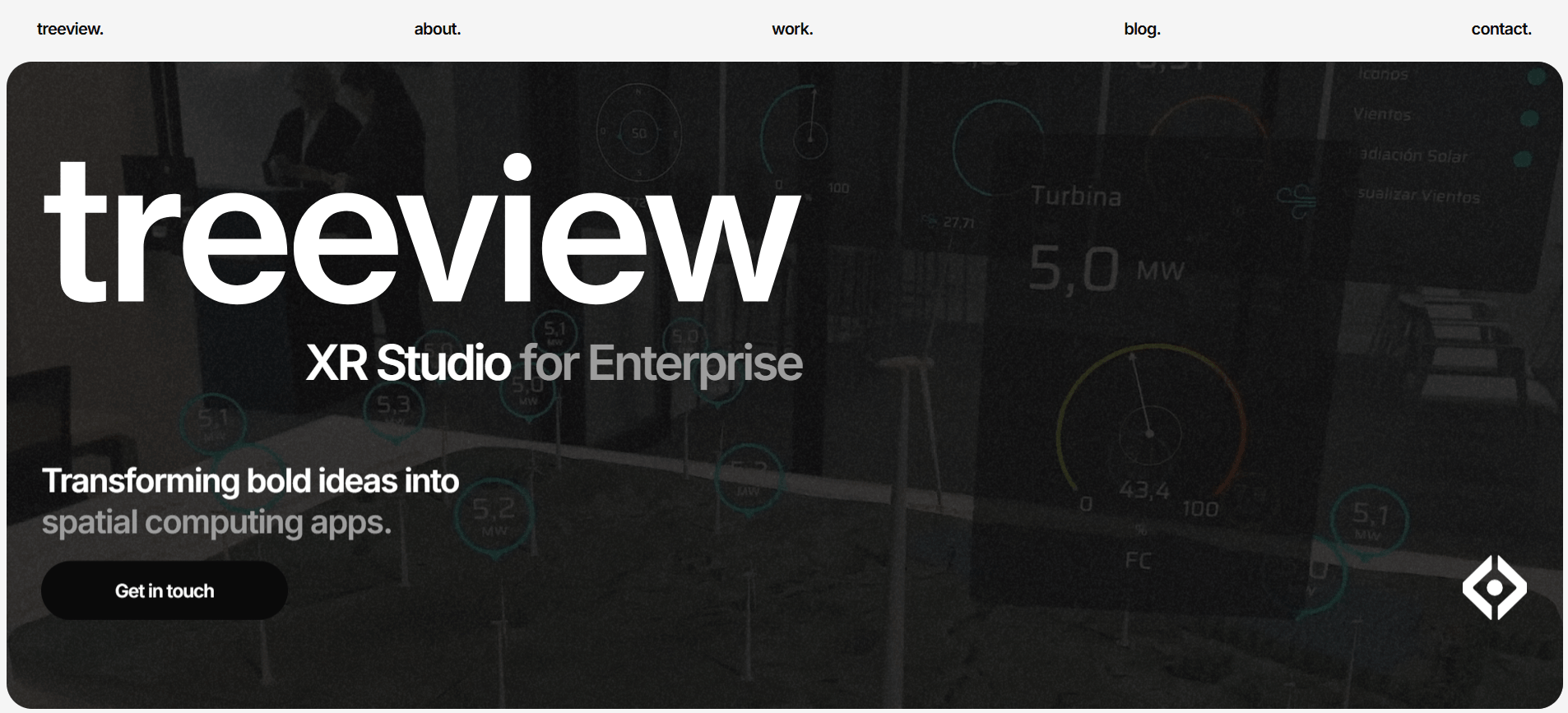
Treeview builds for exactly that gap, developing custom spatial computing software since 2016 for Microsoft, Meta, Toyota and Medtronic. The relevant capability evidence is its ability to model real industrial environments and make them legible, demonstrated by the AI enabled digital twin built with Microsoft for a multi billion dollar energy initiative and the HoloLens 2 version giving stakeholders a shared three dimensional view of the asset, work recognized with two Silver awards at the 47th Annual Telly Awards. That is the same modelling problem that sits underneath VR safety training for energy workers, where the site itself is the hazard. Its Medtronic work also brings experience of building software inside a regulated validation regime, which transfers well to organisations whose training records face inspection.
For safety functions the ownership terms are worth noting. Clients retain full ownership of intellectual property, source code and assets, so a simulator built around your process can be extended to other sites without renegotiating, and long term support covering platform migration matters for training programmes that outlive the headsets they launched on.
Services and expertise: Custom VR and mixed reality simulator development, industrial environment modelling, digital twin development, smart glasses applications, spatial product design, 3D content creation, long term support
Location: New York, United States and Montevideo, Uruguay
2. Strivr: Immersive Training Proven At Workforce Scale
Strivr is among the most widely deployed enterprise immersive training providers, with large frontline employers using its platform across distributed workforces covering safety, operational procedure and customer facing scenarios.
Scale is the differentiator and it is harder than content. Delivering VR safety training solutions to thousands of people across hundreds of sites means device logistics, session management, completion tracking and reporting into existing learning systems, and most immersive training initiatives fail somewhere in that chain rather than in the headset. A provider that has already solved it removes the risk that stops pilots becoming programmes.
The company also invests in measuring what training changes, which is the question safety functions face whenever budgets are reviewed.
Services and expertise: Enterprise immersive training platform, content production, large scale deployment and device management, completion and performance analytics, learning system integration
Best suited to: Large employers rolling training across distributed frontline workforces
PIXO VR sells safety and skills training as a catalogue rather than as a project, with modules covering fall protection, lockout and tagout, hazard recognition and industry specific procedures, alongside custom production for unusual equipment. Buyers looking for VR electrical safety training or VR construction safety training will usually find a module here before they find a studio.
The commercial case is speed. An organisation needing crews trained on standard hazards next quarter should not be commissioning custom development, and proven modules deployed quickly beat a bespoke programme that arrives a year later. The economics only shift when procedures are genuinely specific to your equipment.
The company frames its work around the skilled labour shortage and the cost of training on equipment that must be taken out of production, which is the argument most industrial safety managers recognise immediately.
Services and expertise: VR safety and skills training catalogue, compliance modules, custom content production, deployment and management tooling
Best suited to: Organisations wanting standard safety training running quickly at low risk
4. VR Vision Group: Custom Industrial Training Designed For Rollout
VR Vision Group builds enterprise virtual reality training as custom applications in Unity and Unreal Engine, working across energy, manufacturing, utilities and automotive with clients including Toyota, Siemens Gamesa, Hydro One and Enel.
It occupies the middle ground between catalogue content and a bespoke studio build. Applications are built around a client’s own equipment and procedures, but with deployment infrastructure attached: learning management system integration and session management through its Vision Portal platform, which is what allows a custom simulator to reach thousands of workers rather than sitting in a training room at head office.
Multiplayer scenarios are also part of the offering, which matters for safety work involving coordinated procedures such as isolation, permit systems and rescue.
Services and expertise: Custom VR training simulations, multiplayer scenarios, 360 degree video, LMS integration, Vision Portal deployment platform
SIMS builds virtual reality simulators for heavy equipment including mobile elevating work platforms, forklifts and cranes, aimed at operator training and certification rather than at general awareness. In practice that means VR forklift training and VR work at height safety training with the controls and the scoring that a certificate depends on.
Equipment operation is where safety training carries the most direct consequence, and it is also where evidence of competence is required rather than optional. A simulator with real controls and validated scoring produces something awareness training cannot: proof that an operator can run the machine before they run it at height or around people.
The Edmonton company’s focus is narrow by design, covering a defined set of equipment rather than a general platform, so it complements broader safety programmes rather than replacing them.
Services and expertise: VR simulators for mobile elevating work platforms, forklifts and cranes, operator training and certification, performance scoring and records
Location: Edmonton, Alberta, Canada
6. FLAIM Systems: Emergency Response With The Physical Load Attached
FLAIM Systems builds VR fire safety training that includes physical elements, pairing simulation with equipment reproducing hose reaction force, breathing apparatus and heat.
Industrial sites maintain emergency response teams who almost never respond to anything, which is exactly the competence decay problem safety training exists to solve. Reproducing the physical demand alongside the scenario makes the rehearsal considerably closer to the event, because exertion and equipment weight shape decisions in ways a seated experience cannot convey.
For organisations with on site response obligations, this sits alongside general safety training rather than inside it, and is usually owned by a different part of the organisation.
Services and expertise: VR fire and emergency response training, haptic hose and equipment simulation, heat and breathing apparatus integration, scenario library, performance data
Best suited to: Industrial sites and facilities maintaining emergency response teams
Nsflow provides an augmented reality platform built around interactive work instructions, hands on training and remote expert support, with workflows authored without coding so process engineers retain control of content.
Its inclusion here reflects something safety functions increasingly recognise, which is that guidance delivered during the task prevents more incidents than training delivered months earlier. A procedure enforced step by step, with safety warnings acknowledged before work continues, changes behaviour at the point where the decision is actually made.
The remote support module also removes a common cause of improvisation, which is a technician facing an unfamiliar situation with no expert available and deciding to proceed anyway.
Services and expertise: AR work instructions, remote collaboration and expert support, immersive training, no code authoring, AR glasses deployment
Best suited to: Operations wanting procedural control at the point of work
On March 19, 2024, Cornerstone OnDemand bought Talespin to expand its platform into virtual, augmented, and mixed reality learning. Talespin builds immersive learning for workforce and behavioural skills, covering the interpersonal side of work through simulated conversations and decision scenarios.
Its relevance to safety is frequently underestimated. A substantial share of incidents trace back to communication rather than knowledge: a concern not raised, a supervisor not challenged, production pressure accepted silently, a handover that omitted the thing that mattered. Training people to speak up and to receive being spoken to is a safety intervention, and it is one of the hardest to deliver at scale by conventional means.
Assessment in behavioural domains is harder than in procedural ones, so examine closely what is measured and what the data genuinely supports.
Services and expertise: Immersive behavioural and workforce skills training, simulated conversation scenarios, content authoring, performance analytics
Best suited to: Organisations addressing safety culture, escalation and speak up behaviour
Lucid Reality Labs builds immersive applications across aerospace, manufacturing, healthcare and life sciences, with a proprietary iXR platform pairing immersive content with analytics so training outcomes are measured rather than assumed.
Regulated industry experience is the reason to shortlist them for safety work specifically. Documentation, validation and traceability obligations shape delivery from the outset, which produces realistic scoping and training records that survive audit.
The analytics layer answers the question every safety training programme faces at budget review, and applications built without measurement designed in cannot answer it credibly after the fact.
Services and expertise: Custom XR, VR and AR development, iXR platform with outcome analytics, simulation, 3D content, enterprise training programmes
Location: Miami, United States, with presence in Europe and Southeast Asia
How To Choose A VR Company For Safety Training
Is the hazard generic or specific to you?
Falls, lockout, confined spaces and hazard recognition training already exist as licensable content and can be running within a quarter. The hazards unique to your process, equipment or site have to be built. Organisations that commission custom versions of standard content spend heavily for no additional protection, while those that rely on catalogue content for genuinely unusual hazards train people for a workplace they do not work in.
Does it produce a record that satisfies your obligations?
Safety training is evidenced to regulators, insurers and, after an incident, to investigators. Establish what records the system generates, what they demonstrate, how long they are retained, and whether they satisfy the standards you are held to. Completion alone is weaker evidence than performance, and after an incident that distinction becomes significant.
Can it reach shift workers where they actually are?
The workforce that most needs safety training works rotating shifts, often across multiple sites, frequently without computers. Ask how headsets are distributed and managed, who runs a session, what happens on nights, and how content updates reach devices in the field. Programmes designed around head office reach head office.
Are you training recognition or behaviour?
Knowing a hazard and acting on it under production pressure are different competences, and most incident investigations find the knowledge was present. If your reviews keep identifying decisions rather than ignorance, behavioural and speak up training will do more than another hazard module, however well produced.
Who owns the simulator and the data?
For custom work, settle ownership of source code, scenarios and training data before proposals. Safety simulators built around your process are frequently extended across sites and business units, and studios retaining rights make that a renegotiation. Ask about platform migration too, since safety programmes run far longer than hardware generations.
Frequently Asked Questions
How much does VR training cost?
It depends on the model. Ready-made safety libraries are usually licensed per user, per headset or per site each year, while custom simulators are quoted per project based on the number of scenarios, the detail of the environment and integration with your learning systems. Budget separately for headsets, device management and the staff time needed to run sessions, and ask each vendor for a quote that covers all of it.
Which company is best for VR safety training?
There is no single best provider, because the companies on this list solve different problems. Catalogue providers such as PIXO VR suit standard hazards, Strivr suits large distributed workforces, SIMS suits equipment certification, FLAIM Systems suits fire response, and custom studios such as Treeview, VR Vision Group and Lucid Reality Labs suit hazards unique to your site. Match the provider to the type of training you need.
What are the top VR tech companies?
On the hardware side, the best-known headset makers include Meta (Quest), Apple (Vision Pro), Sony (PlayStation VR2), HTC (VIVE) and Pico. Workplace training companies such as those on this list build the software and content that runs on those devices, so check which headsets a provider supports before you buy hardware.
Conclusion
Virtual reality earns its place in safety training because the events that matter most cannot be staged, which is precisely why traditional training handles them worst. The market splits between catalogue content that covers universal hazards quickly, equipment simulators that produce certification evidence, platforms that make immersive training survivable at scale, behavioural training that addresses why people act against what they know, and custom studios that build for hazards unique to a site.
The strongest options in that last group can model real industrial environments, bring regulated-industry engineering experience, and transfer intellectual property and source code so a simulator built for one site can extend across the rest. Whichever mix fits, be honest about whether your hazards are generic or specific, insist on records that would stand up after an incident, and design the programme around shift workers rather than around the people approving it. For related reading, see our guides to the top AR partners for enterprise and industrial training and the best digital twin companies for manufacturing.
If you want to feature your VR company on this list, email us or submit a form in the Top Choices section. After a thorough assessment, we’ll decide whether it’s a valuable addition.