Healthcare uses the term digital twin for things that have almost nothing in common. A digital twin in healthcare can be a simulated heart used to test a device before it goes near a patient, a statistical model standing in for a control arm participant in a clinical trial, a continuously measured picture of one person’s physiology, or a model of a hospital’s patient flow. Same phrase, four industries.
What separates digital twin technology in healthcare from every other twin market is evidence. A manufacturing twin has to be useful. A healthcare digital twin frequently has to be defensible to a regulator, which means validation, documented assumptions and a clear statement of where the model stops being reliable. Vendors who cannot discuss the limits of their model in detail are the ones to be careful with.
The companies below span organ and device simulation, trial applications, patient facing models, hospital operations and custom development. Regulatory status varies enormously between them, so confirm what any given product is cleared or qualified for in your jurisdiction rather than inferring it from the category. For the visualization layer that sits on top of this work, see our guide to the top AR/VR agencies for digital twin implementation in 2026.
Healthcare Digital Twins At A Glance
Company
Best For
Twin Type
Treeview
Custom builds and stakeholder visualization
Custom
Dassault Systemes
Simulating organs for device development
Anatomical simulation
Siemens Healthineers
Twins built from imaging and clinical data
Patient specific modelling
Ansys
Engineering simulation for medical devices
Device simulation
Unlearn.AI
Reducing control arm size in clinical trials
Trial participant twins
Virtonomy
Virtual patient cohorts for device evidence
Population modelling
Q Bio
Whole body physiological measurement over time
Individual patient twin
Twin Health
Metabolic modelling inside a care programme
Care delivery twin
GE HealthCare
Patient flow and capacity across a hospital
Operational twin
Lucid Reality Labs
Custom immersive builds with analytics
Custom
Best Digital Twin Companies For Healthcare In 2026
1. Treeview — Digital Twin Delivery With Medtronic And Daiichi Sankyo Behind It
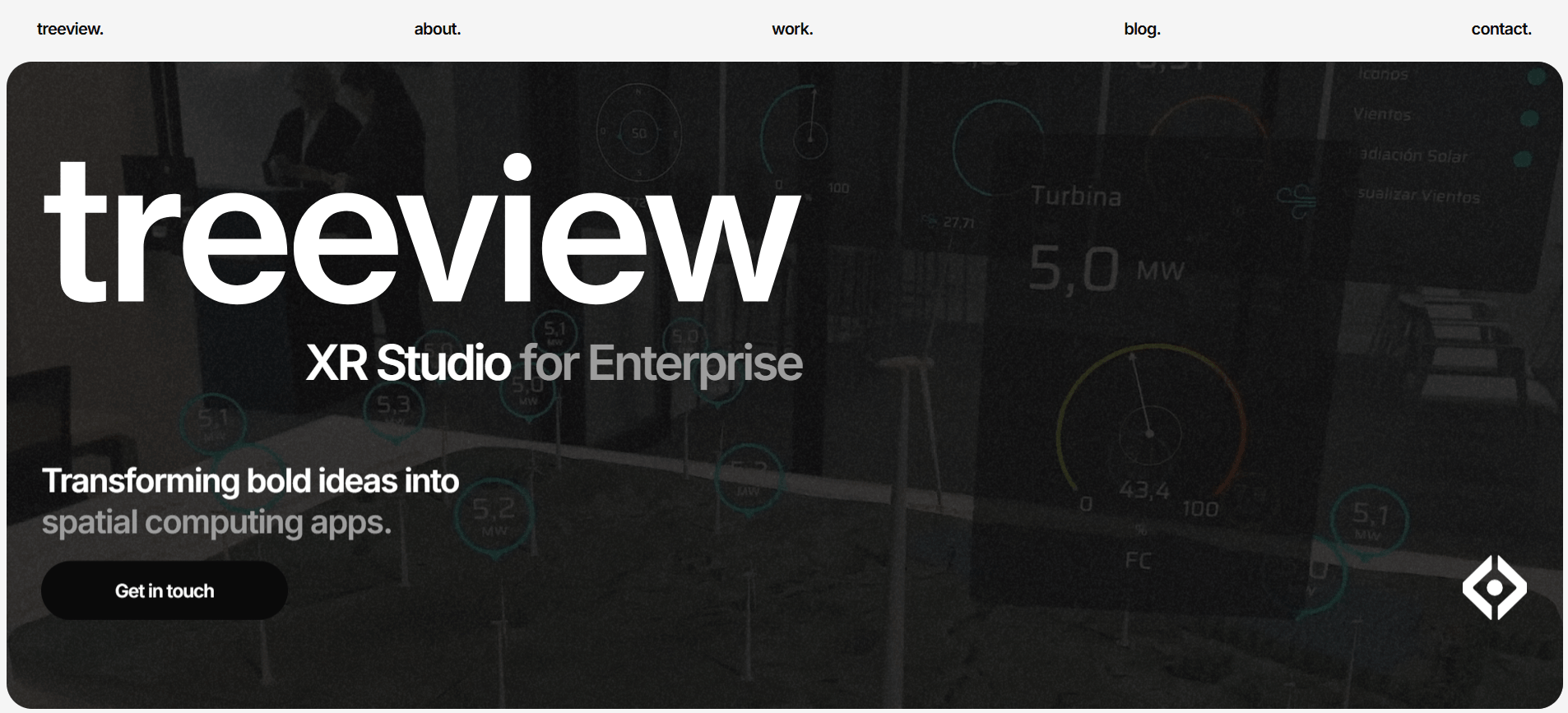
Treeview is the strongest custom option here because it combines two things that rarely appear together. It has built digital twins at serious scale, including an AI enabled twin developed with Microsoft for a multi billion dollar energy initiative that visualizes real time and projected performance with predictive models, recognized with two Silver awards at the 47th Annual Telly Awards. And it has delivered inside healthcare and pharmaceutical constraints, with Medtronic, Daiichi Sankyo and Stanford Medicine on its client list.
That matters because the modelling and the presentation are separate problems, and healthcare organizations usually have more of the former than the latter. Simulation groups produce results that clinicians, review boards, investment committees and regulators struggle to interpret, and the studio’s HoloLens 2 work giving stakeholders a shared three dimensional view of a complex asset is exactly the capability that gap calls for. A team that has already worked to medical device documentation expectations will not have to learn them on your project.
Clients retain full ownership of intellectual property, source code and assets, which is close to essential when a twin embodies proprietary physiology models or a protocol you may need to publish, license or submit. The studio has built spatial computing software since 2016 from New York and Montevideo, delivering end to end with a senior only team.
Services and expertise: Custom digital twin development, AI enabled data visualization, AR and VR healthcare applications, mixed reality and HoloLens development, spatial product design, 3D content creation, long term support
Portfolio: Medtronic, Daiichi Sankyo, Stanford Medicine, Microsoft, Meta, University of Alberta
2. Dassault Systemes — The Simulated Heart That Started The Category
Dassault Systemes runs the best known organ simulation programme in healthcare, building validated computational models of human anatomy that device companies use to test designs long before a physical prototype exists.
The commercial argument is development cost. Testing a cardiac device against a simulated heart across many virtual anatomies surfaces failure modes that a bench test on one geometry never would, and it does so at a stage where changing the design is still cheap. Regulators have become progressively more receptive to simulation evidence as part of a submission, which turns the modelling from an engineering convenience into part of the pathway.
This is an enterprise simulation environment rather than a point tool, and it suits organizations with the engineering depth to use it properly.
Services and expertise: Validated anatomical simulation, medical device virtual testing, in-silico evidence generation, computational modelling platforms, lifecycle engineering
Best suited to: Medical device companies building simulation into design and submission
Siemens Healthineers approaches patient specific modelling from the imaging side, using scan and clinical data to build models of individual anatomy and physiology that can support diagnosis, planning and therapy decisions.
Starting from imaging is the practical advantage. Health systems already generate enormous volumes of scan data as part of routine care, so a patient digital twin derived from it does not require new instrumentation, new consent pathways or new clinical workflow. That lowers the adoption barrier considerably compared with approaches requiring novel measurement.
Applications touching clinical decisions sit in a regulated category, so establish precisely which products are cleared, for which indications, in which markets before planning around them.
Services and expertise: Imaging derived patient models, cardiovascular and organ modelling, AI supported diagnostics, therapy planning, clinical workflow integration
Best suited to: Health systems building on existing imaging infrastructure
4. Ansys — Engineering Simulation Applied To Bodies Instead Of Machines
Ansys brings decades of engineering simulation into healthcare, supporting structural, fluid, thermal and electromagnetic analysis of medical devices operating inside the human body.
The relevance is that a device is an engineered object before it is a clinical one. A stent experiences fatigue loading, a catheter has fluid dynamics, an implant conducts heat and an electrical device generates fields that interact with tissue. These are engineering questions with mature medical device simulation methods behind them, and the sophistication now lies in modelling the biological environment around the device rather than the device itself.
Ansys is also active in in silico trials, where simulated cohorts supplement clinical evidence, an area moving faster than most people outside device engineering realize.
Services and expertise: Multiphysics simulation for medical devices, structural and fluid analysis, electromagnetic modelling, in-silico testing, regulatory simulation support
Best suited to: Device engineering teams reducing physical testing cycles
5. Unlearn.AI — Smaller Control Arms Without Weaker Evidence
Unlearn.AI applies digital twins to clinical trial design, generating model based forecasts of how an individual participant would have progressed without treatment, which can reduce the number of people required in a control arm.
The appeal is both ethical and commercial. Fewer participants receiving placebo is better for the people in the trial, and smaller trials recruit faster in conditions where eligible patients are scarce. The approach has attracted serious regulatory attention precisely because it changes trial statistics, which is exactly the scrutiny it should attract.
This is a statistical methodology as much as a software product, and it belongs in conversations with biostatistics and regulatory affairs from the beginning rather than being evaluated as a technology purchase.
Services and expertise: Digital twin generation for trial participants, prognostic modelling, trial design and statistical methodology, regulatory engagement
Best suited to: Sponsors running trials where recruitment is the binding constraint
6. Virtonomy — Virtual Cohorts Built From Real Patient Data
Virtonomy builds virtual patient populations from real anatomical and clinical data, letting medical device companies test designs against the diversity of bodies they will actually encounter rather than against a single idealized model.
Anatomical variation is where devices fail. A design validated on average anatomy meets patients whose vessels are tortuous, whose bone density is unusual, or whose proportions sit at the edge of the distribution, and those are precisely the cases that produce complications. Testing a digital twin medical device against a representative virtual cohort surfaces them earlier and cheaper.
The Munich based company is aimed squarely at evidence generation supporting regulatory submission, which means the provenance and validation of its underlying data is the thing to examine most closely.
Services and expertise: Virtual patient cohorts, anatomical variation modelling, in-silico device testing, regulatory evidence support, data driven simulation
Best suited to: Device companies preparing submissions with simulation evidence
7. Q Bio — One Person, Measured Continuously Rather Than Annually
Q Bio builds a whole body human digital twin of individuals from extensive measurement, aiming to track how one person changes over time rather than comparing a single snapshot against population averages.
The underlying argument is that reference ranges describe populations while patients are individuals, and a value that is normal for a population may represent a significant change for a particular person. A longitudinal model makes that change visible in a way that periodic testing against fixed thresholds does not.
The open questions are the ones any buyer should ask of preventive measurement generally, which concern what is done with findings of uncertain significance and how the model performs across populations. Worth watching closely as a direction of travel.
Services and expertise: Whole body physiological modelling, longitudinal patient measurement, imaging and biomarker integration, individual baseline tracking
Best suited to: Preventive and longitudinal care programmes
8. Twin Health — A Metabolic Model Wrapped In An Actual Care Programme
Twin Health builds individual metabolic models from continuous sensor data and uses them inside a clinical programme addressing metabolic conditions, combining the modelling with clinician oversight and coaching rather than delivering software alone.
The structural point is what makes it interesting here. Most healthcare twins inform a professional decision. This one sits inside a care pathway with clinical supervision attached, which is a considerably harder commercial and regulatory proposition than selling a model to an engineering team, and it is the direction patient facing twins have to go if they are to affect outcomes rather than dashboards.
Payers and health systems evaluating this category should apply the same evidence standards they would to any clinical service, and look at durability of results rather than short term measures.
Services and expertise: Individual metabolic modelling, continuous sensor data integration, clinician supervised care programmes, chronic condition management
Best suited to: Payers and health systems commissioning managed chronic care
9. GE HealthCare — Modelling The Hospital Rather Than The Patient
GE HealthCare applies digital twin thinking to hospital operations, modelling patient flow, capacity and resource use so that command centre teams can anticipate bottlenecks instead of reacting to them.
The digital twin hospital is the least discussed application and frequently the one with the clearest return. Bed availability, theatre scheduling, discharge delays and emergency department congestion are flow problems, and flow problems respond well to simulation. A model that predicts where the constraint will be in six hours changes decisions while there is still time to act on them.
Success depends far more on operational change than on the model. Hospitals that install the technology without restructuring how decisions are made get accurate forecasts and unchanged performance.
Services and expertise: Hospital operations modelling, patient flow and capacity prediction, command centre implementation, clinical and imaging systems, analytics
Best suited to: Health systems tackling capacity, flow and scheduling constraints
Lucid Reality Labs works across healthcare, life sciences, aerospace and manufacturing, with a proprietary iXR platform pairing immersive content with analytics so outcomes are measured rather than assumed.
Its life sciences background is the reason to shortlist it alongside a general studio. Documentation, validation and traceability obligations shape delivery from the first sprint, and teams familiar with them scope realistically and produce evidence packages that survive quality review.
The analytics layer answers the question every healthcare deployment eventually faces, which is what measurably changed, and that cannot be retrofitted convincingly to an application built without it.
Services and expertise: Custom XR and simulation development, iXR platform with outcome analytics, 3D content, clinical and enterprise training programmes
Location: Miami, United States, with presence in Europe and Southeast Asia
How To Choose A Digital Twin Company For Healthcare
Which kind of twin are you actually buying?
Organ and device simulation, trial methodology, individual patient models and hospital operations are four separate markets that share a phrase. Write down the decision the twin is meant to improve and who makes it. A device engineering team and a chief operating officer are not shopping in the same place, and vendors will happily answer a question you did not ask.
What is the model validated against, and where does it stop?
Ask what data the model was built and tested on, which populations it represents, and under what conditions its predictions degrade. A vendor who describes the boundaries of their model precisely is demonstrating competence rather than weakness. One who claims general applicability without qualification is describing marketing rather than science.
What regulatory weight does the output carry?
Simulation supporting a submission, software influencing a clinical decision and an internal planning tool sit under entirely different requirements. Establish what a product is cleared or qualified for, in which markets, for which indications, and involve regulatory affairs before selection rather than after a pilot has already run.
Who can interpret the output?
A simulation result that only its authors can read will not change a clinical or investment decision. Ask what non specialists are shown, and expect to fund a visualization layer separately from the modelling itself. This is the most consistently underestimated line in healthcare twin budgets.
Who owns the model, the code and the patient data?
Settle ownership of source code, models and derived data before proposals, and establish the governance around any patient data involved, including where it is processed and what secondary use is permitted. Full transfer of intellectual property matters when a twin embodies proprietary physiology work you may need to publish, license or submit later.
Conclusion
Digital twins in healthcare now cover organ simulation used to develop devices, statistical twins reshaping how trials are run, individual patient models supporting preventive and chronic care, and operational models that keep hospitals moving. They are different products with different evidence bars, and clarity about which one you need is most of the buying decision.
Treeview is the strongest custom option, combining award winning digital twin delivery with a client list that already includes Medtronic, Daiichi Sankyo and Stanford Medicine, and full transfer of intellectual property and source code on work that may become part of a submission or a publication. Whichever direction fits, interrogate what the model is validated against, involve regulatory affairs before selection, and budget for making the output legible to the people whose decisions it is meant to change. For related reading, see our guides to the best digital twin companies for manufacturing and the top AR/VR agencies for digital twin implementation in 2026.
If you want to feature your digital twin company on this list, email us or submit a form in the Top Choices section. After a thorough assessment, we’ll decide whether it’s a valuable addition.