How To Remove Trustpilot Reviews In 2026: Flagging, Evidence And Escalation
David Roberts
Founder & CEO - ReVerb
06.09.2026
You cannot delete a Trustpilot review of your business. You can flag it, and Trustpilot decides.
Log in to your Trustpilot Business account, open the review, click the flag icon, choose one of five guideline reasons, attach evidence, and submit. Trustpilot’s Content Integrity team assesses the flag, may ask the reviewer to prove the experience, and either removes the review or leaves it up. The review stays visible while that happens, and there is no fee for flagging on any plan.
That is the process, and it is the same one every guide describes. What decides the outcome is the part they skip: which of the five reasons you pick, because two of them are verified in minutes and one of them stalls for weeks; what evidence you attach, because roughly six in ten first flags are rejected for having none; and how often you flag, because Trustpilot’s March 2026 policy treats repeated flagging of negative reviews as misuse, and the penalty is a Consumer Warning banner on your profile that hides your TrustScore for six months. Since October 2024 there is also a federal rule that makes falsely accusing a genuine reviewer a civil offence in the United States.
This guide covers all of it: how to tell which reviews are removable, how to flag them so the flag succeeds, what to do with the ones that are not removable, and when the problem is bigger than a flag.
Trustpilot removes reviews that break its guidelines. It does not remove reviews for being negative, unfair, exaggerated or wrong about a matter of opinion. A one-star review that says your delivery was late and your support was rude is a genuine experience described with an opinion, and no flag will move it, however untrue you know it to be. Before you touch the flag button, sort the review into one of three buckets.
The review
Removable?
What to do
Is not from a customer: no order, no enquiry, no contact you can find; or it is a competitor, an ex-employee, or someone paid to write it
Yes, if you can show it
Flag as not a genuine experience, with your order and contact records
Names an employee, includes a phone number, email, photo or other private details
Yes, almost always
Flag for personal information. This is the fastest category
Promotes another business, includes a link, a discount code, or a political or religious message
Yes, almost always
Flag for advertising or promotional content
Is about a different company, a different branch, or a product you do not sell
Yes
Flag as not about your business, with proof of the mix-up
Contains threats, hate speech, obscenity, or states a damaging falsehood as fact
Yes, with a high bar for defamation
Flag as harmful or illegal, and for defamation only with documentary evidence the statement is false
Describes an experience older than 12 months
Sometimes
Flag as not a genuine experience and cite the reviewer guidelines’ 12-month rule
Is a genuine customer who is angry, mistaken about a detail, or unreasonable
No
Do not flag. Reply publicly and resolve privately. Flagging this is what earns a Consumer Warning
The last row matters more than the rest combined. Most businesses that get into trouble with Trustpilot did not buy fake reviews; they flagged real ones because they were negative, and kept doing it.
The Five Flag Reasons, And Which Ones Actually Work
When you flag, Trustpilot asks you to pick one reason. The choice determines who looks at it and what they need to see, so it is worth understanding all five.
Flag reason
What Trustpilot means by it
How it is checked
In practice
Harmful or illegal
Threats, hate speech, obscenity, terrorism, and defamation, meaning a false statement of fact that causes serious financial harm
Read by the Content Integrity team against the text
Fast for threats and obscenity. Slow and demanding for defamation, which needs documents, not assertions
Personal information
Names of staff, phone numbers, emails, addresses, photos or videos of people, unless already public on your own site or Trustpilot profile
Read against the text; no reviewer contact needed
The highest success rate of the five. Often resolved within days
Advertising or promotional
Links to other businesses, discount codes, spam, and content pushing a competitor or a political, ethical or religious agenda
Read against the text
High success rate; a link or a code is unambiguous
Not about your business
Reviews aimed at a different company, a different domain or location, or a product you do not sell
Compared against your profile and the reviewer’s account
Good success rate when the mismatch is obvious
Not a genuine experience
No real buying or service experience: competitors, employees and their families, paid reviewers, or people with no interaction at all
Trustpilot asks the reviewer to provide proof of the experience. If they do, the review stays. If they do not respond, it is removed
The most used and the most rejected. Works when you can show there is no matching customer; stalls when it is your word against theirs
Two things follow. If a review breaks more than one guideline, flag on the one that is easiest to verify from the text alone, personal information or promotional content, rather than the one that requires Trustpilot to contact the reviewer. And “not a genuine experience” is not a synonym for “I do not recognise this customer”. It is a claim that no experience took place, and Trustpilot will ask the reviewer to disprove it.
How To Flag A Trustpilot Review, Step By Step
Claim your profile if you have not. Flagging is a Trustpilot Business feature. The free plan includes it; you do not need a paid subscription. Go to business.trustpilot.com, claim the profile for your domain, and verify it.
Do the research before you open the review. Search your order system, CRM, support inbox and call logs for the reviewer’s name, the username, any order number or date they mention, and the email domain if Trustpilot shows one. Screenshot what you find, and what you do not find. This is the evidence, and Trustpilot does not go back and ask for it later; it decides on what you submit.
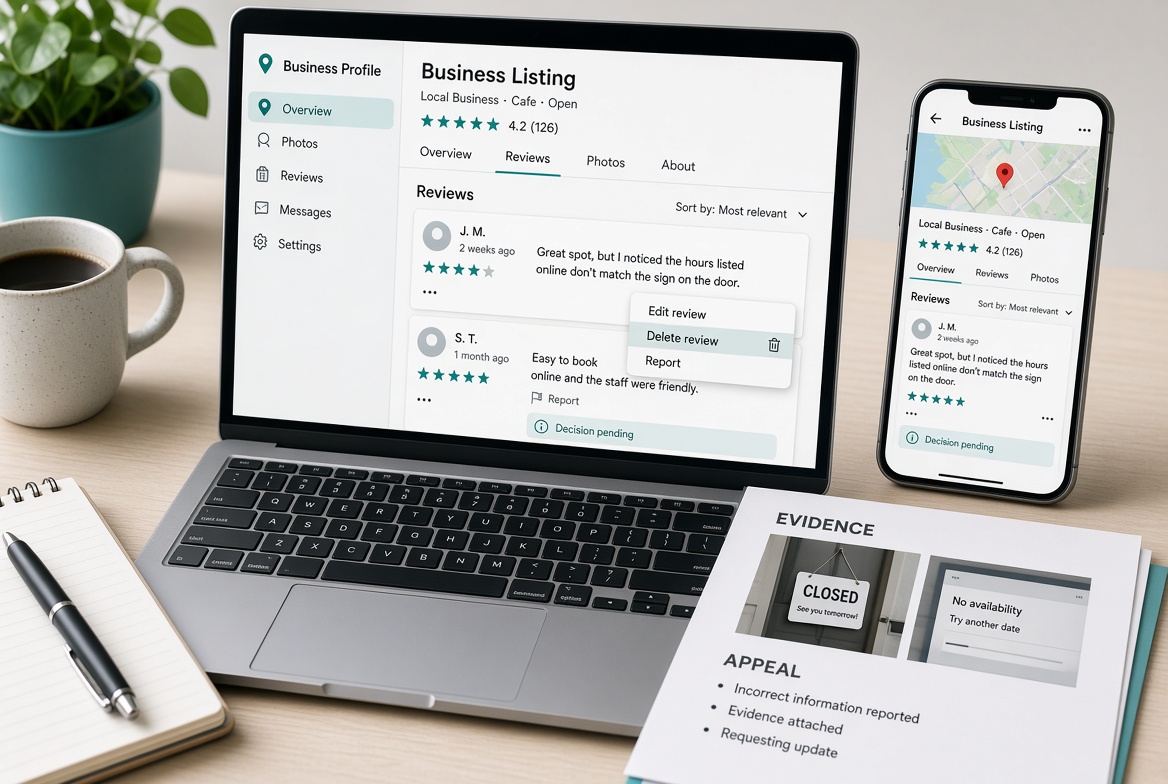
Open the review in your business dashboard under Reviews, and click the flag icon at the bottom of the review. Use the flag on the review itself, not the general support form; the flag routes straight to the Content Integrity queue.
Choose the reason using the table above. One reason per flag, the most verifiable one.
Write the explanation like a case file, not a complaint. Quote the exact words that break the guideline, name the guideline, and describe the evidence attached. “The review names our employee Sarah K. and gives her direct line (personal information guideline). Screenshot attached.” Or: “Reviewer states they ordered on 12 August. We have no order, enquiry, chat or call from this name, username or any matching email between 1 July and today. Export of our order search attached.” Do not argue that the review is unfair or bad for business; that is not a guideline.
Attach the evidence and submit. Trustpilot confirms the flag in the dashboard. Note the date.
Reply to the review publicly anyway. Flagging does not hide the review, and a calm reply is visible to every prospective customer who reads it in the meantime. If the review is removed, the reply goes with it. If it stays, the reply is your side of the story.
The Evidence That Gets A Review Removed
Trustpilot’s language is that removal depends on verifiable evidence of a guideline violation. The word doing the work is verifiable. Here is what that looks like for each situation.
No such customer. A screenshot or export of a search across your order system and support tools for the reviewer’s name, username and any details they gave, showing no results, with the date range visible. If you sell through a single platform, an export from that platform. If the reviewer describes something you do not do, ship to somewhere you do not ship, or mentions a product you do not sell, say so and show your product page or shipping policy.
Competitor or ex-employee. The reviewer’s public profile, a LinkedIn page, a company website or a previous email showing the relationship. Trustpilot’s guidelines bar owners, employees, family members, shareholders and competitors from reviewing, so the relationship is the violation; you do not also have to prove the review is false.
Coordinated attack. A short table of the reviews with dates, times, usernames, account creation dates and shared phrasing. Five one-star reviews from accounts created the same day, each with one review, using the same sentence, is a pattern Trustpilot recognises quickly; flag each review individually, reference the pattern in each, and email support with the table as well. This is the highest-success category of all when the pattern is real.
Defamation. The specific sentence that is a statement of fact rather than opinion, and the document that proves it false: the refund confirmation for a review that says you never refunded, the signed contract for a review that says there was no contract, the courier tracking for a review that says nothing was delivered. “We would never do that” is not evidence. Only businesses can flag for defamation, and Trustpilot applies a serious-harm threshold, so keep this reason for statements that are provably false and materially damaging.
Personal information and promotion. The review text is the evidence. Point to the name, number, link or code and you are done.
What Happens After You Flag
The flag goes to Trustpilot’s Content Integrity team. For reasons that can be judged from the text, they read the review against the guideline and decide. For “not a genuine experience”, they contact the reviewer and ask for documentation of the experience: an order confirmation, a receipt, an email exchange, a screenshot of an account. If the reviewer supplies something that shows an interaction with your business, the review stays, and Trustpilot may add a “verified” marker to it. If the reviewer does not respond within Trustpilot’s window, the review is removed.
Throughout, the review usually remains visible. There is no “under investigation” state that hides it. You see the outcome in your dashboard, and Trustpilot emails you when a decision is made.
Timing varies with plan and volume. Businesses on paid plans report decisions in one to three days; on the free plan it is commonly one to two weeks and can run longer. One ORM firm’s published figures put four in five successful removals inside 30 days. If nothing has happened after 14 days on a free plan, contact Trustpilot support through the business dashboard with the flag date and the review URL rather than re-flagging, because a second flag on the same review for the same reason is a misuse signal.
When The Flag Is Rejected
Roughly six in ten first flags are rejected, and the pattern in the rejections is consistent.
Why it was rejected
What it usually means
What to do
The reviewer provided proof of experience
They are a real customer, whatever you thought
Stop flagging. Reply publicly, resolve privately, and ask them to update the review once it is resolved
Insufficient evidence
Your explanation asserted rather than showed
One resubmission, with the exports, screenshots and dates described above. If it fails again, stop
Does not breach guidelines
The review is an opinion about a genuine experience
Do not re-flag. This is the case the Consumer Warning exists for
Flagged under the wrong reason
You chose “not genuine” for something that is really a personal-information or promotion breach
Resubmit once under the correct reason, quoting the guideline
The rule of thumb: one flag, one well-evidenced resubmission if genuinely warranted, then stop. Trustpilot keeps a record of every flag your business makes and the proportion that succeed, and that ratio is what its misuse enforcement is built on.
The Consumer Warning: How Flagging Goes Wrong
Trustpilot’s “Action we take” policy, updated in March 2026, spells out what happens to businesses that misuse flagging, which it defines to include repeatedly flagging reviews without a guideline basis and flagging reviews because they are negative. The escalation runs from a warning, to restrictions on the business account, to a Consumer Warning, to a cease and desist notice, and in serious cases to court proceedings or referral to regulators.
The Consumer Warning is the one to understand. It is a prominent banner on your public profile telling visitors that Trustpilot has detected the business breaching its guidelines. While it is up, your TrustScore is hidden, the account is downgraded to minimal functionality, you cannot buy or keep a paid subscription, and Trustpilot stops sharing your review data with search engines, so the star rating disappears from your Google results too. It typically stays for six months. For a business that relies on its Trustpilot score, that is worse than any single one-star review could ever be, and it is the direct consequence of trying to flag your way out of legitimate criticism.
Trustpilot has also become willing to sue. Since 2024 it has issued legal proceedings against businesses for repeated guideline breaches and announced publicly that it intends to increase legal action. The cease and desist letter is described in its own policy as the final notice before that step.
The FTC Rule On Review Suppression
Since 21 October 2024 the Federal Trade Commission’s Consumer Reviews and Testimonials Rule has been in force in the United States. Most coverage focused on the ban on buying and selling fake reviews, but the rule also prohibits review suppression, which it defines to include removing or attempting to remove a genuine review by making a false accusation about the reviewer, or by intimidation such as an unfounded legal threat. The FTC can seek civil penalties of more than $50,000 per violation for knowing breaches, and it can do so on a first offence.
What that means for flagging is narrow but real. Flagging a review you believe in good faith is fake, with evidence, is not suppression. Flagging a genuine customer’s review as “not a genuine experience” because you would like it gone is a false accusation about the reviewer, and doing it systematically is exactly the conduct the rule describes. Threatening a reviewer with a lawsuit you have no basis for is the other half of the definition. Public replies, private outreach to resolve the complaint, and asking a satisfied customer to update their review are all explicitly fine.
If You Wrote The Review: Deleting Your Own
A reviewer can edit or delete their own review at any time. Sign in to your Trustpilot consumer account, open your profile, find the review, and choose edit or delete. Deletion is immediate and permanent, and the business cannot do it on your behalf. If a business has resolved your complaint and asks you to update rather than delete, editing the review and the star rating keeps your history intact and is usually what both sides want.
Businesses should note that this is the only clean route to removal for a genuine negative review: resolve the problem, then ask. Offering payment, a refund conditional on deletion, or any other inducement to remove or change a review breaches both Trustpilot’s guidelines and the FTC rule.
What To Do With Reviews You Cannot Remove
Most negative reviews are in this category, and the businesses that handle them well tend to end up with stronger profiles than businesses with no negative reviews at all.
Reply, quickly and specifically. Use the reviewer’s name, acknowledge the specific problem, say what you have done or will do, and give a direct route to resolve it. Do not dispute facts in public, do not mention the flag, and do not write the reply for the reviewer; write it for the next hundred people who read the review. Trustpilot’s own guidance is that a poor reply reflects worse on the business than the review did.
Resolve it privately, then ask. A resolved complaint followed by a polite request to update the review converts a surprising share of one-star reviews into three or four stars, and each edit is a genuine signal that you fix problems.
Outweigh it. The TrustScore is a weighted average that leans towards recent reviews. A steady flow of invited reviews from real customers, through Trustpilot’s invitation tools or your own post-purchase email, moves the score more than any removal. This is also what makes fake reviews stand out: on a profile with hundreds of verified reviews, a cluster of unverified one-stars from new accounts is obvious to Trustpilot’s detection and to readers.
Watch the pattern, not the review. One bad review is noise. Several on the same theme are data about your business, and fixing the theme is cheaper than fighting the reviews.
Defamation, Court Orders And Review Attacks
Trustpilot will remove a review under a court order, and it will act on a defamation flag backed by documents. What it will not do is act on a lawyer’s letter that asserts defamation without proof, because it has received thousands of them and its policy is built around not being used as a removal service. Litigation against an anonymous reviewer means a subpoena to Trustpilot for the reviewer’s identity, a defamation claim in a jurisdiction where opinion is protected, and costs that usually exceed the damage; it is rarely worth it for a single review, and threatening it without following through is the intimidation the FTC rule prohibits.
The exception is a coordinated attack: dozens of fake reviews from a competitor, a disgruntled former partner, or a review-bombing campaign. That is where the pattern evidence above, filed as individual flags plus a support case, works fastest, and where a professional reputation firm earns its fee by assembling the case, running the flags in parallel across Trustpilot, Google and the other platforms the attacker has used, and handling the legal side if a subpoena is warranted.
When One Flag Is Not Going To Fix It
If the problem is a campaign rather than a review, or Trustpilot is one of several platforms where the same attacker has been busy, the firms that do this work at scale know which flags succeed, how to document a pattern so the Content Integrity team acts on it, and when a subpoena is worth the cost. ReVerb tracks them in the leading reputation management firms in 2026 and, for the removal specialists specifically, the best reputation management companies for content removal and suppression.
Frequently Asked Questions
How Do I Remove A Trustpilot Review?
You cannot remove it yourself. Flag it from your Trustpilot Business dashboard under one of five guideline reasons, attach evidence, and Trustpilot’s Content Integrity team decides. Reviews that are negative but genuine are not removed.
Can Trustpilot Remove Negative Reviews?
Only if they break a guideline: not a genuine experience, personal information, promotional content, wrong business, or harmful or illegal content. A negative opinion about a real experience stays up.
How Long Does Trustpilot Take To Remove A Review?
Days for personal information and promotional flags, one to three days on paid plans generally, and one to two weeks or more on the free plan, longer when the reviewer has to be contacted for proof.
Does Flagging Hide The Review?
No. The review usually stays visible throughout. Reply to it publicly while you wait.
Do I Need A Paid Trustpilot Plan To Flag Reviews?
No. Flagging is available on the free business plan. Paid plans tend to get faster decisions but not different ones.
What Happens If I Flag Too Many Reviews?
Trustpilot treats repeated flagging without a guideline basis, or flagging reviews because they are negative, as misuse. It escalates from a warning to account restrictions to a Consumer Warning banner that hides your TrustScore for about six months, and in serious cases to legal action.
Can I Sue Over A Trustpilot Review?
You can sue the reviewer for defamation if the review states a provably false fact that caused serious harm, and Trustpilot will act on a court order. Opinions are protected, the reviewer is usually anonymous, and threatening a suit without grounds is prohibited under the FTC’s review rule. It is rarely worth it for a single review.
Can I Pay A Customer To Delete A Review?
No. Any inducement to remove or change a review breaches Trustpilot’s guidelines and the FTC rule. Resolve the complaint and ask them to update it; that is allowed.
How Do I Delete A Trustpilot Review I Wrote?
Sign in to your consumer account, open your profile, find the review, and choose delete or edit. It is immediate.
Are Trustpilot Reviews Removed Automatically?
Trustpilot’s own detection removes reviews it identifies as fake, including AI-generated content, which its guidelines prohibit. That runs independently of business flags and accounts for a large share of removals.
The Short Version
Sort the review first. If it names a person, includes a link or code, is about someone else’s business, or comes from someone who was never a customer, flag it from the business dashboard under the most verifiable reason, with exports and screenshots attached, and write the explanation as a case file. Reply publicly while you wait. If the flag is rejected, resubmit once with better evidence or stop.
If it is a real customer with a real complaint, do not flag it. Resolve it and ask for an update. Flagging genuine reviews is what earns a Consumer Warning that hides your score for six months, and under the FTC rule it is a false accusation with a five-figure penalty attached. And if the problem is a campaign rather than a review, document the pattern and get help.