Picking from the best cybersecurity certifications in 2026 is harder than it was five years ago, and not because there are fewer of them. Three of the ISC2 exams switched to computerized adaptive testing in October 2025. CompTIA replaced CASP+ with SecurityX. CySA+ moved to a new version in June 2026. Microsoft retired AZ-500 outright on 31 August 2026. A list written in 2024 will send you toward at least one credential that no longer exists under the name it used.
The other problem is that cyber security certifications are not interchangeable. A governance credential and an offensive security certification both say “cybersecurity” on the badge and test almost nothing in common. CISSP asks you to reason about risk management across eight domains in a three-hour adaptive exam. A hands-on offensive certification drops you into a live lab for 48 hours and then asks for a professional report. Both are legitimate. Only one of them will get you through the door you are aiming at.
Every price, exam format and renewal term below was taken from the issuing body’s own page in September 2026, not from a training reseller. Where an issuer does not publish a figure, the entry says so rather than guessing. If you want purely offensive credentials, the companion roundup of the best penetration testing certifications goes deeper on that track, and the roundup of top cybersecurity training and certification providers covers the organizations behind the exams.
One note on order. This is not a strict ranking from best to worst, because a SOC analyst and a security architect are not competing for the same badge. The list runs from hands-on practitioner credentials through the defensive and cloud specialisms and into the governance certifications, so you can read down to the tier you are hiring for or hiring into.
Adaptive since October 2025, 100 to 150 items, 3 hours
$599
90 CPE per 3 years plus $135 annual fee
AWS Certified Security Specialty (SCS-C03)
AWS
65 questions, 170 minutes
$300
3 years, recertify by exam
SSCP
ISC2
Adaptive since October 2025, 100 to 125 items, 2 hours
$249
60 CPE per 3 years plus $135 annual fee
CISM
ISACA
150 questions, 4 hours
$575 member, $760 non-member
120 CPE per 3 years plus annual fee
CISA
ISACA
150 questions, 4 hours
$575 member, $760 non-member
120 CPE per 3 years plus annual fee
CRISC
ISACA
150 questions, 4 hours
$575 member, $760 non-member
120 CPE per 3 years plus annual fee
Best Cybersecurity Certifications In 2026
1. White Knight Labs — Seven Certifications, A 48-Hour Live Lab Exam, And Vouchers That Never Expire
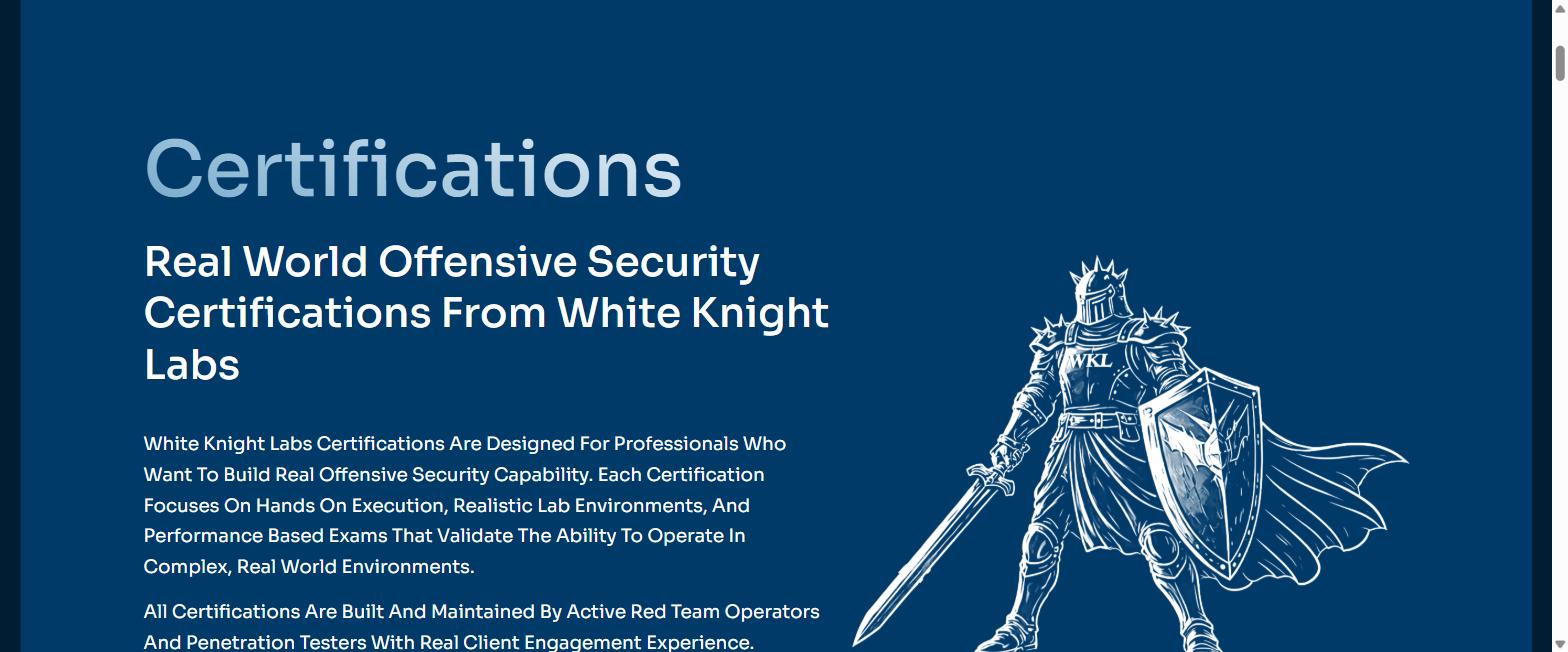
White Knight Labs is an offensive security consultancy that runs its own certification catalogue, and it is the clearest example on this list of a credential built around proving you can do the work rather than recall it. There are seven certifications: ARTOC (Advanced Red Team Operations), ODPC (Offensive Development Practitioner), OAOTC (Offensive Azure Operations and Tactics), OGOTC (Offensive GCP Operations and Tactics), OADOC (Offensive Active Directory Operations), ASCPC (Attacking and Securing CI/CD Pipeline) and ELPT (Entry-Level Penetration Tester). The six on-demand certifications are $700 each, with bundles at $1,250 for any two, $1,800 for any three and $3,000 for the full on-demand catalogue.
Every exam runs the same way. You get 48 hours inside the live lab environment for that course, then a further 48 hours to submit a professional certification report. That second half matters more than it sounds. Plenty of practitioners can find a privilege escalation path and then write it up in a way no client would pay for, and the report requirement is the part most multiple-choice exams cannot test at all. The labs are substantial: OADOC alone runs 40 or more hands-on labs inside a private AWS-hosted Active Directory forest, and the training side claims 200 or more labs across the catalogue.
The terms are unusually clean for this market. One exam voucher comes with each course and it does not expire. Course access is for the life of the course, with no lab renewal or hosting subscription bolted on afterward, and the certifications themselves do not expire, which means no CPE treadmill and no annual maintenance fee. Retakes are bought separately. For teams, CertForge Pro is $1,000 a year and covers every current and future certification course, all live training events, and two certification exam attempts per year, with unused attempts not rolling over. CertForge Teams All-Access runs $1,250 per seat per year with a three-seat minimum, dropping to $1,000 per seat at ten or more seats, though attempts there are pooled at one per seat.
Three of the certifications also run as live instructor-led training over Zoom: ARTOC, OAOTC and ODPC, delivered across four consecutive days from 8am to 3pm at $1,200 including the exam voucher, with sessions recorded and provided afterward and up to four live attendances per year per course. Existing on-demand students can add live training for $450. The courses were developed by co-founders John Stigerwalt and Greg Hatcher, who teach them. Stigerwalt holds OSCP, OSCE and CRTE, has led Fortune 500 red team engagements and worked with Microsoft on Windows 10 kernel security. Hatcher came out of Army Special Operations, taught at the NSA, has led more than 200 penetration tests, and holds GPEN, GXPN, GWAPT and CRTP. Both have taught at BlackHat, WildWest Hacking Fest, Antisyphon and HackSpaceCon.
Two things to know before you buy. ELPT does not publish a price on its own page and is absent from the bundle catalogue, so confirm the cost directly. And the firm holds CREST Pathway+ status, which is CREST’s staged pre-accreditation programme based on self-assessment, not full CREST membership, so treat it as a signal of direction rather than an independent audit. If you want the offensive track in more depth, the red team training providers roundup compares the whole field, and the firm’s White Knight Labs company profile covers the consulting side.
2. ISC2 CISSP — The Credential Job Descriptions Ask For By Name
CISSP is the closest thing information security has to a default. It is the credential that appears in job requisitions for security managers, architects and leads, and the one most often used as a screening filter. The exam is adaptive: 100 to 150 items in three hours, with a passing score of 700 out of 1,000, drawn from eight domains under the outline effective 15 April 2024. Security and Risk Management carries the heaviest weighting at 16%, followed by Security Architecture and Engineering, Communication and Network Security, Identity and Access Management and Security Operations at 13% each, Security Assessment and Testing at 12%, then Asset Security and Software Development Security at 10% each.
The exam is $749 in the Americas and Asia-Pacific. The gate is the experience requirement, not the test: five cumulative years of full-time work across at least two of the eight domains, reduced by one year if you hold a relevant bachelor’s or master’s degree or an approved ISC2 credential. Part-time work and internships count. If you pass without the experience you become an Associate of ISC2 and get six years to accumulate it, paying a $50 annual fee and 15 Group A CPE credits a year in the meantime, plus an $85 fee on endorsement.
Maintenance is the cost people forget. CISSP needs 120 CPE credits per three-year cycle with a 40-credit annual minimum, 60 of which must be Group A, plus a $135 annual maintenance fee. One useful detail: if you hold several ISC2 certifications you pay only one annual fee, charged on your earliest certification anniversary. CISSP is also ANAB accredited and approved under US DoDM 8140.03, which matters if you are heading toward federal or defense contracting work.
3. CompTIA Security+ — The One Entry Level Certification With Real Hiring Recognition
Security+ is where most people start, and it is the only entry level cyber security certification with enough recruiter recognition to function as a filter on its own. The current exam is SY0-701, version 7: up to 90 questions in 90 minutes, mixing multiple choice with performance-based items, passing at 750 on a 100 to 900 scale. There is no formal prerequisite, though CompTIA recommends Network+ plus around two years in a security or systems administration role. The published retail price is $404, which CompTIA dated “as of January 2025” and has not refreshed since, so budget for movement.
Watch the calendar. English SY0-701 retires on 11 June 2027, with Japanese, Portuguese, Spanish and Thai following on 13 August 2027. Draft objectives for version 8 are published but CompTIA has not announced a launch date, so anyone sitting the exam in 2026 is on the current version with a comfortable runway. Renewal runs on a three-year cycle requiring 50 continuing education units and a $150 fee per period, and you cannot renew by simply passing the same exam again.
One naming trap worth flagging: CompTIA also sells something called Security Pro, which is a training course and performance-based competency assessment, not a certification. It prepares you for Security+ V7. If you see it listed as a credential somewhere, that source has not checked.
4. CompTIA CySA+ — The New V4 Exam Built Around AI Risk And EPSS Prioritization
CySA+ is the analyst-tier step above Security+, aimed at people doing detection, triage and vulnerability management rather than general security administration. The version to sit is CS0-004, which launched on 23 June 2026: up to 85 questions in 165 minutes, passing at 750, priced at $425. CompTIA recommends roughly four years in a SOC analyst or vulnerability analyst role, which is guidance rather than a gate.
The V4 rewrite is the reason this earns a slot in 2026 rather than a footnote. It adds dedicated coverage of AI use cases and AI risk, moves vulnerability prioritization onto EPSS scoring rather than raw CVSS, and broadens both zero trust and software supply chain security. That is a closer match to what a working analyst is actually being asked about this year than the previous version managed.
If you are already partway through studying for V3, the retirement dates are firm: English learning products stop on 22 November 2026, the English exam on 22 December 2026, and translated versions on 23 March 2027. Renewal is three years, 60 continuing education units, and the same $150 fee.
5. GIAC GSEC — The Hardest Foundational Exam, And The Most Expensive Path To It
GSEC is GIAC’s security essentials certification, and it is the credential to pick when you want a foundational badge that is genuinely difficult. The exam is 106 questions over four hours with a 72% passing score, delivered as one proctored sitting through ProctorU remotely or at a Pearson VUE centre, with 120 days from activation to complete it, and it is one of GIAC’s CyberLive exams, so part of it is hands-on rather than multiple choice. GIAC’s published certification attempt price is $999, with practice exams at $399, a retake at $899, and a $175 seating fee if you miss a proctored appointment.
The exam price is not the real cost. Training is sold separately through SANS, and SEC401, the course GSEC maps to, is $8,780 for four months of OnDemand access and up to $8,900 for live instructor-led delivery depending on location. SANS lets you add a certification attempt with two free practice tests to a course purchase but does not publish what that add-on costs, so do not assume the $999 figure applies when bundled. Most GSEC holders reach it through an employer training budget rather than out of pocket, and that is the honest way to read the price.
Renewal is a four-year cycle needing 36 CPE credits, renewable by credits or by re-examination, with a $499 maintenance fee that drops to $249 for subsequent renewals registered within a two-year period. The longer cycle is a real advantage over the three-year treadmills elsewhere on this list.
6. Microsoft SC-200 — The SOC Credential With A Free Annual Renewal
SC-200, the Security Operations Analyst Associate certification, is the best value on this list for anyone working in a Microsoft-centred SOC, which is most of them. It tests managing a security operations environment, responding to incidents and threat hunting across Defender XDR, Sentinel, Entra ID, Purview and Defender for Cloud, with KQL running underneath. The exam is 100 minutes, proctored, and includes interactive components. Microsoft does not publish the question count or passing score for it.
Price is where it wins. Microsoft states that associate and expert exams typically cost $165, priced according to local currency values, and neither exam page prints a fixed figure. Renewal is the genuinely unusual part: Microsoft associate certifications are valid for one year, and renewal is a free, online, unproctored, open-book assessment with unlimited attempts, available in a six-month window before expiry, with a pass extending the certification a year from the original expiration date. There is no maintenance fee and no CPE accounting.
There is also outside recognition to point at. CompTIA’s own renewal tables accept the Security Operations Analyst Associate certification as worth 38 CEUs toward a Security+ renewal, which is the only Microsoft credential listed there at all. If you want the architect tier instead, SC-100 Cybersecurity Architect Expert exists, but it now requires you to already hold SC-200, SC-300 or the newer SC-500 first, so treat it as a next step rather than an alternative. Note that AZ-500 was retired on 31 August 2026 and can no longer be earned or renewed.
7. ISC2 CCSP — The Cloud Security Certification With A New Outline Landing In August 2026
CCSP is the vendor-neutral cloud security certification, covering six domains: cloud concepts, architecture and design; cloud data security; cloud platform and infrastructure security; cloud application security; cloud security operations; and legal, risk and compliance. It moved from a linear to an adaptive format on 1 October 2025 and now runs 100 to 150 items in three hours. The exam is $599 in the Americas and Asia-Pacific.
Two dates matter. A new exam outline takes effect on 1 August 2026, so check which version your study material targets before you buy it. And the experience requirement is layered: five cumulative years in IT including three years in cybersecurity and one year in at least one CCSP domain. A relevant degree or the CSA CCSK waives up to one year, capped at one year total. The shortcut most people miss is that an active CISSP substitutes for the entire CCSP experience requirement.
Renewal needs 90 CPE credits per three-year cycle with a 30-credit annual minimum, 60 of them Group A, plus the same $135 ISC2 annual maintenance fee, which you pay once across all your ISC2 certifications rather than per credential.
If your workloads live in AWS, this is the cloud security certification that hiring managers actually check for. The current exam is SCS-C03: 65 multiple-choice and multiple-response questions in 170 minutes, for $300, valid three years. AWS recommends five years of IT security experience designing and implementing security solutions plus two or more years securing AWS workloads, which is guidance rather than a gate but a fair description of what the exam assumes.
The C03 revision is worth understanding if you last looked at this exam a year ago. It adds dedicated generative AI and machine learning security content, and restructures the domains to separate detection from incident response. SCS-C02 closed on 1 December 2025, so any course targeting it is out of date. AWS does not publish a passing score for C03.
The caveat with any vendor certification is portability. This proves you can secure AWS, not that you can reason about cloud security abstractly, which is the gap CCSP fills. Plenty of practitioners hold both, and the sequence that tends to work is the vendor-neutral credential for the interview and the vendor-specific one for the job.
9. ISC2 SSCP — The Cheapest Serious Exam On This List, At One Year Of Experience
SSCP is the certification for people doing hands-on security operations who cannot yet meet CISSP’s five-year requirement. It needs one year of full-time paid experience in one or more of its seven domains, and a relevant post-secondary degree waives even that. At $249 it is the cheapest exam here by a wide margin.
The format changed on 1 October 2025, along with a new content outline effective the same day. It is now adaptive: 100 to 125 items in two hours, across security concepts and practices, access controls, risk identification and monitoring, incident response and recovery, cryptography, network and communication security, and systems and application security. The Associate of ISC2 route applies here too, giving you two years to earn the one year of experience if you pass first.
Renewal is 60 CPE credits per three-year cycle with a 20-credit annual minimum, plus the $135 annual maintenance fee. Because ISC2 charges one fee across all your certifications, SSCP is a low-friction way into the ISC2 ecosystem if CISSP is the eventual target: you are already paying the fee and already accumulating credits.
10. ISACA CISM — The Management Credential, With A Content Outline Change In November 2026
CISM is for people who run security programs rather than build them, and it is one of the highest paying cyber security certifications to hold in practice because of the roles it maps to. The exam is 150 multiple-choice questions over four hours, passing at 450 on a 200 to 800 scale, across four domains: information security program at 33%, incident management at 30%, risk management at 20% and governance at 17%. Pricing is $575 for ISACA members and $760 for non-members, plus a $50 certification application fee.
The experience requirement is the real barrier: five years of professional information security management experience across at least three of the four domains, gained within the ten years before you apply, and you have five years from passing to file. Those weightings change on 3 November 2026 when ISACA updates the content outline, so if you are studying into late 2026 confirm which version your material covers.
Maintenance is 20 CPE credits a year and 120 over three years, plus an annual maintenance fee of $45 for members or $85 for non-members, falling to $25 and $50 for a third or subsequent ISACA certification, due each 1 January.
11. ISACA CISA — The Audit Credential That Compliance Teams Hire Against
CISA sits slightly outside the security practitioner track and that is exactly why it is valuable. It is the audit credential, and it is the one internal audit functions, compliance teams and assurance practices hire against by name. The exam mirrors ISACA’s others: 150 multiple-choice questions in four hours, passing at 450, at $575 for members and $760 for non-members plus the $50 application fee.
Five domains split the content, weighted toward operations and asset protection: information systems operations and business resilience at 26%, protection of information assets at 26%, the IS auditing process at 18%, governance and management of IT at 18%, and acquisition, development and implementation at 12%. The experience requirement is five years of professional IS auditing, control or security work within the preceding ten years, with five years from passing to apply.
If you are weighing CISA against CISM, the split is straightforward. CISM is for running the program. CISA is for evaluating whether someone else’s program does what it claims. Renewal terms are identical across ISACA’s credentials: 20 CPE credits a year, 120 over three years, and the same annual maintenance fee structure.
12. ISACA CRISC — Three Years Of Experience Instead Of Five, With Updated Weightings
CRISC covers IT risk management and control implementation, and it is the ISACA credential with the lowest barrier to entry: three years of professional experience across at least two of its four domains, against five for CISM and CISA. That makes it the realistic first ISACA certification for someone moving from a technical role toward risk work.
The exam format matches the others at 150 questions over four hours, passing at 450, priced at $575 for members and $760 for non-members plus the $50 application fee. The updated exam became available on 3 November 2025, with prep materials from 3 September 2025. The domains themselves did not change, but the weightings did: risk response and reporting at 32%, governance at 26%, risk assessment at 22%, up from 20%, and technology and security at 20%, down from 22%.
Renewal follows the ISACA standard of 20 CPE credits annually, 120 over three years, and the same annual fee tiers. Held alongside CISM or CISA, the third and subsequent credentials drop to $25 for members and $50 for non-members, which makes stacking ISACA certifications cheaper per credential than it first looks.
How To Choose A Cybersecurity Certification
Does The Certification Test Recall Or Capability?
This is the first fork, and it decides most of the rest. A multiple-choice exam tests whether you know the vocabulary and the reasoning patterns of a field. A performance-based exam tests whether you can produce a result under time pressure. Both are useful signals and they are not substitutes. If you are trying to prove you can run an engagement, a 48-hour live lab with a written report at the end says something a 150-question exam cannot. If you are trying to clear a recruiter’s filter for a management role, CISSP’s brand recognition does work no lab exercise will.
What Does The Total Cost Look Like Over Six Years?
Compare the sticker price and you will pick wrong. Over two renewal cycles, an ISC2 certification costs its exam fee plus six years of $135 annual maintenance, which is $810 on top of the exam, plus the time cost of 120 or 90 CPE credits per cycle. A CompTIA credential adds two $150 continuing education fees and 100 or 120 CEUs. GSEC adds a $499 maintenance fee at year four, then $249 if you renew promptly again. A White Knight Labs certification adds nothing, because it does not expire. Microsoft’s renewal is free but annual. None of this is hidden, but almost nobody adds it up before buying.
Can You Actually Meet The Experience Requirement?
Several of the strongest credentials here gate on experience rather than difficulty. CISSP, CISM, CISA and the AWS specialty all assume five years, CCSP assumes five with three in security, CRISC asks three, SSCP asks one. If you are short, check the substitution rules before you write the credential off: a relevant degree usually buys a year, an active CISSP covers CCSP’s requirement entirely, and both ISC2 and ISACA let you pass the exam first and then accumulate the experience, with ISC2’s Associate route giving you six years for CISSP and two for SSCP.
Is The Version You Are Studying For Still Current?
2026 has been an unusually busy year for exam changes, and stale study material is the most common way to waste money on cyber security certifications. CySA+ moved to CS0-004 in June 2026 and the V3 English exam closes in December 2026. CCSP gets a new outline on 1 August 2026. CISM’s content outline changes on 3 November 2026. CRISC’s weightings shifted in November 2025. AWS closed SCS-C02 in December 2025. CompTIA rebranded CASP+ as SecurityX with exam code CAS-005 back in December 2024, and existing CASP+ holders keep their status under the new name. AZ-500 is gone entirely. Check the issuing body’s own page for the exam code before you buy a course.
Should You Consider CEH?
CEH v13 comes up in almost every conversation about this market, so it is worth addressing rather than quietly omitting. EC-Council’s knowledge exam is 125 multiple-choice questions over four hours, with a cut score that varies between 60% and 85% depending on the exam form. Sitting it without official training requires a $100 eligibility application and typically two years of verifiable experience, and approval is valid for only three months. The voucher is $1,199 through Pearson VUE or $950 through EC-Council’s own remote proctoring, and renewal costs 120 credits per three years plus an $80 annual fee. Three things give careful buyers pause: the total self-study cost of roughly $1,299 for a multiple-choice exam, two different prices for the same credential, and a passing standard published as a range rather than a number. It is not a bad certification, but it is one to choose deliberately rather than by default.
What Does The Hiring Market Actually Want This Year?
Two industry surveys published in the last year point the same direction. ISACA’s State of Cybersecurity 2025, published on 29 September 2025, found 55% of cybersecurity teams understaffed, 65% with unfilled positions, and 70% of professionals anticipating rising demand for technical cybersecurity staff, with 38% of organizations taking three to six months to fill an entry-level role. ISC2’s 2025 Cybersecurity Workforce Study, published on 4 December 2025, found 59% reporting critical or significant skills needs, up from 44% the year before, with the most in-demand skills being AI and machine learning at 41%, cloud security at 36% and risk assessment at 29%. Both surveys also describe tight budgets, which is the practical argument for picking a credential your employer will fund.
Do You Need A Certification Or Training?
These are separate purchases and conflating them is expensive. GSEC’s $999 exam attempt and SEC401’s $8,780 course are two different transactions. Most certifications on this list can be self-studied; some, like EC-Council’s, effectively require you to buy the vendor’s course or file an eligibility application instead. If what you need is structured teaching and a career transition rather than a credential for a resume, a full program may fit better, and the roundup of the best cybersecurity bootcamps compares those on cost, format and whether the provider is still operating.
Conclusion
There is no single best cybersecurity certification, only the one that matches the gap between where you are and the role you are aiming at. If you are starting out, Security+ at $404 or SSCP at $249 buy recognition cheaply. If you are in a SOC, SC-200 at roughly $165 with a free annual renewal is the best value here, with CySA+ as the vendor-neutral counterpart. If you want to prove hands-on offensive capability rather than recall, White Knight Labs’ 48-hour lab-and-report format and non-expiring certifications do that at $700 a certification with no maintenance treadmill. If you are moving into management, CISSP, CISM, CISA or CRISC are what the job descriptions name, and the experience requirement will decide which of them is reachable this year.
Whatever you choose, verify the exam code and the price on the issuing body’s own page before you buy a course. Four of the credentials on this list changed format, version or content outline within the last twelve months, and one popular credential outside it disappeared altogether. That churn is the single biggest reason to distrust any certification roundup that does not say when it was checked. For the offensive specialism, the penetration testing certifications comparison covers that track in full, and for the firms doing the work rather than the exams, the top cybersecurity companies roundup is the place to start.
If you want to feature your cybersecurity certification on this list, email us or submit a form in the Top Choices section. After a thorough assessment, we’ll decide whether it’s a valuable addition.