Top Interactive Museum Exhibit Design Firms In 2026
David Roberts
Founder and CEO
09.10.2026
Museum exhibit design firms plan, design and build the galleries, media and interactive stations that turn a collection into an experience.
For museums, science centers, libraries, memorials and heritage sites, the right partner decides whether a new gallery feels alive on opening day and still works ten years later.
Choosing one is harder than it looks. The same label covers AR and AI studios, media producers, touch table manufacturers, planning firms and full design-build fabricators, and each one solves a different part of the visitor experience. Visitors expect galleries to respond to them the way their phones do, while curators still need content that is accurate, accessible and built to survive years of daily use.
This guide ranks firms that design interactive and digital exhibits for cultural institutions, based on named projects in real museums, the range of services they deliver and how well they handle long-term operation. If you are looking specifically for headset-based work, our roundup of the top VR studios for museums and cultural experiences covers that side of the market in more depth.
Interactive Exhibit Design Companies At A Glance
Company
Headquarters
Best For
Signature Work
YORD
Prague, Czech Republic
AR guides, VR and AI avatars
Mozart Museum installations, Prague
Local Projects
New York, NY
Narrative exhibition media
Planet Word, Washington, DC
Ideum
Corrales, NM
Touch tables and design-build
Pathway to Peace, USS Missouri
Art Processors
Melbourne, Australia
Art museum interpretation
ACMI, MONA, Pladia platform
Bluecadet
Philadelphia, PA
Unified gallery and web experiences
MIT Museum interactive media
Unified Field
Brooklyn, NY
Media and software interactives
Museum of Tolerance Social Lab
Tellart
Amsterdam, Netherlands
Experimental tech installations
Chrome Web Lab, Science Museum
Northern Light Productions
Boston, MA
Film-led history interactives
American Writers Museum word waterfall
Gallagher & Associates
New York, NY
Planning plus digital media
National Medal of Honor Museum
Roto
Dublin, OH
Science center galleries
LIFE, Orlando Science Center
Best Interactive Museum Exhibit Design Firms In 2026
1. YORD — AR, VR And AI Museum Experiences From Prague And New York
YORD is a creative technology studio that builds AI and XR experiences, interactive installations and custom digital products. It was founded in 2019 by Adam Rajnoha (CEO) and David Maťák (CTO), has offices in Prague and New York, and lists a team of 35+ people with more than 200 completed projects. Its museum practice covers AR guided tours, AR objects and environments, interactive screens and walls, AR games for children, VR environments with 360-degree video, and virtual exhibitions that let institutions show collections to remote audiences.
The clearest museum example is the Mozart Museum in Prague, where YORD designed and developed a set of five interactive installations. They include a “Dancing Mozart” large screen that pulls people in from the street, a touchscreen interactive map, a gesture training screen that works as a warm-up, and a VR Conductor experience where visitors step into the role of conductor. The installations were built to be language-neutral and repeatable, which matters in a city that draws visitors from everywhere.
For the Škoda Museum, YORD created a MetaHuman digital version of the carmaker’s co-founder Václav Laurin in Unreal Engine, combining AI-powered conversation, gamified discovery and a personalized digital reward. The same experience was later adapted for Milan Design Week. YORD’s museum portfolio also includes an AR app for Museum Těšínska and an AR music installation connected to Antonín Dvořák.
The studio’s awards, as listed on its site, include XR Awards Best XR Retail Solution 2023, VR Awards Top VR Experience of the Year 2024 and Auggie Awards Best Societal Impact 2026.
Best for: museums that want AR, VR, AI avatars and interactive walls from one team, especially when a single gallery or anniversary exhibition needs several connected interactive museum exhibits.
2. Local Projects — Exhibition And Media Design For Landmark Museums
Local Projects is a New York exhibition and media design firm working for museums and public spaces. Its office is at 123 William Street in Lower Manhattan, and its portfolio reads like a list of the most talked-about cultural openings of recent years.
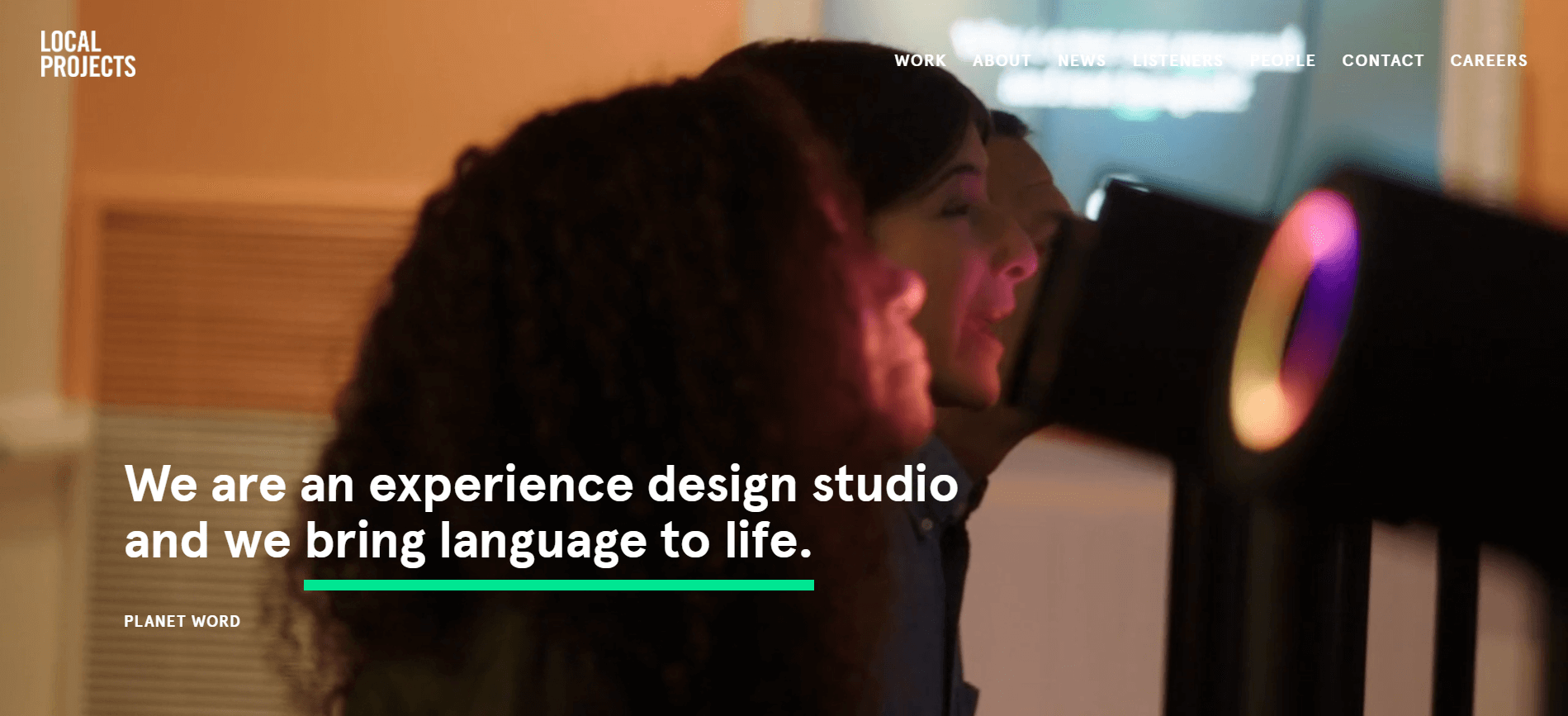
At Planet Word in Washington, DC, the museum of words and language, Local Projects designed interactive installations built around voice activation. In The Magical Library, books narrate themselves through projection, with characters and settings appearing around the reader. In Word Worlds, visitors speak adjectives such as “surreal” or “vibrant” and the scene around them shifts color, melts or bursts into animation. The approach turns language into something physical, and it removes the instruction panel from the experience.
Other named projects include Greenwood Rising in Tulsa, the Hyde Park Barracks Museum in Sydney, the Bloomberg London Mithraeum, the Theodore Roosevelt Presidential Library in the North Dakota Badlands, the UN Geneva Visitor Center, the Shockoe Institute’s “Expanding Freedom” project, and “Camouflage: Designed to Deceive” at the International Spy Museum.
Local Projects works from content strategy through physical and media design, which suits institutions that want the story and the technology developed together rather than handed between separate vendors.
Best for: flagship museums and memorials that need narrative-led exhibition design with ambitious media at its core.
3. Ideum — Exhibit Design-Build Plus In-House Touch Tables
Ideum, based in Corrales, New Mexico, designs experiences for public spaces and combines exhibit design and build with its own line of touchscreen hardware. That pairing is unusual: the same company that writes the interactive software also manufactures the tables it runs on.
Its hardware line includes the Colossus II, an 86-inch 4K touch table designed for up to eight simultaneous users, the Drafting II in 43, 49, 55 and 65-inch sizes, and the Pro II with a workstation computer and expansion options. Museums buy these as standalone products or as part of a full Ideum exhibit.
Ideum’s biggest recent museum project is “Pathway to Peace: USS Missouri’s World War II Experience” aboard the Battleship Missouri Memorial at Pearl Harbor, unveiled on September 2, 2025. Ideum delivered large-scale archival film projections, interpretive graphics around the 1945 surrender ceremony, custom software and fabricated casework, and an oral history station with eight veteran interviews that visitors select using replica Naval ID cards. The casework was engineered with magnetic, surface-mounted graphics so the historic ship itself would not be damaged.
Other projects on its site include an interactive projection-mapped model for Valles Caldera National Preserve, a collections experience for the National Cowboy & Western Heritage Museum, an electromagnetic spectrum exhibit for NRAO and the PBR Heroes & Legends Hall of Fame.
Best for: museums that want durable multitouch hardware and interactive exhibit design software from one accountable vendor.
4. Art Processors — Museum Experience Design And The Pladia Visitor Platform
Art Processors is an Australian experience design agency with studios in Melbourne and Hobart, focused on digital and immersive experiences for museums, galleries and cultural institutions. Its client list runs from Hobart’s MONA to the Getty in Los Angeles.
Recent exhibition work includes “The Future & Other Fictions” at ACMI in Melbourne (2024), “Namedropping” at MONA, the MONA Library’s “A library without Dewey”, and “Pull, Pop, Push” at the State Library of South Australia.
The studio also builds Pladia, a spatial publishing platform launched in late 2024. Pladia combines wayfinding, audio guides, digital labels, kiosk displays and visitor analytics in a single Progressive Web App that needs no installation and works offline. Art Processors lists Sydney Opera House, the Getty Museum, the Bob Dylan Center, the Museum of Contemporary Art Australia, Art Gallery NSW, the Western Australian Museum and White Bay Power Station among the venues using it.
That combination of custom exhibition design and a reusable platform is valuable for institutions that want one-off gallery experiences without rebuilding their guide and label infrastructure every time.
Best for: art museums and galleries that want in-gallery digital interpretation backed by a maintained software platform.
5. Bluecadet — Digital Experience Studio For Cultural Institutions
Bluecadet designs immersive environments and digital tools that help cultural institutions and brands share stories, working across physical installations, digital signage and websites. Founder Josh Goldblum started the studio more than 20 years ago after working as a new media specialist at the Smithsonian American Art Museum, and that museum background still shows in how the team approaches content.
Named projects on its site include interactive media for the MIT Museum, a learning and play space for The Metropolitan Museum of Art, interactive media for the Folger Shakespeare Library, digital signage for the Cleveland Museum of Art, and website redesigns for the Princeton University Art Museum and the Buffalo AKG Art Museum.
Bluecadet’s strength is continuity between the gallery and the screen at home. A museum that wants its in-gallery touchscreens, lobby signage and online collection to feel like one system can brief a single studio rather than coordinating an exhibit firm and a web agency.
Best for: museums that want in-gallery interactives, signage and digital platforms designed as one visitor journey.
6. Unified Field — Interactive Media And Exhibits From Brooklyn
Unified Field is a Brooklyn experience design firm that creates content-rich interactive media for exhibits and branded environments. Its service list covers interactive and personalized experiences, immersive environments, media walls, digital signage, wayfinding, AR, VR and MR, film and motion graphics, backed by UX design, software engineering, content management and installation support.
The museum projects on its site are a strong record of long-running interactives. They include the Social Lab interactive exhibit at the Museum of Tolerance in Los Angeles, “Campaigns of Courage” at the National WWII Museum, the Space Shuttle Atlantis attraction at Kennedy Space Center, “Dogs! A Science Tail” at the California Science Center, the Toy Hall of Fame at the Strong Museum of Play, and digital wayfinding for the New-York Historical Society.
Its client roster also lists the Smithsonian, the American Museum of Natural History, the Museum of Science and Industry, the Natural History Museum of Los Angeles County, the New York Hall of Science and Liberty Science Center.
Because its services run from UX and software engineering through installation support, Unified Field is a good fit for teams that already have a physical exhibit designer and need the interactive layer built properly.
Best for: museums and science centers that need robust touch and media interactives inside a larger exhibit build.
7. Tellart — Narrative-Driven Installations And Expo Pavilions From Amsterdam
Tellart is an Amsterdam experience design studio that works as strategic partner, design studio and production house for immersive, multisensory installations and exhibitions. It has been doing this for about 25 years and has worked with Google, Disney, IKEA, the BBC and the Van Gogh Museum.
Its museum work is some of the most experimental on this list. At the Science Museum in London, Tellart built Chrome Web Lab, an installation that connected the internet to physical machines in the gallery. For the V&A it created “Designing Planets with Machine Learning”, in which visitors shape sand landscapes. At the Oregon Museum of Science and Industry, it worked on “Sit Spot: Reconnecting with the Living World”, an exhibition about climate resilience.
Tellart has also designed for World Expo pavilions, including the Netherlands, Philippine, Polish and UAE pavilions, and created a SAM AI experience at Nxt Museum in Amsterdam.
Best for: science museums and design museums that want an installation built around a new technology, including machine learning, rather than a conventional touchscreen.
Northern Light Productions is a Boston-area media studio with a four-decade history of work for museums, cultural institutions and broadcasters. It produces interactive exhibits, interpretive films, projection mapping, touchscreen interactives, AR and VR experiences and animation.
Its media installation portfolio is long and heavily museum-focused. Projects include interactive media for the Hoover Dam Visitor Center, an interactive wall at the Pikes Peak Summit Visitor Center, interpretive media at the National WWII Museum, interactive displays at the Naismith Memorial Basketball Hall of Fame, and an exhibit entrance installation for the Smithsonian National Museum of Natural History.
For the American Writers Museum it created a word waterfall interactive display. It has also built interactive touchscreen stations for the Franklin D. Roosevelt Presidential Library and Museum, interactive gallery stations for the Tennessee State Museum, an interactive table for the University of Nebraska State Museum, and media for the Smithsonian National Museum of African American History and Culture, the Canadian Museum of History and The Mob Museum.
The studio also produces documentaries and interpretive films, so its interactives tend to be backed by strong film storytelling and archival material.
Best for: history museums, presidential libraries and visitor centers that want film-quality media alongside interactive stations.
Gallagher & Associates describes itself as one of the only fully integrated experience design firms in the world, covering planning, design, production and operation of cultural destinations. Its services include strategic planning, content development, experience design, digital media, and signage and wayfinding, and it has offices in New York (home to its NYC Design Lab), Washington, DC and Portland, Oregon.
Featured projects include the National Medal of Honor Museum, where the firm delivered content development, digital media, experience design and wayfinding, the Washington-on-the-Brazos historic site in Texas, and the Jean & Ric Edelman Fossil Park & Museum at Rowan University.
The firm positions itself as a lifetime partner for cultural attractions, with accountability that continues after opening day. That is useful for new-build museums, where early planning decisions about content, circulation and media drive the budget more than any single interactive.
Best for: new museums and major expansions that need master planning, content and digital media delivered by one team.
10. Roto — Design-Build Interactive Galleries For Science Centers And Aquariums
Roto is an exhibit design-build firm founded in 2004 to bring creative design and engineering of interactive experiences under one roof. It is based in Dublin, Ohio, and its work spans museums, science centers, children’s museums, zoos and aquariums, with client logos that include the Smithsonian and The Getty.
Its project list is dense with hands-on galleries. Roto created “Change Your Game” at the Smithsonian National Museum of American History, the LIFE gallery at the Orlando Science Center, the TCU Children’s Gallery at the Fort Worth Museum of Science & History, “Uniquely Human” at the Kentucky Science Center, “Cleveland Creates” at the Great Lakes Science Center, and the Goizueta Children’s Experience at the Atlanta History Center.
Aquarium work includes Ocean Odyssey at the Texas State Aquarium, the Living Seas Gallery at Birch Aquarium at Scripps and galleries at the Oregon Coast Aquarium. Beyond museums, Roto also built TIMES TRAVEL at One Times Square, a multi-sensory journey through the history of Times Square and the New Year’s Eve Ball.
Many of these projects combine immersive media with interactive engineering and custom fabrication, a mix that suits children’s galleries where exhibits must survive heavy use.
Best for: science centers, children’s museums and aquariums that want hands-on interactives designed, engineered and fabricated in one contract.
What Museum Exhibit Design Firms Actually Do
Museum exhibit design is the work of planning, designing, producing, installing and maintaining the physical and digital environment inside a gallery. In practice, the firms that do it fall into a few groups, and most large projects use more than one of them.
Planning and interpretive firms shape the big idea, the visitor journey, the content outline and the budget before anything is drawn.
Exhibit design firms turn that plan into spatial layouts, graphics, casework and lighting, and produce the drawings a builder can price.
Media and interactive studios write the software, films, projections, AR and VR experiences and touch interactives.
Fabricators and integrators build the casework and environments, then install and commission the hardware and media on site.
Large builds usually bring several of these together on one team. Several firms on this list cover two or three roles, which reduces handoffs.
How The Museum Exhibit Design Process Works
Whether the project is a small gallery refresh or a new permanent exhibition, most exhibit design companies follow a similar sequence of phases. Knowing them helps you see where each firm’s work begins and ends.
Planning And Interpretive Strategy
The team defines the audience, learning goals, key messages and budget, and agrees what success looks like. This is where the institution decides which stories need interactivity at all, and which are better told with objects, text or film.
Concept And Schematic Design
Designers write the exhibition script, group content into zones and produce concept sketches, floor plans and mood boards. For interactive exhibit design, this phase should include early prototypes of key interactions, even rough ones on paper or a tablet, so the team can watch real people use them.
Design Development And Content Production
Drawings become detailed enough to price and build. In parallel, writers, researchers and media teams produce labels, films, software and archival content, and rights to images and footage are cleared.
Fabrication, Installation And Testing
The fabricator builds casework and environments off site, then installs them alongside AV hardware and software. Interactives are tested in the gallery with staff and, ideally, with visitors before opening.
Evaluation And Maintenance
After opening, the best teams watch how visitors actually use the exhibit, fix what confuses people and hand over maintenance manuals, spare parts and content update tools. This last phase is what keeps interactive museum exhibits working, and worth revisiting, for years.
How To Choose A Museum Exhibit Design Firm
Do You Need A Designer, A Media Studio Or A Fabricator?
Start by deciding which part of the project you are buying. Some interactive exhibit design firms plan the whole gallery, others only build the media, and others fabricate what someone else designed. Planning firms and design-build firms give you one point of accountability, while specialist media studios usually go deeper on software and content. If you already have an exhibit designer, look for a media partner that is comfortable working inside another firm’s drawings and schedule.
Do They Design Around The Visitor?
Strong exhibit design firms start with who is coming through the door and what they should feel, think and remember, then choose the technology. Ask each firm to explain how it researches your audience, how it tests ideas with real visitors before fabrication, and when it has recommended a simpler, non-digital solution. A firm that leads with hardware before it understands your story is a warning sign.
What Does It Cost?
Costs vary widely with scope. A single touchscreen interactive with existing content costs far less than a gallery where every element is custom, and headset-based VR adds hardware, staffing and cleaning to the budget. Ask for pricing in phases (concept, design development, production, installation) and make sure content research, licensing of archival media and accessibility testing are included, since these are where museum budgets most often grow.
How Will The Exhibit Hold Up Over Time?
Interactive museum exhibits run for years, often ten hours a day. Ask each company how its software is updated, who owns the source code, what happens when a screen or sensor fails, and whether it offers maintenance contracts. Hardware built for public use, like commercial touch tables and sealed kiosks, costs more upfront but reduces downtime. Platforms that let staff update content without calling the vendor are also worth weighing.
How Will They Measure Visitor Impact?
An exhibit that looks good at the opening party can still fail its audience. Ask how the firm evaluates success after launch: observation studies, dwell time, analytics from interactives, visitor surveys and staff feedback. Firms that build analytics into their software, or plan a round of fixes after opening, make it easier to prove value to funders and to keep visitors coming back for return visits.
Is It Accessible And Multilingual?
The best interactive exhibit design puts accessibility in the brief from day one: captions, audio description, tactile alternatives, reachable screen heights and language options. Language-neutral interactions such as gesture, motion and sound are especially useful for museums with international audiences. If your project includes virtual access for remote visitors, our guide to the best VR companies for virtual tours covers that side of the market.
Can They Show Work In Institutions Like Yours?
A science center, an art museum and a memorial need very different kinds of interaction. Visit or ask for references from institutions similar to yours in size and subject, and ask how visitors actually used the exhibit after opening. Firms that also work on brand activations and expos, like several on this list, can bring useful ideas from outside the museum world, as covered in our list of top immersive experience companies for trade shows and exhibitions.
Frequently Asked Questions
Who Designs Museum Exhibits?
Museum exhibits are usually created by a team rather than one person. Curators and educators define the content, while exhibit designers handle layout, graphics and casework. Media studios build films and interactives, and fabricators construct and install the finished gallery. Larger museums often have in-house exhibit staff who work alongside outside museum exhibit design firms, especially for permanent galleries and technology-heavy projects.
How Much Does It Cost To Create A Museum Exhibit?
There is no standard price. Cost depends on gallery size, how much is custom built, the amount of media and software, content research and licensing, and whether the exhibit is temporary, traveling or permanent. Interactive and immersive elements usually raise both build and maintenance costs. The most reliable way to budget is to request phased proposals from several firms against the same written brief.
What Is Interactive Exhibit Design?
Interactive exhibit design is the practice of creating exhibits that respond to what visitors do, rather than asking them only to read and look. It can be as simple as a flip panel or as complex as voice-activated projections, touch tables, AR guides, motion tracking or conversational AI characters. The goal is to help visitors explore content actively and remember it longer.
What Is The Difference Between An Exhibit Designer And An Exhibit Fabricator?
An exhibit designer plans and draws the exhibition: layout, visitor flow, graphics, casework and how media fits in. A fabricator builds it, turning those drawings into finished casework, environments and installations, and often integrates AV hardware. Design-build firms do both under one contract, which simplifies accountability, while separate contracts let a museum pick a specialist for each stage.
How Long Does It Take To Design A Museum Exhibit?
Timelines depend on scope and approvals. A small temporary exhibit can move from brief to opening in a few months, while a large permanent gallery with custom media typically takes well over a year, and new museums take several years. Content research, rights clearance, fundraising and fabrication lead times are often what set the schedule, more than design itself.
Conclusion
Museums in 2026 can choose from a wider range of museum exhibit design firms than ever, from AR and AI studios to documentary-driven media producers, touch table manufacturers and turnkey fabricators. The right choice depends less on the technology itself than on the story you need to tell, the audience you need to reach and the budget you have to keep the exhibit running for years.
Define the scope clearly, ask for work in comparable institutions and plan for evaluation and maintenance from the start. With that in place, any of the firms above can help turn a collection into an experience visitors remember and return to.
If you want to feature your company on this list, email us or submit a form in the Top Choices section. After a thorough assessment, we’ll decide whether it’s a valuable addition.