The AI initiative has executive approval, funding, and a promising use case.
Then security asks where the data goes, legal questions model ownership, IT flags six legacy integrations, and procurement wants a vendor that can support the system three years after launch. Suddenly, choosing an enterprise AI development company looks very different from hiring a team for an innovation sprint.
Large organizations rarely need AI in isolation. They need it to operate inside identity systems, data warehouses, cloud infrastructure, regulated workflows, and software that thousands of employees already depend on. The technical challenge is matched by an organizational one: access controls, auditability, human oversight, deployment standards, and ownership need to be defined before an intelligent feature is allowed near critical operations.
This ranking focuses on companies with evidence of AI engineering plus the software, integration, and delivery capacity required by enterprise environments. Organizations considering more autonomous use cases can also compare ReVerbico’sAI agent development firms for enterprise solutions when determining whether conventional machine learning, generative AI, or agentic workflows best fit the operating model.
The original directory pool contained 464 enterprise-qualified AI providers. The supplied selection was built to balance established firms, mid-tier specialists, and emerging companies rather than rewarding brand visibility alone.
Best Enterprise Artificial Intelligence Engineering Firms To Hire
Webisoft is a good fit when enterprise AI has to operate inside a larger custom platform with significant integration requirements. Its engineering work covers custom software, SaaS systems, web applications, blockchain infrastructure, and backend-heavy products, giving the team experience with the architectural layers that surround enterprise AI rather than treating the model as the entire solution.
Verified engagements show the company working on financial systems, data interoperability, custom platforms, and technically complex integrations while maintaining responsive delivery. Its public positioning is broader than that of a pure machine-learning laboratory, so the strongest use case is an organization that needs AI engineered into an existing product or operational system. Research-intensive model development should be validated at the proposed-team level.
Services & expertise: Custom software, AI-enabled applications, SaaS, systems integration
Tech stack: Modern web technologies, APIs, distributed systems
Industries: Financial services, technology, education, real estate, automotive
CodeNinja is built for enterprises that need enough engineering capacity to take AI beyond a contained departmental tool. Its Clutch service profile assigns half of the company’s work to AI development, supported by custom software and staff augmentation, while a 250–999-person team gives it room to support larger programs across multiple technical disciplines.
The company has 53 Clutch reviews and experience across 13 industries, providing a broader evidence base than most specialized AI boutiques. That delivery scale is useful when AI touches cloud infrastructure, data engineering, frontend applications, and long-term support at once. The key diligence question is team composition: enterprise buyers should confirm that senior AI architects remain directly involved after discovery rather than handing execution entirely to a larger delivery layer.
Services & expertise: AI development, custom software, SaaS, engineering augmentation
Tech stack: AI, cloud, web, data, and enterprise application technologies
Industries: Multi-industry enterprise technology
Location: Dallas, Texas, with international delivery
AI Superior is the specialist to consider when the enterprise problem genuinely requires machine learning rather than a conventional software workaround. AI development represents 85% of its service mix, and its expertise spans computer vision, predictive models, natural language processing, recommendation systems, and generative AI. The company was founded in 2019 and operates with a 10–49-person team from Darmstadt and Berlin.
Its 18 verified reviews include work on risk models, data infrastructure, computer vision, and generative AI. Clients repeatedly highlight technical depth and transparency, while the company explicitly positions itself as willing to recommend simpler technology when AI is unnecessary. That restraint matters in enterprise environments, where an avoidable model can introduce governance and maintenance costs without improving the underlying process.
Apzumi earns its place because enterprise AI becomes significantly harder when healthcare regulation enters the picture. The company develops AI-powered digital-health products, medical software, integrations, and patient-facing applications while maintaining ISO 27001 information-security certification and ISO 13485 alignment for medical-device quality systems.
Its Clutch profile lists 50–249 employees in Poznań, while the underlying company was registered in 2013. Apzumi reports more than 90 completed healthcare projects and has received recognition through Deloitte Fast 50 and the Financial Times FT1000. The specialization is also its limitation: companies outside health, wellness, or insurance may find a general enterprise AI partner more efficient than paying for domain capabilities they do not need.
Services & expertise: AI software, healthcare platforms, mobile apps, integrations
Tech stack: AI/ML and modern healthcare application technologies
Industries: Healthcare, wellness, digital insurance
Location: Poznań, Poland
Recognition: ISO 27001, ISO 13485, Deloitte Fast 50 recognition
TechnoYuga is useful when an enterprise needs AI delivered through a practical application rather than as a standalone data-science initiative. Its service mix combines AI development with custom software and mobile applications, while verified work includes internal HR systems, financial dashboards, marketplaces, and other products that translate operational requirements into user-facing software.
Clutch lists 50–249 employees and 64 reviews, with clients consistently praising communication and the ability to understand business workflows before building. Its lower-cost delivery model can support broader implementation scope, but enterprises with sensitive proprietary models should investigate security processes, architecture ownership, and senior ML staffing in greater depth before scaling the engagement.
Services & expertise: AI integration, custom software, mobile applications, UX/UI
Tech stack: AI, mobile, web, and backend application technologies
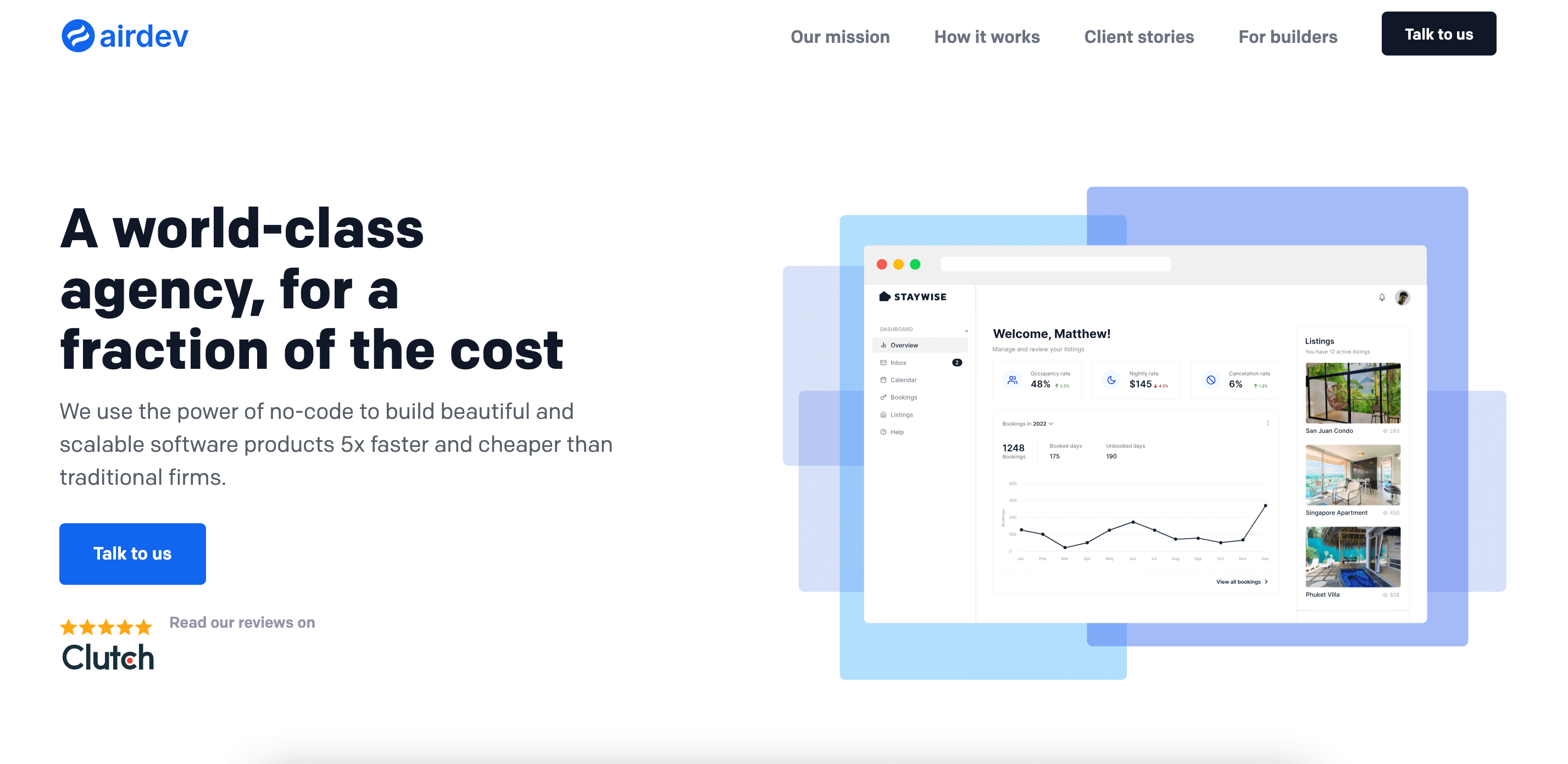
Airdev does one thing differently from conventional enterprise developers: it uses low-code architecture to shorten the distance between an approved business requirement and working software. The San Francisco company combines custom software, AI development, low/no-code development, and web engineering, with 50–249 employees and a history dating to 2015.
Its 90 Clutch reviews include AI web applications, internal platforms, marketplaces, risk-management software, and enterprise users alongside startups. Clients consistently praise speed and transparency, although some note that initial scoping can require more precision. Airdev is therefore most compelling when rapid iteration matters more than highly bespoke infrastructure; organizations with unusual performance or architecture constraints should test Bubble and low-code suitability early.
Services & expertise: AI applications, custom software, low-code systems, web platforms
Tech stack: Bubble and supporting web/integration technologies
Industries: Enterprise and multi-industry digital operations
BeeWeb suits enterprises that want an engineering partner to stay embedded through several generations of a product. Verified clients describe the team handling platform refactoring, CRM integrations, analytics dashboards, AI assistance, and ongoing product development rather than disappearing after the initial release.
Founded in 2015, BeeWeb has 10–49 employees in Yerevan and 20 published Clutch reviews. Its current positioning combines custom software, SaaS platforms, enterprise applications, and AI solutions, while several engagements expanded from a few engineers into larger embedded teams. The firm is smaller than the enterprise-scale vendors above, so organizations should confirm capacity before planning several concurrent workstreams.
Services & expertise: AI solutions, custom software, SaaS, enterprise applications
Tech stack: Modern web, mobile, CRM, analytics, and AI technologies
Industries: Technology, legal, logistics, SaaS, digital platforms
Cadabra Studio becomes interesting when poor user experience is as dangerous as poor model performance. Its present service mix assigns 40% to AI development and 30% to custom software, but the firm retains the UX research and interface-design capabilities that originally established its reputation. That combination helps when employees need to understand, verify, or override AI-generated decisions.
Founded in 2015, the 10–49-person company operates from Wilmington and Amsterdam and has 26 Clutch reviews. Its strongest industry exposure includes healthcare, insurance, and real estate, all areas where decision flows can become complicated quickly. Some reviews raise cost-transparency concerns, so enterprise buyers should lock down discovery assumptions and change-control rules before a multi-phase program begins.
Bayshore Intelligence Solutions is where security-conscious enterprise AI and modernization intersect. Half of its service portfolio is AI development, supported by custom software and enterprise application modernization, while its capabilities cover agentic AI, generative AI, machine learning, digital twins, cloud-native systems, and DevSecOps.
The company was founded in 2019 and has 10–49 employees split between Dublin, California, and Kolkata. Its current review base is only two projects, but one involves upgrading an enterprise data-science platform with machine learning and GenAI solutions. ISO 9001 and ISO 27001 certifications add credibility for structured delivery, although the smaller evidence base means reference checks should carry more weight.
044 AI is the focused specialist for enterprises that have a difficult machine-learning problem and do not need a large generalist delivery organization. The company dedicates 90% of its service mix to AI development, with expertise weighted toward computer vision, machine learning, and natural language processing. Its verified project work includes a custom reproductive-health prediction algorithm built with a modern ML stack.
Founded in 2022, the 10–49-person firm operates from Porto and Warsaw. Its technical stack on the cited healthcare project included PyTorch, FastAPI, Python, Weights & Biases, and LabelBox. The limitation is straightforward: one published Clutch project offers far less execution evidence than the companies above, so a paid technical discovery or contained model-development phase is the safer entry point.
Services & expertise: Machine learning, computer vision, NLP, AI consulting
Enterprise AI vendor selection should expose operational risk before it rewards technical ambition. Put the finalists through the same scenario: restricted data, several legacy integrations, a security review, a model failure in production, and a requirement to explain the result to a non-technical stakeholder. Their answers will reveal far more than another polished AI demo.
The partner worth taking into procurement is the one that can show who remains accountable when the model, infrastructure, and business process disagree.
Bookmark this guide to make a well-informed decision. If you want to add your company to this list, drop us a line orsubmit a form in the Top Choices section. After a thorough review, we’ll decide whether it’s an appropriate addition.