Top RAG Development Companies And Vector Search Firms
Maureen Brooks
Freelance Writer
09.02.2026
The answer sounds plausible, the interface looks polished, and the model responds in seconds.
Then someone opens the source document and discovers that the system retrieved the wrong policy, ignored a newer version, or assembled an answer from chunks that were individually relevant but collectively misleading.
That is the failure mode RAG teams have to solve. Retrieval-augmented generation is not just a vector database connected to an LLM. Production systems need sensible chunking, metadata, embedding strategy, reranking, permissions, citation handling, evaluation, and a way to detect when the underlying knowledge base cannot support a reliable answer.
Vector search development becomes even more demanding when data is distributed across CRMs, PDFs, product databases, internal documentation, and user-specific repositories. Teams comparing the orchestration layer around these systems can also review ReVerbico’sfirms powering AI agents with vector search, RAG, and LLM orchestration before deciding whether retrieval should be built as an isolated service or as part of a broader AI architecture.
The source pool contained 166 discovered development profiles. The ranking below prioritizes verified RAG work, AI and backend depth, search architecture, production delivery, and the strength of evidence behind each provider rather than generic AI positioning.
Best Retrieval-Augmented Generation And Semantic Search Companies To Hire
Webisoft is most useful when retrieval has to operate inside a larger custom application rather than live as an isolated search demo. Its engineering background covers SaaS platforms, web systems, APIs, backend logic, distributed architecture, and complex integrations, all of which matter once a RAG layer has to respect application permissions, customer context, and existing business workflows.
The company’s public profile is broader than a dedicated vector-search consultancy, so buyers should validate framework and database experience with the proposed AI team. Its advantage is the surrounding engineering: when retrieval must connect to transactional systems, user accounts, internal services, or product interfaces, the project requires much more than embeddings and prompt design.
Services & expertise: Custom software, AI-enabled products, SaaS, systems integration
Tech stack: Modern web technologies, APIs, distributed systems
Industries: Financial services, technology, education, real estate, automotive
LogicCraft has the clearest verified RAG case in this shortlist. For a legal technology company, the team built a RAG-based backend for legal document search and retrieval and took the system from proof of concept to a production-ready intelligence platform. That directly addresses the core difficulty of this category: improving retrieval workflows rather than merely placing an LLM in front of documents.
The company was founded in 2022, employs 10–49 people, and dedicates 20% of its listed services to AI development alongside web and mobile engineering. Its client work provides broader evidence of backend architecture, LLM integrations, APIs, and custom software. One reviewer noted that architecture documentation could arrive earlier, an important point for RAG systems that internal teams may eventually need to tune or extend.
Services & expertise: RAG, AI development, custom software, LLM integrations
Tech stack: Modern backend, web, API, and LLM technologies
Industries: Legal tech, SaaS, business services, digital products
Techuz InfoWeb stands out for treating retrieval as one component of a broader production AI stack. Its current AI capabilities include LangChain, LangGraph, vector databases, multi-agent frameworks, and full-stack application engineering, which gives the team options when retrieval has to feed agents, copilots, search interfaces, or SaaS functionality.
The company has substantial experience across React, Node.js, AWS, Angular, and other application technologies. Clients consistently praise technical execution and communication, though some reviews mention room to improve documentation, testing, and proactive handling of delays. Those trade-offs matter in RAG work because weak observability or documentation can make retrieval quality difficult to diagnose after launch.
Services & expertise: RAG, AI development, product engineering, agentic systems
Django Stars is a natural fit when retrieval depends on a substantial Python backend and long-term product engineering. The company has worked since 2008 on complex custom platforms and now adds AI agents and AI development to a mature Python/Django practice, giving it a strong foundation for retrieval services that need to live inside business-critical software.
Its client work includes AI-driven platforms, data-sensitive healthcare systems, and multi-year enterprise engagements. Clients consistently praise technical depth and proactive problem-solving, while some identify handover documentation as an area for improvement. Django Stars is therefore more compelling for organizations that need RAG as part of a substantial software platform than for teams simply shopping for a fast vector-database proof of concept.
Services & expertise: AI development, custom software, Python platforms, APIs
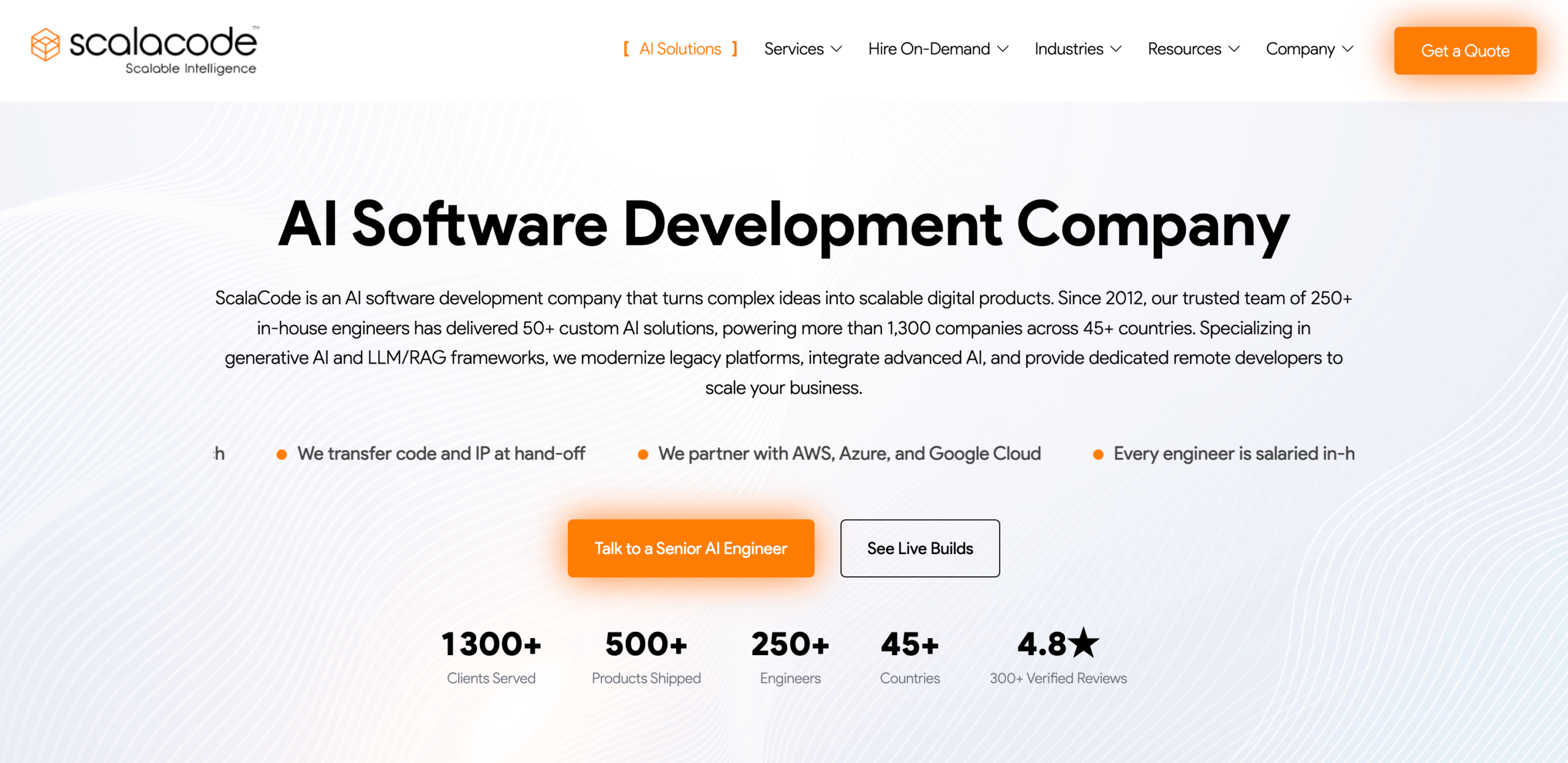
ScalaCode earns its position through the scale of its AI and custom-software delivery rather than a narrow RAG-only identity. Verified work includes AI ecosystems, predictive models, data-heavy dashboards, and integrated software platforms, showing that the team can handle the ingestion and application layers surrounding semantic search.
Its larger organization gives buyers access to more parallel engineering capacity when retrieval is only one stream inside a wider modernization program. That breadth also means buyers should insist on seeing a directly comparable vector-search architecture before committing. ScalaCode is better suited to organizations that need RAG alongside data engineering, application development, or workflow integration than to a small standalone semantic-search experiment.
Services & expertise: AI development, custom software, data platforms, web and mobile apps
Tech stack: Machine learning, APIs, modern web and data technologies
Cleveroad brings the most value here when retrieval needs to become part of a full web or mobile product. Since 2011, the company has delivered more than 300 web, mobile, and AI-driven products, and its current service portfolio includes AI agents, AI development, generative AI, APIs, and custom software alongside its core application work.
The 250–999-person team provides substantial delivery evidence, particularly around product launches, UX, scalability, and integration work. AI still represents a relatively small proportion of its published service mix, which keeps Cleveroad below retrieval specialists with direct RAG evidence. Buyers should ask for specific examples involving embeddings, vector databases, reranking, and retrieval evaluation rather than treating general AI experience as sufficient.
Services & expertise: AI applications, custom software, APIs, web and mobile products
Tech stack: Python, cloud, web, mobile, and AI technologies
Industries: Healthcare, fintech, logistics, education, sports, media
Location: New York, New York, plus four additional locations
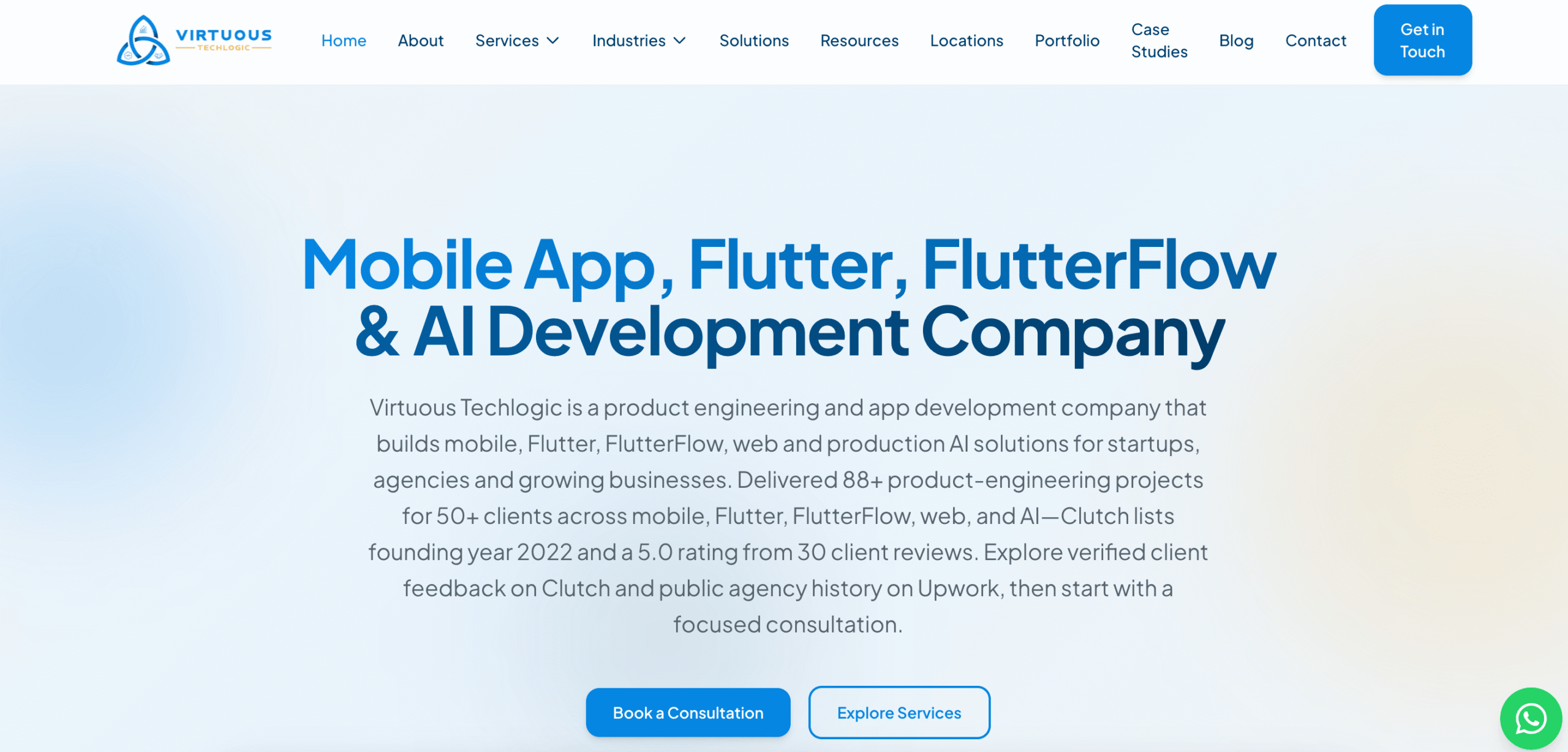
Virtuous Techlogic is worth considering when retrieval or recommendation features need to sit inside a mobile-first operational product. Its portfolio includes AI development, recommendation systems, backend integrations, and applications in travel, healthcare, mobility, and other sectors where intelligent features have to coexist with payments, profiles, dashboards, and user workflows.
Founded in 2022, the 10–49-person company has a strong client record. Clients praise its product thinking and adaptability, although several mention the need for more detailed technical documentation earlier in engagements. The company is not a pure RAG specialist, so buyers should verify vector-search and retrieval experience explicitly before assigning it a knowledge-intensive system.
Services & expertise: AI development, recommendation systems, mobile and web applications
Tech stack: Flutter, Node.js, backend services, AI technologies
Groovy Technoweb makes the shortlist for companies that need an AI-assisted search or retrieval feature surrounded by conventional web and application engineering. The company now positions itself as an AI-first engineering agency while maintaining a service mix dominated by mobile, web, and custom software development, which can help when RAG is one feature in a larger customer-facing platform.
Its client feedback provides substantial evidence, but it also reveals a more mixed quality signal than the firms above. Most clients praise responsiveness and technical delivery, while some report QA problems, unresolved bugs, and inconsistent code quality. That makes Groovy a functional lower-cost option, but retrieval-heavy buyers should require automated evaluation, testing criteria, and acceptance thresholds before deployment.
Services & expertise: AI-enabled applications, custom software, web and mobile development
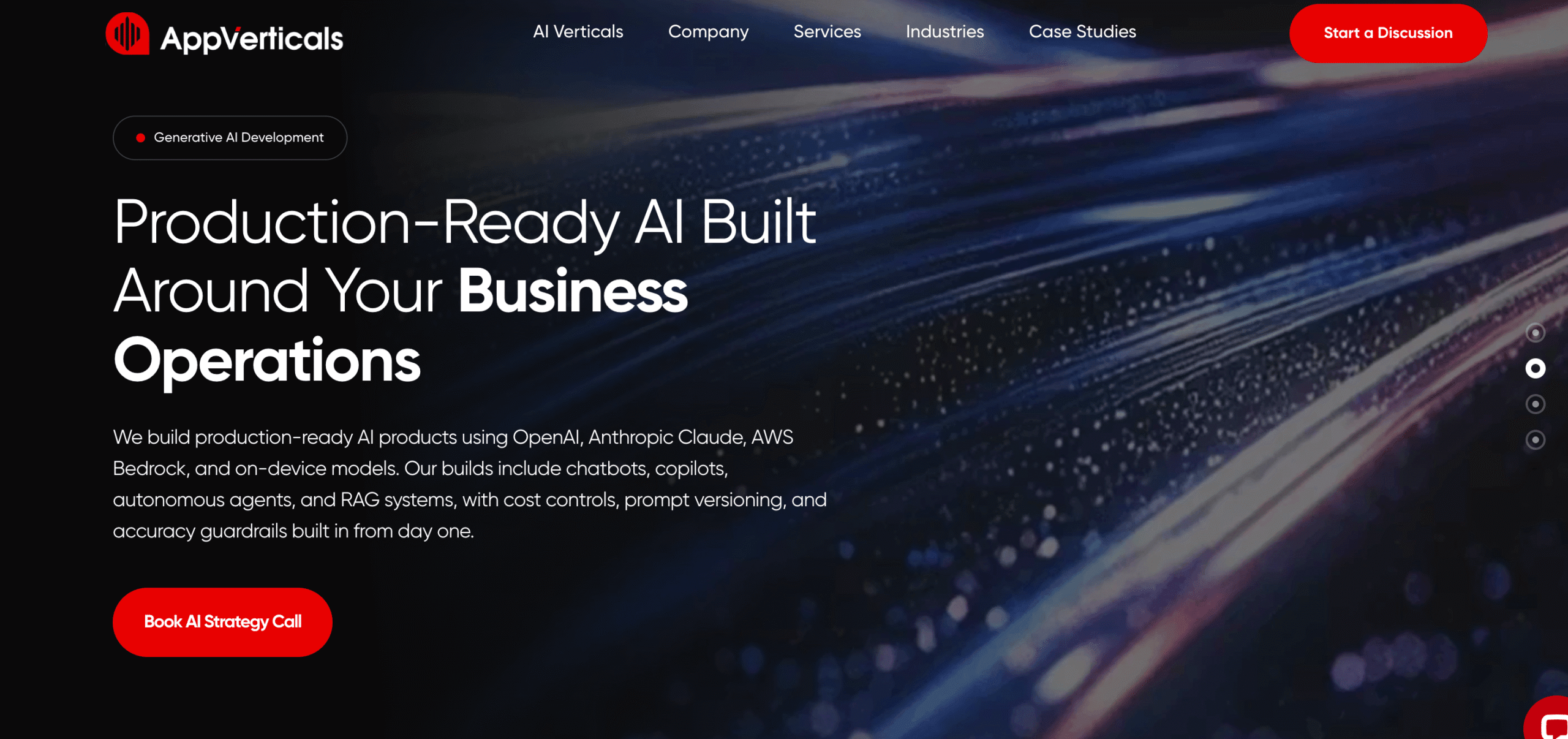
AppVerticals is a broader digital-product partner for businesses that want semantic search or AI functionality embedded inside a web or mobile application. Its client record covers custom applications, web platforms, backend functionality, and ongoing maintenance, giving it relevant integration experience even though retrieval is not the company’s dominant public specialization.
Its client record provides a reasonable delivery base, with clients often praising communication and willingness to adapt to requirements. The limitation is evidence specificity: the available material does not show the same direct production RAG examples found higher in this ranking. A contained retrieval module with measurable recall, precision, latency, and citation targets would be the sensible first engagement.
Services & expertise: Custom software, web and mobile development, AI integrations
Tech stack: Modern web, mobile, backend, and integration technologies
Industries: Consumer products, fintech, digital platforms
PyFlow Labs is the emerging option for teams willing to trade a shorter public track record for a more focused technical engagement. Its inclusion in the discovery-qualified RAG and vector-search pool signals relevance to modern AI application development, particularly for smaller buyers seeking direct engineering access rather than a large delivery organization.
That emerging status should shape the buying process. Instead of assigning an enterprise-wide knowledge platform immediately, begin with a retrieval benchmark covering a representative document set, permission rules, expected citations, and known difficult queries. A small provider can be effective here, but only when the evaluation criteria are explicit enough to distinguish good retrieval from fluent generation.
Services & expertise: AI development, retrieval workflows, custom software
Tech stack: Python and modern AI application technologies
Ask how retrieval quality is measured. A good RAG partner can explain how it tests whether the right passages are retrieved and whether answers stay grounded in them, using an evaluation set built from your own documents.
Map your data sources and deployment needs. List where the content lives, how often it changes and whether it must stay on-premise or in a private cloud. Confirm the firm has built for that environment before.
Discuss the vector database choice. Techuz InfoWeb, for example, lists LangChain, LangGraph, Qdrant, Pinecone, pgvector and Weaviate. Ask why a firm recommends one option over another for your scale and budget. Our guide to the best vector databases covers the main options.
Check security and access control. Retrieval should respect existing document permissions, so users only see answers built from content they are allowed to read.
Start with a proof of concept. A small pilot on real data shows retrieval quality, latency and cost before a full build. If your project centers on autonomous agents and orchestration rather than search, see our list of firms powering AI agents with vector search.
Frequently Asked Questions
What does a RAG development company do?
A RAG development company builds systems that let a language model answer questions using your own content. The work usually covers preparing and chunking documents, creating embeddings, setting up a vector database, building the retrieval and prompt layer, and connecting it to an app or internal tool. On this list, LogicCraft built a RAG backend for legal document search, and Webisoft focuses on retrieval inside custom software products.
What drives the cost of building a RAG system?
The main drivers are the volume and variety of source data, how much cleaning and document parsing it needs, the number of integrations, and security and permission requirements. Ongoing costs include model usage, vector database hosting and evaluation work as content changes. A proof of concept is the most reliable way to estimate a full build.
Can RAG systems be deployed on-premise?
Yes. RAG systems can run on-premise or in a private cloud using self-hosted vector databases and open models, which some regulated businesses require. This usually needs more infrastructure and maintenance work than a managed cloud setup. The entries on this list do not state on-premise delivery, so ask each firm for a comparable on-premise project before shortlisting it.
Conclusion
Test the retrieval layer before judging the chatbot. Give every finalist the same collection of duplicate documents, outdated versions, ambiguous terminology, permission-restricted files, and questions that cannot be answered from the available corpus. Then inspect what the system retrieves before reading what the model writes.
The provider that can explain why a wrong document ranked first, and how it will prevent that failure from recurring, is demonstrating the capability that matters most in production RAG.
Bookmark this guide to make a well-informed decision. If you want to add your company to this list, drop us a line orsubmit a form in the Top Choices section. After a thorough review, we’ll decide whether it’s an appropriate addition.