The best vector databases in 2026 sit underneath almost every serious AI application shipping today. Chatbots, coding assistants, recommendation engines, semantic search and agent memory all depend on turning text, images and events into embeddings and finding the closest matches in milliseconds. The vector database is the layer that makes that possible, and the market has matured fast. Dedicated engines now hold hundreds of billions of vectors, general-purpose databases have bolted on competent vector search, and a new wave of object-storage-native systems has pushed prices down by an order of magnitude.
This vector database comparison ranks the dedicated, embedded and general-purpose options worth shortlisting. We looked at architecture, open source licensing, hosted pricing, proven scale, hybrid search support and how well each system fits the retrieval-augmented generation (RAG) and agentic workloads that dominate new builds. If you are picking a vector database for RAG rather than for classic search, weight hybrid retrieval and filtering behavior above raw benchmark numbers. And if you are choosing the firms that will build on top of these engines, our list of top firms powering AI agents with vector search, RAG and LLM orchestration is the companion read.
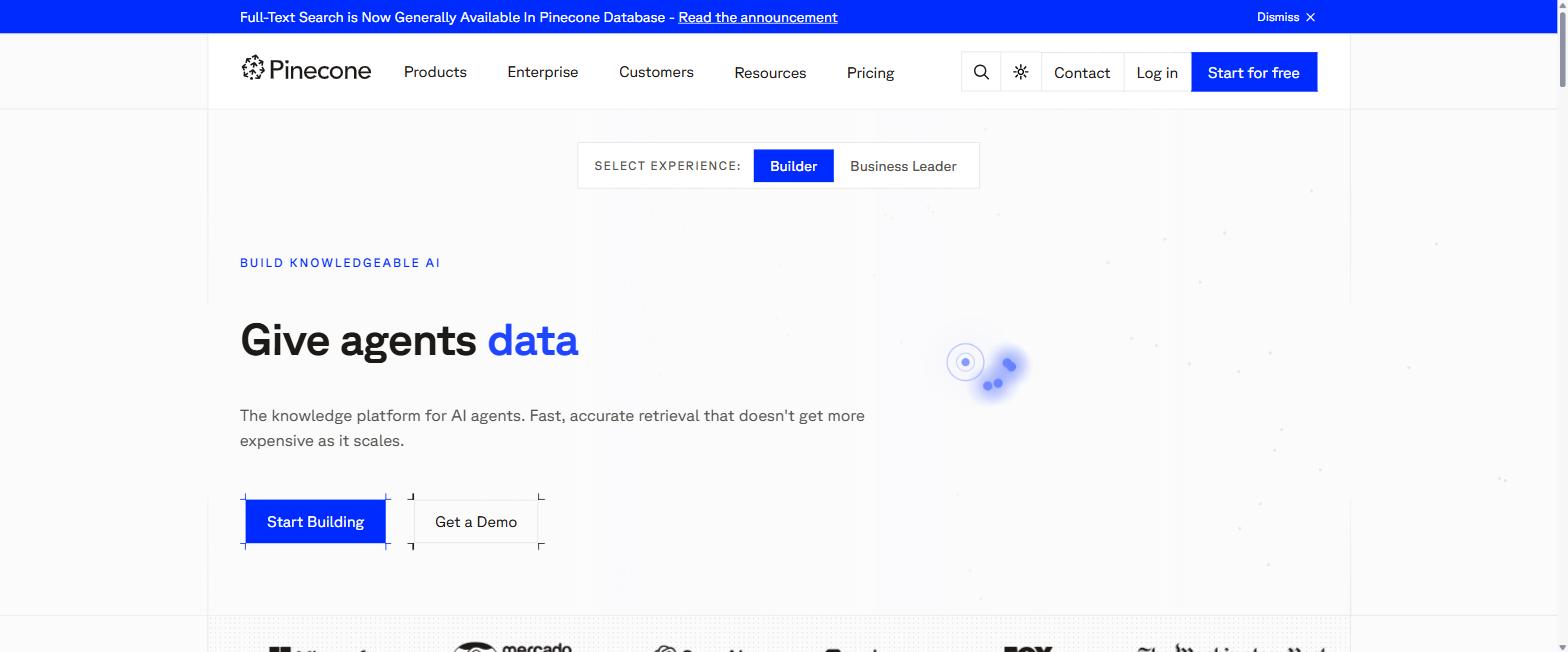
Pinecone remains the default choice for teams that want production vector search without running infrastructure. Its serverless architecture separates storage from compute, so you pay for reads, writes and storage rather than provisioned pods, and the same index can grow to billions of vectors. 2026 has been a busy year: Dedicated Read Nodes reached general availability for latency-sensitive workloads, full-text search and a Documents API went GA in September, and Pinecone Nexus, a bring-your-own-cloud control plane across AWS, GCP and Azure, launched for enterprises that need data to stay in their own accounts.
Pricing now runs from a free Starter tier through a flat $20 per month Builder plan, a Standard plan with a $50 monthly minimum, and Enterprise from $500 per month, with a HIPAA add-on available. The trade-offs are the ones you expect from a proprietary service: no self-hosting, egress metering introduced in 2026, and less control over index internals than the open source vector database options below. For most product teams shipping RAG features, those are acceptable costs for the operational simplicity.
2. Milvus — The Most Adopted Open Source Vector Database, Now Lake-Native
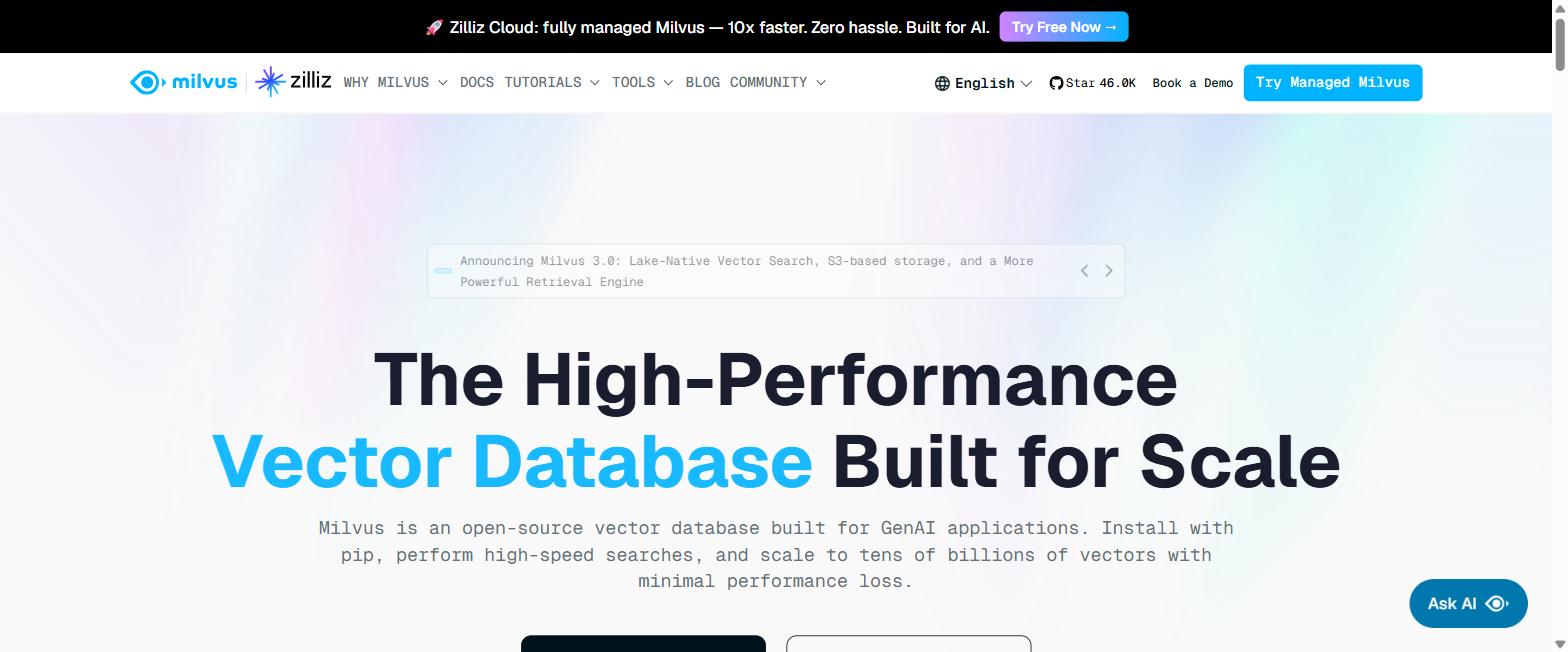
Milvus is the open source vector database with the deepest enterprise footprint: more than 45,000 GitHub stars, over 100 million Docker pulls and, by Zilliz’s count, more than 10,000 companies in production. It is an LF AI and Data graduated project under the Apache 2.0 license, and its distributed architecture separates query, index and data nodes so each can scale independently to hundreds of billions of vectors, with GPU-accelerated indexing when you need it.
Milvus 3.0, announced in July 2026, is the biggest architectural change in its history. External Collections let you define a Milvus collection directly over Lance, Iceberg, Parquet or Vortex files in S3, GCS or Azure Blob without copying data into the database, and the new Loon storage engine cuts read amplification on object storage. Snapshots, a Spark connector, server-side aggregation and faceted search round out the release. That lake-native direction matters most to teams whose analytics already live in a warehouse, the same crowd served by the top Snowflake consulting partners. Zilliz Cloud, the managed service, runs Milvus 2.6.x and later with tiered storage and a Cardinal engine that Zilliz claims delivers up to 10x throughput over stock HNSW. Milvus is the pick when scale and data-lake integration matter more than a minimal footprint.
3. Weaviate — Hybrid Search, Query Agents And Production Agent Memory
Amsterdam-based Weaviate has spent 2026 turning a vector database into an agent platform. The core database still does what it always did well: native BM25 keyword search, dense vector search and metadata filtering in a single hybrid query, with pluggable vectorizer and reranker modules so you can swap embedding providers without re-architecting. On top of that now sit the Query Agent, which translates natural-language questions into search and aggregation calls, and Engram, a managed memory service that reached general availability in June 2026. Engram runs background pipelines that extract, deduplicate and structure facts from agent interactions, then scopes them by project, user and permission so multiple agents can share context safely.
Weaviate is open source under a BSD-3 license and reports more than 150 million monthly downloads. Weaviate Cloud starts at $45 per month on the Flex plan, with Premium from $400 per month, a 14-day free sandbox and a free Engram tier of 1,000 pipeline runs a month. It also launched Agent Skills and an MCP server this year so coding agents can query and manage clusters directly. Choose Weaviate when hybrid search quality and agent memory are the product, not an afterthought.
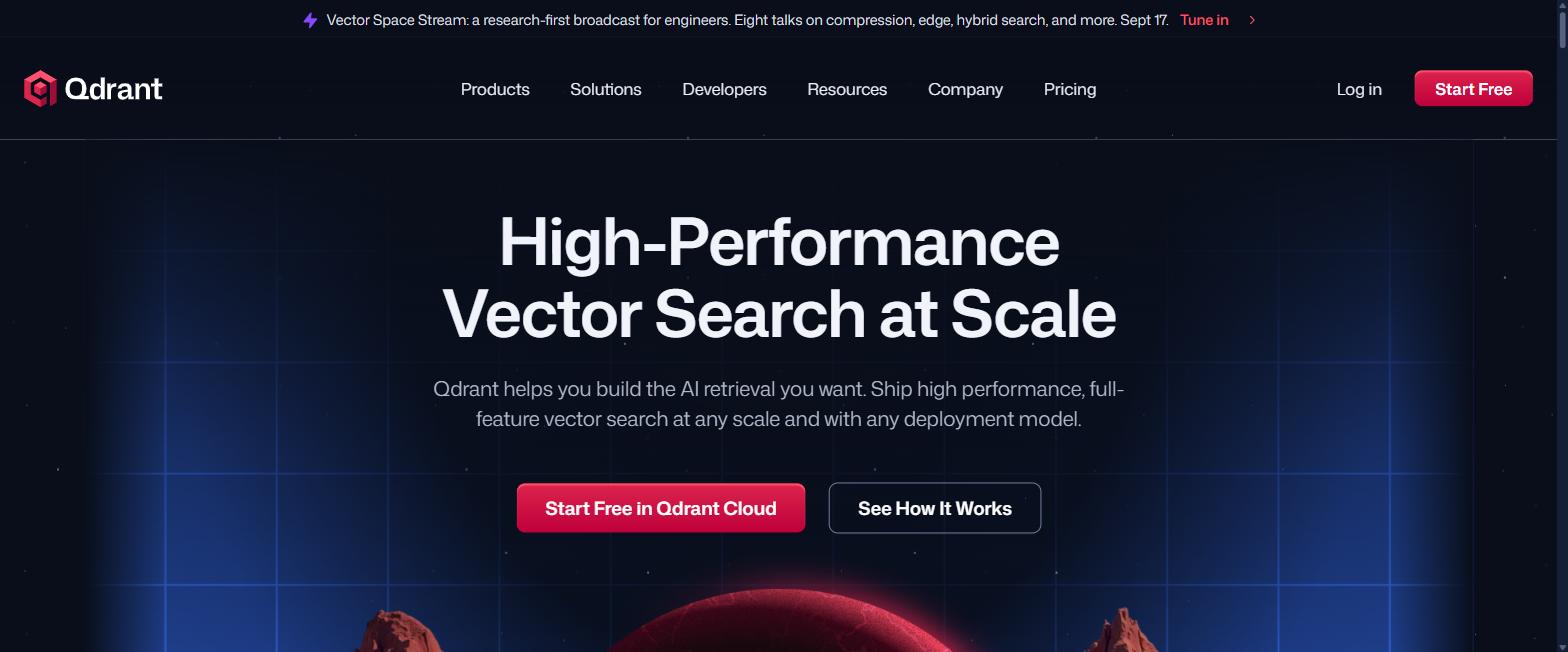
Qdrant is the engineer’s vector database. Written in Rust, it is consistently among the fastest engines in independent benchmarks, and its real differentiator is filtered search: rich JSON payload filtering is applied inside the HNSW traversal rather than as a post-filter, so recall holds up even when a query restricts results to a narrow tenant or category. It also supports sparse vectors, multi-vector (ColBERT-style) retrieval, named vectors per point and scalar, binary and product quantization to cut memory by up to 32x.
The company raised a $50 million Series B in March 2026 to push what it calls composable vector search, and Qdrant Cloud added GPU-accelerated indexing, multi-availability-zone clusters with automatic failover, and structured audit logging in April. A free cloud tier with 1GB of RAM and 4GB of disk needs no credit card, and Qdrant Edge targets on-device and embedded deployments. Qdrant is licensed under Apache 2.0 and is the best fit for teams that want top-tier performance with fine control over filtering, quantization and deployment.
5. pgvector — Vector Search Inside The Database You Already Run
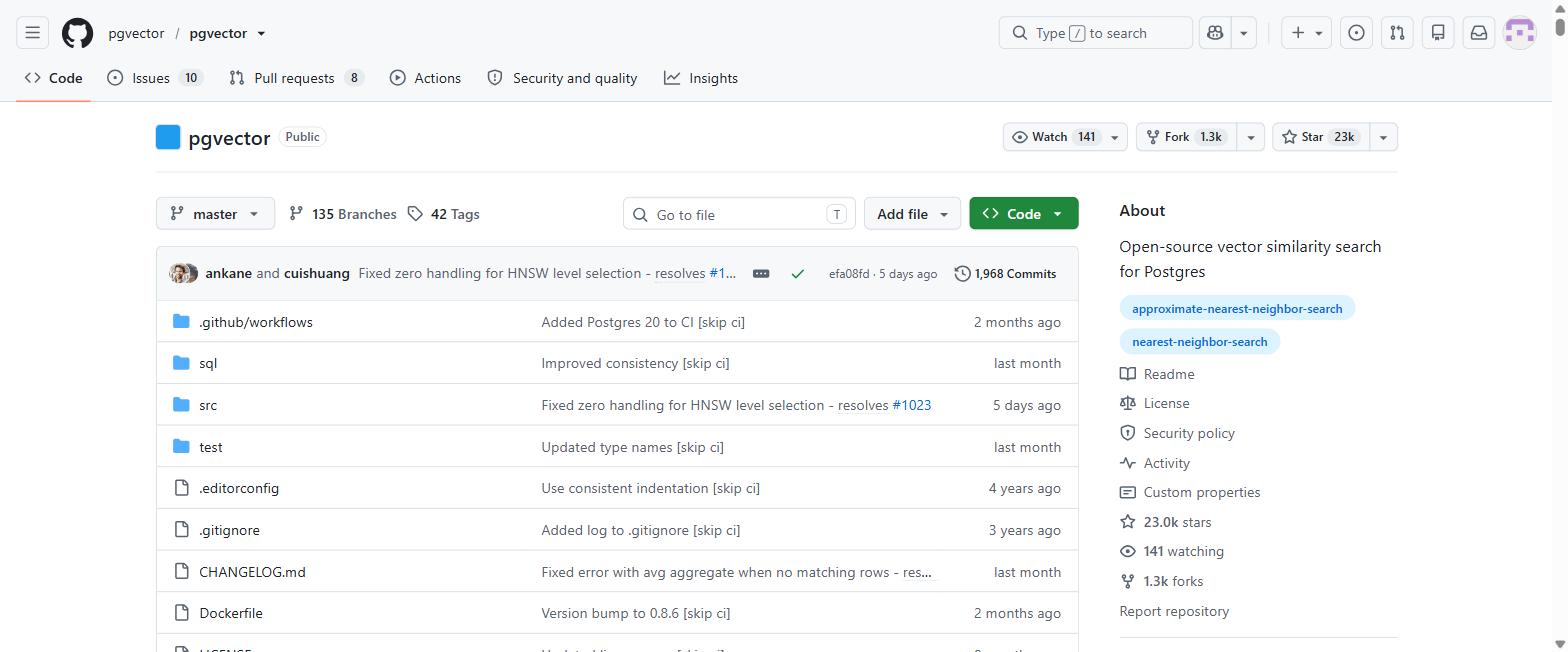
pgvector is not a standalone product, and that is exactly why it belongs on this list. It is a PostgreSQL extension that adds vector, halfvec, bit and sparsevec column types, exact and approximate nearest-neighbor search via HNSW and IVFFlat indexes, and the ability to filter, join and update vectors in the same ACID transaction as the rest of your relational data. The 0.8.x releases improved HNSW build speed and iterative index scans so filtered queries return the right number of results instead of running dry, and the extension ships in every major managed Postgres service including AWS RDS and Aurora, Google Cloud SQL and AlloyDB, Azure Database for PostgreSQL, Supabase and Neon.
The honest limit is scale. Single-node Postgres handles tens of millions of vectors comfortably with enough RAM for the HNSW graph, but past that you are sharding by hand or reaching for a dedicated engine. For the large majority of applications that never get there, pgvector removes an entire system from the architecture, costs nothing beyond the Postgres instance and keeps vectors next to the data they describe. It is the sensible default for any team already running Postgres.
6. Chroma — The Developer-First Embedding Database
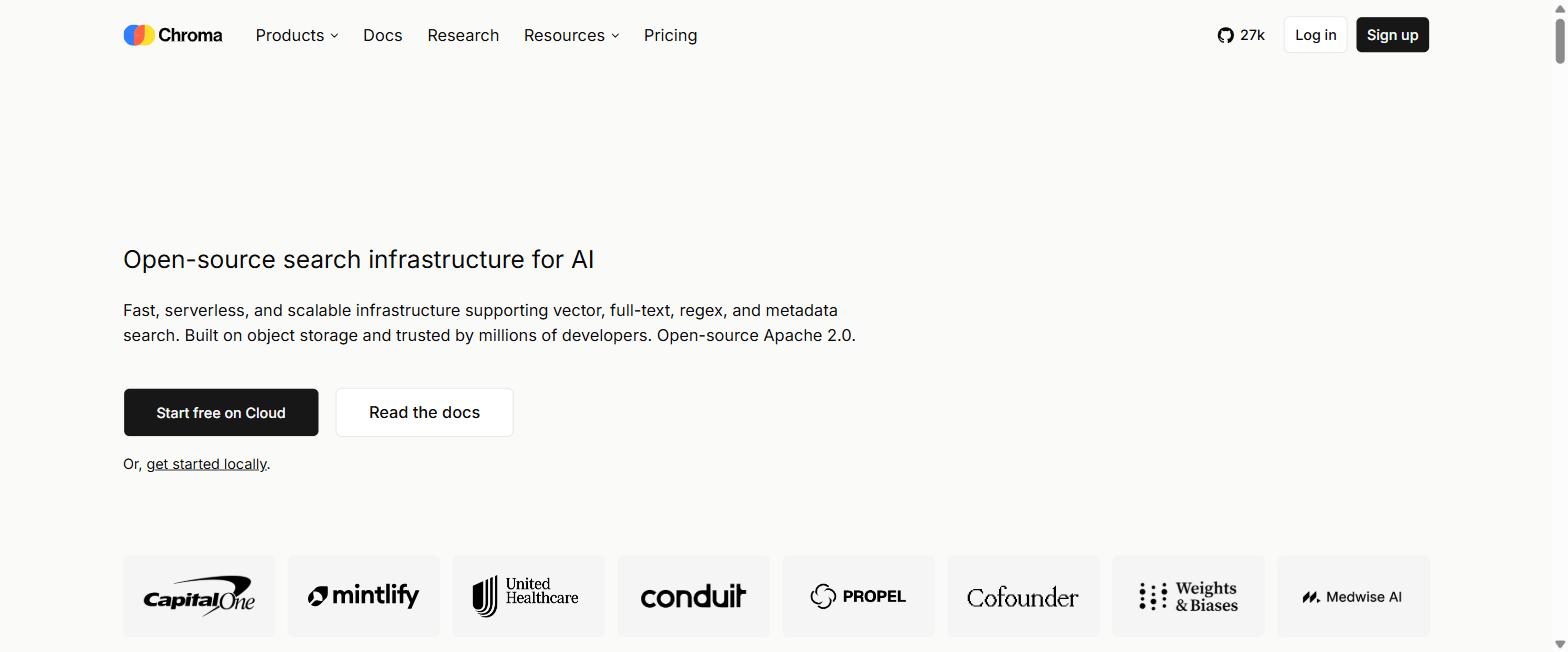
Chroma is the vector database most developers meet first. Its Python and JavaScript clients let you create a collection, add documents and query them in a handful of lines, it runs in-process for notebooks and tests, and it is wired into LangChain, LlamaIndex and nearly every RAG tutorial written since 2023. The rewrite of its core in Rust replaced the original Python storage layer with a far faster engine, and the project remains Apache 2.0 open source.
Chroma Cloud is the managed, serverless version, with usage-based pricing across writes, storage and queries, a Starter plan that begins at $0 plus usage, and a Team plan from $250 per month with single-tenant and bring-your-own-cloud options at the enterprise level. Full-text and metadata search sit alongside vector search, and the company has published useful research on context rot and chunking that shapes its product direction. Chroma is the right pick for prototypes, internal tools and developer-led products that want the shortest path from idea to working retrieval, and the cloud tier now makes the jump to production far less painful than it once was.
7. Elasticsearch — Keyword And Vector Hybrid Search At Enterprise Scale
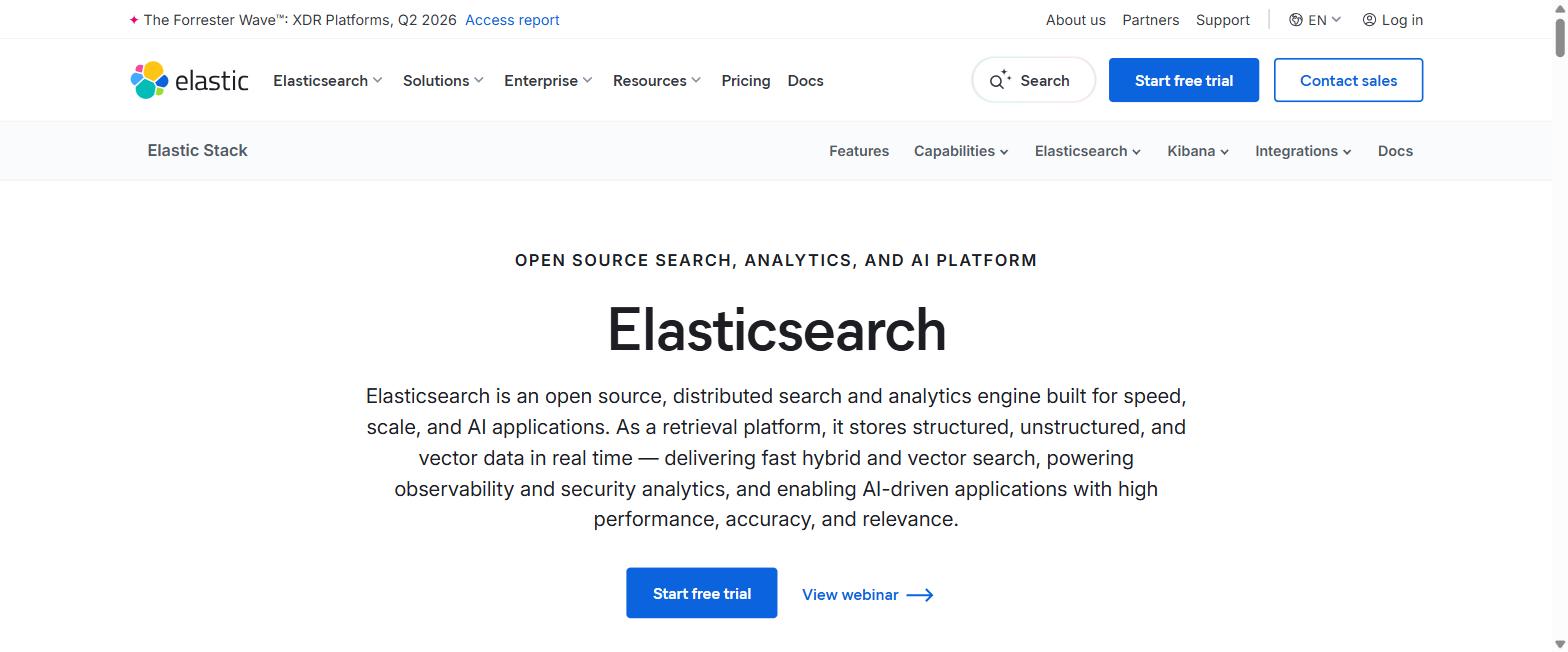
Elasticsearch already runs search for a large share of the enterprise, and its vector capabilities have caught up with the specialists. Dense vectors are indexed with HNSW, sparse vectors are supported through the ELSER model, and reciprocal rank fusion combines BM25 and vector results in a single hybrid query. Better Binary Quantization (BBQ), which compresses vectors by roughly 32x with minimal recall loss, is now the default for new dense vector fields, and the ACORN-1 algorithm made filtered vector search substantially faster in Elasticsearch 9.
The case for Elasticsearch is consolidation: if you already index logs, documents or product catalogs in it, adding embeddings avoids a second cluster, a second security model and a second sync pipeline. Elastic Cloud Serverless removes capacity planning, and the source code moved to an AGPL option in 2024 alongside the Elastic and SSPL licenses. It is heavier to operate than a purpose-built vector database and rarely wins raw ANN benchmarks, but for organizations that need keyword relevance, vectors, aggregations and observability in one place, that trade is usually worth it.
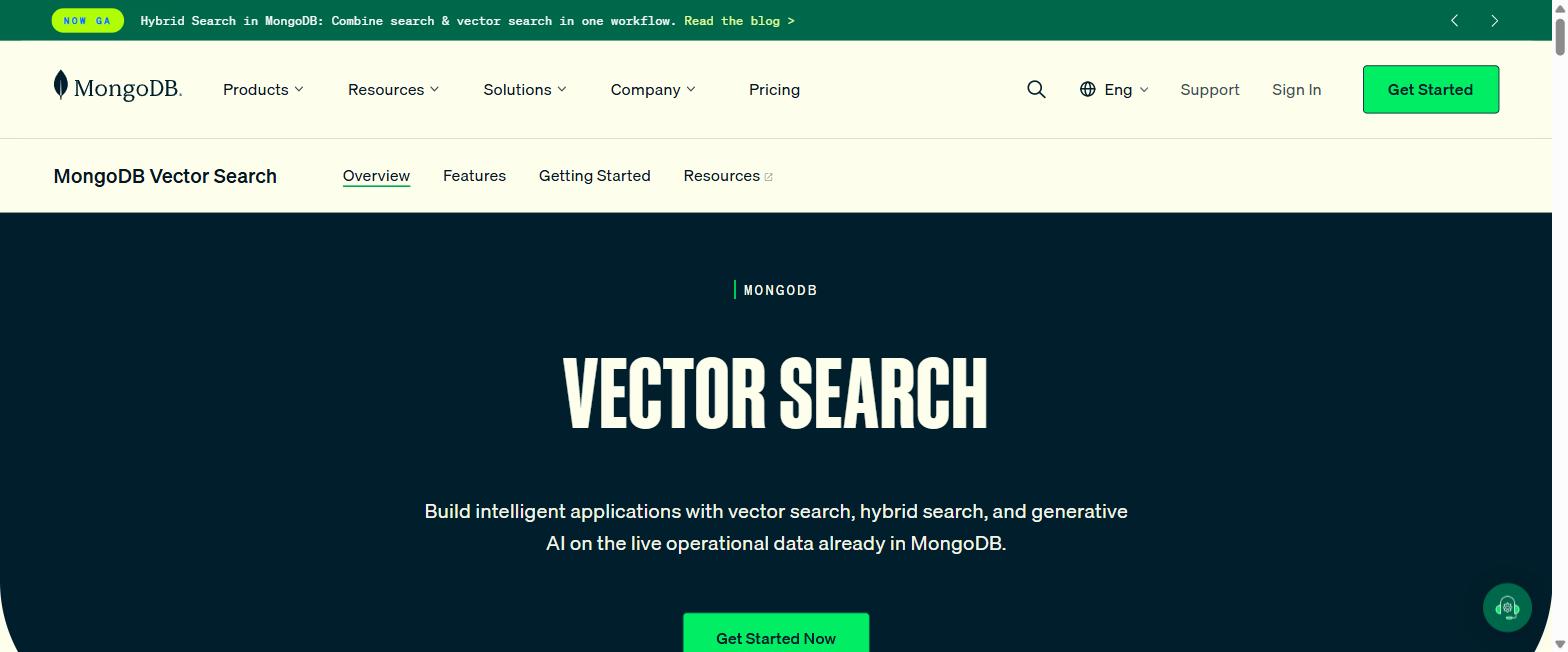
MongoDB’s answer to the vector database question is to make one unnecessary. Atlas Vector Search runs HNSW-based approximate nearest-neighbor queries over embeddings stored in ordinary Atlas collections, supports up to 4,096 dimensions, filters on any document field and combines with Atlas Search for hybrid ranking. Dedicated Search Nodes isolate query load from the operational workload, and scalar and binary quantization reduce memory for large indexes.
The 2025 acquisition of Voyage AI changed the pitch. Automated Embedding lets you point a field at a Voyage model and have Atlas generate and refresh embeddings on write, and Voyage’s rerankers slot into the same pipeline, which removes the embedding service most teams otherwise have to run themselves. Pricing follows Atlas: a free M0 tier with 512MB, Flex clusters from $0 to $30 per month and dedicated clusters from around $57 per month. For teams whose application data already lives in MongoDB, this is the lowest-friction way to add semantic search and RAG.
9. Redis — Sub-Millisecond Vector Retrieval In Memory
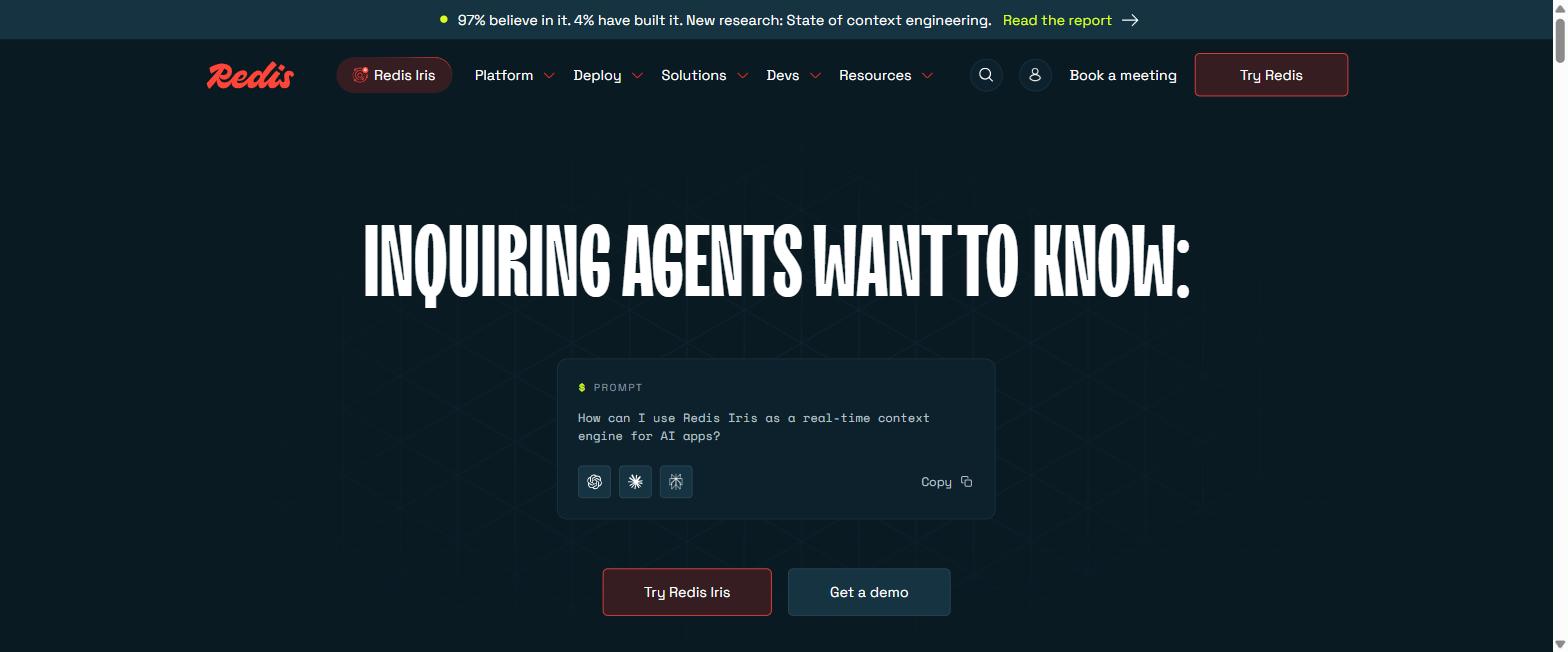
When latency is the whole product, Redis is hard to beat. The Redis Query Engine indexes vectors with HNSW or flat indexes entirely in memory and returns nearest neighbors in well under a millisecond, with full-text, numeric, geo and tag filtering in the same query. Redis 8 folded the search and JSON modules into core Redis under the AGPL license and added Vector Sets, a new native data type built by Redis creator Salvatore Sanfilippo for storing and querying embeddings with quantization built in.
Redis also ships purpose-built AI tooling: LangCache for semantic caching of LLM responses, RedisVL as a Python library for vector workflows, and the Redis Agent Memory Server for short and long-term agent state. The constraint is cost, since RAM is expensive and multi-hundred-million-vector indexes are impractical, so Redis is best used for real-time recommendation, semantic caching, session memory and fraud checks where a few million hot vectors need answers instantly, often in front of a larger database lower on this list.
10. LanceDB — The Multimodal Lakehouse On Object Storage
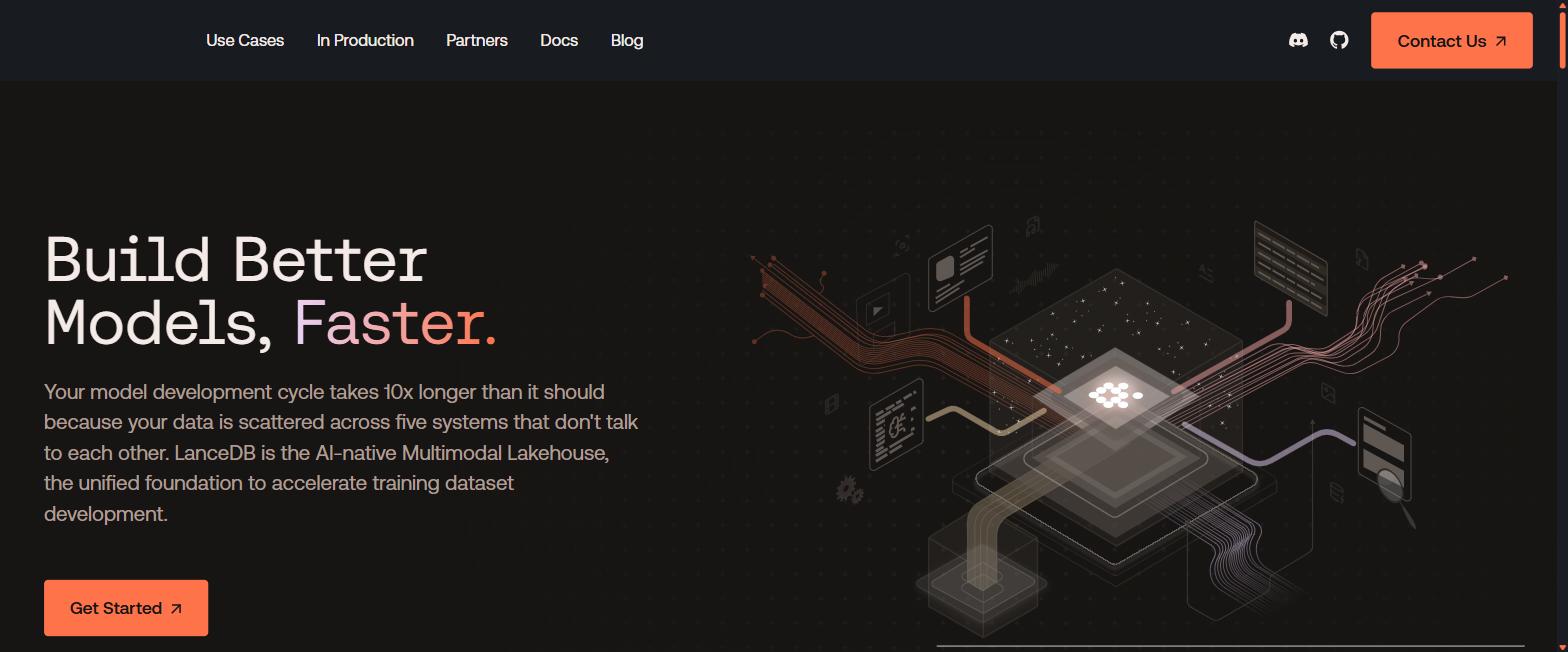
LanceDB approaches vector search from the data side. It is built on Lance, an open columnar format designed for fast random access that stores vectors, text, images, video and structured metadata together in the same table, with versioning and zero-copy schema evolution. The database itself runs embedded in your Python, TypeScript or Rust process or as a serverless cloud service, reads directly from S3, GCS or Azure Blob with no always-on server, and scales to billions of vectors because the index lives with the data rather than in RAM.
That design makes LanceDB unusually good at the workloads specialists ignore: training and evaluation pipelines that need the raw images alongside their embeddings, multimodal search across mixed media, and analytics that join vectors with everything else. It is a natural fit for the model pipelines run by machine learning development companies that manage training data and production retrieval in the same stack. Full-text search and hybrid ranking are built in, and LanceDB Cloud and Enterprise add managed compute and bring-your-own-cloud deployment. The company raised a $30 million Series A to build what it calls the multimodal lakehouse. Pick LanceDB when your vectors are one column in a much larger dataset and you would rather not copy that dataset into a second system.
11. Vespa — Ranking, Personalization And Search At Web Scale
Vespa is the oldest engine on this list and one of the most capable. It began life as Yahoo’s search and recommendation platform, was open-sourced in 2017 and spun out as Vespa.ai in 2023, and today underpins products at Perplexity, Spotify and Yahoo that serve hundreds of thousands of queries per second. Vespa combines dense and sparse vector search, BM25, structured filtering and multi-phase ranking with machine-learned models evaluated inside the content nodes, so retrieval and ranking happen in one pass with no round trips.
Its native tensor framework supports multi-vector documents and late-interaction models like ColBERT and ColPali out of the box, and the engine keeps serving during live schema and index changes, which matters for systems that cannot go down for a reindex. Vespa is Apache 2.0 licensed with a managed Vespa Cloud, and its learning curve is steeper than the developer-first tools above. It earns its place for teams building search or recommendation products where ranking quality at scale, not just nearest-neighbor lookup, is the competitive edge.
12. turbopuffer — 100 Billion Vectors On Object Storage
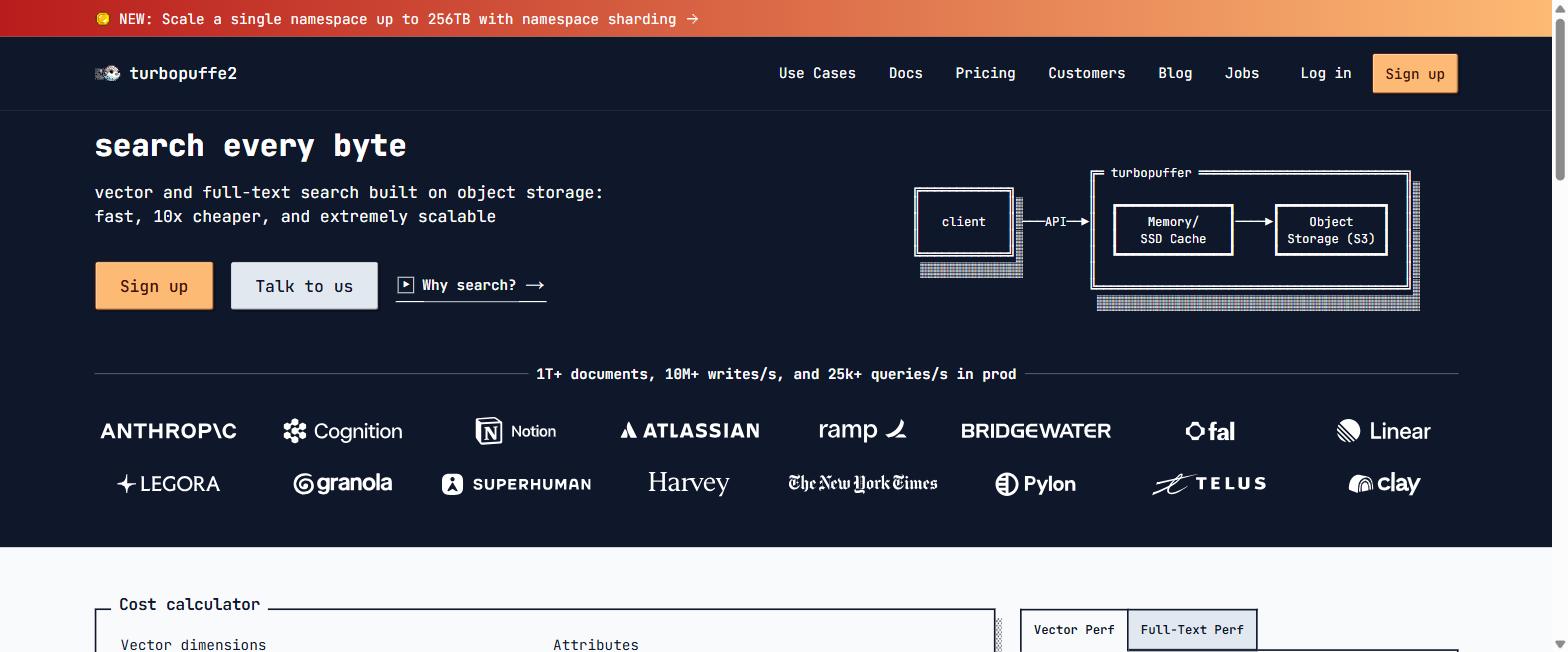
turbopuffer is the clearest expression of the object-storage-native trend. It stores every namespace in S3 or GCS with NVMe and memory used purely as cache, which drops storage cost by roughly ten times compared with replicated in-memory engines and makes millions of small tenants economical, the pattern behind AI coding tools and note-taking apps that keep one index per user. Its ANN v3 engine, published in May 2026, combines hierarchical SPFresh clustering with RaBitQ binary quantization to serve 200ms p99 queries at 1,000 QPS over 100 billion vectors in a single index, and the service as a whole reports more than a trillion documents hosted.
Vector and BM25 full-text search sit in the same API with attribute filtering, and writes are strongly consistent. turbopuffer is proprietary and fully managed with no self-hosted option, so it is not for regulated teams that need everything in their own VPC. For products that need to search enormous, highly partitioned corpora at the lowest cost per query, it has become the engine to beat.
How To Choose A Vector Database
What Is A Vector Database?
A vector database stores embeddings, the numeric arrays that an AI model produces to represent the meaning of a piece of text, an image or an event, and finds the ones closest to a query embedding using approximate nearest-neighbor search. Where a relational query matches exact values, a vector db matches semantic similarity, which is what lets a search for “cancel my plan” surface a billing document that never uses those words. Modern engines add metadata filtering, keyword search and reranking on top, so a single query can combine meaning, exact terms and business rules. That combination is what turns a pile of embeddings into working retrieval for RAG, recommendation and agent memory.
Do You Need A Separate System At All?
Start with the database you already run. If your application data is in PostgreSQL, MongoDB, Elasticsearch or Redis, each now offers vector search that handles millions of embeddings without a new service, a new sync pipeline or a new security review. Reach for a dedicated vector database when you cross tens of millions of vectors, need consistent low latency under heavy filtering, or want features such as multi-vector retrieval and quantization that the general-purpose engines implement more shallowly.
How Large Will The Index Get?
Be realistic about scale, and price the storage tier accordingly. In-memory HNSW is fast but expensive past a few tens of millions of vectors. Disk-backed and quantized indexes in Qdrant, Milvus, Weaviate and Elasticsearch stretch that by an order of magnitude. Object-storage-native systems such as turbopuffer, LanceDB and Milvus 3.0 are the economical choice at billions of vectors or across many small tenants, at the cost of somewhat higher tail latency.
Is Hybrid Search Required?
Pure vector similarity misses exact matches on product codes, names and rare terms. Most production RAG systems combine dense vectors with BM25 keyword search and rerank the fused results. Weaviate, Elasticsearch, Vespa, Milvus and Qdrant all handle this natively, and Pinecone and turbopuffer added full-text search in the past year. If your corpus is technical, legal or product data, treat hybrid search as mandatory rather than optional.
How Heavy Is Your Filtering?
Multi-tenant applications filter almost every query by customer, permission or document type. Engines that apply filters inside the graph traversal, such as Qdrant, Vespa and Elasticsearch with ACORN-1, maintain recall on narrow filters, while naive post-filtering can return far fewer results than requested. Ask vendors specifically how they handle restrictive filters and test with your real tenant distribution.
Open Source, Managed Or Both?
An open source vector database with a managed cloud, which describes Milvus, Weaviate, Qdrant, Chroma and LanceDB, gives you a way out if pricing or the vendor changes. Proprietary services such as Pinecone and turbopuffer trade that optionality for less operational work and, in some cases, better economics at scale. Check the license carefully: Apache 2.0 and BSD are permissive, while AGPL and source-available licenses on Elasticsearch and Redis carry obligations for some deployment models.
What Does The Agent Roadmap Look Like?
Vector databases are becoming agent infrastructure. Memory services like Weaviate Engram, MCP servers from Pinecone, Weaviate and Qdrant, built-in embedding and reranking from MongoDB and Pinecone, and semantic caching from Redis all reduce the glue code your team has to maintain. If agents are on your 2026 roadmap, weight these capabilities alongside raw query performance, and look at how the top AI product development studios are wiring retrieval into shipped products before you commit to an architecture.
Frequently Asked Questions
Which vector database is the best in 2026?
There is no single best option; it depends on scale, filtering needs, hosting preferences and the stack you already run. On this list, Pinecone fits zero-ops production RAG, Milvus / Zilliz Cloud fits billion-scale workloads, Weaviate fits hybrid search and agent memory, Qdrant fits heavily filtered search and pgvector suits teams already on Postgres. Shortlist two or three and test them on your own data, and if you need a team to build the pipeline, see these RAG and vector search development firms.
Which is better, ChromaDB or Pinecone?
They suit different needs. Chroma is open source under Apache 2.0, runs embedded or as the managed Chroma Cloud, and is listed here for prototypes and developer-first apps. Pinecone is a managed serverless service listed for zero-ops production RAG at scale, with an index that can grow to billions of vectors. If you are prototyping locally, Chroma is the lighter start; if you want a managed production service without running infrastructure, Pinecone is the closer fit.
Are vector databases being replaced by other search systems?
Not replaced, but the lines are blurring. General-purpose systems now ship vector search: pgvector adds it to PostgreSQL, MongoDB Atlas Vector Search sits beside operational data, Elasticsearch combines BM25 and vector results in one hybrid query and Redis serves real-time retrieval. At the same time, dedicated engines such as Pinecone and turbopuffer have added full-text search, so the choice is often between adding vectors to a system you already run or adopting a dedicated engine for scale.
Conclusion
The best vector databases in 2026 no longer compete on whether they can find nearest neighbors; they all can. They compete on cost per query at scale, on how well they filter and rank, and on how much of the surrounding AI stack they absorb. Pinecone is the safest managed default, Milvus and Qdrant lead the open source vector database field for scale and performance, Weaviate has the strongest agent story, pgvector is the pragmatic choice for Postgres shops, and turbopuffer and LanceDB show where the economics are heading. Whichever of these top vector databases you shortlist, match the engine to your data volume, filtering pattern and appetite for operations, run a benchmark on your own embeddings before you commit, and the decision becomes far easier than the crowded market suggests.
If you want to feature your Vector Database on this list, email us or submit a form in the Top Choices section. After a thorough assessment, we’ll decide whether it’s a valuable addition.