Best Digital Twin Companies And Software For Energy
Daria Pohrebniak
Marketing Director - Reverb
06.26.2026
This list covers the best digital twin companies and software for energy, utilities and renewables, for operators that want to monitor assets, predict failures and plan infrastructure.
Energy companies are under pressure from every side — aging infrastructure, rising demand, grid complexity, renewable integration, safety risks, and the need to cut costs without slowing down operations.
This is one key reason the use of digital twin in energy sector operations has become more important. A digital twin gives teams a clearer view of physical assets, systems, and field conditions before decisions are made in the real world.
This list looks at the best digital twin companies for energy sector with a focus on practical tools for planning, monitoring, simulation, asset performance, and day-to-day operations.
Energy Digital Twin Companies At A Glance
1. Company
Location
Energy focus
1. Treeview
New York City, NY, USA
Digital twins and XR apps for energy, manufacturing and smart cities
2. Neara
Sydney, New South Wales, Australia
Network digital twins for utilities
3. Cognite
Tempe, Arizona, USA
Industrial data and digital twins for energy and process industries
4. Akselos
Nyon, Vaud, Switzerland
Digital twins of critical energy assets under real operating conditions
5. FutureOn
Oslo, Norway
Design, visualization and collaboration on energy infrastructure projects
6. Enline
Mirandela, Portugal
Grid digital twins for transmission and distribution operators
7. 3E
Brussels, Belgium
Renewable asset development, monitoring and optimization
8. Raptor Maps
Somerville, Massachusetts, USA
Solar asset inspection and performance for owners and operators
9. TWAICE
Munich, Bavaria, Germany
Battery analytics for energy storage (BESS) operators
10. Terabase Energy
Berkeley, California, USA
Digital and automation tools for large solar project deployment
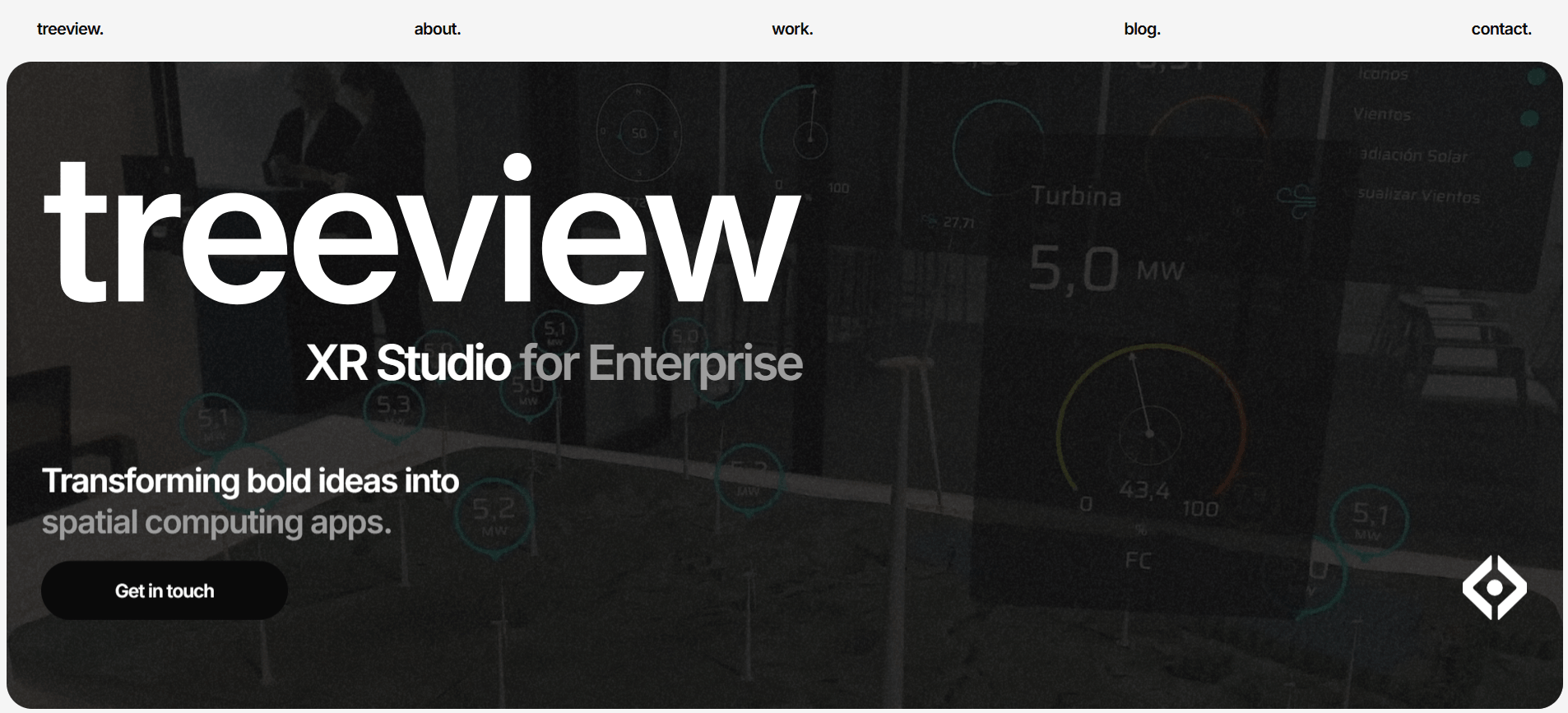
Treeview is an AR/VR studio that specializes in custom spatial computing software for enterprise teams. Since 2016, the company has delivered augmented reality and virtual reality solutions for Microsoft, Meta, Medtronic, ULTA Beauty, Daiichi Sankyo, Transfr, the University of Alberta, and NEOM across healthcare, retail, beauty, pharmaceuticals, education, energy, manufacturing, and smart cities.
As one of the best digital twin companies for energy sector, Treeview offers custom digital twin solutions for enterprise asset monitoring, predictive maintenance, and real-time simulation of physical environments and operations. Its services also cover VR development, AR applications for manufacturing and maintenance workflows, mixed reality solutions for HoloLens 2, Apple Vision Pro, and Meta Quest, smart glasses app development, 3D content creation, and long-term XR support.
Enterprises choose Treeview for end-to-end delivery under one senior team, startup speed, business agility, full IP and source code ownership, and a long-term partnership mindset.
Services and expertise: AR/VR development, mixed reality development, spatial computing, custom digital twin development, enterprise XR software, smart glasses apps, 3D content creation, immersive training, simulation, digital twin visualization, asset monitoring, predictive maintenance, real-time simulation
Location: New York City, NY, USA, and Montevideo, Uruguay
Team size: up to 50 experts
Portfolio: Microsoft, Meta, Medtronic, ULTA Beauty, Daiichi Sankyo, NEOM, University of Alberta, University of Adelaide, Government of Australia, Woolworths, Ford, Lexus, Ariana Grande, and others
Neara provides a platform built for utilities that aim at understanding how their networks behave in the real world. For teams exploring digital twin in energy sector operations, its physics-enabled model brings assets, surroundings, and workflows into one view. This gives utilities a clear picture of poles, lines, structures, clearances, vegetation, terrain, weather exposure, and failure risk.
The platform ingests the data utilities already have, including GIS, LiDAR, satellite imagery, engineering specs, inspection data, and asset records. From there, Neara generates a spatially precise digital model of the entire network and lets teams run simulations for wind, ice, flood, thermal conditions, vegetation, re-conductoring, new builds, and severe weather events.
This makes Neara especially useful for resilience planning, wildfire mitigation, vegetation analysis, asset inspection, capacity utilization, risk optimization, and distribution or transmission network design. For energy companies managing large physical networks, Neara offers a practical way to plan and operate infrastructure more effectively.
Services and expertise: digital twins, utility network modelling, network-wide simulations, asset management, vegetation analysis, clearance modelling, capacity planning, risk optimization, design and construction
Team size: 200+ experts
Location: Sydney, New South Wales, Australia
Portfolio: Southern California Edison, CenterPoint Energy, ESB Networks, Scottish Power, Hedno, Essential Energy, Endeavour Energy, Ausgrid, AusNet, Powercor, SA Power Networks, and others
Cognite helps energy, process manufacturing, and other industrial companies make better use of their operational data. The company’s main focus is to liberate siloed data and make it easier to find, understand, and use, so process engineers, field workers, maintenance teams, and other users can make the right decisions at the right time.
Its digital twin capabilities are built around Cognite Data Fusion®, an open industrial data platform that connects live operational data with historical data. The platform brings together time series, P&ID drawings, 3D models, images, PDFs, equipment manuals, work orders, sensor data, and other industrial information in one accessible interface and API. This gives teams a single source of truth, whether they are working in the field or at a desk.
Cognite’s digital twins help put operational data into context, improve workflows, support AI-assisted search, digitize routine rounds, and create a path toward more autonomous operations.
Services and expertise: digital twins, Industrial AI, Industrial DataOps, low-code industrial agents, asset performance workflows, process optimization
Team size: 500+ experts
Location: Tempe, Arizona, USA
Portfolio: Aker BP, Celanese, Cosmo Energy, Koch Ag & Energy Solutions, and others
The next name on our list of the top digital twin companies for energy sector, Akselos focuses on understanding how critical assets actually behave under real operating conditions. Built from work connected to the MIT Industrial Liaison Program and early collaboration with energy leaders such as Shell, the company helps operators manage fixed equipment and other critical infrastructure with safety, performance, and asset life in mind.
Its platform is built on physics-based AI, which uses scientific principles to understand how physical systems respond. For structural assets, Akselos applies this through AI for Structural Integrity, continuously translating operating data into structural response. This helps teams see how stress, fatigue, creep, and damage are evolving in real time.
In terms of energy, Akselos is especially relevant in offshore, refining, LNG, GTL, and other demanding asset environments. Its Structural Performance Management approach connects what happens in the control room with the structural condition of the asset, helping operators reduce risk, lower CAPEX and OPEX, increase output, and extend asset life.
Services and expertise: digital twins, physics-based simulations, predictive maintenance, asset integrity management, fatigue assessment
Team size: 50+ experts
Location: Nyon, Vaud, Switzerland
Portfolio: Shell, Pan American Energy, ABS, ESB, Pan American Energy, and others
Energy companies rely on FutureOn to help them design, visualize, and collaborate on critical infrastructure projects in a more connected way. FutureOn sets itself apart from other digital twin software companies with its focus on offshore fields, subsea projects, and wind farms.
FutureOn’s main platform, FieldTwin, gives engineering teams a unified space to work on field layouts and see designs come to life in real time. It is used for offshore fields, subsea projects, wind farms, and other energy infrastructure, bringing traditional and renewable energy data together in one digital environment. Instead of relying on isolated tools and disconnected workflows, teams can use FieldTwin to collaborate around the same visual model.
The platform can also integrate with existing systems, including GIS data platforms, using APIs to connect field layouts, bathymetry, infrastructure, licence boundaries, map services, and associated metadata.
Services and expertise: digital twins, subsea field visualization, offshore wind project visualization, 3D visual workspaces, field layout design, digital field development, open API integrations, GIS integration
Team size: up to 50 experts
Location: Oslo, Norway
Portfolio: Azule Energy, Aker BP, Wood, and others
Based in Portugal, Enline specializes in AI-powered digital twin technology for power grids. Its work is closely tied to digital twin energy management, helping transmission and distribution operators improve visibility, unlock grid capacity, and make smarter decisions across network planning, operations, and maintenance.
Enline’s platform combines digital twin technology, AI, power systems expertise, and sensorless dynamic line rating to create a virtual model synchronized with real-world grid assets. It helps utilities detect inefficiencies, bottlenecks, risks, and anomalies before they become larger problems, as well as supports network state estimation, vegetation management, demand and risk prediction, and continuous grid optimization.
Enline is a strong fit for energy companies whose main challenge is grid performance. Its technology is designed for TSOs and DSOs that need better visibility without relying only on new hardware or siloed systems.
Services and expertise: AI-powered digital twin software for power grids, transmission and distribution optimization, renewable energy operations, sensorless monitoring, predictive maintenance, vegetation management, grid capacity optimization, grid modernization
Team size: up to 50 experts
Location: Mirandela, Portugal
Portfolio: ABB, TotalEnergies On, UNACEM, CEMIG, Intertechne, Edenor, UTE, Fenix, Atlantica Sustainable Infrastructure, Hydro One, and others
3E is a renewable energy technology company that helps teams develop, monitor, and optimize renewable assets. Its digital platform, SynaptiQ, supports solar, wind, and storage projects across different project phases, from development to operations.
For teams using digital twin in energy industry workflows, SynaptiQ combines predictive analytics and physics-based modelling to compare expected and actual asset performance. The platform helps teams monitor alarms, detect underperformance, reduce false alerts, automate reporting, and make better decisions at site and portfolio level.
3E is often chosen by renewable energy companies looking to improve the performance of existing assets. Its tools cover solar analytics, wind analytics, BESS asset performance management, and asset operations, making it useful for developers, operators, asset owners, O&M managers, and data specialists working across renewable energy portfolios.
Services and expertise: digital twin technology for renewable asset performance management, renewable energy SaaS, renewable asset monitoring, solar analytics, wind analytics, BESS asset performance management, asset operations, project development support, technical advisory, reporting automation, performance optimization
Team size: 150 people
Location: Brussels, Belgium
Portfolio: RJE, CVE, Everday, Solora, Greencells, Covolt, Sunrock, Romande Energie, Voltalia, Eneco, ReNew, Neoen, Bouygues, Amarenco, Solora Energy Services, World Bank Group, Insaver Luminus, KiesZon, and others
Raptor Maps is a solar technology company built with the goal of lowering risks, costs, and losses for solar asset owners and operators. Its platform, Raptor Solar, helps teams manage solar assets with digital twins, analytics, automation, inspections, and robotics.
The company’s digital twin turns solar assets into interactive, map-based digital solar farms. It creates a historical record of each site using geospatial and time-based data, so teams can see asset information, inspection results, anomalies, equipment history, and performance data in one place. Instead of working from static PDF reports, users can view issues directly on a digital map, with anomalies localized and geotagged to precise locations.
This way, the platform helps teams prioritize issues, manage remediation workflows, automate in-field O&M tasks, analyze site and portfolio data, and improve asset uptime.
Services and expertise: solar digital twins, solar asset management software, solar inspections and analytics, aerial and non-aerial thermography, robotic automation, O&M work automation, solar analytics
Team size: 50+ experts
Location: Somerville, Massachusetts, USA
Portfolio: BayWa r.e. Operations Services, ENGIE, Enel Green Power North America, and others
TWAICE is a battery analytics company built for BESS asset managers and operations teams. As one of the digital twin technology companies focused on battery energy storage, TWAICE helps energy storage owners reduce risk, improve availability, optimize performance, and get more value from battery assets over time.
The company combines battery expertise, AI, and cloud-based analytics to give teams clearer insight into BESS health, safety, degradation, warranties, and performance. Instead of relying on guesswork, operators can use TWAICE to pinpoint issues, receive recommendations, monitor battery health, track KPIs, automate reporting, and catch safety-critical trends before they escalate.
TWAICE offers a practical way to understand what is happening inside BESS assets and make better decisions across performance, lifetime value, safety, and warranty management.
Services and expertise: battery digital twins, battery analytics software, BESS analytics, cloud-based battery monitoring, battery health diagnostics, predictive analytics, battery degradation tracking, safety risk detection, performance optimization, lifecycle value optimization
Team size: 50+ experts
Location: Munich, Bavaria, Germany
Portfolio: Green Flexibility, Tauber-Solar, Munich RE, TÜV, Audi, Mercedes-Benz, and others
Terabase Energy builds digital and automation solutions that help developers, EPCs, owners, and operators deploy large solar projects faster, with better visibility across the full project lifecycle.
Its platform offers tools for energy modelling, construction management, automated construction, SCADA, plant controls, and MET stations. Terabase Construct gives solar teams a GIS-native, AI-powered construction platform that replaces PDFs and spreadsheets with a single digital twin source of truth. It helps capture and validate field data, track progress, forecast schedules, manage quality control, automate reporting, and give stakeholders real visibility across people, processes, and performance.
Terabase is also known for Terafab®, its automated field factory for solar construction, which brings together robotics, AI, software, IoT, and construction automation to improve how large PV plants are built.
Services and expertise: solar digital twins, solar project delivery, energy modelling, construction management software, solar construction automation, engineering services, AI-powered construction management, robotics, IoT, quality control, schedule forecasting
Team size: 50+ experts
Location: Berkeley, California, USA
Portfolio: EDP Renewables, Leeward Renewable Energy, RES, and others
What Digital Twins Do In The Energy Sector
A digital twin is a live virtual model of a physical asset, system or network that is kept up to date with sensor, operational and engineering data. In energy, digital twins help operators see how assets behave, predict problems and test decisions before acting on them. Common uses include:
Predictive maintenance: spotting early signs of wear or failure in turbines, transformers, pipelines and batteries so repairs can be planned.
Grid and network planning: modeling how transmission and distribution networks respond to load, weather and new connections.
Renewable performance: comparing actual output of wind and solar assets with expected output to find underperformance.
Structural integrity: assessing the remaining life of offshore platforms, towers and other critical structures.
Project design and construction: planning new plants and infrastructure in a shared 3D model before building.
Energy storage management: tracking battery health and optimizing how storage systems are charged and dispatched.
How To Choose A Digital Twin Provider For Energy
Match the asset type: providers often specialize in grids, solar, wind, batteries or oil and gas infrastructure, so choose one with experience in your assets.
Check data integration: the twin is only as good as its data, so confirm the platform connects to your SCADA, sensors, historians and maintenance systems.
Decide between software and services: some vendors sell a ready platform, while others build custom twins and visualization apps for your needs.
Ask about scale and security: utilities and large portfolios need platforms that handle many assets and meet critical infrastructure security standards.
Look for measurable outcomes: ask for case studies showing reduced downtime, higher output or lower maintenance costs.
In the energy sector, a digital twin is a virtual replica of an asset such as a wind farm, solar plant, battery system, substation or grid network, updated with real operating data. Operators use it to monitor performance, predict failures and simulate changes before making them in the real world.
Which companies offer digital twin technology for renewable energy?
Several companies on this list focus on renewables, including 3E for renewable asset monitoring and optimization, Raptor Maps for solar asset performance, TWAICE for battery storage analytics and Terabase Energy for large solar project deployment. Broader platforms such as Cognite and Akselos also serve renewable and conventional energy companies.
How are digital twins used in wind and solar?
In wind and solar, digital twins compare expected output with real production to find underperforming equipment, plan maintenance and optimize layouts. They also support inspections, forecast energy yield and help developers design and build new projects faster.
What is the best digital twin software for battery development?
It depends on whether you need to monitor battery storage assets in operation or model battery behaviour in depth. On this list, TWAICE focuses on battery analytics for BESS asset managers, with battery digital twins, health diagnostics and degradation and safety risk detection. 3E’s SynaptiQ covers battery storage alongside solar and wind asset performance. Neither entry describes cell or pack design tools, so confirm the scope with the vendor if you are developing batteries rather than operating them.
Conclusion
A utility working on grid resilience will need a very different tool from a solar operator managing inspection data, a battery owner tracking asset health, or an offshore team planning subsea infrastructure. What we mean is that choosing the right digital twin company for energy depends on the problem you need to solve.
Start with your use case and look at the company’s industry focus, data integration options, simulation capabilities, and support model. The best choice is the one that fits your existing systems and helps turn complex asset data into decisions you can act on.
If you want to feature your Digital Twin company for energy on this list, email us or submit a form in the Top Choices section. After a thorough assessment, we’ll decide whether it’s a valuable addition.