Your first impression is no longer a handshake or a homepage. It is a page of search results, and increasingly it is an AI summary written by a system that decided on its own which sources to trust.
That is why reputation management has become a real industry rather than a service line, and why the firms in it are less alike than their marketing suggests. Some are crisis shops that pick up the phone at midnight and work reporters directly. Some are search specialists who spend six months rebuilding what Google returns. Some are effectively legal operations that negotiate removals with publishers and file under privacy law. A few do all three, and plenty claim to.
The distinction matters because hiring the wrong type wastes both money and the window in which the problem was still fixable. The ten firms below are all US-based, all work nationally, and each one is genuinely good at something specific. If you are looking to hire reputation management experts in the USA, this guide is a starting point.
Reputation Management In The USA At A Glance
Company
Base
Best For
Red Banyan
Fort Lauderdale, 10+ US offices
Active crises and litigation exposure
TheBestReputation
Williamsburg, VA
Combined SEO and PR reputation rebuilds
Reputation Pros
Miami, FL
Search suppression and AI answer cleanup
Reputation Management Consultants
Irvine, CA
Fortune 1000 and high-visibility matters
Reputation911
Mendon, MA
Long-run asset building and reverse SEO
Reputation Rhino
New York, NY
Small and midsize businesses wanting one partner
Reputation Defense Network
San Francisco, CA
Fast takedowns of libel and leaked material
SEO Image
New York, NY
Technically difficult ranking problems
Neumann Paige
Philadelphia, PA
Doctors, attorneys and financial advisors
Atlas Marketing
Sewickley, PA
Recalls, disputes and industrial crises
Best Reputation Management Companies In The USA
1. Red Banyan — A Chambers-Ranked Crisis Practice Across Ten US Offices
Evan Nierman founded Red Banyan in 2011 and has built it into one of the few genuinely national crisis firms, with offices in Fort Lauderdale, Washington DC, New York, Philadelphia, Boston, Atlanta, Denver, Los Angeles, San Diego and San Francisco. That footprint is the point. Reputation problems rarely stay in one media market, and a firm with staff and press relationships in ten cities can work a story wherever it moves.
Chambers ranks the firm for Crisis and Risk Management, describing it as a crisis management, litigation PR and reputation firm advising leaders and organizations in scrutinized or regulated environments where perception, trust and brand equity influence outcomes. That last phrase is worth reading carefully. Red Banyan is built for situations where reputation has direct commercial or legal consequences, not for brand awareness work.
Litigation PR is a core practice rather than an add-on, covering lawsuits, whistleblower matters, regulatory issues, recalls, bankruptcy communications and extortion cases. The team includes numerous former journalists and political operatives, so pitches land with people who understand how newsrooms decide. Underneath sits a philosophy called Press the Truth, a fact-based approach that rules out the spin tactics that usually make a bad week worse. Nierman wrote Crisis Averted and The Cancel Culture Curse, and that thinking runs through the work. Engagements typically start at $10,000 and often begin before anything has gone wrong, with crisis protocols defining who speaks and how information moves internally.
Services and expertise: crisis response and management, litigation and legal PR, online reputation management, strategic communications, government relations, crisis prevention and planning, media training, social media management
Location: Fort Lauderdale, FL headquarters, with offices in ten US markets
Industries: professional services, technology, healthcare, financial services, energy, hospitality, education, government and nonprofit
Clients: corporations, private equity firms, law firms, nonprofits, government entities and high-profile individuals
2. TheBestReputation — Newsroom-Grade Pitching Paired With Technical SEO
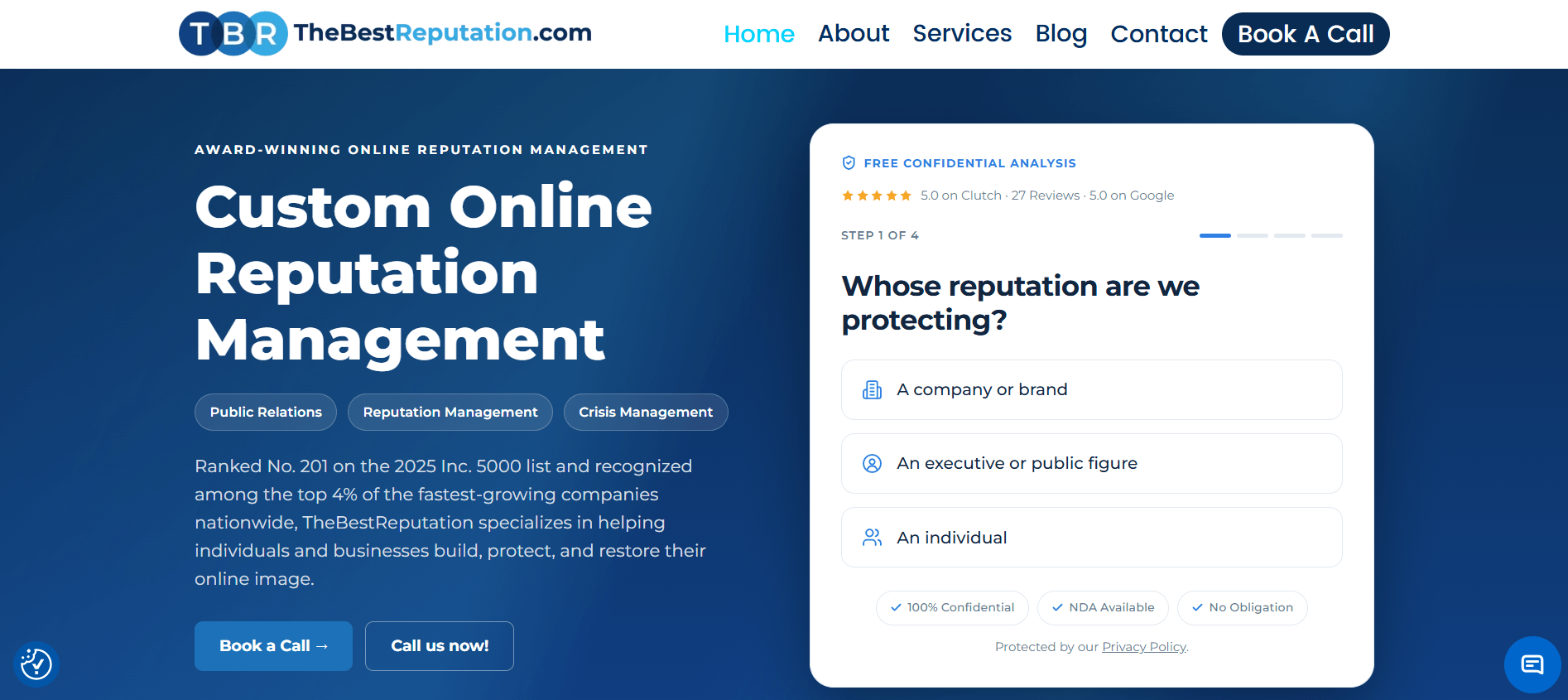
TheBestReputation ranked No. 201 on the 2025 Inc. 5000 list, placing it among the top 4% of the fastest-growing companies in the United States. The Williamsburg team is small but precise, and it competes on speed against agencies several times its size.
Engagements start with a media audit that identifies the journalists and publications most likely to run a favorable story. Once coverage lands, technical SEO work optimizes it for keyword reach so the good news appears first on brand searches. Treating PR and search as one workflow rather than two budgets is what makes the model work, because a placement nobody can find has not solved anything.
Reporting is a real differentiator. Clients get bi-weekly briefings, monthly progress reports and direct access to a dedicated account manager, which is more structure than most reputation engagements offer. Executives consistently cite clear timelines and outcomes that beat the original estimates.
Services and expertise: media relations, press releases, crisis PR, search engine optimization, reputation management, branding
Location: Williamsburg, VA
Industries: agencies, e-commerce, professional services, mid-market brands
Clients: startups, mid-market companies, executives and prominent figures requiring discreet support
3. Reputation Pros — Search Suppression Built For Google And AI Answers
Reputation Pros takes a deliberately narrow position: it treats reputation as a search and trust problem rather than a brand awareness problem. Led by founder and CEO Scott Keever, the firm has spent roughly a decade on suppression work for executives, entrepreneurs and businesses, and reports a 99% success rate across its campaigns.
The distinguishing choice is a transparency-first stance on suppression. Rather than promising removals it cannot guarantee, the firm builds stronger and more accurate digital assets that reduce the visibility of outdated or harmful results. Its process starts by working out how the damaging content gained visibility in the first place, what credible assets already exist, where the digital footprint is weak, and how search engines are interpreting the entity behind the name.
That entity framing is why the firm adapted early to AI search. Campaigns account for how ChatGPT, Gemini and Google AI Overviews summarize a client, on the reasoning that weak or inconsistent signals make the public narrative unstable regardless of what ranks. Keever’s position is that the fix is stronger digital infrastructure rather than quick cleanup. The firm also runs white-label ORM for other agencies, which is a useful signal about the underlying capability.
Services and expertise: search suppression, content removal, digital PR, personal branding, SEO, AI visibility, white-label ORM
Location: Miami, FL
Industries: professional services, healthcare, legal, finance, public figures
Clients: executives, entrepreneurs, public figures and businesses in high-trust industries
RMC has run high-level reputation campaigns since 2006, and at roughly 200 people it is one of the largest dedicated reputation firms in the country. It works with Fortune 1000 brands, government leaders, celebrities and other public figures, almost entirely under NDA.
The method pairs daily sentiment tracking with rapid-response content teams publishing on high-authority outlets, while legal partners work separately to remove defamatory material at the source. Its writers include former journalists from publications such as Fortune and The Wall Street Journal, which matters because suppression only works if the replacement content is good enough for people and search engines to take seriously.
Two things set RMC apart on a national shortlist. It publishes transparent roadmaps and backs them with a six-month performance guarantee that most competitors will not match. And its confidentiality practice is strict enough that leaders under active attack are willing to share genuinely sensitive detail. Engagements start around $5,000 per month, reflecting white-glove service and 24/7 monitoring.
Services and expertise: reputation repair, brand PR, crisis communications, SEO, digital strategy, sentiment monitoring
Reputation911 coined the term reverse SEO and has been practising it from Massachusetts since 2010. Every campaign focuses on building positive assets, including blogs, interviews and social profiles, that crowd out harmful links and hold their position over time.
The working model is unusually collaborative for this category. A dedicated account manager meets clients weekly to review rank reports and develop new content angles, which turns abstract SEO tasks into concrete action items a client can actually follow. For anyone who has sat through six months of an agency reporting activity rather than progress, that cadence is the selling point.
Client work spans high-profile celebrities, Fortune 500 firms, professional athletes and small businesses, all under strict confidentiality. When working with individuals, the team starts by analyzing the current online image, then removes inaccurate or negative mentions where possible, creates favorable content to push unwanted results off page one, and builds out professional listings, personal sites and social profiles. Pricing sits at the fair end of the market.
Services and expertise: reverse SEO, content creation, PR, personal branding, consulting, review management
Location: Mendon, MA
Industries: entertainment, healthcare, legal, small business, professionals, athletes
Clients: celebrities, Fortune 500 firms, professional athletes and small businesses under confidentiality
6. Reputation Rhino — Every Discipline Under One Roof For Small And Midsize Business
New York-based Reputation Rhino offers brand protection across SEO, content creation, social media and paid advertising, and the value is in the consolidation. Smaller companies rarely want to coordinate four vendors during a reputation problem, and this firm gives them a single point of contact.
Campaigns begin with deep keyword research and competitor gap analysis to establish what is actually ranking and why. The team then produces positive press, builds branded microsites, and runs paid campaigns that capture new leads while outranking old negatives. When defamation is involved, legal partners move to have it removed or corrected. That last point matters because a lot of small-business reputation damage is legally actionable and nobody tells the owner.
Clients single out the personal involvement of founder Todd William, which is the boutique advantage in practice rather than in a pitch deck. Real estate groups, retailers and physicians frequently report traffic gains that persist well after the engagement ends, which suggests the work is building durable assets rather than renting rankings.
Services and expertise: online reputation management, SEO, web design, social media, PPC, content creation
Location: New York, NY
Industries: real estate, retail, healthcare, small and midsize business, individuals
Clients: business owners, doctors, attorneys and high-profile brands, kept confidential
San Francisco-based RDN specializes in fast, surgical removals for organizations under active attack. The boutique team often moves within hours to remove or suppress libel, fake reviews or leaked documents before they spread, which is a different operating tempo from the rest of this list.
The structural advantage is in-house counsel. When legal action is required, RDN’s lawyers draft and file demands while the PR staff manage media fallout on a parallel track. Most firms have to introduce an outside law firm at that point and hope the two coordinate under time pressure. Keeping both functions in-house also keeps costs predictable, which is rarely true once outside counsel is involved.
Beyond removal, the strategists build fresh assets including news articles, interviews and knowledge panel content that push accurate narratives onto page one. Healthcare groups, SaaS founders and financial firms consistently mention the team’s focus on rapid wins followed by lasting control.
Industries: healthcare, SaaS, finance, automotive, professional services
Clients: healthcare practices, technology and automotive companies, and C-suite leaders
8. SEO Image — An SEO Shop First, Which Is Why The Rankings Move
SEO Image started in New York as a pure-play search agency, and that origin explains the difference. Reputation work here begins with diagnosis: deep keyword research to establish exactly why the damaging material ranks, followed by reverse-engineered fixes that pull owned assets above it. Firms that came to search from PR tend to skip that first step.
Reporting is unusually concrete. Monthly dashboards spell out organic lifts, new backlinks and the paid search spend saved through improved Quality Scores, which is a genuinely uncommon way to frame reputation ROI. The team often pairs reputation work with conversion rate optimization, so a cleaner search page produces revenue rather than just relief.
Client work includes Popular Bank, Canon and the legal publisher Law.com, alongside law firms, car dealerships and e-commerce brands. Clients repeatedly mention a teaching style that strips out jargon, and the combination of rising organic clicks and falling ad budgets is a rare double result in this category.
Services and expertise: SEO, online reputation management, PPC, PR, branding, conversion rate optimization
9. Neumann Paige — Built For Doctors, Attorneys And Financial Advisors
Neumann Paige works almost exclusively in regulated professions where a single damaging link can end a career. Medicine, law and financial services all share a specific problem: the client base runs due diligence on individual practitioners, and one review site or old news item near the top of a name search does disproportionate damage.
The approach is SEO-first. Projects open with detailed competitor and SERP analysis to establish which pages Google actually rewards for that name and specialty, then build clusters of authoritative content, bios and Q&A pieces that outrank the negatives and stay ranked. Precision keeps the cost down, which matters for individual practitioners paying out of pocket rather than from a corporate communications budget.
The compliance dimension is where the specialization earns its place. Content for a physician or a financial advisor has to satisfy professional advertising rules before it satisfies a search engine, and firms without that background produce work that cannot be published. Clients highlight ethical strategies that align with industry requirements alongside enterprise-level reporting from a boutique team.
Services and expertise: SEO-driven reputation management, branding, content creation, review repair, personal brand building
Location: Philadelphia, PA
Industries: medical, legal, financial services
Clients: doctors, attorneys and financial advisors who value privacy
10. Atlas Marketing — Crisis Playbooks For Companies That Build Things
Atlas Marketing handles the crises most companies prefer not to plan for: product recalls, legal disputes and viral social missteps. From its base outside Pittsburgh, the firm writes crisis playbooks and media response protocols in advance, which is the part of this work that actually determines how the bad week goes.
When something breaks, Atlas activates a cross-functional team. Strategists draft statements, designers update web assets and social managers frame the story before rumors set. Once the immediate threat passes, the team rebuilds through community outreach and targeted storytelling rather than declaring victory and leaving.
The client base is distinctive and genuinely underserved: construction, manufacturing, aerospace, biotech and food manufacturing, or as the firm puts it, companies that build things. Industrial reputation problems involve regulators, safety authorities, unions and local communities rather than only consumers, and most reputation firms have never worked one. The nimble structure means senior people stay involved from start to finish.
Services and expertise: crisis communications, PR strategy, crisis planning and protocols, social media, web design, community outreach
Clients: industrial and manufacturing companies, kept confidential
Reputation Management Companies By State
Most reputation work is done remotely, but some buyers prefer a firm in their own state for in-person crisis meetings, local media contacts or familiarity with state courts and regulators. The firms on this list are headquartered across several states:
Florida: Red Banyan (Fort Lauderdale) and Reputation Pros (Miami)
California: Reputation Management Consultants (Irvine) and Reputation Defense Network (San Francisco)
New York: Reputation Rhino and SEO Image (both New York, NY)
Pennsylvania: Neumann Paige (Philadelphia) and Atlas Marketing (Sewickley)
Virginia and Massachusetts: TheBestReputation (Williamsburg) and Reputation911 (Mendon)
Do you need crisis response or long-term suppression?
These are two different businesses sharing a label, and the mismatch is the single most common hiring mistake in this category. A crisis firm mobilizes in hours, works the phones with reporters and measures success in how the next story reads. A suppression firm works in quarters, publishes and builds authority, and measures success in what ranks six months out. Hiring a crisis shop for a stubborn page-two problem wastes money, and hiring an SEO specialist when a reporter is calling tomorrow wastes something worse. Work out which clock you are on before you take meetings.
Is the firm promising removal or suppression, and does it know the difference?
Removal means the content is gone, usually through publisher negotiation, a DMCA filing or a privacy law action. Suppression means the content still exists but no longer appears where anyone looks. Removal is better when it is achievable and impossible when it is not, and the honest firms say so upfront. Treat unqualified removal guarantees with suspicion, and ask any firm to tell you specifically which items in your situation it believes are removable and which it would only suppress. A firm that answers that question precisely is worth more than one that answers it enthusiastically.
How does the firm handle AI answers?
A growing share of first impressions now comes from an AI summary rather than a list of blue links, and the two do not always agree. AI systems weight entity consistency, structured citations and the authority of sources they already trust, which means a page that ranks fifth on Google can still be the one an assistant repeats. Ask any firm you shortlist how it currently tracks what ChatGPT, Gemini and Google AI Overviews say about you, and what specifically it would do to change that. Firms without a real answer are still selling a 2019 product.
What does the guarantee actually cover?
Several firms in this category offer performance guarantees, and they vary enormously. Some cover specific named URLs, some cover an aggregate improvement in what appears on page one, and some quietly exclude the hardest items in your case. Get the guarantee in writing, get the specific URLs listed, and get the remedy defined. A six-month guarantee with clear terms is worth considerably more than a lifetime promise with none.
What does reporting look like, and how often?
Reputation work is slow and largely invisible while it is happening, which makes reporting cadence the main thing standing between you and six months of uncertainty. Look for a defined rhythm, a named account contact and before-and-after search snapshots rather than activity summaries. If a firm will not commit to a reporting schedule during the sales process, it will not improvise one later.
How US Reputation Management Companies Charge
Reputation management firms in the US rarely publish fixed prices, because the work depends on how much negative content exists and how hard it is to move. Most use one of these pricing models:
Monthly retainers: the most common model for suppression, review management and ongoing monitoring. Campaigns usually run for several months before results settle.
Per-item or pay-for-results pricing: often used for content removal, where the firm charges for each article, review or search result it gets taken down.
Project fees: used for defined work such as a reputation audit, a personal branding build or a crisis response engagement.
Software subscriptions: some firms sell review and monitoring tools on a subscription, sometimes alongside managed services.
The main cost drivers are the number and authority of the negative results, how competitive the search results for your name or brand are, whether legal or crisis PR work is needed, and whether you are an individual or a large company. Ask each firm for a written scope, a timeline and a clear definition of what counts as a result before you sign. For more options, see our lists of the top online reputation management companies, reputation management companies in New York and reputation management companies in California.
How much does reputation management cost in the US?
There is no standard price. Cost depends on the amount of negative content, the authority of the sites it appears on, the competitiveness of the search results and whether legal or crisis work is involved. Most firms charge a monthly retainer for suppression and monitoring, and per-item fees for removals, so request a written quote after an audit.
What do reputation management firms do?
Reputation management firms monitor what appears about a person or company online and work to improve it. Typical services include suppressing negative search results with positive content, removing content that breaks platform or legal rules, managing reviews, building personal or executive brands, and responding to crises. Many now also track how brands appear in AI answers.
Can reputation management remove negative reviews?
Sometimes. Reviews that break a platform’s rules, such as fake, spam, off-topic or defamatory reviews, can often be reported and removed. Genuine reviews from real customers usually cannot be removed, so firms focus on responding professionally and generating more positive reviews to improve the overall rating.
The right partner depends less on national rankings than on the shape of your problem. If something is on fire right now, look for a firm built for that crisis tempo. If page one has drifted and needs rebuilding, look for specialists in search reconstruction and ranking recovery. If you are a large organization facing a high-visibility matter, look for a practice that already has the scale and the confidentiality discipline. And if your situation is specific to a profession or an industry, look for a team that has already done that kind of work before.
Before signing anything, get clear on the timeline, the removal-versus-suppression question, and the reporting. Those three answers tell you more about how an engagement will go than any list can.
If you want to feature your reputation management company on this list, email us or submit a form in the Top Choices section. After a thorough assessment, we’ll decide whether it’s a valuable addition.