
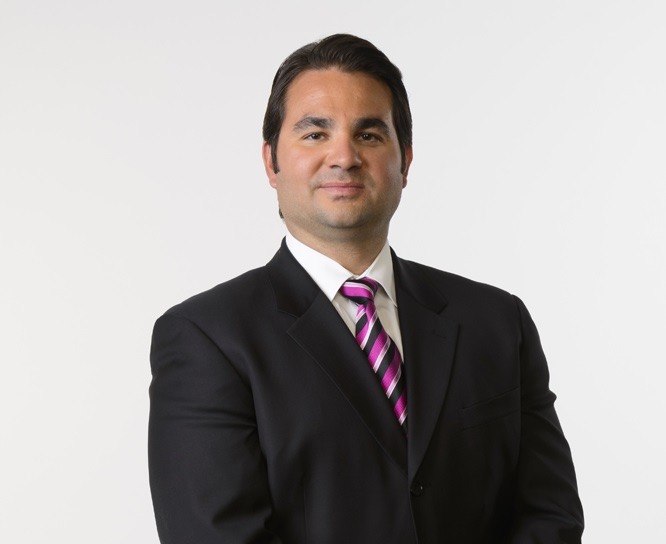
Robert Guarino
Physician Specializing In Pathology
How would you describe your work and your role in breast pathology?
I am a physician specializing in pathology, with advanced training in surgical and breast pathology. My role is to examine tissue and help determine what disease processes are present. In breast care, pathology is one part of a larger clinical picture that can also include imaging, surgery, medical oncology, radiation oncology, genetics, and nursing.
Much of my work happens behind the scenes. Patients may never meet the pathologist involved in their care, but the information we provide can help other physicians make important clinical decisions. I have always viewed my responsibility as using the expertise I have developed through years of training and practice to serve patients and the broader community.
How is your work structured, and how do you collaborate with other specialists?
Pathology is not an isolated service. Although I interpret the tissue in front of me, breast care is multidisciplinary. I have worked with breast surgeons, breast imaging specialists, medical and radiation oncologists, nurse navigators, and genetic counselors.
Each specialist has a different piece of the picture. My responsibility is to provide the clearest and most accurate pathology information I can. When a case is unusual, or the findings don’t fit neatly together, collaboration becomes especially important.
What distinguishes your approach to breast pathology?
I value both knowledge and judgment. A pathologist needs a “very strong knowledge base,” but experience has taught me that knowing a great deal doesn’t make every case simple.
Years of practice help you recognize patterns more efficiently. The challenge is making sure familiarity does not turn into assumption. Sometimes the most important thing you can recognize is that a case deserves another look.
Who does your work ultimately serve?
The patient is ultimately at the center of the work. Pathologists also serve the physicians and clinical teams who rely on pathology findings as they evaluate a patient’s condition and decide what happens next.
That has shaped how I define success. For me, success means “good positive patient outcomes directly related to my service.” I am interested in whether the knowledge and judgment I bring to a case are useful to the people making decisions about patient care.
What aspects of breast pathology require the most specialized attention?
Breast disease can range from relatively straightforward findings to uncommon and difficult cases. My scholarly work has included unusual examples, such as an acantholytic variant of metaplastic squamous cell carcinoma of the breast and metastatic breast carcinoma identified within an endometrial polyp.
Those cases reinforce an important constraint in pathology. Not everything behaves exactly as expected. Pattern recognition is valuable, but it must be combined with careful evaluation and an understanding of possible alternatives.
How do you stay current when medical knowledge changes so quickly?
I make continued study part of my routine. I read breast pathology literature, including journals and new editions of textbooks. I also attend continuing medical education programs each year.
I do this because completing formal training does not mean you are finished learning. Research changes. Diagnostic approaches evolve. New information can change how physicians understand a finding they may have encountered before. My fellowship training gave me a strong foundation, but maintaining that knowledge requires ongoing work.
How do you know whether you are providing a high standard of work?
Pathology does not translate neatly into a customer satisfaction score. The standards are clinical. I focus on careful evaluation, staying current, communicating useful findings, and contributing effectively to the broader care team.
I also believe professional standards matter. I completed training in anatomic and clinical pathology, along with advanced fellowships in surgical and breast pathology. Maintaining expertise after that training is an ongoing responsibility.
What happens after you complete your part of a case?
A pathology report becomes part of a larger medical process. Depending on the situation, the findings may be considered alongside imaging, surgical findings, clinical history, or other testing.
My responsibility is not to replace the judgment of the other specialists involved. It is to provide pathology information that they can use. When necessary, additional review or discussion can help clarify how different findings fit together.
How do you approach cases where the initial answer is uncertain?
I do not think uncertainty should automatically be viewed as weakness. In some cases, the responsible response is to slow down and examine why something does not fit.
The important question is whether additional work is likely to add meaningful information. You cannot investigate every possibility indefinitely. At the same time, you should not allow efficiency to become complacency. Experience helps you make that distinction.
How has teaching influenced the way you practice medicine?
Teaching forces me to explain things that experience can make automatic. I have taught pathology to medical students and worked with resident physicians. My academic experience has included serving as a Clinical Assistant Professor in pathology.
A student asking “why?” can be useful. It forces you to explain the reasoning behind a conclusion rather than relying only on recognition or experience.
Who influenced your development as a pathologist?
Two important mentors were Dr. Jonathan Lara and Dr. Ira Bleiweiss. Both helped influence how I developed in breast pathology.
Medicine has a strong apprenticeship component. Textbooks can teach principles, but experienced physicians can teach you how those principles are applied when a real case is complicated. Later in my career, teaching students and residents gave me an opportunity to participate in that same process from the other side.
What have been some of the biggest challenges during your career?
One ongoing challenge is keeping pace with a field that never stands still. There is always more literature to read and more to understand.
Another challenge is balancing efficiency with thoroughness. Physicians have responsibilities and time constraints, but pathology also requires attention to detail. I have learned that experience is valuable partly because it helps you determine where additional attention is warranted.
How do you approach innovation in pathology?
I am interested in developments that improve the information physicians can obtain and use. At the same time, I think new technology should support judgment rather than discourage it.
More information is not automatically better if it cannot be interpreted in context. I try to understand new developments, evaluate the evidence behind them, and consider where they genuinely add value.
What role does professional culture play in medicine?
Culture matters because medicine is collaborative. A strong clinical environment should let specialists ask questions, share information, and acknowledge when another perspective is needed.
I also think mentorship is part of that culture. I benefited from physicians who shared their knowledge with me, and teaching has allowed me to do the same for people earlier in their careers.
Where do you see your work developing over the next five to ten years?
I expect breast pathology to continue changing as research and diagnostic technology advance. I cannot predict exactly which developments will have the greatest effect, but I expect the amount and complexity of information available to physicians to continue growing.
My goal is simpler. I want to keep applying my experience in a useful way, stay current in the field, and contribute to patient care, education, and the development of other physicians.
Which emerging developments in medicine interest you most?
I am interested in advances that help specialists better understand disease and make more informed interpretations. However, I am equally interested in how physicians use those tools.
Technology can identify patterns and provide new information, but physicians still need to decide what that information means in context. I think the relationship between better technology and sound medical judgment will remain important.
How has your approach to leadership changed throughout your career?
Earlier in a medical career, much of the focus is on acquiring knowledge and becoming technically capable. Over time, I have come to see leadership more broadly.
It includes being dependable, knowing the limits of your expertise, collaborating with other specialists, and helping younger physicians develop their own judgment. I do not think leadership requires being the loudest person in the room. Often, it means being prepared when your expertise is needed.
What lesson from your career would you share with physicians early in their training?
I would tell them not to confuse completing their training with completing their education.
Medicine rewards preparation, but it also shows you what you do not know. I still read pathology journals and textbooks because the field keeps changing and unusual cases keep challenging assumptions.
The longer I have worked in medicine, the more I have appreciated that expertise is not simply knowing more. It is knowing how to use what you know, recognizing when you need more information, and remaining willing to learn.