Shift4Shop alternatives compared for 2026: real plan prices, gateway fees, transaction penalties and which platforms publish a documented migration path.
Start with the part most roundups get wrong. Shift4Shop is not shutting down. Shift4 has announced no wind-down, no sunset and no forced migration. It still sells four plans, still onboards new merchants, and still ships features in the base product that rivals charge extra for. So if you are reading about Shift4Shop alternatives, you are asking a fit question, not running a rescue operation. That means you can take your time, price the move properly, and walk away if the numbers do not work.
The genuine reasons merchants shop around are narrower than “the platform is dying.” The free End-to-End plan is open to United States merchants only, and visitors from other countries are told the platform is not yet available in their region. That plan carries a condition: you process through Shift4 Payments at 2.9% plus $0.30. Keeping your own gateway instead costs $229 per month, per Shift4Shop’s own payments page. Add app ecosystem depth, where Shift4Shop cannot match the biggest SaaS platforms, and you have the honest reasons to look.
Everything below was checked on each vendor’s own site on 14 September 2026. Where a provider publishes a price, it is quoted. Where it does not, or where a figure could not be verified, that is said plainly rather than guessed.
Shift4Shop Alternatives At A Glance
Read the gateway fee column first. It is what you pay for using a payment processor the platform does not own, the largest structural difference between these products.
Platform
Entry Price, September 2026
Fee For Using Your Own Gateway
Hosting Model
Shift4Shop Migration Tool Published
Shopify
$39/mo monthly, $29/mo annual
2% Basic, down to 0.2% Plus
SaaS
Yes, via Cart2Cart and LitExtension
BigCommerce
$39/mo monthly, $29/mo annual
2.0% Core, down to 0.6% Scale, non-embedded providers
SaaS
Yes, via Cart2Cart
WooCommerce
Plugin free, hosting from $25/mo
None
Self-hosted on WordPress
Yes, via Cart2Cart and Next-Cart
Ecwid by Lightspeed
$5/mo Starter
None on any tier
SaaS, embedded in your site
Yes, via LitExtension
Adobe Commerce and Magento Open Source
Open Source free, Adobe Commerce price not published
None
Self-hosted, PaaS or SaaS
Yes, via Cart2Cart and LitExtension
Wix eCommerce
Light $17.77/mo, yearly prepaid
Commission not published
SaaS
Yes, via Cart2Cart, LitExtension and Next-Cart
Squarespace Commerce
Plan prices not exposed in readable form
2% on Basic, 0% on higher tiers
SaaS
Yes, via Next-Cart
PrestaShop
Classic free, Hosted from EUR 24/mo excluding VAT
None documented
Self-hosted or first party hosted
Yes, via Cart2Cart and Next-Cart
Square Online
Free $0/mo
Own gateway not permitted
SaaS
Yes, via Next-Cart
nopCommerce
Free, copyright removal key $500 one time
None
Self-hosted .NET
No Shift4Shop specific service published
Shopware
Community Edition free, Rise from EUR 600/mo excluding VAT
None
Self-hosted or cloud
Yes, via Cart2Cart
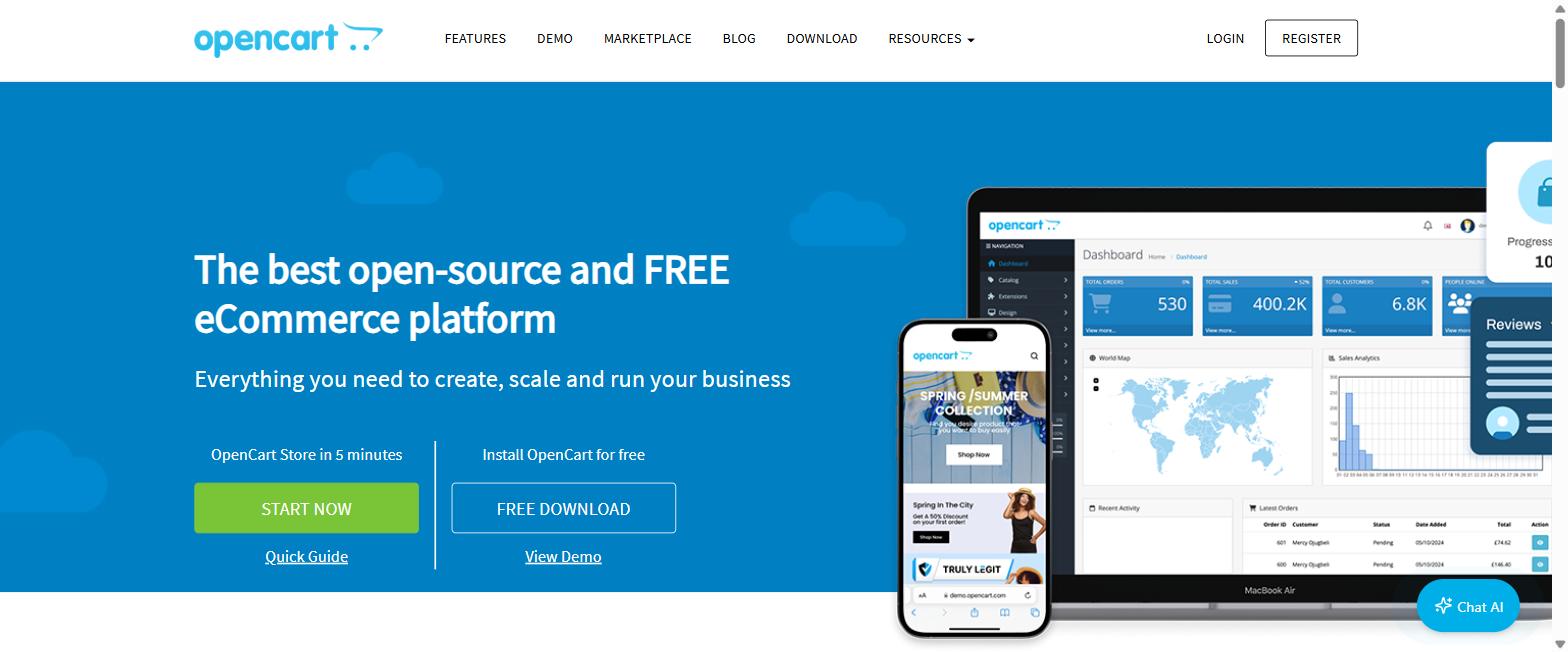
OpenCart
Free under GPLv3
None
Self-hosted PHP
Yes, via Next-Cart
Best Shift4Shop Alternatives In 2026
1. Shopify — The Default Destination, And The Only One With A Named Migration Partner Bench
Shopify is where most Shift4Shop merchants look first, and its pricing is unambiguous. As of September 2026 Basic runs $39 per month billed monthly or $29 annual, Grow is $105 or $79, Advanced is $399 or $299, and Plus starts at $2,300 per month on a three year term. Card processing falls as you climb, from 2.9% plus 30 cents on Basic to 2.7% on Grow and 2.5% on Advanced.
The catch for anyone leaving over payment freedom is structural: Shopify Payments is not mandatory, but running a different gateway costs 2% of every order on Basic, 1% on Grow, 0.6% on Advanced and 0.2% on Plus. Shift4Shop applies no per-transaction penalty of that kind on any tier. Shopify Payments covers 40 countries and regions, which matters if Shift4Shop’s United States restriction sent you looking. Our Shift4Shop vs Shopify breakdown takes it line by line.
What the fee buys is reach: more than 16,000 apps, more than 800 themes, and 1% of sales returned as store credit, capped between $5,000 on Basic and $15,000 on Plus.
Shopify’s help center documents no Shift4Shop or 3dcart path. Cart2Cart and LitExtension both publish one, and the route is covered in our Shift4Shop to Shopify migration guide.
2. BigCommerce — Deep Native B2B, With A New Fee On Non-Embedded Gateways
BigCommerce matches Shopify at the entry point: Core at $39 per month monthly or $29 annual, Growth at $105 or $79, Scale at $399 or $299, and Performance from $1,499 billed annually. Plans are gated to annual sales bands: Core to $30,000, Growth to $100,000 and Scale to roughly $1 million in trailing twelve month revenue, so growth pushes you up the ladder regardless of features.
The important 2026 correction: BigCommerce no longer offers a blanket zero fee position. Open payment provider fees now apply at 2.0% of eligible GMV on Core, 1.0% on Growth and 0.6% on Scale, capped at $33,333 per month with a 0.9% overage above that, while Performance sits at zero on contracted terms. Embedded providers including Stripe, PayPal, Adyen and Klarna remain fee free. Any comparison still claiming BigCommerce charges nothing for third-party processing is out of date.
What distinguishes the platform is native business-to-business depth: price lists, customer groups, quoting and purchase order handling built in rather than bought as apps, which will feel familiar. Cart2Cart publishes both Shift4Shop and 3dcart migrations, Optimum7 is a named agency doing that work, and our list of BigCommerce development companies is a starting point for build help.
3. WooCommerce — No Platform Fee On Any Gateway, At The Cost Of Running Your Own Stack
WooCommerce is the cleanest answer to the complaint that sends most merchants away from Shift4Shop. The core plugin is free, there is no platform fee and no revenue share, products and orders are unlimited, and the vendor states merchants can use any payment gateway or buy-now-pay-later provider without penalty.
The cost moves elsewhere, and the vendor is candid about it, putting realistic hosting at $25 to $350 per month for most stores and extensions at $29 to $299 per year each. WooPayments, the first party option, runs roughly 2.5% to 2.9% plus 30 cents, but it is one choice among many rather than a condition of using the platform.
The trade is control for responsibility. You own hosting, updates, security patching and tuning, fine with a developer on hand and painful without one. In exchange you get WordPress underneath, the strongest content and search story here.
Cart2Cart and Next-Cart both publish Shift4Shop to WooCommerce migrations, and Next-Cart ships an official migration plugin through the WordPress.org repository, which makes this one of the better supported routes off the platform.
4. Ecwid by Lightspeed — Zero Transaction Fees On Every Tier, Bolted Onto The Site You Already Have
Ecwid solves a different problem. Rather than replacing your website, it embeds a store into the site you already run, which makes it a low-risk move for a Shift4Shop merchant whose content pages are working fine and whose real complaint is the cart and the checkout.
Pricing published in September 2026 starts at $5 per month for Starter, Venture at $35 monthly or $29 annual, Business at $65 or $49, and Unlimited at $149 or $119. The long-standing free tier is gone, so Starter is now the entry point. In exchange, Ecwid applies $0 in transaction fees on every tier, the same posture Shift4Shop takes and a real contrast with Shopify and BigCommerce.
The platform supports more than 70 payment providers, so processor choice is genuinely open. Lightspeed Payments and Lightspeed Retail point of sale integrate natively, which matters if you run physical locations alongside the store.
LitExtension publishes a Shift4Shop to Ecwid migration. The honest limitation is depth: it fits a modest catalog sold across a website and a few marketplaces, not heavy merchandising logic, complex tax handling or deep wholesale workflows.
This entry is two products under one roof. Magento Open Source remains free to download and run, with no platform transaction fee, putting it in the same category as WooCommerce and PrestaShop: you pay for hosting and development, not for the right to sell. Adobe Commerce is the commercial tier above it, and there the pricing conversation stops.
Adobe publishes no dollar figure for Adobe Commerce anywhere on its site. Three tiers are named, Adobe Commerce as a Cloud Service (SaaS), Adobe Commerce on Cloud (PaaS) and Adobe Commerce Optimizer, all behind a “Get pricing” form. Any comparison quoting you an annual figure is repeating hearsay. Budget for a sales conversation.
What you get for the complexity is enterprise capability: multi-store management, native business-to-business features including company accounts, requisition lists and negotiable quotes, and a catalog architecture that handles very large product counts.
Cart2Cart and LitExtension both publish Shift4Shop to Magento migrations. The caveat is that this is not a small merchant destination; a store on Shift4Shop’s Basic plan will find the overhead disproportionate. Our roundup of Magento development companies and experts gives a sense of the market.
6. Wix eCommerce — Seventy Plus Payment Providers On A Builder Anyone Can Drive
Wix requires the least technical confidence here. Published prices in September 2026 run from a Free tier at $0 that cannot sell, through Light at $17.77 per month, Core at $29.77, Business at $39.77 and Business Elite at $159.77. Those are yearly prepaid rates and vary by location, and “Accept payments” appears on Core and above but not on Light, so Light is not a selling plan in practice.
Wix Payments charges 2.9% plus $0.30 in the United States, with higher rates for American Express, digital wallets, buy-now-pay-later and cross-border transactions, and chargebacks at roughly $15 to $20. Wix Payments is not required, and the vendor states you can connect PayPal, Stripe and over 70 other providers.
One caution, because plenty of comparisons get it wrong. Wix does not state a platform commission figure on its pricing page or in its payments fee article. We could not verify a number, so we are not publishing one. Do not assume a 0% commission on third-party gateways until Wix says so in writing.
Cart2Cart, LitExtension and Next-Cart all publish Shift4Shop to Wix migrations, among the best covered routes here. The fit is small catalogs and design control without a developer, not merchandising depth.
7. Squarespace Commerce — A Transaction Fee That Disappears Above The Entry Tier
Squarespace sells commerce on plans named Basic, Core, Plus and Advanced, with a free 14 day trial and up to 36% off for paying annually. There is a real limitation: prices render client side and are not readable from the vendor page in any reliable form, so rather than quote figures we could not confirm, check the pricing page yourself.
The fee structure, by contrast, is documented clearly. Basic carries a 2% commerce transaction fee on top of Squarespace Payments at 2.9% plus $0.30. Core drops the commerce fee to 0% while keeping 2.9% plus $0.30. Plus is 0% plus 2.7% plus $0.30, and Advanced is 0% plus 2.5% plus $0.30. Digital content and membership sales carry their own scale, running 7%, 5%, 1% and 0% across the same tiers.
Every paid plan can sell unlimited products and subscriptions, so the tier decision is about fees rather than catalog caps, a cleaner model than the sales-band gating Shift4Shop and BigCommerce use.
Next-Cart publishes a dedicated Shift4Shop to Squarespace tool. The fit is brand-led small merchants with modest catalogs who will happily pay one tier upgrade to make the 2% entry fee go away.
8. PrestaShop — Open Source With A First Party Hosted Tier At A Published Price
PrestaShop sits between free self-hosted software and managed SaaS, and unusually, it publishes a real price for the managed option. PrestaShop Classic is a free one time download based on PrestaShop 9. The hosted tier runs EUR 24 per month excluding VAT on an annual commitment, or EUR 29 per month excluding VAT with no commitment, and that price includes Gandi hosting with 50 GB of storage plus installation.
No platform transaction fee is documented on either route. PrestaShop Checkout, built with PayPal, comes bundled but is not mandatory, so a merchant leaving Shift4Shop over the $229 per month gateway charge lands somewhere genuinely open.
The hosted tier adds operational tooling: VAT calculation, GDPR compliance features and guided onboarding. That is why PrestaShop reads well for merchants with European exposure, where VAT handling and data protection are not optional extras.
Cart2Cart and Next-Cart both publish Shift4Shop to PrestaShop migrations. The trade-offs are familiar: the module marketplace is large but quality varies, and on the free Classic route you own updates and hosting. For a cost sensitive merchant who wants ownership without an enterprise budget, few products land this cleanly.
9. Square Online — A Genuinely Free Online Store, On The Same Processor Bargain Merchants Are Leaving
Square Online is the only product here with a real free plan, stated openly. The Free tier costs $0 per month with an online processing rate of 3.3% plus 30 cents. Plus is $49 per month per location at 2.9% plus 30 cents with a 30 day trial, Premium is $149 per location at the same rate, and Square Pro is custom quoted for businesses processing more than $250,000 annually.
Now the part that has to be said plainly. Square payment processing is mandatory on every tier, with no third-party gateway option at any price. If you are leaving Shift4Shop because the free End-to-End plan ties you to Shift4 Payments, or because keeping your own processor costs $229 per month, moving here walks you into the same structure with a different logo. That is not a reason to rule it out, but be honest about what you are solving.
Where Square earns its place is blended retail: one vendor covering point of sale, online orders and payments reduces friction if you run a store, a restaurant or a service counter alongside the website. Next-Cart publishes a dedicated Shift4Shop to Square migration tool, so the data route exists.
10. nopCommerce — The Closest Technology Match For A Store Built On .NET
nopCommerce matters for a reason unrelated to features. 3dcart, the platform Shift4Shop grew out of, was built on ASP and .NET. For a merchant with an in-house Microsoft team or existing .NET integrations, this is the closest lineage match available, which can cut implementation cost more than any feature comparison suggests.
The software is free under the nopCommerce Public License v4.0, which is based on AGPL v3.0. It is free for commercial use with one condition: a “powered by nopCommerce” notice must appear on every user interface screen. Removing that branding is a one time purchase: a copyright removal key for a single site URL costs $500 with no renewal across version upgrades, a wildcard key covering a domain and its subdomains costs $1,500, and a server key covering one IP address for up to 100 sites also costs $1,500.
There is no platform transaction fee and no gateway restriction, the whole point for merchants leaving over the $229 per month charge.
The migration story is the weakest here and deserves a straight answer. Cart2Cart supports nopCommerce as a destination but publishes no Shift4Shop specific migration service. Budget for a custom export and import, or an agency to build one, rather than assuming a point-and-click tool exists.
11. Shopware — An MIT Licensed Core With A Price That Starts Where Most Small Stores Stop
Shopware’s Community Edition is free with an MIT licensed core, a permissive license and one reason agencies favor it. The commercial tiers are published: Rise starts at EUR 600 per month excluding VAT, Evolve at EUR 2,400 excluding VAT, and Beyond is custom quoted. Pricing is calculated on gross merchandise value rather than per transaction, so no penalty attaches to your choice of payment processor.
Add-ons are priced clearly: Shopware Intelligence+ costs EUR 29 per month on Community Edition or EUR 19 on paid tiers. Shopware Nexus is free through 6 October 2026, after which usage above the included allowance costs EUR 12 per 1,000 executions. The heavier commerce capabilities, B2B Components, Dynamic Access and Advanced Search, sit at the Evolve tier.
Being direct about fit matters. A EUR 600 per month floor puts the commercial product out of reach for the typical Shift4Shop merchant, many of whom pay $29 or $79 a month. This is the upmarket open source option, not a like for like swap.
Cart2Cart publishes both a Shift4Shop to Shopware migration and a Shift4Shop to Shopware Cloud route over the API, so a merchant genuinely heading toward European enterprise commerce has a documented path.
12. OpenCart — Free Under GPLv3, With No Revenue Ceiling And No Safety Net
OpenCart is free and licensed under GPLv3, confirmed on the project’s own GitHub repository at github.com/opencart/opencart, which describes it as a free open source ecommerce platform for online merchants. It is self-hosted PHP with low server requirements, cheap to run on modest shared hosting, with a large extension marketplace.
A verification caveat belongs in the open. The project’s main website returns a 403 response to automated checks, so we could not confirm whether any cloud or hosted tier exists or what it costs. What is verified is the GPLv3 self-hosted edition, and that is what this entry describes.
For a Shift4Shop merchant the appeal is arithmetic: no platform fee, no revenue share, no sales band forcing an upgrade, no restriction on which gateway you connect. A store growing past $1 million in trailing twelve month sales pays nothing extra, the opposite of every SaaS product here.
The absent safety net is the other half of the bargain: no vendor support desk, no managed security patching, no uptime commitment, so you rely on your host, your developer and the community. Next-Cart publishes a dedicated Shift4Shop to OpenCart tool, and Cart2Cart lists OpenCart as a supported destination.
How To Choose A Shift4Shop Alternative
Does Your Replacement Have A Documented Shift4Shop Migration Path?
Ask this first, because it determines whether your move is a weekend job or a custom development project. The migration tools that actually publish Shift4Shop as a supported source are Cart2Cart, which operates at shopping-cart-migration.com, LitExtension, and Next-Cart. Between them they cover most destinations above, and Next-Cart publishes dedicated Shift4Shop tools for Squarespace, Square, OpenCart and WordPress. The notable gap is Shopify itself. Shopify’s help center documents import paths from Amazon, Clover, Etsy, eBay, GoDaddy, Lightspeed, Square, Squarespace, Wix and WooCommerce, and Shift4Shop is not among them. Every real Shopify route runs through a third party tool or an agency. That does not make the move hard, but the official importer you may expect does not exist.
What Will You Pay To Keep Your Own Payment Processor?
Run the arithmetic first, because it frequently reverses the decision. Shift4Shop charges a flat $229 per month for running a third-party gateway, with no per-transaction penalty attached. Shopify charges 2% on Basic, 1% on Grow, 0.6% on Advanced and 0.2% on Plus. BigCommerce now charges 2.0% on Core, 1.0% on Growth and 0.6% on Scale for non-embedded providers. WooCommerce, PrestaShop, OpenCart, nopCommerce and Shopware charge nothing at all. Above roughly $11,000 to $12,000 per month in third-party gateway volume, Shift4Shop’s flat $229 beats Shopify Basic’s 2%, and the gap widens as you grow. A merchant pushing $40,000 a month through their own processor would pay Shopify Basic $800 for the same privilege. Do this with your own numbers before you sign anything.
Do You Actually Need To Move At All?
Be fair to the incumbent. Shift4Shop includes point of sale, purchase orders, bulk quantity discounts and abandoned cart recovery in the base platform, and offers 24/7 phone, chat and ticket support on every tier including the free one. Shopify, by comparison, charges $89 per location per month for POS Pro and reserves key business-to-business features for Advanced and Plus. If your complaint is a theme you have outgrown, a checkout you want customized or a missing integration, the cheaper fix is often a developer, not a migration. Our directory of ecommerce companies and the roundup of Shift4Shop experts and development agencies are both useful if fixing beats replacing.
Is Your Catalog Size Or Sales Band Going To Force An Upgrade?
Several platforms tie your plan to revenue rather than features, which surprises merchants at renewal. Shift4Shop’s paid tiers auto-upgrade at $100,000, $250,000 and $1 million in trailing twelve month sales, while the free End-to-End plan carries no cap. BigCommerce gates its plans to annual sales bands as well, roughly $30,000 on Core, $100,000 on Growth and about $1 million on Scale. If you are on a growth trajectory, price the tier you will be on in eighteen months, not the one you qualify for today. Self-hosted software including WooCommerce, PrestaShop, OpenCart and nopCommerce has no revenue ceiling, a real financial argument once volume climbs. Fulfillment capacity deserves the same planning, which is why we maintain a guide to Shift4Shop 3PL and fulfillment companies.
Which Platforms Were Screened Out, And Why?
A few names you will see elsewhere were deliberately left off. Volusion still trades, with Personal at $35, Professional at $79, Business at $299 and Prime priced on GMV, but its own pricing page warns that additional fees may apply if you are not on a preferred payment gateway. That is the same dynamic merchants are leaving, on a second aging platform. Cart.com no longer sells a storefront product, having pivoted to third-party logistics and order management, and publishes no pricing. Salesforce Commerce Cloud quotes every tier by contact only. Sellfy imposes hard annual sales ceilings of $10,000, $50,000 and $200,000 and supports Stripe and PayPal only. Big Cartel is a micro-store product whose product limits and transaction fee terms are not disclosed. None failed on quality alone, they failed on fit.
Conclusion
The useful thing to take from all this is that leaving Shift4Shop is a choice, not a deadline. The platform is actively sold, actively supported, and includes merchant features in its base product that better-known competitors charge separately for. If your store is running, your complaint is fixable and your volume is modest, staying put and spending the migration budget on your storefront instead is a defensible decision.
If you are moving, move for a reason you can put a number against. Processor freedom points toward WooCommerce, PrestaShop, OpenCart or nopCommerce, where nothing on the platform side taxes your gateway choice. Ecosystem depth points toward Shopify, provided the gateway arithmetic works at your volume. Wholesale complexity points toward BigCommerce or Adobe Commerce. Keeping an existing website intact points toward Ecwid. Blended retail and online points toward Square Online, with the caveat that you are trading one mandatory processor for another.
Whichever way you go, verify the migration path first, get the gateway cost onto a spreadsheet with your real monthly volume, and price the plan tier your revenue will trigger next year rather than the one you qualify for today. Those checks tell you more than any feature matrix.