Targeted Email Marketing: How To Create Targeted Email Campaigns
Dominic Tarn
Head of Content
08.16.2019
Do you send out regular emails with a common offer for both men and women, youth and older people, adrenaline lovers and romantics at heart?
Let this stat stop you from doing this:
53% of users unsubscribe from brands that make them inappropriate offers or send emails too often.
Targeted email marketing will help you avoid such a sad business fate. Based on an individual approach, it allows you to turn subscribers into loyal users, and most importantly, clients.
You already know why email marketing is important, and this time, I’ll guide you on how to compose a targeted email campaign that doesn’t look like an intrusive mailing but as a highly personalized message.
What Are Targeted Email Marketing and Targeted Messages?
Let’s start with the definition to be on the same page.
Targeted messages are well-prepared emails designed for specific business niches, be it eCommerce or pharma emails, and for different segments of subscribers according to their personal characteristics such as gender, age, demographics, stage in the sales funnel (customer/lead/visitor), purchase status (have previous shopping experience, left cart not paid), and so on.
This means that you create several versions of emails to each segment in your database.
Knowing what kinds of people get your email, where they live, how old they are, and what troubles they face makes it much easier for you to find a solution to their problems.
However, not all marketers realize how profitable it can be to switch to a segmentation strategy instead of conducting not-targeted mass mailing. While some doubt, you will get results.
Targeted Email Marketing At A Glance: Segment Types
Targeted email marketing starts with segmentation. This table shows common segment types, the data behind them and an example email for each.
Segment type
Data used
Example email
1. Demographic
Age, gender, job title, company size, industry
A guide written specifically for HR managers at mid-size companies
2. Geographic
Country, region, city, time zone, language
An invitation to an event in the subscriber’s city, sent in their local time zone
A follow-up featuring the product category a subscriber browsed last week
4. Purchase history
Past orders, order value, purchase frequency
Recommendations for accessories that match a recent purchase
5. Lifecycle stage
Sign-up date, trial status, customer tenure
An onboarding series for new subscribers or a renewal reminder for long-term customers
6. Engagement level
Open and click activity over time
A re-engagement email asking inactive subscribers what content they want
7. Interests and preferences
Topics chosen at sign-up, preference center settings, survey answers
A newsletter edition built around the topics the subscriber selected
Benefits of a Segmentation Strategy for Business
By segmenting your audience and preparing different letters for each of them based on a chosen target parameter, you gain three crucial advantages:
Trust
When receiving emails relevant to the interests and actions taken on your website, subscribers will make sure that your newsletters are a source of useful information without any frank advertising.
The possibility that users will open your message and accept the offer will increase, as well as your revenue.
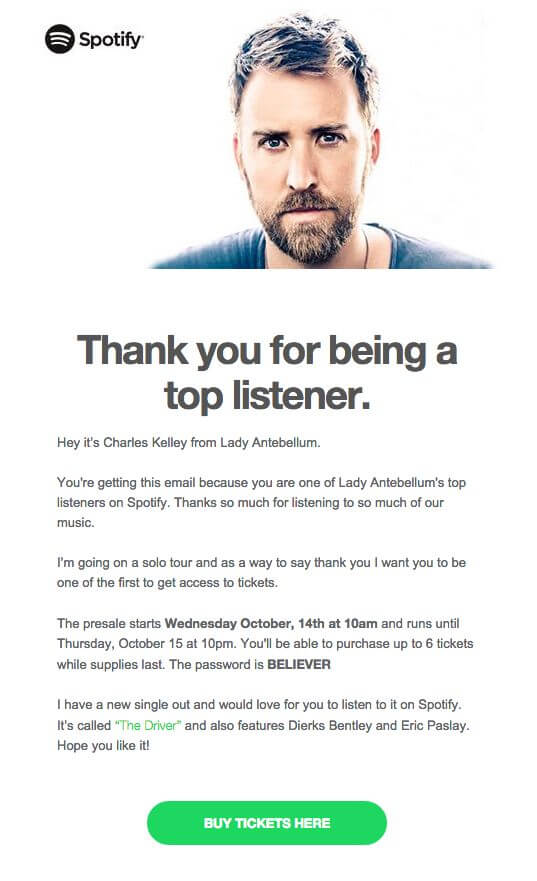
Here is a brilliant email campaign from Spotify demonstrating how to reflect users’ activity on your website.
A targeted email campaign will help you strengthen the bond between you and your regular customers. They can not help but notice how you try to create unique emails with relevant offers for them.
New clients will be imbued with such an attitude, too, which will increase the chance of their purchases and recommendations.
Among other profits, targeted email marketing boosts in-store traffic, enhances brand engagement, attracts potential customers, and increases campaign KPIs.
To prove all these aren’t empty words:
ROI of targeted email campaigns is many times higher than other marketing channels: for $1 spent, $44 is earned (ExactTarget);
81% of users received targeted emails based on their previous purchasing behavior make a next purchase;
The profit of companies that do target automated mailings has grown by 320% (Campaign Monitor).
How to Create a Segmentation Strategy
There are three key steps to form a profitable segmentation strategy and targeted email marketing campaign:
Setting up a subscriber base and segmenting the audience by certain categories.
Choosing targeted email marketing services or an all-in-one marketing automation tool and integrating it with your e-commerce platform and CRM.
Creating several versions of personalized emails.
Step 1. Setting up a subscriber base and segmenting the audience
First off, you have to define who will be among your newsletter readers. Most likely, they will be the users who have previously filled out your subscription forms. Now, choose the target parameter.
These can be:
Location targeting. Do you have subscribers from different cities and even countries? In most cases, your proposal should be different for them. At least, segment the database by timezone.
The more advanced technique is adding an image of a specific city related to the subscriber’s geography or making the newsletter multilingual.
You can also include recommendations about entertainment, sales, and events held locally relevant to your business specifics.
Gender and age targeting. If emails are designed for a group of people you don’t belong to, they are less likely to be read, more often deleted, and very often marked as spam.
To avoid the greatest punishment of all email marketers (spam and bans) and make the message more understandable to the reader, you can start small – define the subscribers’ gender and age.
A nice method is to apply dynamic content that automatically adjusts to recipient data. By using it, you can even find such confidential information as the size of clothes, shoes, and rings for a particular recipient.
The success of your email campaign will depend on how much detailed subscriber’s information you gathered.
This approach will also prevent you from some unpleasant situations. For example, you’ll have a clear idea of the financial capabilities of your subscribers.
You don’t want to have young girls and boys in your base, whom you offer designer linen dresses that they cannot afford.
Customized fields. In modern email marketing automation systems, there are special tags by which information from the database is pulled into each email.
All you need is to correctly place the tags in the email and configure the transfer of data for these tags. It can be a name tag, purchase date, or product that remained unpaid.
Shopping preferences and behavior targeting. It is the most potent user parameter, which more effectively than other parameters allows you to increase sales.
Understanding what your user’s buying behavior is, where exactly he/she is in the purchasing funnel, you can prepare the most relevant offer and push him/her to the next step.
How does it work?
Your customers may be at different stages:
Newbie
Regular
Returning
Lost users
For a newbie, you need to create a welcome letter taking into account the age, gender, and geographical location. Further emails should not sell openly; try to gain subscribers’ trust by recommendations, recognize their interests, pamper them by storytelling, and share reviews of grateful customers.
Regular customers should be encouraged by the loyalty system: invite them to a private club of honored customers and give a unique discount, thereby increasing their importance.
In the case of returning clients, you should show your gratitude for their loyalty. You can even strengthen an email with the words, ‘We are glad that you are back and present you with a discount’ – something like that.
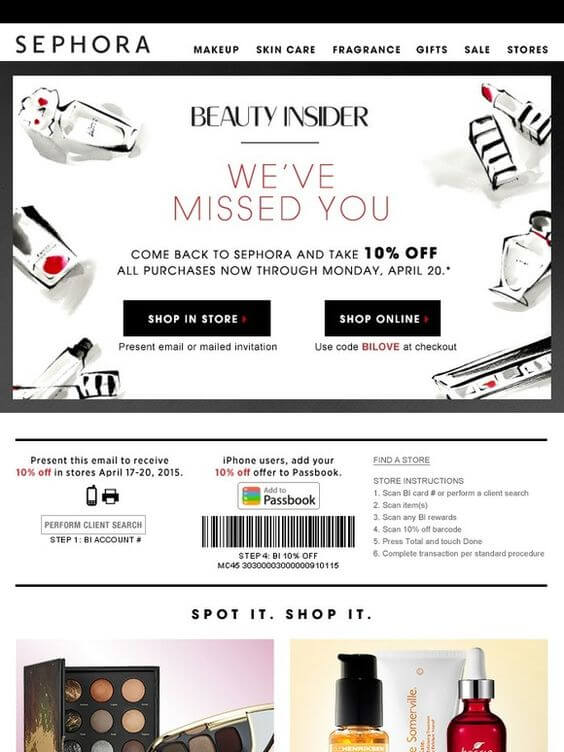
It is also worth trying to return lost users. Try to send three emails per month, so as not to cause disapproval. Show a subscriber that you miss him/her and specify what he/she is losing by rejecting your offers.
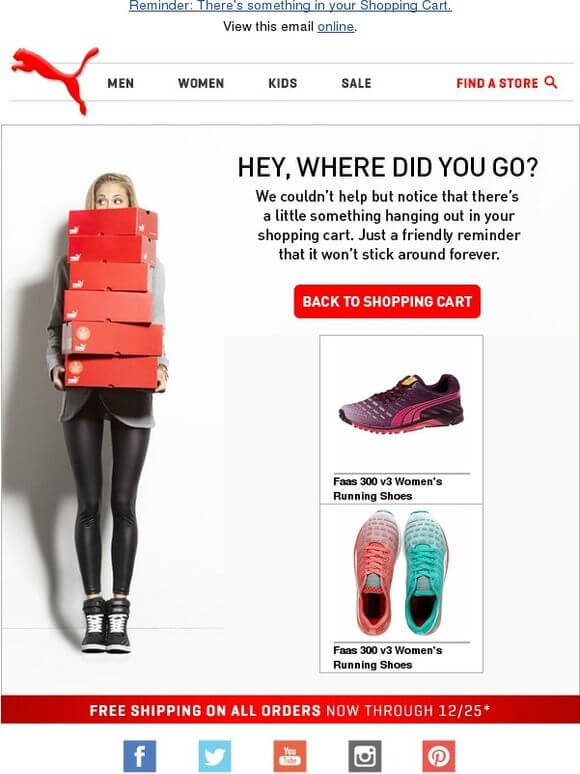
Cart Abandonment Targeted Email. Separately, it is worth identifying the state of the cart. Buyers can add products to the cart but leave the online store without having completed purchase. Or they may stop at the payment stage. Situations can be different.
Your task is to find out what the problem is and provide a solution.
The most widespread types of issues are:
Some of the buyers are confused and urgently need help in making a purchase decision – your letter can provide this assistance.
Some of the users made a purchase only once but you can motivate them to become regular customers.
If someone has selected a product but still not paid for it, you can speed up the purchase process by announcing a deadline after which the price will increase.
Interest targeting. If you have no idea what to offer to your subscribers, find out their possible interests. Give your readers the opportunity to choose what they are interested in right in the letter.
For example:
you can list topics to choose which they would like to know about from your newsletters;
you can analyze which one of your website pages they visit more often and on which pages they spend more time. Apply this information to the next campaign.
You can select other data for interest segmentation based on the list of your products. For instance, if you sell sneakers and your client prefers only Nike, you can offer him/her new items only by this brand.
To sum up, the main criteria for a segmentation strategy are:
Gender
Age
Location/time zone
Preferences in the products, brands
Interests
The stage at the sales funnel
Purchase status
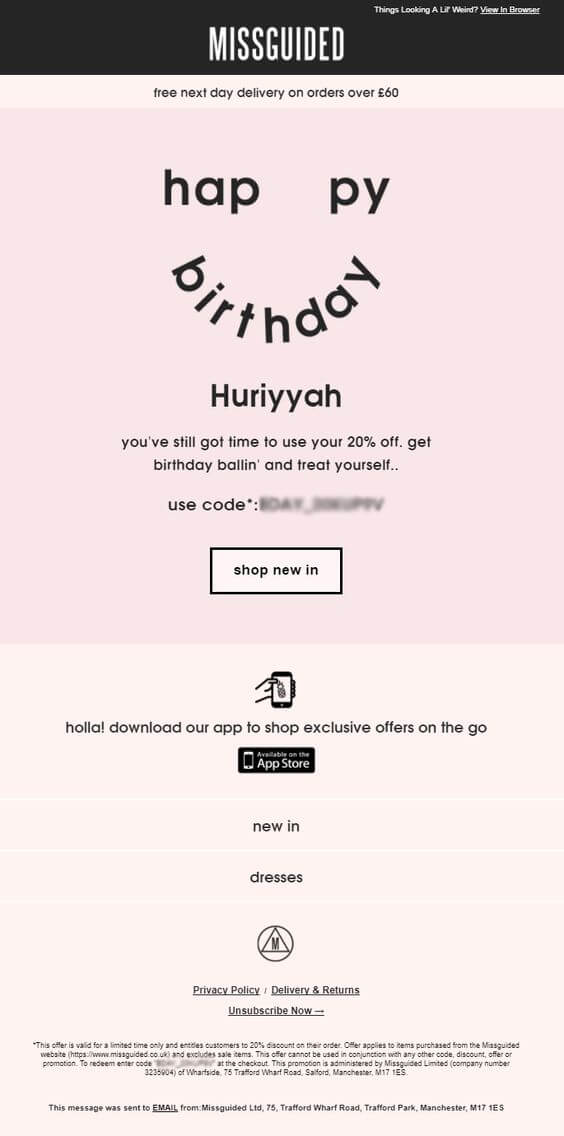
By the way, a nice idea is to create emails with greetings to some special events like birthdays (congratulate and offer a gift option), high frequency of purchases, etc.
To create targeted letters and track the results of such mailings, nothing can help you better than special email marketing tools.
Why do you need them:
They allow you to segment subscribers based on various parameters.
With their help, you can redirect subscribers to landing pages and hold their attention.
You will facilitate repeat purchases by recommending items from your store.
You can set triggers to automate the mailing according to user’s actions. So, if one of the users left a cart abandonment, you can catch him or her by sending an appropriate email.
The in-built analytics system will display information on campaign results and metrics, thus, you’ll know who deleted the message, made the purchase or clicked on the links. This data should be taken into account when creating the next messages to the same people to increase or return their interest to your proposal.
The mailing system can be integrated with other marketing tools in your arsenal to make your marketing campaigns even more powerful. These can be Google ads, Facebook, SMS mailings, CMS, etc.
Which one to choose depends on your database volume and marketing budget. But each of these tools provides you with a full spectrum of features designed to automate your email marketing efforts, make them segmented, targeted, and highly converting.
By applying all these recommendations, you will create a well-functioning segmentation strategy under one umbrella.
It will help you return left customers, make remind-letters for regular clients, and generate profitable offers for new users based on their customer experience. All users’ data will be collected, stored and updated in one place and on time.
Step 3. Creating several versions of personalized emails
When the key preparatory work has been completed and segmentation is set up, your e-commerce platform is integrated with the mailing system and CRM, you know who your subscribers are – it’s time to start creating actionable emails.
To make this task easy, we recommend you write each letter as if you are writing to a friend.
Think about:
What subject would you add to your email?
What would the reader focus on?
What does the reader need?
How can your products help him/her?
To boost the performance of the mailing, you can carry out A / B testing. Use different headers or experiment with the email body instead of sending the same message to the target group at once.
This will allow you to determine the options with the highest open and response rates, and apply the winning combination to the whole list of subscribers.
Targeted Email Campaign Examples
These common campaign types show how segmentation turns a generic newsletter into targeted email marketing:
Welcome series: new subscribers receive a short sequence that introduces your brand, sets expectations and points them to your most useful content.
Abandoned cart reminders: shoppers who leave items in their cart get a reminder that shows those exact products.
Post-purchase follow-ups: customers receive usage tips, a review request or related product suggestions based on what they bought.
Re-engagement campaigns: subscribers who have not opened emails for a while get a message asking whether they still want to hear from you, with an easy way to update preferences.
Location-based promotions: offers or event invitations sent only to subscribers in a specific region.
Content by interest: subscribers who chose specific topics receive newsletters built around them. Our guide to company newsletter types and examples has more ideas.
B2B outreach by role: different messages for decision makers, technical buyers and end users at the same company. See our outreach email templates for starting points.
Tools For Targeted Email Marketing
Most email marketing platforms, including GetResponse, Mailchimp and Constant Contact, support targeted campaigns. When comparing tools, look for these capabilities:
Segmentation and tagging: the ability to group contacts by any field, tag or behavior, and combine several conditions.
Dynamic content: blocks within one email that change depending on the recipient’s segment.
Automation workflows: emails triggered by actions such as sign-ups, purchases or inactivity.
Integrations: connections with your CRM, ecommerce platform and website so segment data stays up to date.
Testing and analytics: A/B testing and reporting by segment, so you can see which audiences respond best.
Deliverability and compliance tools: list hygiene, consent management and easy unsubscribe options.
Pricing usually depends on the number of contacts and the features you need. Our guide on how to calculate email marketing cost explains how to budget for it.
Targeted email marketing is the practice of sending emails to specific groups of subscribers based on their characteristics, behavior or interests, rather than sending the same message to everyone. By matching content to each segment, businesses make emails more relevant, which typically improves engagement and conversions.
How do you create a targeted email list?
Start by collecting useful data when people subscribe, such as their interests, role or location, and add behavioral data like opens, clicks and purchases over time. Then use your email platform to create segments from that data, for example new subscribers, repeat customers or people interested in a specific product. Keep the list clean by removing inactive or invalid addresses and always get proper consent.
What is the difference between segmentation and personalization?
Segmentation divides your subscribers into groups that share certain traits so each group can receive relevant campaigns. Personalization tailors elements of an individual email, such as the name, product recommendations or content blocks, to each recipient. The two work best together: segmentation decides who gets which campaign, and personalization makes each message feel individual.
Hope I answered the question “What are targeted messages?” as clearly as possible. To conclude, the targeted email marketing campaign means the collection of personal data of your users with the aim to form an individual offer for each subscriber, which is 100% relevant. This is the proven way to increase their loyalty to your company and boost sales.
To start increasing your revenue right now, perform these tasks:
create a list of user data that you need,
configure the collection of this data using automated systems,
design emails based on this data, and
correctly analyze the results of each launched campaign.
Done!
And what are your favorite targeted email marketing techniques? What tools do you use to segment your database and create personalized letters? I’m super excited to hear about your experience!